This practical book is intended to support schools and LEAs in developing effective strategies in working with teaching assistants. It is related to the DfEE's recently published Good Practice Guide (2000). Suggested approaches are supported with real examples from practice, showing the reality of how schools can review and develop practice and so become more effective in their management and support of teaching assistants. The aim is to enable managers in schools and LEAs to work effectively with teaching assistants; teachers to plan classroom approaches for working with teaching assistants; teaching assistants to improve their practice; and children to learn more effectively in inclusive settings. This book will be of use to headteachers, senior staff in schools, SENCOs, LEA support staff, class teachers and teaching assistants.
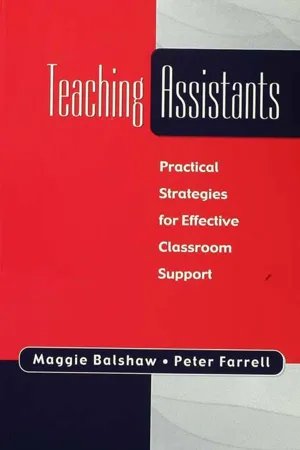
eBook - ePub
Teaching Assistants
Practical Strategies for Effective Classroom Support
- 144 pages
- English
- ePUB (mobile friendly)
- Available on iOS & Android
eBook - ePub
Teaching Assistants
Practical Strategies for Effective Classroom Support
About this book
Information
Topic
EducationSubtopic
Education GeneralBackground to the development of the Good Practice Guide
1 Recent Developments in the work of teaching assistants
Overview
In the past few years the developing role of assistants and the growth in their numbers has attracted a great deal of publicity. The Government has stressed the vital role they can play in supporting the whole process of education. Indeed, there are even suggestions that assistants might in the future take over some of the teachers' tasks. However, some anxiety has been expressed by teaching unions about the effects this might have on teachers' professionalism. Therefore, instead of being seen as a valuable resource to support teaching and learning in schools, TAs could now be viewed as a threat to the development of the teaching profession.
Our view, which is reflected in all of the chapters throughout this book, is that the whole process of teaching and learning requires effective teamwork between teachers and assistants and that each group can support the other. Teachers have a pivotal role in the planning and management of the educational process. Their work can be enhanced greatly through working collaboratively with TAs and as a result all pupils can benefit. Our research indicates that the majority of TAs do not want to take on additional responsibilities that are rightly associated with the teacher's role.
The rise in the number of TAs now working in schools should therefore be seen as a positive development. Indeed a number of research projects, in addition to the Manchester research, have reported on the benefits that TAs can bring to schools (see for example Smith et al. 1999; Lee and Mawson 1998; Mencap 1999). Furthermore there are several books and journal articles that report on the developing work of TAs (see for example Rose 2000; CSIE 2000; Thomas et al. 1998). There are also a number of books that are devoted exclusively to ways in which teachers and assistants can work together to support pupils. Of these perhaps those written by Balshaw (1991, 1999), Lorenz (1998) and Fox (1993, 1998) have had the most impact.
Recently the Government has also recognised the valuable and supportive role that TAs can play. The Good Practice Guide (DfEE 2000a) is only one example of this. Others include the two sets of induction training materials for newly appointed TAs in primary and secondary schools (DfEE 2000b; DfES 2001). These are available in every LEA and are being used extensively. In addition the Government have supported the work of the Local Government National Training Organisation (LGNTO), which has recently devised a set of occupational standards for TAs (LGNTO 2001).
Figures tracking the actual rise in the numbers of TAs suggest that initially the growth was due to the increase in the numbers of pupils with statements being educated in mainstream settings. The 1997 Green Paper Excellence for All Children: Meeting Special Educational Needs (DfEE 1997) suggested that there were 24,000 full-time equivalent teaching assistants working in mainstream schools and that this number was expected to rise. Indeed the rise in the numbers of TAs working in mainstream schools mirrors schools' and LEAs' growing commitment towards inclusion.
Building on these developments a subsequent Green Paper, Teachers: Meeting the Challenge of Change (DfEE 1998), refers to the projected increase of 20,000 in the number of classroom assistants who will provide general support in mainstream schools that is not restricted solely to pupils with special educational needs. In addition the Green Paper refers to the need to recruit and train 2,000 'literacy assistants' to help in the implementation of the Government's literacy strategy. The CSIE (2000) estimate that there are now as many as 80,000 TAs working in mainstream schools. Recently the Government has announced that further funding will be made available until 2002 and beyond to employ more than 20,000 TAs making the total number to be in excess of 100,000 and this figure excludes those who work in special schools. Indeed it is now not uncommon for there to be as many assistants as there are qualified teachers in many primary schools. We have also visited secondary schools where there are over 20 TAs undertaking a range of varied and often quite complex tasks.
Conditions of service for TAs
An issue of growing concern among all professionals working in education is that conditions of service for TAs are inadequate, particularly in comparison with teachers, and do not in any way reflect the highly skilled work that they are required to undertake. This is dealt with in more depth in the next chapter when we review the findings and implications from the Manchester research. Problems associated with temporary contracts, low levels of pay and limited opportunities for career progression are well known. However at the present time the Government has indicated that issues of pay and conditions of service should be managed at a local level. It is therefore unlikely that there will be a nationally agreed pay scale linked to career progression and training, at least in the near future. Consequently, managers and other senior staff in schools and LEAs will continue to be required to use their skills of mentoring and support so that their workforce of TAs can work effectively and with enthusiasm. Indeed one of the aims of this book is to help such staff to develop their work in this area even though the current conditions of service in which TAs work are far from adequate. As this book will show, there is a great deal that senior staff can achieve through supporting and working with their TAs to bring about improvements in the education of all children.
The training of TAs
In addition to problems with conditions of service for TAs, concerns have also been expressed about training opportunities. It is not, for example, uncommon for a TA to be appointed to support a child with autism in a mainstream school who has never met an autistic child before, who has had no prior training and who may have no further education beyond GCSE/O levels. Once again the implication of the training issue will be covered in more detail in the next chapter. However, it is important to point out at this stage that there have been several initiatives at local and national level that have attempted to address this problem. Chief among these is the new induction training programme developed by the DfES, referred to above. In addition there are a whole range of accredited courses run mainly by colleges of further education but also by universities and LEAs. Finally the Local Government National Training Organisation (LGNTO) has supported the development of national occupational standards for TAs which became available in autumn 2001. These indicate the competencies (in NVQ terms) that TAs should possess at two levels, those of a recent entrant into the profession and those of a more experienced assistant.
It is possible that in the future there will be a nationally agreed set of qualifications for TAs that will be based around the NVQ framework and that this will be complemented by a full range of short courses covering a range of areas from induction to more specialised training in a specific area. These developments should help managers and senior staff in schools and LEAs to work with their TAs in planning a coordinated and ongoing programme of training aimed at meeting the needs of the TAs themselves, teachers and other relevant staff.
Developing more inclusive practice and the work of TAs
In mainstream schools the increasing number and expanding role of assistants reflects, in part, a growing national and international movement to make educational provision more inclusive. Assistants therefore have the potential to play a key role in helping to make inclusive education effective for all pupils including those with statements. For this reason it is important to reflect on current developments in inclusive practices so as to understand how TAs can work most effectively within an increasingly inclusive system.
The term inclusion evolved out of earlier concepts of integration or mainstreaming; terms that were used solely to refer to the placement of pupils with special educational needs (SEN) in mainstream schools. One problem with defining integration solely in terms of provision (i.e. the setting in which a pupil is placed) is that it tells us nothing about the quality of the education that is received in this provision. Are pupils placed in units attached to a mainstream school, for example, more 'integrated' than if they were taught in a special school? Jupp (1992) argued that such units can be just as segregating. Similarly a pupil with SEN placed in a mainstream class may in fact be isolated from the rest of the class and not truly 'integrated' within the group, particularly if he or she works with an assistant in one-to-one sessions for the majority of each day. Integrated placements, therefore, may still leave the pupil 'segregated'.
For these reasons the term 'inclusion' has become a more accepted way of describing the extent to which a pupil with SEN is truly 'integrated'. Essentially, in relation to pupils defined as having SEN, the term refers to the extent to which a school or community welcomes all pupils with disabilities as fully inclusive members of the group and values them for the contribution which they make. For inclusion to be effective all pupils must actively belong to, be welcomed by and participate in a mainstream school and community — that is they should be fully included. Their diversity of interests, abilities and attainment should be welcomed and be seen to enrich the life of the school.
Recently definitions of inclusion have broadened still further (see for example Booth and Ainscow 1998). These writers take the view that policies on inclusion should not be restricted to the education of pupils thought to have special needs. Inclusion, they argue, is a process in which schools, communities, local authorities and governments strive to reduce barriers to the participation and learning for all citizens. Looked at in this way inclusive policies and practices should consider ways in which marginalised groups in society, for example people from ethnic minorities and those who are socially and economically disadvantaged, can participate fully in the educational process within mainstream contexts.
This view has been strongly endorsed by the recently published HMI Guidance to Inspectors (Ofsted 2000). This advises HMI on what to look for when assessing the extent to which a school is developing effective policies and practices on inclusion. According to the guidance 'Educational Inclusion covers
- Equal opportunities (for all pupils regardless of age, gender, ethnicity, attainment background);
- The education of pupils having English as a second language;
- The education of pupils with special educational needs — including pupils with challenging and disruptive behaviour;
- Pupils who are gifted or talented,'
This document, above all others, affirms a view of inclusion that has developed far beyond one which focuses on the education of pupils thought to have SEN. In future schools will be judged by the extent to which they are inclusive. Indeed the Guidance states that 'The most effective schools are inclusive schools,' Inclusion is therefore at the heart of the Government's education policy along with its commitment to raise standards.
As referred to above, the increase in the number of TAs working in schools has paralleled developments in thinking on inclusion and raising standards. Indeed, the Good Practice Guide refers to HMI reports that have 'confirmed the tremendous contribution that well trained and well managed teaching assistants can make in driving standards up in schools,' TAs therefore have a major contribution to make in helping the Government to achieve its objectives to raise standards for all pupils within an inclusive framework.
What's in a name?
Professionals working in education and parents over the past few years cannot fail to have noticed that the name given to assistants seems to vary from school to school, from LEA to LEA and from country to country Indeed sometimes assistants in the same school can have different names. In one primary school in which we worked as part of our research for the DfES, there were no less than four 'types' of assistants each with a different name. Those who supported a small group of pupils with severe learning difficulties were referred to as 'resource school integration assistants', those who supported children with moderate learning difficulties were referred to as 'learning support assistants', there were also two 'classroom assistants' and a 'nursery nurse' who worked in the infant department.
Figure 1.1 indicates the different names we encountered, in our research and from reading the literature, that were used to describe staff without teaching qualifications working alongside teachers in the classroom.

Figure 1.1 Different names given to assistants working in classrooms
One might legitimately ask whether the name given to assistants is important, provided their role and function are understood by all concerned. However, we believe that the name can send an important message to teachers, parents and LEA administrators and that there are good reasons for settling on one name only, a name that conveys the correct message about their work within an inclusive framework.
There are names included in Figure 1.1 that convey an inappropriate message. For example 'nursery nurse' seems anachronistic even for those who work in nursery schools or reception classes in infant schools. These staff, who may have the NNEB qualification, do very little nursing and the term has uncokfortable medical connotations. the same could be said of the phrase 'para-professional' used widely in the United States; again the prefix 'para' has medical overtones. 'Special support assistant' suggests that the assistants are only employed to work with students who have SEN and therefore seems inappropriate within an inclusive framework. The term 'teacher's aid', also popular in the USA, has caused some unexpected misunderstandings when, for example, an announcement over the shool's intercom requests that all teachers 'with aids' should come to a staff meeting! Finally the label 'Non-Teaching Assistant' implies that the assistants do no teaching! What is more, should a formal title on a job description begin with a negative such as 'non'? It is hardly likely to lead to positive self-esteem.
Giving different names to assistants can imply that one group with a particular name has a higher status than those who are given a different name. We have evidence that this has led to there being unfortunate jealousies and rivalries within a school when, for example, assistants who work with pupils with special needs feel that they are in some way superior to other assistants partly because they are referred to as 'Special Support Assistants' rather than 'Classroom Assistants'.
We take the view that the name should convey a message that assistants are employed to assist the teacher in all areas of education from pre-school to school leaving age. Their name should not restrict them to working with one group, e.g. pupils with special needs, or imply that they are not employed to teach but are just required to undertake less exacting tasks, e.g. tidying the paint cupboards. The Good Practice Guide stresses the Government's wish to use the term Teaching Assistant', and this seems appropriate given the range of tasks that TAs are now undertaking. They may, of course, develop specialisms in, for example, teaching pupils with visual or hearing impairments. However, they will still be TAs first and foremost. Those with a...
Table of contents
- Cover Page
- Half Title page
- Title Page
- Copyright Page
- Contents
- List of Contributors
- Acknowledgements
- Background to the development of the Good Practice Guide
- Developing a conceptual framework for improving practice
- Strategies drawn from experiences in schools and LEAs
- Summary: reflections on future practice development
- Appendix 1 Pen pictures of the participant schools and services
- Appendix 2 Indicators of effective practice with learning support assistants
- Appendix 3 Indicators of effective practice and choices made by project participants
- Appendix 4 Workshop activities
- Appendix 5 School and service action research plans
- Appendix 6 Examples of questionnaires based on the Manchester Report indicators and review questions
- Appendix 7 Job descriptions
- References
Trusted by 375,005 students
Access to over 1.5 million titles for a fair monthly price.
Study more efficiently using our study tools.
Frequently asked questions
Yes, you can cancel anytime from the Subscription tab in your account settings on the Perlego website. Your subscription will stay active until the end of your current billing period. Learn how to cancel your subscription
No, books cannot be downloaded as external files, such as PDFs, for use outside of Perlego. However, you can download books within the Perlego app for offline reading on mobile or tablet. Learn how to download books offline
Perlego offers two plans: Essential and Complete
- Essential is ideal for learners and professionals who enjoy exploring a wide range of subjects. Access the Essential Library with 800,000+ trusted titles and best-sellers across business, personal growth, and the humanities. Includes unlimited reading time and Standard Read Aloud voice.
- Complete: Perfect for advanced learners and researchers needing full, unrestricted access. Unlock 1.5M+ books across hundreds of subjects, including academic and specialized titles. The Complete Plan also includes advanced features like Premium Read Aloud and Research Assistant.
We are an online textbook subscription service, where you can get access to an entire online library for less than the price of a single book per month. With over 1.5 million books across 990+ topics, we’ve got you covered! Learn about our mission
Look out for the read-aloud symbol on your next book to see if you can listen to it. The read-aloud tool reads text aloud for you, highlighting the text as it is being read. You can pause it, speed it up and slow it down. Learn more about Read Aloud
Yes! You can use the Perlego app on both iOS and Android devices to read anytime, anywhere — even offline. Perfect for commutes or when you’re on the go.
Please note we cannot support devices running on iOS 13 and Android 7 or earlier. Learn more about using the app
Please note we cannot support devices running on iOS 13 and Android 7 or earlier. Learn more about using the app
Yes, you can access Teaching Assistants by Maggie Balshaw,Peter Farrell in PDF and/or ePUB format, as well as other popular books in Education & Education General. We have over 1.5 million books available in our catalogue for you to explore.