The Evaluator's Cookbook
eBook - ePub

The Evaluator's Cookbook

Exercises for participatory evaluation with children and young people

  1. 64 pages
  2. English
  3. ePUB (mobile friendly)
  4. Available on iOS & Android
eBook - ePub

The Evaluator's Cookbook

Exercises for participatory evaluation with children and young people

About this book

Participation is a vital element of working with children and young people – ensuring that services are meeting their needs as well as promoting citizenship, resilience and general well-being.

The Evaluator's Cookbook contains 21 participatory evaluation exercises for use with children, young people and families/community groups. Attractively and clearly presented, the exercises are very easy to use and come with suggestions for use and instructions on how to create the equipment needed. They will appeal to a wide range of people and can be used in a variety of informal and formal settings and most of the exercises are suitable for use with disabled children or children with special needs, as well as people with English as a second language. The book also explores why, how and where participatory research and evaluation should take place and provides suggestions on how the findings can be presented in imaginative ways.

This unique book is an invaluable resource for those wishing to consult with children and families or evaluate social, health and education services in diverse cultural settings.

Frequently asked questions

Yes, you can cancel anytime from the Subscription tab in your account settings on the Perlego website. Your subscription will stay active until the end of your current billing period. Learn how to cancel your subscription.
No, books cannot be downloaded as external files, such as PDFs, for use outside of Perlego. However, you can download books within the Perlego app for offline reading on mobile or tablet. Learn more here.
Perlego offers two plans: Essential and Complete
  • Essential is ideal for learners and professionals who enjoy exploring a wide range of subjects. Access the Essential Library with 800,000+ trusted titles and best-sellers across business, personal growth, and the humanities. Includes unlimited reading time and Standard Read Aloud voice.
  • Complete: Perfect for advanced learners and researchers needing full, unrestricted access. Unlock 1.4M+ books across hundreds of subjects, including academic and specialized titles. The Complete Plan also includes advanced features like Premium Read Aloud and Research Assistant.
Both plans are available with monthly, semester, or annual billing cycles.
We are an online textbook subscription service, where you can get access to an entire online library for less than the price of a single book per month. With over 1 million books across 1000+ topics, we’ve got you covered! Learn more here.
Look out for the read-aloud symbol on your next book to see if you can listen to it. The read-aloud tool reads text aloud for you, highlighting the text as it is being read. You can pause it, speed it up and slow it down. Learn more here.
Yes! You can use the Perlego app on both iOS or Android devices to read anytime, anywhere — even offline. Perfect for commutes or when you’re on the go.
Please note we cannot support devices running on iOS 13 and Android 7 or earlier. Learn more about using the app.
Yes, you can access The Evaluator's Cookbook by Angus McCabe,Katrice Horsley in PDF and/or ePUB format, as well as other popular books in Education & Education General. We have over one million books available in our catalogue for you to explore.

Information

Publisher
Routledge
Year
2008
Print ISBN
9780415453417
Main Courses

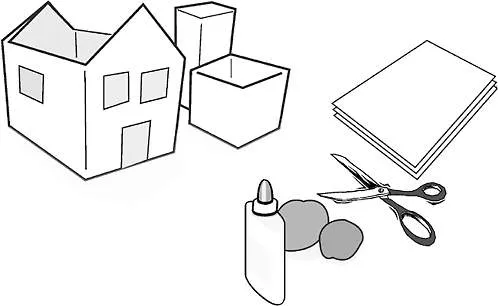
A space of our own

Ingredients


  • Shoe boxes (one for each participant or for a group of about 4)
  • Pipe cleaners
  • Plasticine
  • Bits of card and coloured paper
  • Scissors
  • Glue
  • Colouring crayons/felt tips

Method


  • Identify the subject you wish to explore, e.g. school, hospital, their home
  • Ask children to use the materials to build a 3-dimensional model of how they would like the subject area to be
  • Ask them to label their models, provide clocks to show the amount of time they like to spend there, menus to show what food they would like to eat (if applicable), mini music CDs to show what music they may want to listen to, etc
  • Ask them to share their spaces with the rest of the group and explain their reasons for designing them this way
  • Discuss the findings
Preparation time
30 minutes
Cooking time
30–45 minutes
Energy level
5
Quantity
Up to 20
Whilst this was primarily designed for children it has also been used very successfully with adults to explore their responses to a service. It is important to ensure that materials used are attractive to both genders; these can include clay, wood, wire, boxes, as well as fabrics and stickers, etc.

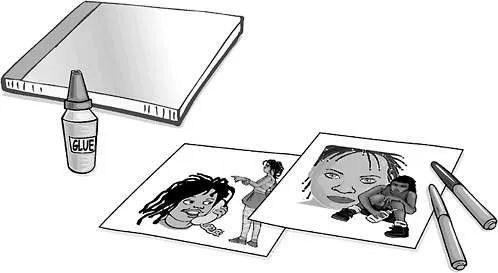
CD covers

Ingredients


  • Blank CD covers
  • Glue
  • Pens
  • Scissors
  • Range of magazines/images that appeal to the group
  • Card cut to fit into the CD covers—two pieces per participant

Method


  • Ask participants to think of a subject they would like to explore—perhaps themselves, their education?
  • Ask them to make a collage image of how the subject appears to others on a piece of card (Image 1)
  • Ask them to create a collage image of their personal experience of the subject (Image 2)
  • Ask them to think of acknowledgements—such as you find in CD covers—do they have any they would like to write? If so ask them to write them on the back of Image 2
  • Do they have any lyrics/words that link into the subject? Can they make any up? They should place these on the back of Image 1
  • They should place Image 1 in a CD case to make the front cover. Image 2 should be placed so that the acknowledgements are placed outward to make the back cover—the image being on the inside
  • Invite the participants to share their personal CDs with the rest of the group
Preparation time
Collection of inclusive collage materials
Cooking time
30 minutes
Energy level
5
Quantity
Works better with smaller groups of older children
This exercise was found to be particularly successful with teenagers. It is really a variant of ā€˜Gingerbread People.’
It can be adapted so that ā€˜collections’ are made that cover different areas of a service, such as access, range of activities, etc.

Collages

Ingredients


  • A selection of magazines, images and catalogues that cover the area you wish to explore. Remember to be as inclusive as possible when choosing these images
  • Glue
  • Scissors

Method


  • Ask participants to fold their paper in half
  • Identify the area you wish to explore, e.g. health, school, particular services, etc
  • Ask participants to cut out images of the subject as they experience it. They should stick these on one side of the card in any shape they wish
  • Ask participants to imagine how they would like the area under discussion to be and stick images on the other half of the card
  • This can be done in small groups or as an individual exercise
  • Discuss findings
Preparation time
1–15 minutes
Cooking time
30 minutes
Energy level
4
Quantity
Up to 30
This again is an adaptation of ā€˜Gingerbread People’ but is a little more accessible to those who may have more limited fine motor skills and would experience problems with finely placing images within an outline.
Preprinted icons or images can be used if a more focused response is needed.

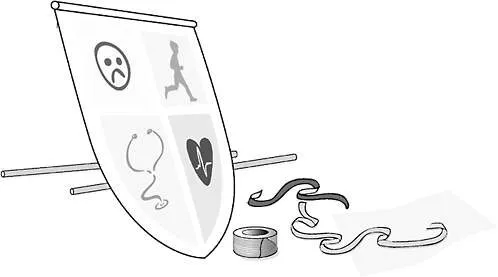
Heraldic banners

Ingredients


  • Large pieces of canvas (if working in groups). Small pieces of canvas if working individually
  • A range of fabrics, felt, cotton, etc
  • Ribbon of varying thicknesses and colours
  • Glue guns or Copydex
  • Scissors
  • Gaffer tape
  • Pieces of dowling
  • Images of heraldic design/banners to share

Method


  • Cut the fabric into large/small banner shapes
  • Identify the area you want to explore, e.g. school, health, access to services
  • Ask participants to divide up their banner into sections and think about the area to be discussed. They should sketch some images from their ideas onto paper first
  • Ask participants to design the banner based on their experience...

Table of contents

  1. Cover
  2. Half Title
  3. Title Page
  4. Copyright Page
  5. Contents
  6. Foreword
  7. Introduction
  8. Using the recipes
  9. Thinking about the recipes
  10. Starters
  11. Main courses
  12. Puddings
  13. Presentation
  14. The Virtual Cookbook
  15. Ingredients—exercise templates