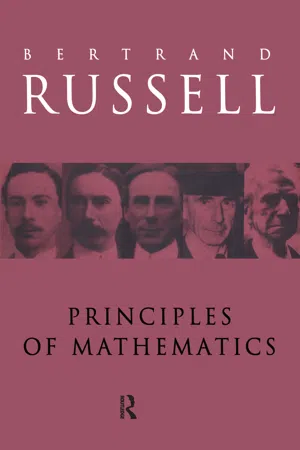
Published in 1903, this book was the first comprehensive treatise on the logical foundations of mathematics written in English. It sets forth, as far as possible without mathematical and logical symbolism, the grounds in favour of the view that mathematics and logic are identical. It proposes simply that what is commonly called mathematics are merely later deductions from logical premises. It provided the thesis for which Principia Mathematica provided the detailed proof, and introduced the work of Frege to a wider audience.
In addition to the new introduction by John Slater, this edition contains Russell's introduction to the 1937 edition in which he defends his position against his formalist and intuitionist critics.
- 576 pages
- English
- ePUB (mobile friendly)
- Available on iOS & Android
eBook - ePub
Principles of Mathematics
About this book
Information
Part I.
The Indefinables of Mathematics.
Chapter I.
Definition of Pure Mathematics.
1. PURE Mathematics is the class of all propositions of the form “p implies q,” where p and q are propositions containing one or more variables, the same in the two propositions, and neither p nor q contains any constants except logical constants. And logical constants are all notions definable in terms of the following: Implication, the relation of a term to a class of which it is a member, the notion of such that, the notion of relation, and such further notions as may be involved in the general notion of propositions of the above form. In addition to these, mathematics uses a notion which is not a constituent of the propositions which it considers, namely the notion of truth.
2. The above definition of pure mathematics is, no doubt, somewhat unusual. Its various parts, nevertheless, appear to be capable of exact justification—a justification which it will be the object of the present work to provide. It will be shown that whatever has, in the past, been regarded as pure mathematics, is included in our definition, and that whatever else is included possesses those marks by which mathematics is commonly though vaguely distinguished from other studies. The definition professes to be, not an arbitrary decision to use a common word in an uncommon signification, but rather a precise analysis of the ideas which, more or less unconsciously, are implied in the ordinary employment of the term. Our method will therefore be one of analysis, and our problem may be called philosophical—in the sense, that is to say, that we seek to pass from the complex to the simple, from the demonstrable to its indemonstrable premisses. But in one respect not a few of our discussions will differ from those that are usually called philosophical. We shall be able, thanks to the labours of the mathematicians themselves, to arrive at certainty in regard to most of the questions with which we shall be concerned; and among those capable of an exact solution we shall find many of the problems which, in the past, have been involved in all the traditional uncertainty of philosophical strife. The nature of number, of infinity, of space, time and motion, and of mathematical inference itself, are all questions to which, in the present work, an answer professing itself demonstrable with mathematical certainty will be given—an answer which, however, consists in reducing the above problems to problems in pure logic, which last will not be found satisfactorily solved in what follows.
3. the philosophy of mathematics has been hitherto as contre versial, obscure and unprogressive as the other branches of philosophy. although it was generally agreed that mathematics is in some sense true, philosophers disputed as to what mathematical propositions really meant: although something was true, no two people were agreed as to what it was that was true, and if something was known, no one knew what it was that was known. so long, however, as this was doubtful, it could hardly be said that any certain and exact knowledge was to be obtained in mathematics. we find, accordingly, that idealists have tended more and more to regard all mathematics as dealing with mere appearance, while empiricists have held everything mathematical to be approximation to some exact truth about which they had nothing to tell us. this state of things, it must be confessed, was thoroughly unsatisfactory. philosophy asks of mathematics: what does it mean? mathematics in the past was unable to answer, and philosophy answered by introducing the totally irrelevant notion of mind. but now mathematics is able to answer, so far at least as to reduce the whole of its propositions to certain fundamental notions of logic. at this point, the discussion must be resumed by philosophy. I shall endeavour to indicate what are the fundamental notions involved, to prove at length that, no others occur in mathematics, and to point out briefly the philosophical difficulties involved in the analysis of these notions. a complete treatment of these difficulties would involve a treatise on logic, which will not be found in the following pages.
4. There was, until very lately, a special difficulty in the principles of mathematics. it seemed plain that mathematics consists of deductions, and yet the orthodox accounts of deduction were largely or wholly inapplicable to existing mathematics. not only the aristotelian syllogistic theory, but also the modern doctrines of symbolic logic, were either theoretically inadequate to mathematical reasoning, or at any rate required such artificial forms of statement that they could not be practically applied. in this fact lay the strength of the kantian view, which asserted that mathematical reasoning is not strictly formal, but always uses intuitions, i.e. the à priori knowledge of space and time. thanks to the progress of symbolic logic, especially as treated by professor peano, this part of the kantian philosophy is now capable of a final and irrevocable refutation. by the help of ten principles of deduction and ten other premisses of a general logical nature (e.g. “implication is a relation”), all mathematics can be strictly and formally deduced; and all the entities that occur in mathematics can be defined in terms of those that occur in the above twenty premisses. In this statement, Mathematics includes not only Arithmetic and Analysis, but also Geometry, Euclidean and non-Euclidean, rational Dynamics, and an indefinite number of other studies still unborn or in their infancy. The fact that all Mathematics is Symbolic Logic is one of the greatest discoveries of our age; and when this fact has been established, the remainder of the principles of mathematics consists in the analysis of Symbolic Logic itself.
5. The general doctrine that all mathematics is deduction by logical principles from logical principles was strongly advocated by Leibniz, who urged constantly that axioms ought to be proved and that all except a few fundamental notions ought to be defined. But owing partly to a faulty logic, partly to belief in the logical necessity of Euclidean Geometry, he was led into hopeless errors in the endeavour to carry out in detail a view which, in its general outline, is now known to be correct*. The actual propositions of Euclid, for example, do not follow from the principles of logic alone; and the perception of this fact led Kant to his innovations in the theory of knowledge. But since the growth of non-Euclidean Geometry, it has appeared that pure mathematics has no concern with the question whether the axioms and propositions of Euclid hold of actual space or not: this is a question for applied mathematics, to be decided, so far as any decision is possible, by experiment and observation. What pure mathematics asserts is merely that the Euclidean propositions follow from the Euclidean axioms—i.e. it asserts an implication: any space which has such and such properties has also such and such other properties. Thus, as dealt with in pure mathematics, the Euclidean and non-Euclidean Geometries are equally true: in each nothing is affirmed except implications. All propositions as to what actually exists, like the space we live in, belong to experimental or empirical science, not to mathematics; when they belong to applied mathematics, they arise from giving to one or more of the variables in a proposition of pure mathematics some constant value satisfying the hypothesis, and thus enabling us, for that value of the variable, actually to assert both hypothesis and consequent instead of asserting merely the implication. We assert always in mathematics that if a certain assertion p is true of any entity x, or of any set of entities x, y, z, …, then some other assertion q is true of those entities; but we do not assert either p or q separately of our entities. We assert a relation between the assertions p and which I shall call formal implication.
6. Mathematical propositions are not only characterized by the fact that they assert implications, but also by the fact that they contain variables. The notion of the variable is one of the most difficult with which Logic has to deal, and in the present work a satisfactory theory as to its nature, in spite of much discussion, will hardly be found. For the present, I only wish to make it plain that there are variables in all mathematical propositions, even where at first sight they might seem to be absent. Elementary Arithmetic might be thought to form an exception: 1 + 1 = 2 appears neither to contain variables nor to assert an implication. But as a matter of fact, as will be shown in Part II, the true meaning of this proposition is: “If x is one and y is one, and x differs from y, then x and y are two.” And this proposition both contains variables and asserts an implication. We shall find always, in all mathematical propositions, that the words any or some occur; and these words are the marks of a variable and a formal implication. Thus the above proposition may be expressed in the form: “Any unit and any other unit are two units.” The typical proposition of mathematics is of the form “ϕ(x, y, z, …) implies ψ(x, y, z,…), whatever values x, y, z, … may have”; where ϕ(x, y, z, …) and ψ(x, y, z, …), for every set of values of x, y, z, …, are propositions. It is not asserted that ϕ is always true, nor yet that ψ is always true, but merely that, in all cases, when ϕ is false as much as when ϕ is true, ψ follows from it.
* On this subject, cf. Couturat, La Logique de Leibniz, Paris, 1901.
The distinction between a variable and a constant is somewhat obscured by mathematical usage. It is customary, for example, to speak of parameters as in some sense constants, but this is a usage which we shall have to reject. A constant is to be something absolutely definite, concerning which there is no ambiguity whatever. Thus 1, 2, 3, e, π, Socrates, are constants; and so are man, and the human race, past, present and future, considered collectively. Proposition, implication, class, etc. are constants; but a proposition, any proposition, some proposition, are not constants, for these phrases do not denote one definite object. And thus what are called parameters are simply variables. Take, for example, the equation ax + by + c = 0, considered as the equation to a straight line in a plane. Here we say that x and y are variables, while a, b, c are constants. But unless we are dealing with one absolutely particular line, say the line from a particular point in London to a particular point in Cambridge, our a, b, c are not definite numbers, but stand for any numbers, and are thus also variables. And in Geometry nobody does deal with actual pa...
Table of contents
- Cover
- Title Page
- Copyright Page
- Introduction
- Introduction to the Second Edition
- Preface
- Table of Contents
- Part I. The Indefinables of Mathematics.
- Part II. Number.
- Part III. Quantity.
- Part IV. Order.
- Part V. Infinity and Continuity.
- Part VI. Space.
- Part VII. Matter and Motion.
- Appendix A. The Logical and Arithmetical Doctrines of Frege.
- Appendix B. The Doctrine of Types.
- Index
Trusted by 375,005 students
Access to over 1.5 million titles for a fair monthly price.
Study more efficiently using our study tools.
Frequently asked questions
Yes, you can cancel anytime from the Subscription tab in your account settings on the Perlego website. Your subscription will stay active until the end of your current billing period. Learn how to cancel your subscription
No, books cannot be downloaded as external files, such as PDFs, for use outside of Perlego. However, you can download books within the Perlego app for offline reading on mobile or tablet. Learn how to download books offline
Perlego offers two plans: Essential and Complete
- Essential is ideal for learners and professionals who enjoy exploring a wide range of subjects. Access the Essential Library with 800,000+ trusted titles and best-sellers across business, personal growth, and the humanities. Includes unlimited reading time and Standard Read Aloud voice.
- Complete: Perfect for advanced learners and researchers needing full, unrestricted access. Unlock 1.5M+ books across hundreds of subjects, including academic and specialized titles. The Complete Plan also includes advanced features like Premium Read Aloud and Research Assistant.
We are an online textbook subscription service, where you can get access to an entire online library for less than the price of a single book per month. With over 1.5 million books across 990+ topics, we’ve got you covered! Learn about our mission
Look out for the read-aloud symbol on your next book to see if you can listen to it. The read-aloud tool reads text aloud for you, highlighting the text as it is being read. You can pause it, speed it up and slow it down. Learn more about Read Aloud
Yes! You can use the Perlego app on both iOS and Android devices to read anytime, anywhere — even offline. Perfect for commutes or when you’re on the go.
Please note we cannot support devices running on iOS 13 and Android 7 or earlier. Learn more about using the app
Please note we cannot support devices running on iOS 13 and Android 7 or earlier. Learn more about using the app
Yes, you can access Principles of Mathematics by Bertrand Russell in PDF and/or ePUB format, as well as other popular books in Matematica & Teoria e pratica della didattica. We have over 1.5 million books available in our catalogue for you to explore.