1 Life and ideas
The life, thought, and writing of Susan Glaspell (1876–1948) are characterized by vivid contrasts and sharp ambiguities, identified by Mary Papke as her “dualist and conflictual vision of human experience” (Papke 2006: 7), thus presenting a challenge for those readers who are anxious to pigeonhole early twentieth-century women into an essentialized compartment as feminists. Glaspell was undoubtedly a feminist of her times, but she was also a modernist reformer who firmly believed that she could improve society, not by marching with zealous acolytes but by bringing attention through her writing to the injustices and social ills that troubled her. As she explained in an interview given in 1921, “I am interested in all progressive movements, whether feminist, social or economic … but I can take no very active part other than through my writing” (Rohe 1921: 4). For a time, she saw the solution in socialism, and in her novel The Visioning (1911) she argued that this imported ideology “tempered by a purely American idealism, garnered from an amalgam of Emerson’s transcendentalism, Nietzsche’s overcoming, and Haeckel’s oneness” (Ozieblo 2000: 47), could bring about a transformation of society. However, her feminism, socialism, and idealism were always controlled by the tension that arose from the inevitable clash of her convictions. Her firm belief in individual freedom of choice and freedom of speech was challenged by a belief just as firm in one’s obligations and responsibilities to friends, family, and society, while her modernist desire to break out and seek new ways of life conflicted with her Victorian upbringing in a traditional, religious family.
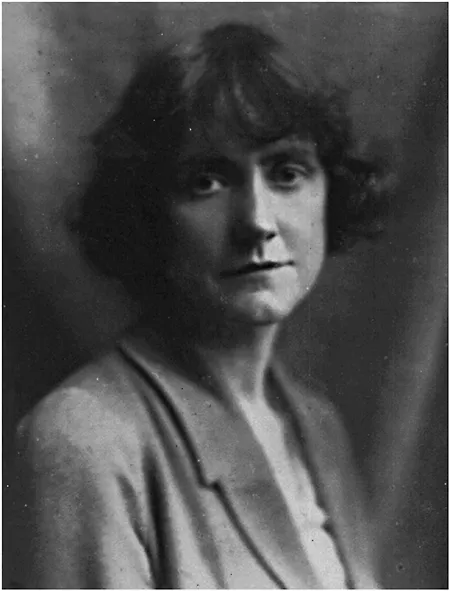
The contrasts that today we see in her work were also apparent in her appearance: one friend described her as “a delicate woman with sad eyes and a sweet smile who seemed as fragile as old lace, until you talked with her and glimpsed the steel lining beneath the tender surface” (Langner 1952: 10). Early photographs depict her as a pensive, romantic young woman with fine hair drawn back in a fairly modest fashion, presumably prepared to obey the dictums of nineteenth-century society and patiently await the arrival of a suitable husband. Yet Glaspell rebelled against Victorian morality and mores: she dreamed of going to college, and meanwhile, challenging male control of the media, started writing up the social life of her town for the local Weekly Outlook. Some years later, she would be one of the first women among the Greenwich Village bohemians to bob her hair, and photographs and portraits from this period depict her deep in thought, mysterious and distant, and undoubtedly modern.
Glaspell was born in the American Midwest to parents who preferred church activities to the cultural and social scene of their town and desired a happy, fruitful marriage for their daughter. Although she disappointed them on that score, they supported her literary ambitions as she wrought for herself a more modern life, becoming a prolific short-story writer, a best-selling novelist, and an experimental playwright who would be awarded Broadway’s Pulitzer Prize for drama in 1931. Glaspell also co-founded America’s most influential little theater,1 the Provincetown Players, with the express aim of giving American dramatists a stage of their own. In spite of such achievements, the professionalization of literature as identified by Paul Lauter (Lauter 1983) and the general silencing of women’s voices caused her whole oeuvre to be ignored from the late 1930s to the early 1980s, when the women’s movement recovered her story “A Jury of Her Peers” (1917). This version of the play Trifles (1916) was recognized as a perfectly composed example of how the bonding between women can combat injustice and domestic violence, and of the different spheres and languages that separate men and women.2
The slow recognition of Glaspell’s stature as a playwright was set in motion in 1981, when the feminist theater scholar Judith Barlow included Trifles in an anthology of plays by women, Plays by American Women: The Early Years: 1900–1930.3 The following year, the British scholar of American theater, Chris Bigsby, gave Glaspell a small section in his Critical Introduction to Twentieth-Century American Drama, and in 1987 he edited a collection of her plays for Cambridge University Press. Thus Trifles, first performed and published in 1916, became once again readily available; it has slowly supplanted “A Jury of Her Peers” in recent anthologies of women’s writing or of American literature and is now widely taught (see Chapter 4). Glaspell’s other plays, even those included in Bigsby’s volume – The Outside, The Verge, and Inheritors – have rarely made it into the classroom or lecture hall, although The Verge and Inheritors have been performed recently, as is indicated in later chapters of this book, and academic criticism is showing more interest—as witnessed by the numerous critical studies and essays published recently (Gainor 2001, Carpentier 2006, and Carpentier and Ozieblo 2006), and by the forthcoming Complete Plays.4
1.1 Susan Glaspell c. 1916. Photograph reproduced by courtesy of the Billy Rose Theatre Division, the New York Public Library for the Performing Arts, Astor, Lenox and Tilden Foundations
Glaspell wrote her early plays for performance by the amateur little theaters of Greenwich Village and for an audience of friends who shared her rejection of “patterned” Broadway plays that “didn’t ask much of you” (Glaspell 1927: 248), as well as her convictions on politics, feminism, and other contemporary developments, such as psychoanalysis. Reviewers on both sides of the Atlantic received most of her plays with glowing praise, comparing her to Strindberg, Chekhov, Ibsen, or Shaw, although some did object to what they experienced as “verbose passages” (Atkinson 1927: 1), “literary quality” (Anon. 1920a: 383), and lack of exciting “dramatic action” on stage (Zatkin 1927: 56). Frank Shay, writing for the Greenwich Villager in 1921, boldly claimed that “The Verge definitely places Susan Glaspell alongside Strindberg, Tchekoff and about three notches above Shaw” (Shay 1921: 7). His claim was endorsed in 1924 by the British critic for the Daily Telegraph, A. D. Peters, who wrote that Glaspell belonged to:
the purely intellectual school of American drama, if one may be permitted to label her work with a word so much feared and so often misunderstood. … She follows directly in the Ibsen tradition, and may justly be described, I think, as his spiritual descendant in America. In fact, she is very much more nearly related to him than Shaw ever was or will be. … She is the most important of the contemporary American dramatists, and in the opinion of almost all she vies for the first place with Eugene O’Neill.
(Peters 1924)
Glaspell’s “originality” was frequently remarked on by reviewers (see, for example, Anon. 1925b: 295), as was her need to examine the workings of her characters’ minds; for one critic she was “a dramatist of the Ego—not so flamboyant as [Ernst] Toller, and with the ironic pity of [John] Galsworthy” (Malone 1924: 107). On the other hand, the underlying social comedy of Glaspell’s plays, which she adroitly allowed to come to the fore in Chains of Dew, today invites comparison with Noel Coward (Ozieblo 2006b: 21), while J. Ellen Gainor notes that J. B. Priestley’s “work resonated with Glaspell’s” (Gainor 2001: 247), particularly with the unpublished and unperformed Springs Eternal.
Susan Glaspell and the Provincetown Players
The origin of the Provincetown Players should be ascribed to Susan Glaspell’s short play Suppressed Desires (see Chapter 2), which she co-authored with her husband George Cram Cook and presented to the recently formed Washington Square Players. A skit on the newly fashionable faith in psychoanalysis, the play was rejected, as Glaspell tells us, because it was “too special” (Glaspell 1927: 250); Cook, indignant at the slight, organized a performance in a friend’s home that summer, 1915, in Provincetown, Cape Cod. The following summer, with the manic zeal that characterized most of his activities, he announced a season of plays for July and August and converted a disused fish shed on a rickety wharf opposite their home in Provincetown into a makeshift theater. Among the plays performed that summer were Glaspell’s Trifles and Eugene O’Neill’s Bound East for Cardiff. It was Glaspell who had convinced O’Neill to read his play to the future Players and her judgement was proved correct. She would later write that, after the performance:
Then we knew what we were for. … I may see it through memories too emotional, but it seems to me I have never sat before a more moving production than our “Bound East for Cardiff,” when Eugene O’Neill was produced for the first time on any stage. … It is not merely figurative language to say the old wharf shook with applause.
(Glaspell 1927: 254)
Glaspell’s part in the founding and success of the Provincetown Players is rarely given the significance her devotion to the venture merits, and is generally confined to her work as a dramatist. The reviewer John Corbin wrote as early as 1919 that “If the Provincetown Players had done nothing more than to give us the delicately humorous and sensitive plays of Susan Glaspell, they would have amply justified their existence” (Corbin 1919). And yet the more perceptive anonymous author of an article in the British Time and Tide asserted:
She gave of her best to the Playwrights Theatre, working as hard for it as Lady Gregory has worked for the Irish theatre, and obtaining from it as her reward that opportunity for expression which is denied to the younger generation of English dramatists at the present time.
(Anon. 1925b: 295)
The Provincetown Players initially performed eight or nine bills of three short plays every winter and only gradually took on the challenge of the full-length play. Thus Glaspell, who wrote eleven plays for the group, offered Trifles, The Outside, Close the Book, Woman’s Honor, and The People, and co-authored Suppressed Desires and Tickless Time with her husband. In 1919, the Players performed Bernice, her first longer play, then the full-length Inheritors and The Verge in 1921, and Chains of Dew (written in 1920) in 1922. The Players ended their activities in 1922, when Glaspell and Cook, weary of the company’s internal power struggles, decided to travel to Greece.
After her return from Greece—alone, as her husband had died there in 1924 – Glaspell, finding no support from the old friends who had usurped the theater she and Cook had created, returned to fiction. She did co-write The Comic Artist with her companion Norman Matson, but disowned the play when the relationship with Matson ended. Her one theatrical success after the Provincetown Players period was Alison’s House, performed in 1930. This was awarded the Pulitzer Prize in 1931, and although critics believed that her work as a whole merited the prize, they did not all consider Alison’s House to be her best play (see Chapter 3). The last play Glaspell wrote, Springs Eternal, was neither performed nor published; the manuscript is in the Glaspell papers at the New York Public Library. Except for this play and Chains of Dew (copyrighted in 1921 but never published), Glaspell’s plays were available to her contemporaries both in the United States (published by Frank Shay) and in the United Kingdom (published by Ernest Benn), where they were successfully performed by avant-garde groups such as Edith Craig’s the Pioneer Players, the People’s National Theatre, the Gate Theatre, and the Lena Ashwell Players.
Susan Glaspell’s life
Susan Glaspell was born in Davenport, Iowa in 1876.5 Her father’s family had owned land, but it was gradually sold off, so that her father, Elmer Glaspell, inherited only a small-holding that was, quite literally, on the wrong side of the railway tracks. Susan’s mother, Alice Keating, came from a family that looked down on Elmer’s attempts to keep himself employed. The Davenport register has him as a contractor, building sewers and drains for the growing town. As a young girl and adolescent, Susan Glaspell longed to be a part of Davenport society; her earliest known writing is for the Davenport Weekly Outlook, reporting on the comings and goings of precisely those people she then admired. It was by her writing that she eventually won their acceptance and recognition: once she started publishing short stories in magazines such as Harper’s and Youth’s Companion, and had won the Black Cat Prize for a story in 1904, Alice French (a.k.a. Octave Thanet), of best Davenport stock and author of numerous novels and stories, took the young Susan under her wing. Glaspell then joined a staid Davenport literary society, the Tuesday Club, and, after the publication of her first novel, The Glory of the Conquered (1909), and a lengthy sojourn in Paris, was invited to lecture on topics such as the novel and European literature.
Although Glaspell had coveted such recognition, by the time it came she had developed in other directions. The discipline and influence of her home atmosphere, particularly her parents’ commitment to the Church and its missionary activities, had paled when confronted with the independence that a couple of years of study at Drake University in Des Moines brought her. After completing the requirements for her degree in 1899, she worked for the Des Moines Daily News, but, in 1901, decided to return to Davenport in order to devote her time entirely to the writing of fiction. Of the cases she covered as a reporter, the best known is the story of the murder of Mr. Hossack by, presumably, his wife. Fifteen years later, she converted this into Trifles (see Chapter 4), her best-known play.
The independence she had acquired while away from her family gave Glaspell the courage to join the radicals and non-conformists of Davenport who were led by George Cram Cook, known as Jig, and a very young, committed socialist, Floyd Dell—journalist and future novelist—who had only recently come to town.6 Davenport, founded in 1836, was sufficiently small and Midwestern to be shocked by the behavior of Cook, scion of one of its best families, but also sufficiently marked by the experience of European immigrants, particularly the Hungarian revolutionaries, to sponsor a lively artistic, musical, and intellectual cultural life. As for Cook, he had recently abandoned a lectureship at Stanford University in order to become a truck farmer on his family’s land, selling his produce at the town market and writing and philosophizing in the long winter evenings. This lifestyle had precipitated a separation from his first wife, and Cook was now fighting for a divorce in order to marry the much younger and very pretty Mollie Price, who, in the meantime, was working on anarchist Emma Goldman’s magazine Mother Earth in New York. It was at this point that Glaspell met Cook and the two fell in love. But they would not marry until 1913, after Cook’s divorce from Mollie, by which time he had had two children by her.
Glaspell joined the Monist Society that Cook and Dell founded in 1907 for, as Cook breezily put it, “the propagation of our philosophy in the guise of religion, or religion in the guise of philosophy” (Glaspell 1927: 191). American Monism had its roots in Emersonian Transcendentalism and came to life under the influence of Ernst Haeckel’s The Riddle of the Universe, an account of his philosophy that was highly popular at the time (see Murphy 2005: 26–29). Years later, Glaspell would recover Cook’s lecture on Monism and include it in The Road to the Temple, the biography she published of her husband in 1927, admitting that his conception of continuity and unity of all things in time and nature had affected her deeply. Discussions at the Monist Society stimulated her to sharpen her idealism and to penetrate deeper into the thought of the German philosophers she had read at college. Floyd Dell had suggested the name for their society, which he took from the German Monist League that Haeckel had founded in 1905 in order to spread his “holistic philosophy (a kind of scientific pantheism) that attempted to reconcile the contemporary knowledge of the origin of the species and the evolution of man with the need for religion” (Hinz...