1
THE ROMANTIC COMEDY
An introduction
Romantic comedy has proved to be one of the most enduring cinematic genres. It has certainly undergone some ebbs and flows in its popularity, but, as with all the major genres, it proves perennially resilient. Audiences still enjoy the blueprint of the romantic comedy, with all its traditional ingredients. Every year sees the release of new romantic comedies, which are strongly in the mould of the earliest examples in cinema history. We want to see the same characters, the same situations, the same narrative trajectory, the same settings and dialogue, with new stars that speak to new generations, yet tell the same story.
The archetypal romantic comedy is certainly perceived to be a woman’s film, perhaps dismissed by some, often male, critics and lumped in a category labelled ‘chickflick’. Of course, this negative perception of the genre is not just to do with its gendered nature, but has been a fate meted out to genre films in the past. Genre is about mass entertainment, it is about studios maximising their returns on their huge investment in a film, by replicating formulae which have made money in the past. Genre has been seen, in such a context, as anathema to creativity and artistry, and hence critical merit. This attitude seems implicit in the critic Peter Bradshaw’s response to Four Christmases (2008):
The film may have merited a poor review, yet the language is permeated with an inherent disdain for the genre. Comedy as a whole has rarely been seen as being as critically respectable as other genres; perhaps it is rather a self-defeating paradox to ask for it to be taken seriously. Even Shakespeare’s comedies seem to be critically overshadowed by the tragedies, perhaps diminished by the foregrounding of characters who are not heroic or noble, and themes that concern issues that can be found in everyday life, such as love and relationships, rather than elemental issues of life, death, good and evil. The most respected romcoms are those associated with artistic figures that are respected as auteurs (e.g. Woody Allen’s Annie Hall and Howard Hawks’ Bringing Up Baby), lifting them above the negative connotations of the commercial imperative of popular Hollywood cinema.
The essence of genre is the fundamental recipe of repetition and difference. As with all major genres, the romcom blueprint has developed some interesting and successful offshoots, which continue to reinvigorate the form and attract new audiences. These new directions challenge the genre’s conventions, stretching the blueprint to its limits, as they borrow and merge with other genres, giving new pleasures to the contemporary audience. This is an audience who are steeped in a heritage of film stretching back over generations. They have ready access to film and media, and welcome the hybridisation of film genres, enjoying the familiar but seeking the new: Eternal Sunshine of the Spotless Mind, Enchanted, Knocked Up and Shaun of the Dead.
Tom Ryall comments that ‘even the most sharply delineated genres include considerable variety’ (1998) and this is certainly true when surveying the breadth of films which are included within the romantic comedy genre. Yet this is ultimately true of all genre films; as Ryall continues, ‘this diversity reflects the hybrid generic qualities of many American films and a fluidity of generic boundaries’. This book will consider the films that seem to epitomise the genre conventions that are commonly agreed to be at the heart of the romantic comedy, but will also discuss the films that push the boundaries, that lurk around the periphery of the genre. Knocked Up, for example, embraces the humour of gross-out comedy, and hence broadens and renews the appeal of the romcom. In this respect, genre theory can be valuable in serving to expose the ‘workings’ and generic nature of an individual film, often reminding us that much of Hollywood’s product is multigeneric in nature.
As with any genre, certain films have come to be seen as definitive, forming a canon; this delineates the romcom for many, particularly critics and academics. Films such as the classic screwball comedies fall into this category: Bringing Up Baby, His Girl Friday, The Philadelphia Story, along with some later landmark romantic comedies including Annie Hall and When Harry Met Sally. These films are seen to be particularly influential, and tend to dominate discussion of the genre. The canon confers ‘classic’ status on these films, against which subsequent additions to the genre are compared and often found to be lacking, being dismissed by reviewers as inferior versions of the earlier ‘classics’.
DEFINING THE GENRE
What is a romantic comedy? In some respects classifying a film as a romantic comedy can be problematic, as its main elements are present in most films. Romance and comedy, to a greater or lesser extent, can be found in many, or even most, genre films, being a standard source of narrative pleasure. The generation of laughter is the fundamental narrative dynamic within any form of comedy. Nevertheless the narrative can be punctuated by tears and sadness, as the trajectory almost always involves the seeming loss of love and the beloved, when despair and disaster prevail. In this respect the romcom can clearly owe a debt to the romance, featuring a melodramatic tone that can be predominant at certain stages of the narrative. Tamar Jeffers McDonald (2007) observes that the romantic comedy since the late 1980s has placed an emphasis on tears. Suffering is often part of the narrative process of self-discovery and transformation that characterises the genre. Sex And The City (2007) sees Carrie go through a process of mourning after Big lets her down on her wedding day. Carrie goes through deep despair and anger, before building her life again, demonstrating strength and resilience. She comes to realise that she was guilty of being selfish, having overlooked Big’s needs when planning their wedding, and is then ready to resume their relationship, which we assume to be enhanced by this period of reflection and realisation.
The romcom can be regarded as a hybrid of the romance and comedy genres, featuring a narrative that centres on the progress of a relationship, and, being a comedy, resulting in a happy ending. The dynamic of the film rests on the central quest – the pursuit of love – and almost always leads to a successful resolution.
So what are the elements that compose the genre? A romcom certainly has a very distinctive narrative structure: boy meets girl, various obstacles prevent them from being together, coincidences and complications ensue, ultimately leading to the couple’s realisation that they were meant to be together. In keeping with the comedy genre, the narrative concludes with a happy ending, with the final union of the couple. The dominant theme is the ‘battle of the sexes’, which provides the central dynamic of the genre. The narrative often hinges around the central couple, who initially are antagonistic towards each other, but who come to recognise their inescapable compatibility in the face of great adversity and, often, mutual loathing. Their incompatibility may arise from social status, wealth, conflicting lifestyles and attitudes, or even purely their differing expectations of relationships. The warring couple clearly involves issues regarding gender, as discussed in the chapters on men and women.
Narrative and plot
Stanley Cavell identified a dominant narrative form of the genre which he labelled ‘the comedy of remarriage’ in his seminal study Pursuits of Happiness (1981). This narrative sees the couple as separated in the initial stages, only to be reunited by the end of the film after discovering that they still love each other, as in films such as His Girl Friday, Adam’s Rib, and Sex And The City. A second variation on the romcom narrative is that of the couple experiencing love at first sight yet being unable to be together, due to factors beyond their control. Examples of this narrative include Pretty Woman, The Wedding Planner, and Enchanted. A third significant model is that of unrequited love. One half of the couple realises their love for the other early on, but the other half is slow to recognise and return their love, often having to lose the wrong partner in order to be ready for the right love, as in My Man Godfrey, Bringing Up Baby, and 27 Dresses. Another identifiable narrative is that of the couple who are at war with each other from the start but come to recognise their love for each other as a result of various misunderstandings and complications. This is a fundamental model for many romantic comedies, as outlined earlier in the chapter. Examples include It Happened One Night, Pillow Talk, and How To Lose A Guy In 10 Days.
All of these variations have a common impetus towards a happy ending. The audience will approach the film in the expectation that the couple will be together, happily, at the end. They can enjoy the journey towards this goal, within the reassurance provided by the very predictability of the plot. The formulaic nature of the genre is often at the heart of the pleasures experienced by the audience.
The narrative will be composed of a sequence of situations that the audience will recognise and, again, expect, from other films of the genre. A typical romantic comedy will feature mistaken identity, disguise and masquerade, intimate tête-à-têtes (often meals), public humiliation, brides bolting from the altar, a race against time, confiding in friends and the ‘meet-cute’. The meet-cute is one of the defining moments of the romcom, when the couple first encounter each other, generally in comic and prophetic circumstances. The meet-cute is prophetic in that it can often suggest the nature of the couple’s relationship. The situation is used to bring together the two central characters, bringing their conflicting personalities into comic collision, initiating the narrative dynamic. In Bringing Up Baby David meets Susan when she commandeers his golf ball, then his car, wrecking his meeting with a potential investor in his museum and damaging his car. Ellie meets Peter in It Happened One Night when they fight over the last seat on the bus, Peter pushes himself onto the seat and Ellie ends up, to her fury and embarrassment, on his lap. Both of these examples are typical of the meet-cute involving embarrassment and conflict, but suggesting the future relationship of the couple.
Characters
The central couple are characterised by paradox: they are objects of desire, and yet remain incomplete, and imperfect, until they are ultimately united with each other. Each may offer an image of gender perfection to the audience, often enhanced by the star persona of the actor, and may also be the object of the desire of more than one character, where a ‘wrong’ partner may be an obstacle in the path to true love. Pillow Talk (1959) makes clear how desirable its two lead characters are, as Brad (Rock Hudson) is clearly irresistible to women, whilst Jan (Doris Day) has to fight off the advances of a younger man, resist the proposals of her millionaire client, and becomes the woman for whom the playboy, Brad, overcomes his anti-marriage feelings.
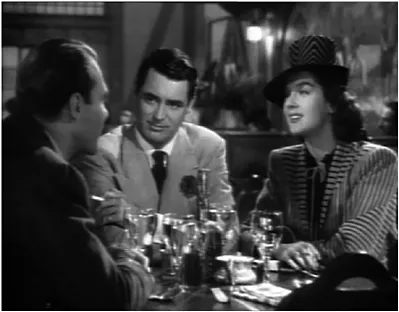
The couple may well demonstrate conflicting character traits, which can help to create initial antagonism that drives the narrative. These traits can prove to be a gift to the other, serving to help them attain greater self knowledge, fulfilment and happiness. On the other hand, one half of the couple may prove themselves to be crippled by need and incompleteness, whether it is the need for love or the need to change, in order to deserve love. In most romcom couples these two states work together, as the narrative shows the couple clashing, and then gradually working through the tumultuous progress of their relationship, until equilibrium is found. His Girl Friday revolves around Walter’s (Cary Grant) efforts to win back his ex-wife, who is about to remarry. He has already learnt the error of his ways in realising that he needs Hildy (Rosalind Russell), as a wife and as a reporter, on his newspaper, whereas Hildy believes that she’ll find happiness with the excruciatingly boring insurance salesman, Bruce, as a wife and mother, yet is helpless to resist the attraction of the adventure and excitement that Walter’s world offers her.
The film ends with Hildy abandoning the tedium of domestic life for remarriage with Walter and resumption of her career, as her dormant desires and needs are brought back to life via Walter’s intervention. The film is typical of the genre in foregrounding the power of love to transform and unite.
Stock characters play a key role in the romcom narrative. Beyond the central couple there may often be other partners, who are rejected in favour of their ‘true love’. Best friends will also play a crucial role, being a source of advice, commenting on the relationship, and being a
repository for the confidences of the couple. The best friend seems very much to be a phenomenon of the romcom since the Woody Allen films of the late 1970s, suggesting the increased emphasis on friendship in filling the void left by fragmented families and communities in the modern world. In this respect it seems significant that friends do not play a significant role in the screwball comedy. The contemporary romantic comedy can surround a central character with a family of friends; Notting Hill and the Bridget Jones films use this device to provide a comic chorus of characters who not only provide a commentary on the central character’s love life, but become an extension of their personality and endorse their popularity through the affection they inspire. He’s Just Not That Into You takes the theme of friendship as the basis of an ensemble film, featuring a number of rotating narratives regarding relationships which are linked through a network of friends.
The frie...