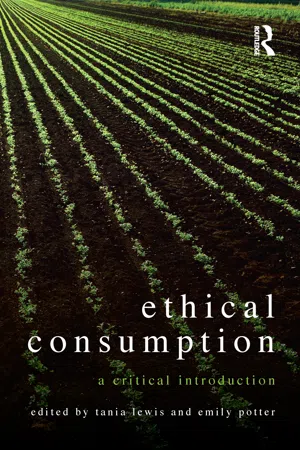
A not-so-quiet revolution seems to be occurring in wealthy capitalist societies - supermarkets selling 'guilt free' Fairtrade products; lifestyle TV gurus exhorting us to eat less, buy local and go green; neighbourhood action groups bent on 'swopping not shopping'. And this is happening not at the margins of society but at its heart, in the shopping centres and homes of ordinary people. Today we are seeing a mainstreaming of ethical concerns around consumption that reflects an increasing anxiety with - and accompanying sense of responsibility for - the risks and excesses of contemporary lifestyles in the 'global north'.
This collection of essays provides a range of critical tools for understanding the turn towards responsible or conscience consumption and, in the process, interrogates the notion that we can shop our way to a more ethical, sustainable future. Written by leading international scholars from a variety of disciplinary backgrounds - and drawing upon examples from across the globe - Ethical Consumption makes a major contribution to the still fledgling field of ethical consumption studies. This collection is a must-read for anyone interested in the relationship between consumer culture and contemporary social life.
In a small courtyard at the University of Melbourne, there is an unprepossessing, somewhat makeshift-looking café called KereKere. The coffee on offer is organic, Fair Trade, Rainforest Alliance-branded and sustainable: a list of options we've increasingly come to expect even in corporate café chains such as Starbucks. But at this café, customers are also asked to decide how the profits from that sale are distributed every time they buy a coffee. As customers are handed their order, they are also presented with playing cards that allow them to choose from a list of causes where the café's profits will go. Operating in the spirit of ‘kerekere’, a Fijian custom in which a relative or neighbour can request something that is needed and it must be willingly given with no expectation of repayment, the café sees itself as fostering ‘a culture that promotes community wellbeing’.
Figure1.1 A chalk stencil of the KereKere logo on a pathway at Melbourne University, by Andrew Aston.
At this café, the traditional economic exchange associated with the purchase of a cup of coffee has been subtly moved into other territories through the introduction of questions of gift giving, and of responsibility, care and even love (the café's logo is a coffee cup with a series of hearts rising from it) into the exchange ritual. Such attempts by social justice-oriented businesses to reconfigure the privatized moment of spending as a communal act, thus positioning consumer choice as a site of responsibility, are increasingly commonplace in today's marketplace. No longer purely associated with fringe politics or hippie lifestyles, terms such as ‘ethical’ and ‘responsible’ shopping and ‘conscience consumption’ are increasingly entering into the everyday language as well as the shopping experiences and practices of so-called ‘ordinary’ consumers.1 Whether through injunctions to buy ‘guilt-free’ Fair Trade chocolate, to minimize the consumption of energy and water on behalf of the planet, or to recycle or swap goods as a means of reducing consumption overall, mainstream consumer choice is increasingly marked by questions of ‘care, solidarity and collective concern’ (Barnett et al. 2005a: 45).
This broadly ethical turn within consumer culture, however, is not necessarily marked by a coherent set of shared politics or values. As both Littler and Humphery note in this collection, what we are terming here as ‘ethical consumption’ is not a clearly defined set of practices, but is rather a convenient catch-all phrase for a range of tendencies within contemporary consumer culture today. Books written for a general audience like Naomi Klein's No Logo (2000), Eric Schlosser's Fast Food Nation (2001), Peter Singer's The Ethics of What We Eat (2006) and Raj Patel's Stuffed and Starved (2007) can be seen as part of a broader fundamental critique of capitalism and consumer culture. In contrast, self-help guides like Sophie Uliano's Gorgeously Green: 8 Simple Steps to an Earth Friendly Life(2008) and Christie Matheson's Green Chic: Saving the Earth in Style (2008) aim to ‘change the world’ while operating within the logic of consumer culture.
Similarly, a glance at the myriad websites and consumer organizations that have emerged around the issue of political consumerism also reveals the difficulty of defining or containing the field as well as aligning it with any particular political valences. The Freegan website (http://freegan.info.), for instance, offers a radical critique of consumption-as-usual, suggesting as it does ‘alternative strategies for living based on limited participation in the conventional economy and minimal consumption of resources’, while ethical food-oriented website The Ethicurean blends politics and pleasure in asking consumers to ‘chew the right thing’. Meanwhile, more pragmatic informational websites like Ethiscore offer to ‘provide information on the companies behind the brand names and to promote the ethical use of consumer power’, while the Fair Trade Federation website points to the limits of a purely individualist consumer-driven approach and the need to articulate such practices to a broader ‘global Fair Trade movement’. Less politically badged is the website Big Green Purse, which offers lifestyle and shopping tips, as well as a blog space, for consumers wanting to ‘shop green’.
The diversity and breadth of popular manifestations of concerns about contemporary materialism and overconsumption points to the limitations of definitional approaches to ethical consumption, and the problems inherent in attempting to draw boundaries around a ‘field’ that touches upon everything from questions of North—South consumer—producer relations, to concerns with buying locally, to issues of sustainability. As we discuss below, the emergent scholarship around ethical consumption likewise reflects the inchoate nature of ‘the field’, with work in the area drawing upon and moving between political economy, geography, sociology, cultural studies, business studies and sustainability studies. Among other things, the tendency towards an intermixing of theories and methods here reflects a healthy recognition of the need for an object- or practice-centred approach to mapping the rise of ethical practices and concerns within consumer culture, rather than privileging the often limited logics of any particular disciplinary or theoretical rationale.
Such an approach also reflects a shift in how the ethical is conceived in recent scholarly work. Foucault's location of ethics in ‘regimes of living’ (Collier and Lakoff 2005) and self-governing has influenced a range of articulations that do not understand ethics in terms of external moral codes and values, but instead ground ethical practice in the terrain of the everyday: the network of relations in which we are each caught up. This is what Gay Hawkins refers to as ‘the ubiquity of ethical work’ (2006: 13), which requires a variety of methodologies to track and analyse its multiple and situated manifestations.
Having highlighted these definitional difficulties, one shared point of commonality that arguably marks the various practices and concerns framed within the ethical consumer turn is the growing politicization of life and lifestyle practices. Michel Feher notes that this expanding realm of non-governmental activism is forcing a redefinition of what counts as politics today, highlighting too the ‘openendedness of the political process’ (2007: 26), which is no longer limited to the classical sphere of the polis defined against the oikos or household. Collier and Lakoff describe how this distinction, a traditional basis for moral philosophy, is no longer tenable in the contemporary world, where ‘ “living” has been rendered problematic’ by a host of concerns around the regulation of life itself, from genetically modified humans and crops to climate change (2005: 22).
Given this political context, why are we using the term ‘ethical consumption’ rather than, say, ‘political consumerism’ to label this trend? In part this is purely to reflect the popular currency of this term beyond the realm of academia. But we also want to signal something of a shift in the nature and status of consumer politics today. While, as we discuss below, there are clearly strong links between ethical consumption and political consumerism, we suggest that it is useful to make connections to, but also distinctions between, what has traditionally been associated with political consumerism — forms of activism, ‘boycotts’, consumer organizations, etc. — and more recent forms of responsible or conscience consumption, which we would see as being particularly oriented to the contemporary moment and its problematization of living. In the following two sections then, we will briefly discuss the development of political consumerism before turning our attention to the distinctive social, cultural and political context from which ethical consumption has emerged as an increasingly mainstream practice today.
Historicizing political consumerism: from boycotts to brands
While the mainstreaming of ethical consumption is a reasonably recent phenomenon, it can clearly be linked to a range of longer-term struggles around consumer politics. As Humphery notes in this collection, the mass market has long been the subject of political and cultural critique by Marxist, liberal and conservative critics alike. Likewise consumer culture has been marked by active political struggles since its beginnings. Here, boycotts can be seen as some of the earliest forms of political consumerism. In the eighteenth century, for example, during the American War of Independence, consumers refused to buy English goods as a way of breaking free from English colonialism. Thus, private consumer experiences were converted into public rituals, as ‘neutral’ consumer items such as imported British tea and clothing become politically charged objects.
One of the more important examples of organized political campaigning around consumption was the US White Label Campaign of 1899, driven by the women's consumer leagues that had first developed in the UK in the late nineteenth century and subsequently spread to the US and Europe. Initiated by middle-class women concerned with the conditions of workers, these consumer leagues worked to compile white (as opposed to black) lists of products and department stores associated with good labor practices. Representing an early example of ‘buycotting’ and an antecedent to the kinds of practices employed by Fair Trade and No Sweat campaigns today, the White Label Campaign took over from these earlier ‘white lists’, with campaigners positively labelling the products of factories that passed the League's inspection. It was during this period, too, that corporations began to take notice of consumer dissent and an increasing suspicion of corporate practices. The visible social impacts of the industrial revolution were met with new forms of corporate philanthropy, such as the trusts dedicated to social reform established by Joseph Rowntree in 1904 (Frankental 2001: 20).
Negative modes of campaigning in the form of boycotts also continued through into the twentieth century, with ‘Don't buy where you can't work’ campaigns for black civil rights impacting on the hiring practices of firms like Woolworths in the US during the 1920s–1940s. As Naomi Klein points out (2000: 336), one of the more recent boycotts and the first case of global brandbased activism was the targeting of Nestlé (1974–84) by various consumer, church and action groups in response to their marketing of infant formula in Africa and Asia, which the company pursued despite medical research which pointed to its associations with higher infant mortality when compared with breast milk. What the Nestlé case also signalled was the shift towards a different kind of political activism around consumerism. Nestlé was targeted because it was a highly visible corporation. Not only was it the largest multinational to make infant formula, it also had a particularly strong brand presence and promoted itself along the lines of ‘family values’, making it especially vulnerable to attack on this issue.
One of the central arguments Klein makes in her book No Logo (2000) is that the mainstreaming of political consumerism today is integrally connected to the centrality of brand culture. As she explains, global anti-consumerist movements have been around since the 1970s, yet the shift towards an everyday mode of ethical consumerism has ironically been enabled by the rise of branding as a central corporate strategy and the growing presence of corporate brands in everyday life. While contemporary branding has enabled corporations to seamlessly integrate themselves into spheres of life that were once relatively free of market logics, as Klein argues, the flip side of brand strategies that position corporations as good, responsible citizens is that they are increasingly being held to account for their social responsibilities to customers and the community at large. The culturally and socially immanent nature of the brand today is thus at once both the strength and the Achilles heel of the contemporary corporation. While Klein links the anti-globalization movement and its highly visible forms of activism to the rise of brand culture, the more ordinary, everyday politics associated with ethical consumer practices today can be linked clearly to the simultaneously ubiquitous and quotidian nature of brand culture.
The mainstreaming of ethical consumption
Aside from Klein's argument regarding the centrality of the brand, the distinctive quality of what counts as political consumerism today — and in particular its integration into the consciousnesses and shopping habits of ordinary consumers — can also be linked to a range of other contemporary developments. One important context for the ethical turn in mainstream consumerism has clearly been the increased focus within popular media culture on the impacts and risks of capitalist modernity, particularly in relation to the environment (Lewis 2008). The global success and impact of Al Gore's An Inconvenient Truth (2006) alongside youthoriented ‘green’ entertainment spectacles such as Live Earth has seen the growing coverage of green issues by popular media.
Marketers and advertisers have been quick to jump on the green bandwagon, increasingly embracing the language of corporate responsibility and incorporating green rhetoric and imagery into media-marketing strategies, a trend that has in turn seen rising concerns about corporate ‘greenwashing’. Closely linked to and overlapping with environmental critiques of modernity, a range of critical commentaries on materialism and ‘affluenza’ in wealthy developed nations (De Graaf et al. 2005) have recently made their presence felt in the mainstream cultural landscape, from media interest in anti-consumerist activism around corporate practices (particularly the targeting of major transnational corporations (TNCs) like Nike and McDonald's) to popular cultural critiques of overconsumption, such as that offered up in the 2004 film Super Size Me.
The rise of ethical consumption thus connects to a broader popular critique focused on a range of concerns around environmentalism, anti-materialism and unsustainable lifestyles. Barnett et al. also contend that Fair Trade organizations and campaigners played a central role in the mainstreaming of ethical consumption, using strategies such as survey data to actively work ‘to mobilise “the ethical consumer” as a newsworthy narrative figure’ (2005a: 48). Alongside the No Sweat campaigning of the mid 1990s (see Ross 1997), the media-savvy strategies of organized consumer groups saw the growing mainstream coverage of ethical issues.
Perhaps what was most crucial here in terms of normalizing the figure of the ethical consumer was the mode of address adopted by the ethical consumption lobby. As Barnett et al. argue, while grounded in ‘wider programs of mobilization, activism, lobbying and campaigning’ (2005a: 50), various organizations sought to impact on and shape everyday consumer practices by addressing the consumer in the media as a privatized, informed individual. Connelly and Prothero likewise note that in the past two decades the ‘green consumer’ has become an increasingly popular concept (2008), with government initiatives over the past decade targeting consumers as informed, calculative agents through domestically based campaigns such as ‘reduce, reuse and recycle’, thereby privileging the home as a site of politico-cultural change (Hobson 2006; Potter and Oster 2008).
The prominent figure of a savvy, reflexive consumer-citizen within the media and in government policy has inevitably found the attention of marketers concerned with exploiting the cultural shift ...
Table of contents
Cover Page
Half Title Page
Title Page
Copyright Page
Contents
List of Contributors
Acknowledgements
Foreword
PART I Introduction
Part II Politics
Part III Commodities and materiality
Part IV Practices, sites and representations
Index
Trusted by 375,005 students
Access to over 1.5 million titles for a fair monthly price.
Study more efficiently using our study tools.
Frequently asked questions
Yes, you can cancel anytime from the Subscription tab in your account settings on the Perlego website. Your subscription will stay active until the end of your current billing period. Learn how to cancel your subscription
No, books cannot be downloaded as external files, such as PDFs, for use outside of Perlego. However, you can download books within the Perlego app for offline reading on mobile or tablet. Learn how to download books offline
Perlego offers two plans: Essential and Complete
Essential is ideal for learners and professionals who enjoy exploring a wide range of subjects. Access the Essential Library with 800,000+ trusted titles and best-sellers across business, personal growth, and the humanities. Includes unlimited reading time and Standard Read Aloud voice.
Complete: Perfect for advanced learners and researchers needing full, unrestricted access. Unlock 1.5M+ books across hundreds of subjects, including academic and specialized titles. The Complete Plan also includes advanced features like Premium Read Aloud and Research Assistant.
Both plans are available with monthly, semester, or annual billing cycles.
We are an online textbook subscription service, where you can get access to an entire online library for less than the price of a single book per month. With over 1.5 million books across 990+ topics, we’ve got you covered! Learn about our mission
Look out for the read-aloud symbol on your next book to see if you can listen to it. The read-aloud tool reads text aloud for you, highlighting the text as it is being read. You can pause it, speed it up and slow it down. Learn more about Read Aloud
Yes! You can use the Perlego app on both iOS and Android devices to read anytime, anywhere — even offline. Perfect for commutes or when you’re on the go. Please note we cannot support devices running on iOS 13 and Android 7 or earlier. Learn more about using the app
Yes, you can access Ethical Consumption by Tania Lewis, Emily Potter, Tania Lewis,Emily Potter in PDF and/or ePUB format, as well as other popular books in Social Sciences & Consumer Behaviour. We have over 1.5 million books available in our catalogue for you to explore.