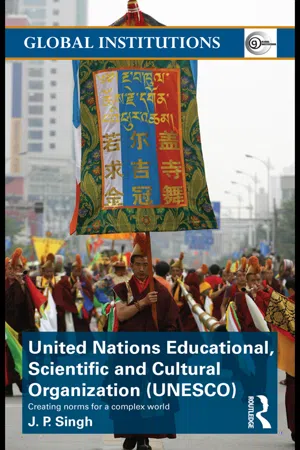
United Nations Educational, Scientific, and Cultural Organization (UNESCO)
eBook - ePub

United Nations Educational, Scientific, and Cultural Organization (UNESCO)

Creating Norms for a Complex World

  1. 166 pages
  2. English
  3. ePUB (mobile friendly)
  4. Available on iOS & Android
eBook - ePub

United Nations Educational, Scientific, and Cultural Organization (UNESCO)

Creating Norms for a Complex World

About this book

This book traces the history of UNESCO from its foundational idealism to its current stature as the preeminent international organization for science, education, and culture, building a well rounded understanding of this important organization.

The book:

  • provides an overview of the organization and its institutional architecture in the context of its humanistic idealism
  • details the subsequent challenges UNESCO faced through cold war and power politics, global dependence and interdependence, and the rise of identity and culture in global politics
  • analyses the functioning of UNESCO administration, finance, and its various constituencies including the secretariat, member-states, and civil society
  • explores the major controversies and issues underlying the initiatives in education, sciences, culture and communication
  • examines the current agenda and future challenges through three major issues in UNESCO: Education or All, digital divide issues, and norms on cultural diversity
  • assesses the role of UNESCO in making norms in complex world of multiple actors and intersecting issue-areas.

Reflecting on UNESCO's vision, its everyday practices, and future challenges; this work is an essential resource for students and scholars of international relations and international organizations.

Frequently asked questions

Yes, you can cancel anytime from the Subscription tab in your account settings on the Perlego website. Your subscription will stay active until the end of your current billing period. Learn how to cancel your subscription.
No, books cannot be downloaded as external files, such as PDFs, for use outside of Perlego. However, you can download books within the Perlego app for offline reading on mobile or tablet. Learn more here.
Perlego offers two plans: Essential and Complete
  • Essential is ideal for learners and professionals who enjoy exploring a wide range of subjects. Access the Essential Library with 800,000+ trusted titles and best-sellers across business, personal growth, and the humanities. Includes unlimited reading time and Standard Read Aloud voice.
  • Complete: Perfect for advanced learners and researchers needing full, unrestricted access. Unlock 1.4M+ books across hundreds of subjects, including academic and specialized titles. The Complete Plan also includes advanced features like Premium Read Aloud and Research Assistant.
Both plans are available with monthly, semester, or annual billing cycles.
We are an online textbook subscription service, where you can get access to an entire online library for less than the price of a single book per month. With over 1 million books across 1000+ topics, we’ve got you covered! Learn more here.
Look out for the read-aloud symbol on your next book to see if you can listen to it. The read-aloud tool reads text aloud for you, highlighting the text as it is being read. You can pause it, speed it up and slow it down. Learn more here.
Yes! You can use the Perlego app on both iOS or Android devices to read anytime, anywhere — even offline. Perfect for commutes or when you’re on the go.
Please note we cannot support devices running on iOS 13 and Android 7 or earlier. Learn more about using the app.
Yes, you can access United Nations Educational, Scientific, and Cultural Organization (UNESCO) by J.P. Singh in PDF and/or ePUB format, as well as other popular books in Politics & International Relations & Diplomacy & Treaties. We have over one million books available in our catalogue for you to explore.

Table of contents

  1. Routledge Global Institutions
  2. Contents
  3. Illustrations
  4. Foreword
  5. Acknowledgements
  6. Abbreviations
  7. Introduction
  8. 1 UNESCO’s organizational history and structure
  9. 2 Prioritizing education
  10. 3 Making science
  11. 4 The prominence of culture
  12. 5 Debating global communication orders
  13. 6 Reflections and possibilities
  14. Appendix UNESCO Constitution
  15. Notes
  16. Select bibliography
  17. Index