eBook - ePub
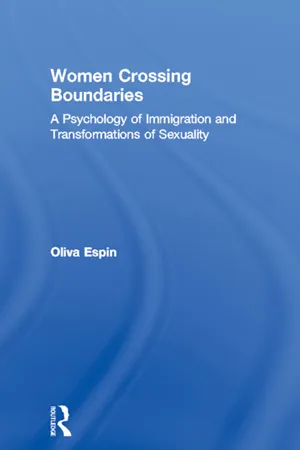
Women Crossing Boundaries
A Psychology of Immigration and Transformations of Sexuality
- 194 pages
- English
- ePUB (mobile friendly)
- Available on iOS & Android
eBook - ePub
About this book
First published in 1999. This book looks at the consequences of border crossings and immigration on women and their culture and sexual orientations. Espin demonstrates how deeply sexuality, language and gender affected by this large life change with the aid of 43 biographies of adolescent and adult women.
Information
1Women’s Experience of Migration
The discipline of psychology has paid little attention to the impact of traumatic historical and political events on psychological development. Other social sciences have sought explanations for human behavior in the cultural context. But for psychology, this is almost a novelty. Although the voices of feminist and cultural psychologists have strongly addressed the impact of cultural forces on the individual, psychology has persisted in using intrapsychic individual explanatory models. The omission of social and cultural factors in psychological theory occurs despite the fact that these forces are central to the psychological development of individuals. Their impact is obvious in the traumatic events of the modern world. A few examples of social, political, and historical traumatic events that can create psychological scars are the Nazi Holocaust, the Vietnam War, and exposure to terrorist attacks. These events can produce emotional responses for several generations.
The experience of immigration into another country, either forced or voluntary, is another example of a life transition that can trigger anxieties and create unique psychological consequences for individuals who migrate. Migration also produces psychological effects for the immigrants’ descendants beyond the obvious fact that the younger generations are born or grow into adulthood in the new country. The intergenerational transmission of trauma combines with the psychological transformations prompted by the migration to produce these effects and to influence the nature of parenting and other relationships. Posttraumatic stress, mourning and grieving, acculturative stress, and other phenomena are common among immigrant and refugees. These psychological effects are derived from losses and traumatic experiences, but also from the successes the immigrants may achieve through the process of migration.
Migration is the move from one region, country, or place of abode to settle in another. In this book I use the word migration to describe the geographical move of individuals across national borders for the purpose of residing more or less permanently in a country other than the person’s country of birth. Historically, immigration is at the core of the United States as a nation. But throughout history, American attitudes toward immigration and migrants have varied dramatically, from encouragement and receptivity to outright rejection and contempt for immigrants (e.g., Easterlin et al., 1982; Pedraza & Rumbaut, 1996; Portes & Rumbaut, 1996). Globally and nationally, immigration policy has been one of the most important political issues in the 1980s and 1990s.
To understand the psychological impact of migration in the lives of immigrants and refugees, attention needs to be placed on the characteristics of both “the context of exit” and “the context of reception.” Both are significant determinants of the success of immigrants’ adaptation to their new life (Portes & Rumbaut, 1996).
Migration is motivated by diverse factors including a desire for better economic conditions, fear of political or other forms of persecution,1 family reunification, and other personal reasons. If economic gain is the main force behind the migration, the person migrating is considered an immigrant. If persecution and danger are the motivating force behind the migration, the person is considered a refugee. Sociologists Alejandro Portes and Ruben Rumbaut in their book Immigrant America: A Portrait (1996), explain that
The distinction hinges on the notion of refugees as involuntary and relatively unprepared migrants “pushed out” by coercive political conditions or by an “exposure to disaster,” versus immigrants as voluntary and better prepared movers “pulled in” by perceived opportunities for economic advancement or family reunification. The distinction is actually more elusive than this definition suggests, (p. 168)
The legal distinction between immigrants and refugees is colored by the political persuasion of governments. Their definitions tend to override the realities of the situation as experienced by the person who migrates (Cole, Espín, & Rothblum, 1992; Pedraza & Rumbaut, 1996; Portes & Rumbaut, 1996; Richmond, 1994).
“Refugee” is not a self-assigned label, but one assigned by the host government…. Differential labeling by the U.S. government has marked, for example, the divergent official receptions and subsequent adaptation experiences of South East Asian boat people, on the one hand, and Central American escapees, on the other. (Portes & Rumbaut, 1996, p. 168)
To avoid the confusion of politically based definitions, I conceptualize the differences between immigrants and refugees from a psychological point of view, not on the basis of governmental decisions about who is assigned one status or another. Hence, when I use the terms “immigrant” or “refugee” I refer to the migrant’s perception of the situation and the degree of trauma experienced, not their assigned legal status.
Usually refugees have experienced more traumatic events than immigrants. “Although both refugees and immigrants must cope with a significant amount of life change, ‘refugees’ appear to experience more threat, more undesirable change, and less control over the events that define their context of exit” (Fortes & Rumbaut, 1996, p. 169). Higher stress and posttraumatic stress symptoms are found among people who define themselves as refugees (Molesky, 1986), such as “Salvadorans and Guatemalans who came to the United States escaping civil war conditions in their respective native countries [although these people are] not recognized as refugees by the U.S. government” (Fortes & Rumbaut, 1996, p. 170).
These higher levels of stress have been found particularly among females (e.g., Salgado de Snyder, 1986; Salgado de Snyder et al., 1990). This phenomenon is more present in women because of traumatic experiences in the process of migration, loss of their networks of female relatives and childhood friends through migration, or lack of participation in the decision to migrate (Salgado de Snyder, 1986; Salgado de Snyder et al., 1990).
In this book I use the terms “migrant” and “immigrant” interchangeably to refer to both immigrant and refugee women. At times I specify when the issues in question apply exclusively to either immigrants or refugees.
In the last several decades, increased interest and awareness concerning the plight of immigrants and refugees have developed worldwide. Accordingly, research studies emerged, and publications addressed migration issues. These studies were informed by the different social science disciplines’ perspectives (e.g., Mahler, 1995; Pedraza & Rumbaut, 1996; Fortes & Rumbaut, 1996; Richmond, 1994; Todd, 1994). Most research on migration focuses on economic, political, and social variables. When mental health and psychological issues are addressed in this literature, the focus is upon the number and characteristics of psychiatric diagnoses, hospital admissions, and so on. This emphasis overshadows understanding the intrapsychic and personal experiences of immigrants as individuals.
The role of women in international migration has begun to draw attention from researchers, policy makers, and service providers; although it continues to be understudied. Several studies exclusively emphasize women’s experience during the migration process in Europe, the United States, Israel, and other parts of the world (e.g., Andizian et al., 1983; Gabaccia, 1992, 1994; Phizacklea, 1983; U.N.-INSTRAW, 1994; U.N.-IMPSF, 1995). These studies, while valuable, mostly focus on women’s struggles to adjust to the external trappings of a new society. In a few cases, they address the subjects’ coping with the loss of country and social networks. Some address women’s increased involvement in public life, such as labor force participation and educational attainment. This research has clearly established that “immigration has a decided impact on the labor force participation of women” (Pedraza, 1991, p. 311). Still, little is known about the experiences of heterosexual and lesbian immigrant women in the private realm, even though we know that different types of male-female power relations in the family develop as a consequence of migration (Pedraza, 1991). These new types of power relations involve sexuality and other aspects of their emotional and affective lives.
Indeed, as sociologist Sylvia Pedraza emphasizes, “we have yet to develop a truly gendered understanding of the causes, processes, and consequences of migration” (1991, p. 304). Thus “research on immigrant women…needs to chronicle…the private world of immigrant women and their community, and the contribution immigrant women made to [that] private sphere” (Pedraza, 1991, p. 318).
Regardless of the immigrant’s or refugee’s eagerness to be in a new country, the transitions they confront often result in loneliness from minimal contact with people who shared past experiences. They also struggle with the strain and fatigue derived from adapting and coping with cognitive overload; feelings of rejection from the new society, which affect self-esteem and may lead to alienation; confusion in terms of role expectations, values, and identity; shock resulting from the differences between the two cultures; and a sense of uprootedness and impotence resulting from an inability to function competently in the new culture (Espín, 1997; Garza-Guerrero, 1974; Taft, 1977).
As migrants cross borders, they also cross emotional and behavioral boundaries. Becoming a member of a new society stretches the boundaries of what is possible in several ways. It also curtails what might have been possible in the country of origin. One’s life and roles change. With them, identities change as well. The identities expected and permitted in the home culture are frequently no longer expected or permitted in the host society. Boundaries are crossed when new identities and roles are incorporated into life. Most immigrants and refugees crossing geographical borders rarely anticipate the emotional and behavioral boundaries they will confront.
Psychological Stages of the Migratory Process
On the basis of clinical observations, I have postulated three stages in the process of migration (Espín, 1987b): (a) the initial decision concerning relocation, (b) the actual geographical move into another country, and (c) the adaptation to a new society and way of life. At each step, men and women experience the process differently. In other words, gender is central to the lived experience of migration. For instance, at the decision-making stage, women are frequently not consulted about their preference to leave or stay or are not expected to make those decisions independently. Most men, however, participate in the family decision to leave, or they make the decision themselves. During relocation, particularly if escaping dangerous political conditions, women’s physical endurance may be questioned or their vulnerability may be exploited. This may impair their being provided the same opportunities to escape as men. It also may add further trauma through rape and other forms of abuse. At the third stage, when acculturation and adaptation occur, women’s gender roles may be modified more dramatically than men’s. Their struggles to adapt to the new environment may be further complicated by gender-based cultural prescriptions.
Acculturation and adaptation to a new culture also follows several stages (Arredondo-Dowd, 1981). These include: initial joy and relief, disillusionment with the new country, and, finally, acceptance of the good and the bad in the host country. This process entails some form of psychological reorganization as well as material adjustment and emotional adaptation to the situation (Garza-Guerrero, 1974; Grinberg & Grinberg, 1984). Identity is subject to change through-out life. However, social forms of trauma, such as migration, shake its foundations like nothing else.
Understanding the processes of psychological reorganization necessary for adaptation to another culture is essential for understanding what the experience of migration entails at the intrapsychic level. This process, usually termed acculturation, is at the core of the psychological implications of migration. Acculturation is distinguished from assimilation in that the former does not imply the disappearance of all values, customs, and behaviors originating in the home culture. The emphasis on acculturation rather than assimilation contradicts the melting pot ideology of assimilation. To some degree, acculturation is inevitable for all individuals who migrate. Nevertheless, “acculturation is not a simple solution to the traumas of immigration because it itself becomes a traumatic process” (Portes & Rumbaut, 1996, p. 186). Yet it is not necessarily negatively disruptive. Healthy acculturation can emerge into healthy biculturalism (Szapocznik & Kurtines, 1980).
Regardless of one’s gender and cultural background, the process of immigration always involves important psychological changes. These changes continue to evolve throughout the immigrant’s life and include the development of a new identity (Garza-Guerrero, 1974). Indeed, “cultural relocation tugs at the very roots of identity” (Levy-Warren, 1987, p. 301). However, “[j]ust how it is that culture plays a role in the process of identity formation and how cultural relocation, therefore, shakes identity to its core have still to be clearly delineated” (Levy-Warren, 1987, p. 302).
The process of adaptation and acculturation is not linear. The multiple intrapsychic and behavioral changes required for successful acculturation occur at many levels. Individuals will experience these changes at their own unique paces. The specific circumstances surrounding the migration also impinge on the process of adaptation. Besides the characteristics of the context of exit and the degree of support or rejection provided by the context of reception, other factors act as modifiers of the experience. These include the possibility of returning to the home country for periodic visits; the magnitude of the differences in culture, values, and religion between home and host countries; previous knowledge of the language of the home country; opportunities for upward mobility and maintenance of one’s occupational and social class identity; and racial status as a member of the “majority” or “minority” group. Age is of particular importance in this process. It is common wisdom that children learn faster and adapt better than adults to their new surroundings and language. However, adult immigrants may have the advantage of having achieved the intrapsychic capacity for separateness. This may help them be more adept at tolerating distance from loved ones than children and adolescents who presumably do not yet have this capacity, particularly if the latter migrate unaccompanied by immediate family. For children and adolescents, parents’ ability to cope with the stress of the migration and continue performing protective roles (versus disintegrating psychologically under it) is usually a determining factor in successful adaptation.
The pace of acculturation is also a significant factor. The adaptation process may be accomplished so quickly that it produces negative results, including a higher incidence of mental illness, drug dependence, and loss of identity (Portes & Rumbaut, 1996). Several decades ago, in an article that became a classic on this topic, Stonequist (1937) addressed the “inner strain and malaise, a feeling of isolation or not quite belonging” (p. 2) that characterize the experience of what he referred to as “the marginal man”—a term he coined. Conversely, acculturation might never be successfully completed if rejection and distance from the host culture are the preferred modes of coping with the new society and way of life. The traditional role expectations for women in a particular culture may foster their isolation from the mainstream culture, thus stalling the acculturation process.
Although some immigrant women choose to adhere to the traditional roles dictated by their culture, most—particularly young women—find these dysfunctional and unsatisfying in the new environment. Culturally based conflicts may develop in families as women try to reconcile the traditional gender roles of their home culture with the demands of participation in the new environment. This is particularly true for women who encounter greater access to paid employment and educational opportunities. These new economic, social, and emotional options create an imbalance in the traditional power structure of the family (Torres-Matrullo, 1980). Age and gender weigh heavily in familial-role conflicts among immigrants (Szapocznik & Kurtines, 1980). In many cultures, respect for elders and males goes uncontested until those traditions are confronted with the standards and expectations of the new society. These contradictions of old and new expectations produce explicit distress that emanates from the migratory process and conflicting cultural dictums.
Gender Roles and the Acculturation Process
Immigrant women and girls in the United States attempt acculturation into American society amid ever-changing role expectations for women. Some immigrants come from countries whose official governmental policies or cultural beliefs foster the transformation of women’s roles. Others migrate from an urban professional environment that reflects the global feminist movement. In other instances, immigrants come from very traditional rural or religious environments where minimal social change has taken place for years or decades before migration. What is appropriate behavior for women in the host culture may be unclear and confusing for the immigrant. Frequently it is more difficult for women than for men to negotiate “acceptable” behavior. The need or desire to adapt to the host culture is easily interpreted as disrespectful of the home culture’s values and those people—usually the older generations—who represent them most ardently.
As previously mentioned...
Table of contents
- Cover
- Half Title
- Title Page
- Copyright
- Dedication
- Contents
- Acknowledgments
- Introduction
- 1. Women’s Experience of Migration
- 2. Collecting Immigrant Women’s Life Narratives
- 3. The Stories
- 4. Migration, Sexuality, and the Preservation of Culture and Tradition
- 5. Language: Identity, Silence, and Sexuality
- 6. Mothers, Daughters, and Migration
- 7. The Experience of Lesbian Immigrants
- 8. Final Thoughts
- Appendix A
- References
- Index
Trusted by 375,005 students
Access to over 1.5 million titles for a fair monthly price.
Study more efficiently using our study tools.
Frequently asked questions
Yes, you can cancel anytime from the Subscription tab in your account settings on the Perlego website. Your subscription will stay active until the end of your current billing period. Learn how to cancel your subscription
No, books cannot be downloaded as external files, such as PDFs, for use outside of Perlego. However, you can download books within the Perlego app for offline reading on mobile or tablet. Learn how to download books offline
Perlego offers two plans: Essential and Complete
- Essential is ideal for learners and professionals who enjoy exploring a wide range of subjects. Access the Essential Library with 800,000+ trusted titles and best-sellers across business, personal growth, and the humanities. Includes unlimited reading time and Standard Read Aloud voice.
- Complete: Perfect for advanced learners and researchers needing full, unrestricted access. Unlock 1.5M+ books across hundreds of subjects, including academic and specialized titles. The Complete Plan also includes advanced features like Premium Read Aloud and Research Assistant.
We are an online textbook subscription service, where you can get access to an entire online library for less than the price of a single book per month. With over 1.5 million books across 990+ topics, we’ve got you covered! Learn about our mission
Look out for the read-aloud symbol on your next book to see if you can listen to it. The read-aloud tool reads text aloud for you, highlighting the text as it is being read. You can pause it, speed it up and slow it down. Learn more about Read Aloud
Yes! You can use the Perlego app on both iOS and Android devices to read anytime, anywhere — even offline. Perfect for commutes or when you’re on the go.
Please note we cannot support devices running on iOS 13 and Android 7 or earlier. Learn more about using the app
Please note we cannot support devices running on iOS 13 and Android 7 or earlier. Learn more about using the app
Yes, you can access Women Crossing Boundaries by Oliva Espin in PDF and/or ePUB format, as well as other popular books in Social Sciences & Emigration & Immigration. We have over 1.5 million books available in our catalogue for you to explore.