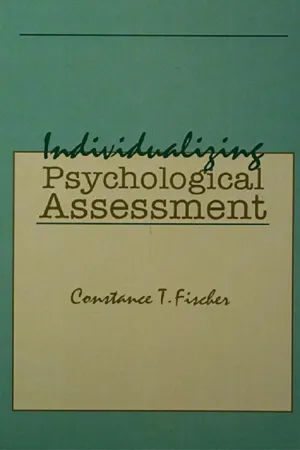
Assessments by psychologists, educators, and other human-service professionals too often end with the client being reported in terms of scores, bell-shaped curves, traits, psychodynamic forces, or diagnostic labels. Individualizing Psychological Assessment uses these classification devices in ways that facilitate returning from them to the individual's life, both during the assessment session and in written reports. The book presents an approach and procedures through which a person's actual life becomes the subject matter of assessment. Thoroughly revised from the previous edition, the book presents a wide range of concrete examples and illustrative cases that will serve both students and practicing professionals alike in individualizing assessments.
eBook - ePub
Individualizing Psychological Assessment
A Collaborative and Therapeutic Approach
- 424 pages
- English
- ePUB (mobile friendly)
- Available on iOS & Android
eBook - ePub
Individualizing Psychological Assessment
A Collaborative and Therapeutic Approach
About this book
Information
Part One
The Context and Practices of Individualized Assessment
THESE FIRST four chapters overview the entire process of individualizing psychological assessments and of writing reports, then describe the course of assessment sessions in detail. Each chapter ends with answers to questions often raised by students and practitioners.
Chapter 1 tells about the changing times during which this author adopted a human-science framework that supported development of procedures for individualizing psychological assessments. This chapter also describes touch-points with the independent work of like-minded psychologists. It briefly indicates that major movements within psychology, such as behavior modification, have become more holistic and more accepting of the active roles of experience and consciousness.
Chapter 2 begins with an individualized assessment report, which illustrates both the spirit of the assessment practices and ways of describing the assessee in terms of his or her individuality. The rest of this chapter overviews the entire assessment and report-writing process. Following this glimpse of practices, the chapter includes a list of guiding principles for individualizing assessments.
Chapter 3 takes the reader through the “nitty gritty” of the beginning phases of an assessment: for example, preparing materials, taking notes, typical ways in which beginners stumble in their attempts to relate to clients. A table summarizes the positive functions of test materials. Chapter 4 shows how one can see the client shaping and being shaped by his or her world—that is, how the assessor can observe process. Tables of excerpts illustrate collaborative exploration with the client, both of his or her present style of moving through situations, and of personally viable options.
Chapter 1
A History of the Individualized Approach
INDIVIDUALIZING PSYCHOLOGICAL ASSESSMENT presents ways to explore and describe a person’s life in process. Going beyond normative data and classifications, it addresses a particular person’s situation as he or she experiences it and simultaneously contributes to it. Hence the client can collaborate throughout the psychological assessment, and may read and comment on the report, which is written in everyday language. That report summarizes ways the client and the assessor have discovered that the client can recognize movement into problematic terrain, and then pivot into an alternative, but still personally viable, course.
This individualizing of assessment is not always necessary. For many recording and decision-making purposes, a brief account of the person’s standing in comparison to various criterion groups is sufficient. On other occasions it may be appropriate to individualize the assessment process but to write only a brief normative report or to individualize only descriptions of selected issues. Thorough familiarity with individualizing practices allows the assessor to employ them whenever it would be useful for the client and the client’s other helpers to understand this person’s situation as he or she lives it out.
During the process of presenting procedures and rationales for individualizing psychological assessment, this book touches on many issues and practices that also pertain to standardized assessment. However, this book is not intended to be a textbook on standardized testing. These chapters all assume that the reader already has such training or is in the process of receiving it. Individualizing Psychological Assessment is one more cornerstone, to be used with others on tests and measurements (Anastasi, 1982; Cronbach, 1984), projective techniques (Rabin, 1981), the history of testing (DuBois, 1970; Tuddenham, 1963), multimethod assessment (Nay, 1979), and clinical psychology as a profession (Garfield, 1983; Korchin, 1976).
The theoretical orientation of Individualizing Psychological Assessment will be referred to as “human-science psychology.” This orientation within contemporary psychology wants our discipline to remain scientific but also to recognize human characteristics that are not particularly amenable to the traditional methods of the natural sciences. These characteristics include humans’ simultaneous shaping of their environments even as they are shaped by them, behaving in accordance with their experience rather than just responding to external determinants, and being purposive. The term “human science” is a label for many movements that are trying in different ways to develop this paradigm. It is not opposed to our natural science methods and findings. Rather, its purpose is to integrate those achievements with others that emerge from recognition that humans are at once physical, biological, and psychological—related to their environments through consciousness, action, and goals, as well as through history and unconscious behavior.
A human-science approach is not essential for conducting individualized assessments. Most clinicians have carried out such practices to one degree or another, at one time or another, through principles of practicality and concern for clients. The practices presented in this book, however, were developed within a human-science orientation, and in the absence of some such explicit framework, most practitioners have found it difficult to individualize their assessments as thoroughly and consistently as possible. But this book is not a text on human-science psychology. Rather, it focuses on individualizing assessments; rationales and theory are presented only as they pertain to that project.
My Own Development
My own history may help readers to see the context in which this book’s approach to individualized assessment arose and within which principles and practices were spelled out as alternatives. Although my particular route and theoretical foundations are not necessary for development of individualized practices, they may help readers to identify similarities and differences in their own experience. Readers may thereby be encouraged to take up this book’s principles and practices in accordance with their own reading of changing times. Other psychologists who have traveled different routes to similar assessment innovations are considered later in this chapter.
Like many graduate students then (1960–1966) and now, I supplemented my reading of natural scientific psychology with novels and course-unrelated works such as those of Camus (1942, 1955), Sartre (1943, 1975), and May, Angel, and Ellenberger (1958). The natural science psychology was intriguing because of its rigor, its clear if overly simplified logic, and its ingenuity in devising laboratory experiments. Moreover, psychology departments were beginning to convert from cash-register style calculators to computers, with the exciting promise of information storage and analysis, which has now materialized. In addition, psychologists, inspired by diverse theories of learning, were beginning to apply laboratory research with animals to patients in mental hospitals and to institutionalized children. It was the birth of what has since become known as behavior modification. My private reading, however, was at least as necessary as my academic training when I attempted to understand my own life and the lives of the patients with whom I worked during practica and throughout my five-year traineeship with neuropsychiatry; Veterans Administration hospitals.
At the university, graduate students were trained extensively in research design, statistical analysis, psychometric testing, and learning theory. Cognitive and associative theories of learning were giving way to the behavioral theories of Watson, Skinner, and Hull in courses taught by younger faculty members. From some of the older faculty members we learned psychoanalytic theory and projective testing. The latter were valued by supervisors in our clinical settings, but were regarded with disdain by the majority of the faculty. Most of us discovered that both realms of knowledge were helpful in our clinical work. We variously allowed them to co-exist, or relied on psychoanalytic understandings but reached into behaviorism and objective testing to fill gaps, or in the manner of Dollard and Miller (1950), incorporated psychoanalytic concepts into learning theory. Many of us accepted this dual framework for our testing and diagnostic activities, but also looked to Rogers’ (1951, 1961) work on client-centered counseling to guide our therapy.
However we made peace with our university training, a major activity of psychologists in those days was testing. There, performance expectations were clear. The tester was a scientist whose task was to identify the patient’s traits, defenses, symptoms, and diseases through measurement. Testing was a unilateral enterprise. The psychologist administered a battery of tests in a standardized manner, dismissed the patient, scored the tests, analyzed these scores along with other productions, drew conclusions from these data, and wrote a laboratory report. In fact, in those days, the VA hospital referral form requesting “psychologicals” was the same form used to request blood tests and other laboratory procedures. Psychologists, like physicians and lab technicians, wore white coats (and trainees wore blazer-length white jackets). Nursing aides escorted the patient into a testing cubicle that contained a table, two straight-backed chairs, and a wall clock that was in fact a stopwatch operated by a foot pedal. The psychologist conducted a clinical interview, administered the tests, wished the patient well, called an aide to return the patient to his1 ward, and went back to the Psychology Service to score the tests. The language of the ensuing report was that of psychometrics (deciles, IQs, trait clusters) and of psychoanalytic psychiatry (symptoms, psychodynamic defenses, diseases). We were provided with checklists of such possibilities, alphabetically arranged: “anhedonia, anxiety, ataxia …” to jog our memories and enrichen our reports. There were no positive terms. Only with the advent of DSM II in 1968 were we allowed to diagnose “318.00—No Mental Disorder.”
Besides arrival at a diagnostic label and the naming of psychoanalytically conceived dynamics (for example, “compulsive defensives decompensating,” “unresolved Oedipal strivings”), these procedures were intended for psychology to make a scientific contribution to the case conference. The hallmark of science was objectivity; hence the distanced, unilateral approach to patients. Prior to the case conference, the psychologist carefully avoided the patient’s charts and other sources of information that might bias the testing conclusions. The tests were supposed to stand on their own. At the case conference, a social worker presented the patient’s social history, and the psychologist reviewed the testing and presented a diagnostic impression. The patient was brought in for a brief interview by the presiding physician, who then prescribed medications and told the ward nurse what attitude the staff should take toward the patient (for example, supportive or strict). The patient was then assigned to group and perhaps individual therapy, and to hospital activities.
This format afforded superb training for the professionals and trainees. We learned to recognize a wide range of pathology, and we came to appreciate the relationships between social history and pathology, as well as the power of psychological tests to predict behavior from psychodynamics and levels of ability. Supervision of psychotherapy was also superb. Nevertheless, I was decidedly uncomfortable about the testing/diagnosing enterprise. Often we found that we had written the entire psychological evaluation, based exclusively on an array of test forms and productions (Bender-gestalt, House-Tree-Person drawings, and so on) spread across a desk, without recalling the patient—what he looked like or how we had interacted with him. In those lab reports, there was no person, neither veteran nor psychologist. Instead, the infrastructure of psychodynamics, traits, and abilities, along with schedules of reinforcement, extinction, and secondary reinforcement, presumably accounted for all else.
It seemed to me that the style of our psychological evaluations perpetuated the belief that for patients, trait equals fate. Patients—who indeed were called patients, not clients or residents—were treated kindly but with the general assumption that only external intervention could change their unconscious and conditioned maladaptions. To me, it seemed that we thereby were stultifying these persons’ sense of purpose, responsibility, and esteem. The reports became self-fulfilling by contributing to the fatalistic, deterministic attitude toward the veteran on the part of the staff and the counselled family. In particular, since the report focused on explaining what was wrong with the patient, readers and hearers of the report then related to that patient as someone who was diseased, dumb, damaged, or deficient. My reading of existential authors strengthened my observation that we are our relationships. Insofar as mental health professionals treated veterans as sick, they were so. Because patients and family were not allowed to see the psychiatric records or psychological report, these “medical” charts seemed to be unquestionable, authoritative. The patient had no opportunity to confirm, question, qualify, or contradict the documents. The reason for secrecy was the assumption that only experts could understand these highly technical documents, but the effect was that patient and family were totally dependent upon the experts. The other side of this circumstance was that we professionals were locked into our own system, with little room for confrontation, correction, or growth.
Secrecy and distance on the part of the professionals seemed to engender guardedness and secrecy on the patient’s part. It was no wonder that the prominent revelations of our tests were repression and other defenses. I wondered further if the mechanistic aspects of psychoanalysis, behaviorism, and psychometrics were not both a function of our materialistic, production-oriented society and a construction of our pragmatic “do something” helping professions. At the time, these concerns were mostly “in back of my mind,” as I went about learning at the hospital, studying for comprehensive exams, writing a dissertation, and so on. In retrospect, I realize that if I had had the courage or confidence, I could have engaged at least several of my professors and many of my supervisors in extended discussions of these doubts. Instead, I began my progress by decrements—that is, I progressed toward an alternative understanding of psychological evaluation by dropping out the aspects of testing with which I disagreed. Gradually, and depending upon circumstances, I found that an evaluation’s purposes were served just as well when I deleted IQs (a standard part of all reports), diagnoses, and jargon. These deletions were not accepted at my university, but they did not occasion the least disturbance at the Lexington VA hospital, where many of the psychologists had gathered to study with the phenomenological psychiatrist Erwin Straus, or through his influence had become interested in existential-phenomenological psychology. Among these psychologists were Erling Eng, William Fischer, Richard Griffith, Leonard Lipton, and Joseph Lyons. Although I do not recall phenomenological discussions of testing, there were numerous discussions and seminars about the philosophy of psychology.
After we had finished our internships and received our doctoral degrees, most psychologists of my generation chose, when they could, to engage in activities other than testing. We preferred activities like psychotherapy, consultation, supervision, and administration, which allowed for both collaboration and direct help in bringing about positive change. Increasingly, trainees and master’s level psychometrists were delegated to do any necessary testing. Concomitantly, testing came to be remunerated at a lower level than other activities.
At the same time the literature criticizing testing, from several angles, began to grow. Szasz’s (1960) naming and critique of the implicit medical model of mental illness, along with the humanistic movement’s criticism of power elites, led to a widespread rejection not only of diagnostic labeling but of the evaluation process that had typically concluded with such labels. The Community Mental Health system was established in the midst of this changing climate. Many, perhaps most, CMH centers eschewed testing, and instead promoted community involvement by nonprofessionals (“paraprofessionals”) or immediate assignment to a therapist. The therapist was typically a person with an M.A. degree in one of a wide range of programs—such as English, speech, or psychology—with little or no training in psychopathology or psychodiagnostic evaluation. In response to both diminished demand and a compelling literature demonstrating the nonreliability of diagnostic labels and of projective techniques, university graduate programs increasingly dropped from their curricula all assessment courses except intelligence testing and in...
Table of contents
- Cover Page
- Half Title Page
- Title Page
- Copyright Page
- Preface
- Contents
- Part One The Context and Practices of Individualized Assessment
- Part Two Report Writing and Sample Reports
- Part Three Some Psychological Topics Reconsidered
- Appendix A Assessor's General Checklist
- Appendix B Wisc–R Checklist
- References
- Name Index
- Subject Index
Trusted by 375,005 students
Access to over 1.5 million titles for a fair monthly price.
Study more efficiently using our study tools.
Frequently asked questions
Yes, you can cancel anytime from the Subscription tab in your account settings on the Perlego website. Your subscription will stay active until the end of your current billing period. Learn how to cancel your subscription
No, books cannot be downloaded as external files, such as PDFs, for use outside of Perlego. However, you can download books within the Perlego app for offline reading on mobile or tablet. Learn how to download books offline
Perlego offers two plans: Essential and Complete
- Essential is ideal for learners and professionals who enjoy exploring a wide range of subjects. Access the Essential Library with 800,000+ trusted titles and best-sellers across business, personal growth, and the humanities. Includes unlimited reading time and Standard Read Aloud voice.
- Complete: Perfect for advanced learners and researchers needing full, unrestricted access. Unlock 1.5M+ books across hundreds of subjects, including academic and specialized titles. The Complete Plan also includes advanced features like Premium Read Aloud and Research Assistant.
We are an online textbook subscription service, where you can get access to an entire online library for less than the price of a single book per month. With over 1.5 million books across 990+ topics, we’ve got you covered! Learn about our mission
Look out for the read-aloud symbol on your next book to see if you can listen to it. The read-aloud tool reads text aloud for you, highlighting the text as it is being read. You can pause it, speed it up and slow it down. Learn more about Read Aloud
Yes! You can use the Perlego app on both iOS and Android devices to read anytime, anywhere — even offline. Perfect for commutes or when you’re on the go.
Please note we cannot support devices running on iOS 13 and Android 7 or earlier. Learn more about using the app
Please note we cannot support devices running on iOS 13 and Android 7 or earlier. Learn more about using the app
Yes, you can access Individualizing Psychological Assessment by Constance T. Fischer in PDF and/or ePUB format, as well as other popular books in Psychology & Clinical Psychology. We have over 1.5 million books available in our catalogue for you to explore.