- 438 pages
- English
- ePUB (mobile friendly)
- Available on iOS & Android
eBook - ePub
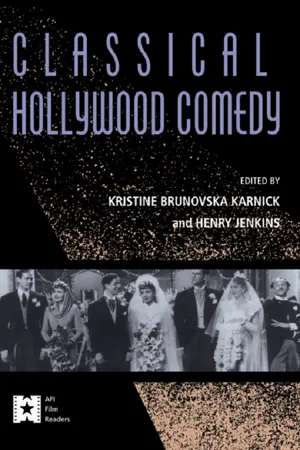
Classical Hollywood Comedy
About this book
Applies the recent `return to history' in film studies to the genre of classical Hollywood comedy as well as broadening the definition of those works considered central in this field.
Information
1
A Spanner in the Works?
Genre, Narrative and the Hollywood Comedian
As a genre, Hollywood comedian comedy differed from mainstream fiction films in one important respect:1 comedian-centered films were not organized simply in accordance with the narrative-based aesthetic of classical cinema.2 They exhibit, instead, a combination of fiction-making and performative entertainment spectacle. In these films, aspects of the classical representational paradigm coexist with a presentational mode of attraction that has its roots in such variety forms as vaudeville and burlesque.3 My main concern here is with a distinct period in the history of the genre: the late 1930s to the early 1960s. In the comedian films of this period, the twin demands of representation and presentation are articulated and contained within a stable and predictable formal mode. This formal mode suited and was generated by the demand of the Hollywood film industry for product standardization, following the destabilizing effects of the introduction of sound. Compared to other genres, the standardization of the comedian comedy came comparatively late. (It is a curious fact that comedian comedy has always been slower than other genres to fall in line with industrial practices of standardization.)
In relation to earlier comedian comedies, the films produced from the late 1930s to the early 1960s reveal a greater degree of consistency in formal organization, regardless of the particular talents on display. Because these films gave a definite form and shape to the genre during this period, I will refer to them as formalized comedian comedies. The history of the genre is not simply a history of individual creative performers: the star comedians operated within specific formal contexts that were in themselves determined by the institutional and industrial context of Hollywood cinema.
Hollywood Comedian Comedy: Historical Forms
Gag-based slapstick comedy began to be channeled into comedian-centered comedy with the exploitation of the star performer in the 1910s. Besides foregrounding dynamic chase sequences and the spectacular choreography of thrown pies, Mack Sennett’s influential Keystone studios recruited comic performers from vaudeville, circus, pantomime and British music hall. Peter Kramer has suggested, however, that the Keystone shorts of the 1912 to 1916 period—featuring star comedians like Mabel Normand and Roscoe “Fatty” Arbuckle—focused “on comic action rather than on the characterization of its protagonists.”4 It is only later, Kramer argues, that comic performers emerge as the organizing force within gag-based comedy:
Slapstick “comedian comedies” of the late ’teens and early ’20’s [were] more exclusively concerned with the character and performance of the star comedian than early slapstick, differentiating his/her status and performance from that of all the other actors, thus turning the star into the film’s main attraction.5
Centralizing the star performer in slapstick comedy was one move towards greater formal stability. A further significant factor was the innovation of the comedian-centered feature film. Early feature narratives, of the 1910 to 1915 period, tended to draw upon the structural models provided by literature and drama. The majority of film comedians, however, were experienced in performance contexts more readily suited to the short film format (the variety act was similar in length to the comedy short—from eight to twelve minutes). After the feature film was standardized as the dominant form of cinematic product, comedian-centered films remained ghettoized within the “confines” of the short. Consequently, they suffered from a relatively inferior status, playing as supporting attractions rather than the principal draw (Chaplin’s shorts being the most famous exceptions).
The transition from the gag-based short to feature-length narratives was a major and difficult step for the established film comedians—although their films did increase gradually in length. As Steve Neale has suggested, the 1920s features of Charlie Chaplin, Buster Keaton and Harold Lloyd were transitory hybrids produced in response to changing conditions of industrial practice and economic profitability:
features were privileged over shorts at the points both of production and exhibition, and features earned more money … these films are a specific and unstable combination of slapstick and narrative elements rather than the final flowering of an authentic slapstick tradition, which is how they have generally tended to be seen.”6
There were two significant formal paradigms in the feature-length comedian comedies of this time: (a) the Keystone films starring Ben Turpin; and (b) the feature films of Harold Lloyd, which combined slapstick comedy with a form of “genteel” comedy.7 Extending a form already established in the Keystone shorts, Turpin vehicles such as Down on the Farm (1920), A Small Town Idol (1921) and The Shriek of Araby (1923) were slapstick parodies of contemporary (melo)dramatic or adventure films, and, as such, they were able to borrow and exploit an already formulated narrative framework. Harold Lloyd’s major feature films of the 1920s, by contrast, are a much smoother, more integrated blend of gags and narrative. Lloyd’s most successful screen persona (the “glasses” character) differs substantially from the physical grotesques and social outcasts who populate the Keystone comedies. Unlike Chaplin’s Tramp figure, which was the model for Lloyd’s earlier “Willie Work” and “Lonesome Luke” personas, the “glasses” character actively seeks social integration, and is not so readily barred from it. In films like Safety Last (1923), Girl Shy (1924), The Freshman (1925) and The Kid Brother (1927), the Lloyd figure overtly aspires to upward mobility, a wish that is given literal expression when he scales a skyscraper in Safety Last. Moreover, he possesses no insurmountable physical or psychological handicap that will ultimately frustrate the realization of his goals—attaining success, esteem and the love of a woman. Through determination, hard work and initiative Lloyd’s hero proves himself and becomes accepted.
This drive towards integration is reflected by the structure of Lloyd’s films: gags tend to arise from the narrative rather than competing with it. Both the status of Lloyd-as-comedian and the gags themselves are “naturalized” within a narrative process. Lloyd plays down his character’s misfit connotations, and the films also downplay his special status as a comic performer, laying far more stress upon his role as a character. In their feature films of the 1920s, Chaplin, Keaton and Lloyd all accommodated themselves to the principles of “genteel” social comedy, while more traditional forms of slapstick comedy remained prevalent in the subsidiary realm of the short film.8
However, the innovation and standardization of the sound film resulted in a renewed and concerted exploitation of performative comedy by the Hollywood studios.9 In their drive to capitalize upon the novelty attraction of sound in the late 1920s and early 1930s, Hollywood film companies recruited many of the top Broadway and vaudeville performers, including Burns and Allen, Olson and Johnson, Jack Benny, Eddie Cantor, Wheeler and Woolsey, W.C. Fields, Joe E. Brown and Ed Wynn. The short format served as the initial framework for many of these performers. Hollywood also exploited these stage comedians in other contexts: in feature-length comedian comedies centered upon such performers as the Marx Brothers and Wheeler and Woolsey; in revue films that brought together a range of musical and comedy performers (for example, The Hollywood Revue of 1929; New Movietone Follies of 1930); and in what Henry Jenkins has termed showcase films (Paramount’s Big Broadcast series (1932–38) and International House (1933)), where comic and musical performance sequences are embedded within a slender narrative.10
Jenkins defines the most distinctive form of feature-length comedian centered film in this period as “anarchistic comedy.”11 The films of Wheeler and Woolsey and the Marx Brothers represented a shift away from the genteel slapstick mode dominant in the feature comedies. Where the films of Chaplin, Lloyd and Keaton seek to integrate comic performance and narrative, the anarchistic films present a “highly fragmented and disruptive style of comedy.”12 For example, the Marx Brothers’ films from The Cocoanuts (1929) to Duck Soup (1933) show a determined resistance to principles of narrative integration. In each instance, plot continuity is dissipated rather than consolidated from scene to scene. The gangster/kidnap narrative of Monkey Business (1931) and the political conspiracies of Duck Soup, for example, develop in a haphazard, seemingly impromptu manner, with little regard for “classical” norms of motivation and causality. The comedians function as invaders of the diegetic world. Significantly, there is no attempt to establish stable, unified, character identities for them.
Anarchistic comedian comedy was inevitably short-lived, as these films were the products of a transitional period in which established norms were momentarily destabilized. The anarchistic films of the early 1930s were superseded later in the decade by a more standardized brand of comedian centered film.13 This increased generic standardization was motivated by the declining box office revenues from the anarchistic films in the mid-1930s, “a decline which the trade press attributed to the overexposure of their comic stars and their failure to produce a consistently high quality product.”14 The Hollywood studios responded either by releasing these comic performers or by demanding “greater conformity with classical storytelling conventions.”15 The most famous example is what happened to the Marx Brothers: Paramount dropped them after the box office failure of Duck Soup, and MGM signed them for A Night at the Opera (1935), a film that situates the comic performance of the team within the structural conventions of a musical comedy plot and set the model for subsequent vehicles. In the Marx Brothers’ MGM films, the move towards “formalization” resulted in a more emphatic ordering of their “disruptive” comic performance in relation to a clearly defined narrative process. Groucho, Chico and Harpo Marx operate as figures who are peripheral to the narrative—they are not protagonists. In this sense, films like A Night at the Opera and A Day at the Races (1937) differ significantly from the formalized star vehicles of Bob Hope, Danny Kaye and the team of Dean Martin and Jerry Lewis. For example, in A Night at the Opera, the Marx Brothers cooperate with the romantic plot, in that they machinate to bring Rosa (Kitty Carlisle) and Ricardo (Allan Jones) together, but they are not fully bound by this plot, and have no deep personal stake in it. They are able to shift from disruptive to avuncular presences, circulating around the romance plot, but never overwhelming it. The comic subplot between Otis B. Driftwood (Groucho Marx) and Mrs Claypool (Margaret Dumont) introduces a parodic romance, but this in itself is not allowed to contaminate the Rosa-Ricardo love story.
As suggested earlier, the comedian comedies of the late 1930s to the early 1960s provided a standardized framework that suited the demands of the oligopolistic structure of the classical Hollywood film industry. The star vehicles of such comedians as Hope, Kaye, Red Skelton and Martin and Lewis provided a familiar and predictable combination of fiction-making and entertainment spectacle/comic performance.
From the late 1950s, the genre experienced substantial reorientations as Hollywood’s established mode of production was subjected to widespread transformations. One of the results was the eccentric self-directed work of Jerry Lewis, which inflated the customary procedures of the formalized comedies beyond recognition.16 Another development was the dispersal of “personality” found in epic slapstick spectacles like It’s a Mad Mad Mad Mad World (1963), The Great Race (1965), Those Magnificent Men in Their Flying Machines (Britain, 1965) and Monte Carlo or Bust / Those Daring Young Men in Their Jaunty Jalopies (Britain-France-Italy, 1969). Unlike comedian comedies, these grandiose chase narratives are not unified by a central comic presence. Instead, they feature a range of performers who literally compete for the central focus. This range includes comedians like Peter Cook and Dudley Moore, Jerry Lewis, The Three Stooges, Milton Berle and Phil Silvers; situational comedy performers like Jack Lemmon, Tony Curtis, Terry-Thomas; and such dramatic actors as Spencer Tracy, George Macready and Stuart Whitman. The sustaining principle, then, is the competition between opposed modes of performance and spectacle. More recent trends offer a similar displacement of gag comedy away from the unifying presence of the comedian. For example, there are the team-based films of the National Lampoon and Police Academy series, and the scattershot generic burlesques of Zucker/Abraham/Zucker (the Airplane and Naked Gun films; Top Secret!, 1984; Hot Shots, 1991). The central presence of Naked Gun: From the Files of Police Squad (1988) and Naked Gun 2: The Smell of Fear (1991) is Leslie Neilsen, who is not so much a comedian as a perpetually befuddled straight-man.
It seems that since the breakdown of classical Hollywood, the attractions previously presented by the genre of comedian comedy have been dispersed across a range of contrasting forms. There have been few prominent film comedians over the last 20 years.17 Woody Allen specialized in gag comedy from the late 1960s to the mid-1970s (for example, Take the Money and Run (1968), Bananas (1971), Sleeper (1973)), but then shifted to “neurotic” romantic comedy (Annie Hall (1977), Manhattan (1979)), and subsequently to the more idiosyncratic auteurist films (Zelig (1983), September (1987), Crimes and Misdemeanors (1989)). Steve Martin’s “crazy” comedy (The Jerk (1979), Dead Men Don’t Wear Plaid (1982), The Man With Two Brains (1983)) has also been followed by more emphatically situational comedy (Roxanne (1987), Dirty Rotten Scoundrels (1988), Parenthood (1989), L.A. Story (1990...
Table of contents
- Cover Page
- Half Title Page
- AFI Film Readers
- Title Page
- Copyright Page
- Contents
- Acknowledgments
- Introduction Golden Eras and Blind Spots—Genre, History and Comedy
- Two Traditions
- Narrative
- Performance
- Ideology The Case of Romantic Comedy
- Notes
- Index
- List of Contributors
Trusted by 375,005 students
Access to over 1.5 million titles for a fair monthly price.
Study more efficiently using our study tools.
Frequently asked questions
Yes, you can cancel anytime from the Subscription tab in your account settings on the Perlego website. Your subscription will stay active until the end of your current billing period. Learn how to cancel your subscription
No, books cannot be downloaded as external files, such as PDFs, for use outside of Perlego. However, you can download books within the Perlego app for offline reading on mobile or tablet. Learn how to download books offline
Perlego offers two plans: Essential and Complete
- Essential is ideal for learners and professionals who enjoy exploring a wide range of subjects. Access the Essential Library with 800,000+ trusted titles and best-sellers across business, personal growth, and the humanities. Includes unlimited reading time and Standard Read Aloud voice.
- Complete: Perfect for advanced learners and researchers needing full, unrestricted access. Unlock 1.5M+ books across hundreds of subjects, including academic and specialized titles. The Complete Plan also includes advanced features like Premium Read Aloud and Research Assistant.
We are an online textbook subscription service, where you can get access to an entire online library for less than the price of a single book per month. With over 1.5 million books across 990+ topics, we’ve got you covered! Learn about our mission
Look out for the read-aloud symbol on your next book to see if you can listen to it. The read-aloud tool reads text aloud for you, highlighting the text as it is being read. You can pause it, speed it up and slow it down. Learn more about Read Aloud
Yes! You can use the Perlego app on both iOS and Android devices to read anytime, anywhere — even offline. Perfect for commutes or when you’re on the go.
Please note we cannot support devices running on iOS 13 and Android 7 or earlier. Learn more about using the app
Please note we cannot support devices running on iOS 13 and Android 7 or earlier. Learn more about using the app
Yes, you can access Classical Hollywood Comedy by Kristine Brunovska Karnick,Henry Jenkins in PDF and/or ePUB format, as well as other popular books in Media & Performing Arts & Film & Video. We have over 1.5 million books available in our catalogue for you to explore.