![]()
1
THE CLOTHING OF WOMEN
Auferimur cultu; gemmis auroque teguntur / Omnia; pars minima est ipsa puella, sui.
We are transported by fashion; all things are covered by gems and gold; the smallest part is the girl herself.
(Ov. Rem. 343–4)
The ancient literary sources present difficulties for the study of female clothing, inasmuch as the ancient authors tend to mention male rather than female clothing when they mention it at all. Still, some useful information may be gleaned from literary references. Of course, the way in which an author characterized female adornment depended very much on his (or in rare cases, her) rhetorical purpose in writing: the majority of classical authors who reproached women for adornment were moralists such as the elder Seneca, and the majority of those who praised female ornamentation were erotic poets, such as Ovid. Such strategies aside, it is nonetheless interesting to note that some Roman moralists do acknowledge the aesthetic worth of the adorned woman, and that some of the authors whom we would expect to be most approving actually do censure female adornment. These similarities among these authors illuminate, in general terms, what female adornment was intended or expected to do in Roman society.
Women's clothing was ideally bound up with notions of honour and ideals of relations between the sexes, and then as now played an important part in the cultural construction of sexual categories: gender-specific clothing and adornment formed the normal aesthetic codes for men and women. Although male and female clothing at Rome was similar in basic design, women's appearance was recognizably female: women clearly had a separate normal (and normative) style of clothing from that of men. Thus the Digest states that women's clothes are those which “a man cannot easily use without incurring censure” (vituperatione; 34.2.23.2; and see Bartman 1999: 40). Quintilian remarks that “men would be disfigured by necklaces, pearls, and long dresses, for these are the ornaments of women; nor would the costume of a triumphant general … be appropriate for a woman” (ut monilibus et margaritis ac veste longa, quae sunt ornamenta feminarum, deformentur viri, nec habitus triumphalis … feminas deceat; Inst. 11.1.3). Excessive adornment on the part of one sex and not the other also served to emphasize gender differences: the use of cosmetics, color, and jewelry in addition marked women off from men. But such elements of surface trimming also constructed them as female: by these items women defined their sexual and social selves and helped to create the idea of femininity prevalent at Rome. Ostentation was properly and peculiarly woman's sphere (Tert. Cult. 1.2.1).
Clothing had other serious functions as well. Female dress in Roman antiquity ideally marked a woman's rank and status, sexual as well as social, and displayed the characteristics of her role in marriage and society. A woman muffled in certain kinds of all-enveloping clothing, for instance, showed herself chaste and upright. Women who were located outside of a particular class, or those who consciously rejected the beliefs and values of a class, were supposed to fall outside its sartorial norms as well. But many of the details of female dress in the literary sources are prescriptive: the discourse on clothing often specified an ideal moral system, not necessarily social practice, and I try to comment fully both on this prescription and on the disjunction between the literary and the artistic evidence for female clothing.
On a more pragmatic and descriptive level, I collect here the available literary evidence for types and items of female clothing. The use of discrete categories (girl, wife, bride, etc.) in the description and elucidation of clothing items, such as those below, is misleading inasmuch as it implies there were isolated kinds of appearance. Sartorial categories in fact bled into one another in antiquity, as is shown in part by the fact that many items of feminine clothing and ornament crossed economic and social boundaries: appearance was fluid, unstable, and adaptable. Much of what follows, then, is a description of ideal or normative appearance.
Women's colors1
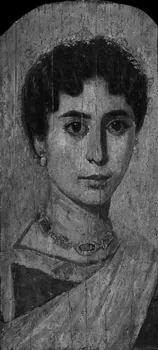
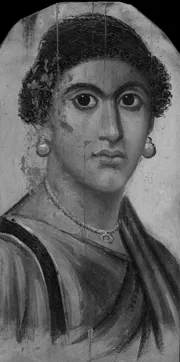
Considerations of space unfortunately preclude any detailed description of fabric and dyeing in antiquity or any significant engagment with Roman or Mediterranean textiles.2 We can, however, make a few general statements. Rome was a sartorially conservative society, and the basic shape of female clothing (long tunic and palla) did not change for centuries. But women had more leeway than men did in the dyeing and ornamentation of their clothing. It is often difficult for modern scholars to picture Roman antiquity as a world of colorful and showy cloth and garments. Marble sculpture preserves few of the clothing tints available to the women in Roman antiquity (although these may be discerned to a certain extent in Roman painting and mummy portraits, such as Figures 1.1 and 1.2,3 but literary references to the kaleidoscope of colors are numerous.
Plautus (Epid. 230–5) mentions sky-blue (caesicius), marigold-yellow (caltula), red-orange (crocotula), sea-blue (cumatilis), walnut brown (carinus), and waxy or pale yellow (cerinus).4 Ovid, writing two hundred years later (Ars 3.169– 92), begs women not to wear purple continually,5 and suggests instead colors that complement the complexion: sky-blue (aer), sea-blue (unda), golden (aureus), yellow (croceus), wax-yellow or pale yellow (cereus), dark green (Paphiae myrti), amethyst (purpurae amethysti), pale pink (albentes rosae), gray (pullus), acorn or dark brown (glandes), and almond-coloured or beige (amygdala). There are many more colours, he says, that he could name, as many as the flowers that bloom in the spring.6 White as a color for women is not in fact mentioned very often.7 Women's garments could also be multicolored. Apuleius speaks of a woman's “bright robe” (vestis florida), and women's clothes are sometimes described as versicolori, of many or varied colours (Met. 7.8 and 8.27; see also Livy 34.1.3; Petr. Satyr. 131; Artem. 2.3; Tert. Cult. 1.8.1–2; and below).
Figure 1.1 Gilded mummy portrait of a woman, 160–170 CE, probably from er-Rubayat, Egypt. British Museum, London. Photo: British Museum/Art Resource, NY: ART179629.
Although women had a wide range of hues for their clothing, some authors did not consider purple seemly for women, probably because of the strong status implications involved (e.g. Pl. Most. 289). But Caesar's restrictions on purple (Suet. Iul. 43) assumes women wore the color often (and see Ovid, above). Certain garish colors, such as greenish-yellow (galbinus) and cherry-red (cerasinus) were deemed lower-class, at least by the elite, and Fortunata appears in them in Petronius’ Satyricon (67). A bright-green dinner-dress (prasina synthesis) is given to a mistress at Martial 10.29.4, and Photis’ girdle is russeus, bright red (Apul. Met. 2.7); these also may be instances of lower-class hues.8
Some colours were associated almost exclusively with women: violet, for instance (amethystinus; see Mart. 1.96.7; André 1949: 196–7), and yellow.9 Pliny reported that yellow was the earliest color to be highly esteemed, but as it was granted as an exclusive privilege to women for their bridal veils, it was not included among the “the principal colors” (principales) (Nat. 21.46).10 This color strongly denoted clothing as female, and a man who wore a yellow garment risked being branded as effeminate (Cic. Hars. 44; see also Var. L.7.53; Juv. 6 O22). When Juvenal describes the clothing of such men “at home,” he chooses what are presumably also feminine colours and patterns: caerulea scutulata, blue checks or diamond shapes, and galbina rasa, smooth green.11 In Apuleius’ piece of the same nature, the men wear varicoloured garments, or yellow ones, or white tunics decorated with purple designs, and yellow shoes (Met. 8.27; Dig. 34.2.32.7). Such passages would be meaningless unless the clothing described was conventionally held to be feminine. Men ideally wore a natural wool toga, white if they were canvassing, black or gray if they were in mourning.12 The status hues of scarlet and purple were part of the masculine sartorial sphere, but, as in nineteenth-century France and England, “black, white, and grey, the very negation of colour, were the paradigm of dignity, control, and morality” and thus were the everyday color of male garments: the greater part of the rainbow was left to women.13
Figure 1.2 Mummy portrait of a woman, 55–70 CE, from Hawara, Egypt. British Museum, London. Photo: British Museum/Art Resource, NY: ART307519.
Women's fabrics: coan silk
Silk is the fabric most closely associated with women in antiquity, and a type called Coan silk was common enough (or outrageous enough) to be mentioned in many different genres of literature. This was a transparent stuff originally woven by women on the island of Cos: Pliny the Elder gave credit for the invention of Coan silk to one Pamphile “who has the undeniable distinction of having devised a plan to reduce women's clothing to nakedness” (non fraudanda gloria excogitatae rationis ut denudet feminas vestis; Nat. 11.76; see Vons 2000: 356–9). Using Aristotle's Historia Animalium and the comments of Pliny, scholars have suggested that the Coan material is wild or tusseh silk, “made from two moths: the Pachypasa otus and the Saturnia pyri.”14
The infamous vestes Coae were worn by women of doubtful reputation (Prop. 4.2.23). The younger Seneca congratulated his mother Helvia for not having worn this material: “never have you fancied the kind of dress that exposed no greater nakedness by being removed” (numquam tibi placuit vestis, quae nihil amplius nudaret, cum poneretur; Helv. 16.4)....