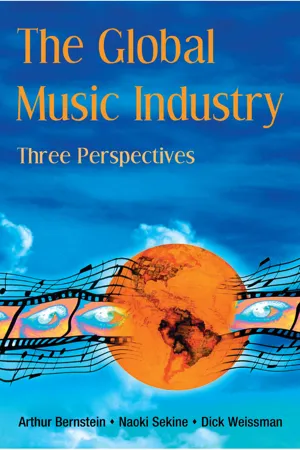
For everyone in the music industry—record labels, managers, music publishers, and the performers themselves—it is important to understand the world music marketplace and how it functions. Yet remarkably little has been written about the music business outside of the U.S. The Global Music Industry: Three Perspectives gives a concise overview of the issues facing everyone in the international music industry. Designed for an introductory course on music business, the book begins with an introduction to the field around the world, then focuses on global issues by region, from bootlegging and copyright to censorship and government support. It will be a standard resource for students, professionals, and musicians.
- 304 pages
- English
- ePUB (mobile friendly)
- Available on iOS & Android
eBook - ePub
About this book
Information
CHAPTER 1
Introduction
It is a bit of a mystery to us why there is currently no book available that deals with the music industry as a global phenomenon. There are several dozen books about the American music industry and a half dozen on the music business in England, and a recent volume deals with the Australian music business. The groundbreaking book Big Sounds from Little People: The Music Business in the Third World by Krister Malm and Ralph Wallis deals with the music industry in the third world. The book is now twenty years old, and no one has followed up this work, other than the same authors, who published a much less ambitious volume several years later. There are a dozen or so generally academic books that discuss the relationship between music and politics. Many of these books are fascinating, dealing with such matters as the underground transmission of rock and roll in communist countries, but they seldom are very specific about the business aspects of the industry.
We included the subtitle “Three Perspectives” because we not only cover different areas of the world but truly do have three different perspectives. We have each written according to our own style, with our own voice. It is interesting to note that our writing styles depict something of the music industry. The more informal tone in the chapters regarding the United States is, in fact, indicative of the more casual business environment, whereas the presentation of material in the chapters regarding Asia and Europe properly suggests more formal work relationships.
At the time of publication we are in the middle of the first decade of the twenty-first century. The record business really dates back to the early twentieth century, so it is only a hundred years old. During this time many profound changes have taken place. From a technological standpoint we have moved from cylinders to 78-RPM records, the long-playing record, eight-track tapes, cassettes, the aborted compact cassettes, the compact disc, enhanced compact disc, CD-ROMs, DVDs, and two-sided CDs that contain a CD side and a DVD side.
Along the way we have graduated from “direct to disk recording” to the use of analog tape and various digital formats, such as A DAT tapes and Pro Tools. Many early recordings were done on location, wherever the artists were living, rather than in recording studios as such. These settings ranged from folkloristic recordings done in prisons, at work sites, or in people’s homes to rented hotel rooms and radio stations. By the 1930s many record companies had built expensive and large studios and used those facilities to record their artists. Although field recordings continued to be done by folklorists, and still are, in most instances record companies preferred to use their own stationary facilities. Prior to the introduction of multitrack recording, all recording sessions were done live, with singers and musicians working at the same time. The master recording was made direct to disk, and a simple mistake, such as an incorrect bass note, could require a large orchestra to record the same material over and over again.
Multitrack recording began during the 1950s, pioneered by guitarist Les Paul and Mitch Miller. It was initially done by recording a piece over and over on different machines in a process called overdubbing, and as the number of available tracks proliferated, parts were recorded, often separately, on a single multitrack machine. By the time sixteen and twentyfour tracks had become available, artists were essentially compelled to use expensive urban facilities that were either owned by the companies or rented by them. Because of this high-level technology, most of these studios were located in such large cities as New York, London, Paris, Tokyo, and Los Angeles.
When rock and roll became an important part of the record business, musical accuracy was often sacrificed to powerful rhythms and performances that focused on emotion rather than on technical musical excellence. Of course in popular music this had always been the case to some extent, but it was accentuated in rock-and-roll records. In the early Elvis Presley records, for example, the musical content of the recordings is generally simple, but the energy and emotion communicated are profound. As a consequence the music began to be recorded in places such as Memphis or New Orleans, cities large enough to have recording facilities but far from the headquarters of the major record companies. Initially rock and roll was primarily an American phenomenon, but the British bands, notably the Beatles, the Rolling Stones, and Led Zeppelin, quickly converted what was a phenomenon based on a marriage of American roots music styles into what by now is a worldwide vocabulary.
By the end of the 1960s the smaller early American music centers had declined, and the American music business was headquartered in New York and Los Angeles, with the relatively new country music center of Nashville on the rise. Although many British rock-and-roll bands came from such cities as Liverpool and Newcastle, in England the London studios prevailed. In India the music scene became, and to a large extent remains, connected with the “Bollywood” movie industry, which centers in Mumbai (Bombay).
Each country or area of the world has its own indigenous musical styles and tastes. One of the many revolutionary aspects of the Beatles’ music was that they brought Indian music to worldwide attention. The Rolling Stones and Led Zeppelin also plowed this ground, integrating Middle Eastern and North African music styles into their music. At the same time some new pop music styles arose and spread far beyond their origins. Reggae, born in Jamaica, was one example. One man, Chris Blackwell, was largely responsible for the spread of the music, turning Jimmy Cliff and, even more notable, Bob Marley into worldwide superstars. Many of the sidebars of rock and roll, such as art rock and punk rock, owe their origins to British rock bands. Salsa is a musical style that arose in New York and resulted from the large Puerto Rican and Cuban exodus to New York City and Miami. Heavy metal music developed in New York and London, and Bhangra rock is a musical style that fused rock-and-roll music with Indian musical idioms. It is particularly popular in London and has been exported to India. Bhangra is also partly a function of the large-scale immigration from India and Pakistan to England. Dance music has been particularly popular in Germany, and Europe in general has been active in the electronic pop music, which is synthesizer driven.
African American musical styles became increasingly important not only in the United States but also internationally. Among these styles were rhythm and blues, which evolved out of a combination of folk-blues and band styles, followed by soul music, which added gospel music vocal stylings to the mix. During the 1980s rap music began to emerge as an important musical style, which remains today. Rap music has developed in many seemingly unlikely places. In North America there are American Indian rap groups, Chicano rap groups, and even Chinese rappers. Of course foreign-language rappers have appeared in various parts of the world.
Experiments in integrating the music of different cultures into pop music were occurring as early as the Weavers’ folk-pop recordings of the early 1950s, notably the South African song “Wimoweh,” a hit recording not only in their version but also in a slightly rewritten American version called “The Lion Sleeps Tonight.” Paul Simon’s Graceland album of 1986 integrated South African music into American pop, with worldwide success and repercussions. Peter Gabriel and David Byrne each started record labels devoted to world music styles, and world music assumed a place in record bins and record-company advertising. It has never been entirely clear what world music is; as publicized it appears to involve integrating the music of various cultures into a pop framework, so that musicians from different cultures play their musical styles together. Musical styles that were once restricted to a particular area and culture, such as Hawaiian slack-key guitar, become combined with other musical styles in a way that might have been regarded as unimaginable twenty years ago. American musicians such as Bob Brozman, Ry Cooder, Corey Harris, Henry Kaiser, Taj Mahal, and David Lindley have played with musicians from Africa, Norway, Hawaii, and India.
The emergence of musical hybrids is a never-ending process, and the latest flavor is reggaeton, a Panama-originated fusion of reggae, Jamaican dancehall, American rap, and varied helpings of other Latin rhythm patterns.
Music and Censorship
In some instances the migration of musical styles had roots in political situations. For example, the Algerian rai music scene grew and developed in Paris, which has a large Algerian population. The music was heavily discouraged by the Algerian government, because Algeria is a fundamentalist Muslim country that considered rai to be suspect and tinged with immoral sentiments.
African music also frequently included political sentiments that displeased many of the local governments. The music and lifestyle of Afro-pop artist Fela Kuti proved troublesome to the Nigerian government. They invaded his communal compound, incensed at his open political opposition to the government and his offbeat lifestyle of polygamy and open drug use. South Africa had its own system of musical censorship, and the government refused to play music that even suggested any opposition to apartheid, prior to the current political leadership of Nelson Mandela. Some musicians, such as Hugh Masakela, went into voluntary or forced exile in the United States or England.
A similar situation prevailed in Chile, where singer–songwriter Victor Jara was murdered by the fascist Pinochet regime, and the group Quilipayun fled to Paris. Brazil also undertook musical censorship, and Gilberto Gil and Caetano Veloso were exiled in England for several years in the late 1960s.
At various times musicians in the United States have also had their bouts with censorship. During the McCarthy period of the 1950s, musicians suspected of connections to the Communist Party were banned from television, through the efforts of a magazine called Red Channels. The Weavers lost their recording contract with Decca, had their records taken off the radio, and were picketed in live performances for their alleged radical ties. Two members of the group were threatened with prison after appearances before the House Un-American Activities Committee, and the group’s career was effectively diminished if not demolished.
In more recent years American censorship has revolved around so-called moral issues, the use of four-letter words, and misogynist records advocating violence against women or the use of drugs. A women-led parental music group, the Parents’ Music Resource Center (PRMC), advocated putting stickers on records that use sexually charged words. Some of the early political rap artists were censored on political grounds, notably artist Ice-T for his song “Cop Killer,” which created a storm of protest among police officers and led to the artist’s losing his contract with Warner Brothers.
In some other countries, notably Singapore, the government strongly controls what sort of music is played on the radio. American readers need to understand that in most countries of the world, radio is controlled by the government, so this sort of control is much easier to exercise there than it is in the United States, with its thousands of radio stations. Chinese media are under tight government control, and music clips played on TV must be approved for broadcasting. Korean media, because of the historical conflict between Korea and Japan, are still reluctant to play Japanese music on radio and TV, although broadcasting J-pop is not prohibited in the Korean market. Malaysia and other countries that have even a modest number of Islamic people try to limit the broadcasting of video clips that show men smoking cigarettes or women in bikini swimsuits.
Another example of censorship is the fines levied against a French rap group for slandering the police. In Cuba the government controls the music scene because it offers employment and even a comparative amount of economic security to musicians by controlling where and under what terms musicians can work.
Government Encouragement of Local Music
In a number of countries the government has taken steps to promote the national music industry. There are two fundamental approaches that governments have taken. One approach is to make some sort of investment in the field of popular music, and the other approach is to exercise some control over what is played on the radio. In England, for example, the government uses music as a training tool for unemployed youth as a way of combating unemployment. In Canada the government realized that American records were flooding the Canadian airwaves, so they instituted the Canadian Content Laws. These rules required radio stations to give 35 percent of their airtime to Canadian records. These recordings were defined as having two of three Canadian elements: songwriters, producers of the record, and artists. France requires a certain percentage of programming that is in the French language. This i...
Table of contents
- Cover
- Half Title
- Title Page
- Copyright Page
- CONTENTS
- About the Authors
- 1 Introduction
- 2 The Music Business in the United States
- 3 The Music Business in Canada
- 4 The Music Business in Latin America and the Caribbean
- 5 The Music Business in Africa
- 6 The Music Business in Europe
- 7 The Music Business in Asia
- Conclusion: Loose Ends, Final Thoughts, and the Future
- Index
Trusted by 375,005 students
Access to over 1.5 million titles for a fair monthly price.
Study more efficiently using our study tools.
Frequently asked questions
Yes, you can cancel anytime from the Subscription tab in your account settings on the Perlego website. Your subscription will stay active until the end of your current billing period. Learn how to cancel your subscription
No, books cannot be downloaded as external files, such as PDFs, for use outside of Perlego. However, you can download books within the Perlego app for offline reading on mobile or tablet. Learn how to download books offline
Perlego offers two plans: Essential and Complete
- Essential is ideal for learners and professionals who enjoy exploring a wide range of subjects. Access the Essential Library with 800,000+ trusted titles and best-sellers across business, personal growth, and the humanities. Includes unlimited reading time and Standard Read Aloud voice.
- Complete: Perfect for advanced learners and researchers needing full, unrestricted access. Unlock 1.5M+ books across hundreds of subjects, including academic and specialized titles. The Complete Plan also includes advanced features like Premium Read Aloud and Research Assistant.
We are an online textbook subscription service, where you can get access to an entire online library for less than the price of a single book per month. With over 1.5 million books across 990+ topics, we’ve got you covered! Learn about our mission
Look out for the read-aloud symbol on your next book to see if you can listen to it. The read-aloud tool reads text aloud for you, highlighting the text as it is being read. You can pause it, speed it up and slow it down. Learn more about Read Aloud
Yes! You can use the Perlego app on both iOS and Android devices to read anytime, anywhere — even offline. Perfect for commutes or when you’re on the go.
Please note we cannot support devices running on iOS 13 and Android 7 or earlier. Learn more about using the app
Please note we cannot support devices running on iOS 13 and Android 7 or earlier. Learn more about using the app
Yes, you can access The Global Music Industry by Arthur Bernstein,Naoki Sekine,Dick Weissman in PDF and/or ePUB format, as well as other popular books in Media & Performing Arts & Music. We have over 1.5 million books available in our catalogue for you to explore.