Because reporting is changing, this volume offers readers a thorough introduction to the rapidly evolving world of gathering information for local news organizations. This easy-to-read text is filled with contemporary examples and solid advice for the beginning reporting student. Designed for students with a foundation in news writing, it provides chapters on such basics as news research, interviewing, and observation skills. It further offers a chapter on the use of personal computers as research and reporting tools. Readers will find useful tips and examples written by award-winning professional journalists that reflect the numerous changes in the art and science of information gathering in the past decade.
- 352 pages
- English
- ePUB (mobile friendly)
- Available on iOS & Android
eBook - ePub
Professional News Reporting
About this book
Information
I INTRODUCTION TO REPORTING
1 Life In The Newsroom
Life as a reporter these days is not easy. But oh, it can be exciting. Take veteran Miami television and newspaper reporter Bonnie Anderson, for example. Her work as a television reporter includes routine crime stories, local politics, and consumer scams. When Iraq invaded Kuwait, she was on a jet headed for Israel and Jordan to get the story for south Florida viewers. She returned after a month. But when war broke out in the Middle East, her station, WTMJ-TV, Channel 4, the National Broadcasting Company (NBC) owned-and-operated station in south Florida, sent Anderson to Saudi Arabia to get the war front story about south Florida soldiers for local viewers. Her stories offered local perspectives of the war in the Persian Gulf not provided by network coverage. She was there another month. Then, as the war ended, she returned to the Middle East, this time to Syria for the peace talks. Her previous experience as a foreign correspondent based in Beirut, Lebanon, for NBC helped her to provide strong, meaningful reporting. She knew local customs and had local contacts. But she also knew how to work safely in a dangerous region. “The random violence is the most dangerous aspect of working there,” she explained. “You have to sleep with one eye open all the time” (B. Anderson, 1991).
Her weeks in a tension-filled region, hand-writing scripts, filing stories by telephone and by satellite, offered opportunities that many young reporters dream about. She had many problems, however, even with her extensive experience in the region. “Restrictions in the various countries are the worst thing,” she said. “Censorship is a big problem in Iraq and in Israel. In Syria, it’s hard to get the pictures, but not hard to feed them,” she explained. “In Israel and Baghdad, a censor will look at the tape you want to feed and if he doesn’t like what he sees, he’ll blackburst (erase) it.” Anderson also said the work is interesting because much of the reporting involves use of anonymous sources. “People are scared. It’s tough trying to talk to people.”
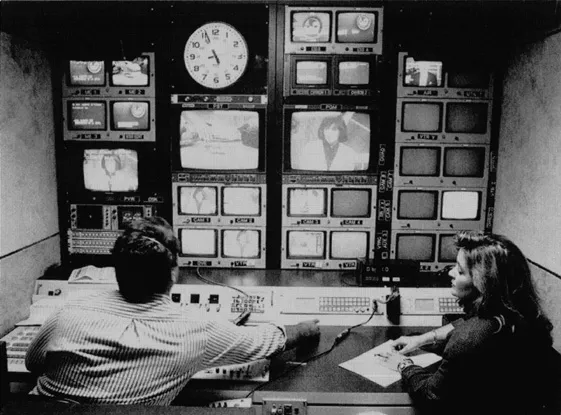
A television director and producer mix sounds and pictures to create their final product (photo by Al Diaz, Miami Herald staff).
American Broadcasting Company (ABC) correspondent Chris Bury is based in Chicago. Bury spends most of his time in the Midwest covering stories such as the Clinton campaign in 1992, other benchmark regional elections, major breaking stories, and even occasional feature stories. But when the war broke out in the Middle East, Bury was dispatched as part of a rotating team of ABC correspondents in Saudi Arabia. Suddenly, he was preparing stories about U.S. troops in the desert. He was unable to spend the Christmas holidays with his family, because of his long-term assignment, but it was a sacrifice he was willing to make to do the job. Bury spent two stints in the Middle East before returning to his routine. But his daily routine would make many people dizzy. Bury often must run for an airplane at O’Hare Airport to cover a breaking story hundreds of miles from Chicago. On the Clinton campaign trail, he would visit a half dozen cities in one day. He’s never quite sure when he will be able to catch up on things.
Associated Press (AP) reporter Sandra Jaramillo Walewski spends part of her time at work in the office as an editor, but she goes out on general assignment as needed. Based in AP’s Miami bureau for 5 years, Walewski takes advantage of her Latin American heritage and bilingual abilities to move in and out of the different cultures of a diverse urban area such as Miami and Fort Lauderdale. She must spend most of her reporting time covering breaking stories, which means she is assigned major announcements at press conferences, visits by national and international figures, crimes and trials, and major traffic or industrial accidents, as well as generating “enterprise” stories and writing an occasional feature story. She also takes to the road when needed, driving to assignments where the news service needs a reporter. In 1991, for example, a 30-year-old woman told police she was sexually assaulted by a member of the Kennedy family at the Kennedy winter home in exclusive Palm Beach, about 80 miles north of Miami. Walewski was dispatched to get the national story for AP. Working with police and tough-to-reach sources within the Kennedy home, she filed her story by dictating over the telephone what she learned on the scene. Her “A” wire story was filed just a few hours after she finished her interviews. Walewski worked primarily with public relations people from the police department and spokespersons representing the Kennedy family, but also had to contend with dozens of competing reporters. “It was unbelievable,” she said, recalling her arrival in Palm Beach the day after the story broke. “Trying to get something unique was difficult. There were too many people all going to the same places. And it was tough because I was not familiar with the town.” Walewski also got help from the major Palm Beach-area newspaper, which frequently exchanges information as part of its arrangement with AP. To complete her story, Walewski talked to Palm Beach residents and tourists to get their reaction, and she added background information about previous incidents involving the Kennedys at Palm Beach, such as the 1984 drug-related death of Robert Kennedy’s son, David. Walewski wrote two versions of the same story, one for morning-cycle news organizations and one for evening-cycle news organizations (Walewski, 1991). Her story is reprinted at the end of this chapter.
When President George Bush visited Tulsa, Oklahoma, in 1990, ABC affiliate KTUL-TV, Channel 8, had on its hands a big story that one reporter alone could not handle. Instead, the station used a team approach, making the most of its 28 news staff members and 15 photographers. The president arrived in the morning, headed to Stillwater to give a speech, and returned to Tulsa late that afternoon just before the early evening newscast went on the air. Anchors introduced stories chronicling the day’s excitement of a presidential visit. First, the president’s commencement address at Oklahoma State University was highlighted. Then viewers saw reports on the president in Tulsa, preparing for an address at the city’s convention center. Switched to reporter Steve Knight at the speech site, viewers were updated on activities and heard a live interview with Oklahoma Democratic Sen. David Boren. This is high-pressure instantaneous television news. “It is hectic, wild and a wonderful place to work,” said Melba Calkins (1990), assistant to KTUL-TV News Director Michael Sullivan. The script of the KTUL-TV 5 P.M. report is reproduced at the end of this chapter.
At CBS affiliate WCCO-TV, Channel 4, in Minneapolis-St. Paul, reporter Darryl Savage was sent one morning to cover what seemed to be a routine fire for the evening newscasts. The fire had destroyed a houseboat moored in the Mississippi River in the middle of the night; firefighters had not been able to get to the scene on time. But the fire raised an even bigger safety issue for residents of the island where the fire occurred. Savage saw the bigger dimension in the story and highlighted this point in his “package.” His story script, reprinted at the end of this chapter, shows a variety of sources needed for this basic television news story: effective video of the fire and the neighborhood, video of the blocked route and bridge, interviews that lead to strong natural sound — the broadcasting term for ambient sound — from witnesses and neighborhood property owners and residents, and informat...
Table of contents
- Cover
- Title Page
- Copyright Page
- Contents
- Foreword
- Preface
- Part I Introduction to Reporting
- Chapter 1 Life in the Newsroom
- Chapter 2 General Assignment and Beat Reporting
- Chapter 3 Developing and Using Sources
- Part II Reporting Techniques
- Chapter 4 Background: Researching News Stories
- Chapter 5 Computer Databases and Document Searching
- Chapter 6 Interviewing Basics
- Chapter 7 Interviewing for Television and Radio
- Chapter 8 Observation Skills
- Chapter 9 Press Conferences, Hearings, Meetings, Conventions
- Part III Reporting Regulation And Controls
- Chapter 10 Law Affecting Reporting
- Chapter 11 News Reporting Ethics
- Part IV Appendices
- Appendix A: Confidential Sources and Anonymity
- Appendix B: Public Information Policy
- Appendix C: A Writers Bookshelf From the Orlando Sentinel
- Appendix D: Code of Ethics of the Society of Professional Journalists
- Appendix E: Code of Broadcast News Ethics of the Radio-Television News Directors Association
- References
- Index
Trusted by 375,005 students
Access to over 1.5 million titles for a fair monthly price.
Study more efficiently using our study tools.
Frequently asked questions
Yes, you can cancel anytime from the Subscription tab in your account settings on the Perlego website. Your subscription will stay active until the end of your current billing period. Learn how to cancel your subscription
No, books cannot be downloaded as external files, such as PDFs, for use outside of Perlego. However, you can download books within the Perlego app for offline reading on mobile or tablet. Learn how to download books offline
Perlego offers two plans: Essential and Complete
- Essential is ideal for learners and professionals who enjoy exploring a wide range of subjects. Access the Essential Library with 800,000+ trusted titles and best-sellers across business, personal growth, and the humanities. Includes unlimited reading time and Standard Read Aloud voice.
- Complete: Perfect for advanced learners and researchers needing full, unrestricted access. Unlock 1.5M+ books across hundreds of subjects, including academic and specialized titles. The Complete Plan also includes advanced features like Premium Read Aloud and Research Assistant.
We are an online textbook subscription service, where you can get access to an entire online library for less than the price of a single book per month. With over 1.5 million books across 990+ topics, we’ve got you covered! Learn about our mission
Look out for the read-aloud symbol on your next book to see if you can listen to it. The read-aloud tool reads text aloud for you, highlighting the text as it is being read. You can pause it, speed it up and slow it down. Learn more about Read Aloud
Yes! You can use the Perlego app on both iOS and Android devices to read anytime, anywhere — even offline. Perfect for commutes or when you’re on the go.
Please note we cannot support devices running on iOS 13 and Android 7 or earlier. Learn more about using the app
Please note we cannot support devices running on iOS 13 and Android 7 or earlier. Learn more about using the app
Yes, you can access Professional News Reporting by Bruce Garrison in PDF and/or ePUB format, as well as other popular books in Lingue e linguistica & Studi sulla comunicazione. We have over 1.5 million books available in our catalogue for you to explore.