eBook - ePub
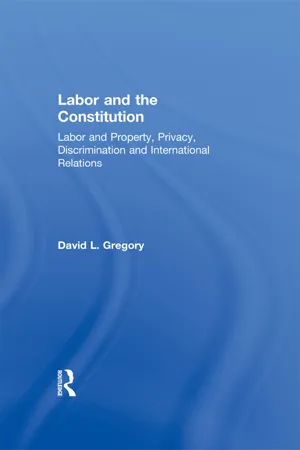
Labor and the Constitution
Labor and Property, Privacy, Discrimination and International Relations
- 367 pages
- English
- ePUB (mobile friendly)
- Available on iOS & Android
eBook - ePub
Labor and the Constitution
Labor and Property, Privacy, Discrimination and International Relations
About this book
First published in 1999. This ongoing series, Controversies in Constitutional Law, provides teachers, scholars, and students convenient access to the debates and scholarly literature surrounding major questions of constitutional law. In the structure of government in the United States the Constitution, the Bill of Rights and other Amendments - especially the Fourteenth Amendment - are the primary referential points to locate, protect, and enhance our fundamental political freedoms. The intersections between Labor Law and Constitutional Law occasionally synergize, but perhaps more often obviate the tensions among, several fundamental freedoms. This first volume will situate and examine the intersections among labor, religion, and speech, the two latter among our most fundamental First Amendment rights.
Information
COMMUNICATIONS WORKERS OF AMERICA ET AL. v. BECK ET AL.
CERTIORARI TO THE UNITED STATES COURT OF APPEALS FOR THE FOURTH CIRCUIT
No. 86–637. Argued January 11, 1988-Decided June 29, 1988
Section 8(a)(3) of the National Labor Relations Act (NLRA) permits an employer and a union to enter into an agreement requiring all employees in the bargaining unit to pay union dues as a condition of continued employment, whether or not the employees become union members. Petitioner Communications Workers of America (CWA) entered into a collective-bargaining agreement that contains a union-security clause under which all represented employees who do not become union members must pay the union “agency fees” in amounts equal to the dues paid by union members. Respondents, bargaining-unit employees who chose not to become union members, filed this suit in Federal District Court, challenging CWA’s use of their agency fees for purposes other than collective bargaining, contract administration, or grievance adjustment (hereinafter “collective-bargaining” activities). They alleged that expenditure of their fees on activities such as organizing the employees of other employers, lobbying for labor legislation, and participating in social, charitable, and political events violated CWA’s duty of fair representation, § 8(a)(3), and the First Amendment. The court concluded that CWA’s collection and disbursement of agency fees for purposes other than collective-bargaining activities violated the associational and free speech rights of objecting nonmembers, and granted injunctive relief and an order for reimbursement of excess fees. The Court of Appeals, preferring to rest its judgment on a ground other than the Constitution, ultimately concluded, inter alia, that the collection of non-members’ fees for purposes unrelated to collective bargaining violated CWA’s duty of fair representation.
Held:
1. The courts below properly exercised jurisdiction over respondents’ claims that exactions of agency fees beyond those necessary to finance collective-bargaining activities violated the judicially created duty of fair representation and respondents’ First Amendment rights. Although the National Labor Relations Board (Board) had primary jurisdiction over respondents’ § 8(a)(3) claim, cf. San Diego Building Trades Council v. Garmon, 359 U. S. 236, the courts below were not precluded from deciding the merits of that claim insofar as such a decision was necessary to the disposition of respondents’ duty-of-fair-representation challenge. Federal courts may resolve unfair labor practice questions that emerge as collateral issues in suits brought under independent federal remedies. Respondents did not attempt to circumvent the Board’s primary jurisdiction by casting their statutory claim as a violation of CWA’s duty of fair representation. Instead, the necessity of deciding the scope of § 8(a)(3) arose because CWA and its copetitioner local unions sought to defend themselves on the ground that the statute authorizes the type of union-security agreement in issue. Pp. 742–744.
2. Section 8(a)(3) does not permit a union, over the objections of dues-paying nonmember employees, to expend funds collected from them on activities unrelated to collective-bargaining activities. Pp. 744–762.
(a) The decision in Machinists v. Street, 367 U. S. 740—holding that § 2, Eleventh of the Railway Labor Act (RLA) does not permit a union, over the objections of nonmembers, to expend agency fees on political causes—is controlling, for § 8(a)(3) and §2, Eleventh are in all material respects identical. Their nearly identical language reflects the fact that in both Congress authorized compulsory unionism only to the extent necessary to ensure that those who enjoy union-negotiated benefits contribute to their cost. Indeed, Congress, in 1951, expressly modeled §2, Eleventh on § 8(a)(3), which it had added to the NLRA by the Taft-Hartley Act only four years earlier, and emphasized that it was extending to railroad labor the same rights and privileges of the union shop that were contained in the Taft-Hartley Act. Pp. 744–747.
(b) Section 8(a)(3) was intended to correct abuses of compulsory unionism that had developed under “closed shop” agreements and, at the same time, to require, through union-security clauses, that nonmember employees pay their share of the cost of benefits secured by the union through collective bargaining. These same concerns prompted Congress’ later amendment of the RLA. Given the parallel purpose, structure, and language of § 8(a)(3) and § 2, Eleventh, both provisions must be interpreted in the same manner. Only the most compelling evidence would support a contrary conclusion, and petitioners have not proffered such evidence here. Pp. 747–754.
(c) Petitioners claim that the union-security provisions of the RLA and NLRA should be read differently in light of the different history of unionism in the regulated industries—that is, the tradition of voluntary unionism in the railway industry prior to the 1951 amendment of the RLA and the history of compulsory unionism in NLRA-regulated industries prior to 1947. Petitioners contend that because agreements requiring the payment of uniform dues were not among the specific abuses Congress sought to remedy in the Taft-Hartley Act, § 8(a)(3) cannot plausibly be read to prohibit the collection of fees in excess of those necessary to cover the costs of collective bargaining. This argument is unpersuasive because the legislative history of § 8(a)(3) shows that Congress was concerned with numerous and systemic abuses of the closed shop and therefore resolved to ban the closed shop altogether; to the extent it permitted union-security agreements at all, Congress was guided—as it was in its later amendment of the RLA—by the principle that those enjoying the benefits of union representation should contribute their fair share to the expense of securing those benefits. Moreover, it is clear that Congress understood its actions in 1947 and 1951 to have placed the respective regulated industries on an equal footing insofar as compulsory unionism was concerned. Pp. 754–756.
(d) The fact that in the Taft-Hartley Act Congress expressly considered proposals regulating union finances but ultimately placed only a few limitations on the collection and use of dues and fees, and otherwise left unions free to arrange their financial affairs as they saw fit, is not sufficient to compel a broader construction of § 8(a)(3) than that accorded § 2, Eleventh in Street. The legislative history of § 8(a)(3) shows that Congress was concerned with the dues and rights of union members, not the agency fees and rights of nonmembers. The absence, in such legislative history, of congressional concern for the rights of nonmembers is consistent with the view that Congress understood § 8(a)(3) to afford nonmembers adequate protection by authorizing the collection of only those fees necessary to finance collective-bargaining activities. Nor is there any merit to the contention that, because unions had previously used members’ dues for a variety of purposes in addition to collective-bargaining agreements, Congress’ silence in 1947 as to the uses to which unions could put nonmembers’ fees should be understood as an acquiescence in such union practices. Pp. 756–761.
(e) Street cannot be distinguished on the theory that the construction of § 2, Eleventh was merely expedient to avoid the constitutional question—as to the use of fees for political causes that nonmembers find objectionable—that otherwise would have been raised because the RLA (unlike the NLRA) pre-empts state laws banning union-security agreements and thus nonmember fees were compelled by “governmental action.” Even assuming that the exercise of rights permitted, though not compelled, by § 8(a)(3) does not involve state action, and that the NLRA and RLA therefore differ in such respect, nevertheless the absence of any constitutional concerns in this case would not warrant reading the nearly identical language of § 8(a)(3) and § 2, Eleventh differently. Pp. 761–762.
800 F. 2d 1280, affirmed.
BRENNAN, J., delivered the opinion of the Court, in which REHNQUIST, C. J., and WHITE, MARSHALL, and STEVENS, JJ., joined, and in Parts I and II of which BLACKMUN, O’CONNOR, and SCALIA, JJ., joined. BLACKMUN, J., filed an opinion concurring in part and dissenting in part, in which O’CONNOR and SCALIA, JJ., joined, post, p. 763. KENNEDY, J., took no part in the consideration or decision of the case.
Laurence Gold argued the cause for petitioners. With him on the briefs were Thomas S. Adair, James Coppess, and George Kaufmann.
Edwin Vieira, Jr., argued the cause for respondents. With him on the brief was Hugh L. Reilly.*
JUSTICE BRENNAN delivered the opinion of the Court.
Section 8(a)(3) of the National Labor Relations Act of 1935 (NLRA), 49 Stat. 452, as amended, 29 U. S. C. § 158(a)(3), permits an employer and an exclusive bargaining representative to enter into an agreement requiring all employees in the bargaining unit to pay periodic union dues and initiation fees as a condition of continued employment, whether or not the employees otherwise wish to become union members. Today we must decide whether this provision also permits a union, over the objections of dues-paying nonmember employees, to expend funds so collected on activities unrelated to collective bargaining, contract administration, or grievance adjustment, and, if so, whether such expenditures violate the union’s duty of fair representation or the objecting employees’ First Amendment rights.
I
In accordance with §9 of the NLRA, 49 Stat. 453, as amended, 29 U. S. C. § 159, a majority of the employees of American Telephone and Telegraph Company and several of its subsidiaries selected petitioner Communications Workers of America (CWA) as their exclusive bargaining representative. As such, the union is empowered to bargain collectively with the employer on behalf of all employees in the bargaining unit over wages, hours, and other terms and conditions of employment, §9(a), 29 U. S. C. § 159(a), and it accordingly enjoys “broad authority…in the negotiation and administration of [the] collective bargaining contract.” Humphrey v. Moore, 375 U. S. 335, 342 (1964). This broad authority, however, is tempered by the union’s “statutory obligation to serve the interests of all members without hostility or discrimination toward any,” Vaca v. Sipes, 386 U. S. 171, 177 (1967), a duty that extends not only to the negotiation of the collective-bargaining agreement itself but also to the subsequent enforcement of that agreement, including the administration of any grievance procedure the agreement may establish. Ibid. CWA chartered several local unions, copetitioners in this case, to assist it in discharging these statutory duties. In addition, at least in part to help defray the considerable costs it incurs in performing these tasks, CWA negotiated a union-security clause in the collective-bargaining agreement under which all represented employees, including those who do not wish to become union members, must pay the union “agency fees” in “amounts equal to the periodic dues” paid by union members. Plaintiffs’ Complaint ¶11 and Plaintiffs’ Exhibit A-1, 1 Record. Under the clause, failure to tender the required fee may be grounds for discharge.
In June 1976, respondents, 20 employees who chose not to become union members, initiated this suit challenging CWA’s use of their agency fees for purposes other than collective bargaining, contract administration, or grievance adjustment (hereinafter “collective-bargaining” or “representational” activities). Specifically, respondents alleged that the union’s expenditure of their fees on activities such as organizing the employees of other employers, lobbying for labor legislation, and participating in social, charitable, and political events violated petitioners’ duty of fair representation, § 8(a)(3) of the NLRA, the First Amendment, and various common-law fiduciary duties. In addition to declaratory relief, respondents sought an injunction barring petitioners from exacting fees above those necessary to finance collective-bargaining activities, as well as damages for the past collection of such excess fees.
The District Court concluded that the union’s collection and disbursement of agency fees for purposes other than bargaining unit representation violated the associational and free speech rights of objecting nonmembers, and therefore enjoined their future collection. 468 F. Supp. 93 (Md. 1979). Applying a “clear and convincing” evidentiary standard, the District Court concluded that the union had failed to show that more than 21% of its funds were expended on collective-bargaining matters. App. to Pet. for Cert. 119a. The court ordered reimbursement of all excess fees respondents had paid since January 1976, and directed the union to institute a recordkeeping system to segregate accounts for representational and noncollective-bargaining activities. Id., at 125a, 108a-109a.
A divided panel of the United States Court of Appeals for the Fourth Circuit agreed that respondents stated a valid claim for relief under the First Amendment, but, preferring to rest its judgment on a ground other than the Constitution, concluded that the collection of nonmembers’ fees for purposes unrelated to collective bargaining violated § 8(a)(3). 776 F. 2d 1187 (1985). Turning to the specific activities challenged, the majority noted that the District Court’s adoption of a “cl...
Table of contents
- Cover
- Title Page
- Copyright Page
- Table of Contents
- General Introduction
- Volume Introduction
- The Constitutionality and Purpose of the Federal Labor Laws
- Labor and Religion
- Labor and Speech
- Acknowledgments
Trusted by 375,005 students
Access to over 1.5 million titles for a fair monthly price.
Study more efficiently using our study tools.
Frequently asked questions
Yes, you can cancel anytime from the Subscription tab in your account settings on the Perlego website. Your subscription will stay active until the end of your current billing period. Learn how to cancel your subscription
No, books cannot be downloaded as external files, such as PDFs, for use outside of Perlego. However, you can download books within the Perlego app for offline reading on mobile or tablet. Learn how to download books offline
Perlego offers two plans: Essential and Complete
- Essential is ideal for learners and professionals who enjoy exploring a wide range of subjects. Access the Essential Library with 800,000+ trusted titles and best-sellers across business, personal growth, and the humanities. Includes unlimited reading time and Standard Read Aloud voice.
- Complete: Perfect for advanced learners and researchers needing full, unrestricted access. Unlock 1.5M+ books across hundreds of subjects, including academic and specialized titles. The Complete Plan also includes advanced features like Premium Read Aloud and Research Assistant.
We are an online textbook subscription service, where you can get access to an entire online library for less than the price of a single book per month. With over 1.5 million books across 990+ topics, we’ve got you covered! Learn about our mission
Look out for the read-aloud symbol on your next book to see if you can listen to it. The read-aloud tool reads text aloud for you, highlighting the text as it is being read. You can pause it, speed it up and slow it down. Learn more about Read Aloud
Yes! You can use the Perlego app on both iOS and Android devices to read anytime, anywhere — even offline. Perfect for commutes or when you’re on the go.
Please note we cannot support devices running on iOS 13 and Android 7 or earlier. Learn more about using the app
Please note we cannot support devices running on iOS 13 and Android 7 or earlier. Learn more about using the app
Yes, you can access Labor and the Constitution by David L. Gregory in PDF and/or ePUB format, as well as other popular books in Diritto & Diritto del lavoro e dell'impiego. We have over 1.5 million books available in our catalogue for you to explore.