Chapter 1
Taking stock
Annual income twenty pounds, annual expenditure nineteen pounds nineteen shillings and sixpence, result happiness. Annual income twenty pounds, annual expenditure twenty pounds and sixpence, result misery.
(Mr Micawber in Charles Dickens’ David Copperfield)
■ Misery!
Many headteachers will be familiar with Mr Micawber’s theory of resource management, particularly those who have limited funds. Some may choose to follow his philosophy of escaping from their problems by waiting for something to turn up. Fortunately they are likely to avoid debtor’s prison, unlike their role model, but the resulting misery of redundancies, shortage of equipment and materials, and consequent local publicity can be nearly as painful.
This book sets out a systematic approach to avoiding such misery by giving you practical tips for improving your management of resources. However, in doing this, we need to take a rather more sophisticated approach to our definition of resource management than Mr Micawber takes. It is not enough that you spend within your budget; you need to consider how you spend your budget. We will challenge you to evaluate whether the objectives of the school are properly reflected in your expenditure.
Many shrewd governors will ask their headteachers to explain how the budget they have set will achieve the objectives set out in the School Development Plan (SDP). This is a proper question for them to ask – to make sure they fulfil their role as a critical friend and are accountable for the school budget. Unfortunately, some heads struggle to answer the question, and the way that accounts are publicly presented is not straightforward, and therefore not much help to the head.
When the school budget is analysed, some schools are unable to demonstrate that they are earmarking resources to meet their objectives. Indeed, because some schools plan their budgets using a historical model, they find that resources are being utilised for purposes entirely different than the current objectives. A school may declare that their major priority is to improve the literacy of the pupils when the hard reality is that money is being spent on design and technology.
■ The financial management cycle
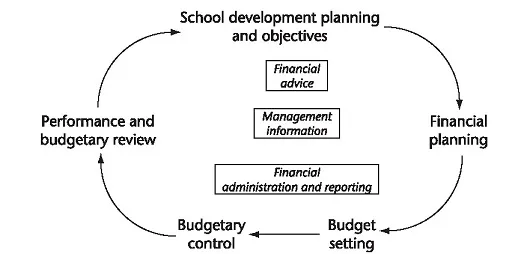
To help take a more strategic approach to the use of resources, we will follow a model that has been around for many years but is still valid (Figure 1.1).
Essentially, good resource management means deploying your resources carefully to ensure you can meet the objectives in the SDP, achieve best value and undertake activities that the school can afford.
Figure 1.1 The financial management cycle
The estimated cost of achieving the SDP objectives and planned cost of maintaining the school’s existing provision should be shown in a financial plan. This plan should ideally cover a three-year period at least. You should build anticipated income for the three-year period into the plan and compare these with estimated costs, to determine if the school’s plans are affordable. If the plans are not affordable, you will need to:
- review the SDP objectives;
- consider alternative, more cost-effective ways of achieving the SDP objectives;
- pursue additional sources of income.
Keep in mind that long-term financial planning is an inexact science. Even with the DfES Dedicated Schools Grant (DSG), it is likely that future funding will inevitably be somewhat different from that originally anticipated.
The school’s annual budget should reflect the first year of your long-term plan. The budget sets the annual income and expenditure targets that a school needs to meet if it is going to deliver planned provision in an affordable way. Actual income and expenditure should be monitored against the budget regularly, with any big differences being controlled and reviewed as the financial year progresses. The success of this process depends on:
- the effectiveness of the school’s financial administration and accounting systems;
- a strong culture of financial responsibility and accountability at all levels in the school; and
- effective leadership, challenge and support to the financial management process by the governing body and leadership team.
■ The DfES Financial Management Standard and Toolkit (FMSiS)
Our route map for this journey will be the FMSiS. Published in 2004 and updated in 2005 and 2006, FMSiS sets the standard for financial management in schools and provides a wealth of relevant guidance for schools on how to manage their resources. It includes a toolkit to help schools reach the standard and improve.
FMSiS also includes a comprehensive self-assessment tool to enable you to evaluate your own management of resources. Although this can be a time-consuming process, it is straightforward to break FMSiS down into constituent parts and evaluate your resource management systematically. The five main parts of FMSiS are:
- leadership and governance;
- people management;
- policy and strategy;
- partnerships and resources;
- processes.
We shall refer to relevant parts of FMSiS throughout this book.
Some of the headings may appear to have little to do with the subject in hand, but FMSiS consciously takes a broader approach, one that Mr Micawber sadly missed. At present, use of FMSiS is still discretionary for primaries, but the DfES is likely to make both self- and external assessment mandatory for such schools in the next few years. FMSiS is available on www.fmsis.info.
■ Stocktaking and PESTE analysis
A useful way to begin to review the use of resources in a school is to think about the school environment, which can lead to review of the effectiveness of the SDP. A PESTE (political, economic, social, technological and environmental) analysis is excellent for this and focuses attention on the factors facing the school. There are several different versions of PESTE.
Table 1.1 One school’s PESTE analysis
In the example in Table 1.1, the headteacher analysed the factors facing the school and divided them into the five PESTE categories (some factors may run into more than one category). The next step would be to think about when and how these factors are likely to affect the school and what the resulting costs might be, and use this information as a basis for assumptions in the financial plan.
■ Reviewing the previous year
The summer term is the ideal time for schools to begin to review their use of the previous financial year’s resources. Look at those areas where there was a significant difference between what you planned to spend and what you actually spent. Try to understand the reasons why this happened; will it happen again in the current year or was it a ‘one-off ’? This review should throw up any ‘pinch points’ – places where budget heads did not have sufficient resources allocated at the start of the financial year or there were control issues. The review should also help identify areas of recurring costs you had not planned for in the past but will need to plan for in the future. For example:
- Did you cut down on supply because of a new cover assistant but have a spate of days when two or even three colleagues were absent?
- Did you find that repair bills were much lower than previous years because the new security system cut the cost of vandalism?
The review needs to be more than just an examination of whether more or less money has been spent than expected. It can also help show if the school’s development and planning objectives have been achieved (see Figure 1.1).
Tip – Never just look at the money! Your review should include what the money was spent on and how well it matched up to the needs of the school.
Be very specific when you evaluate expenditure against objectives, for example:
- Has the expenditure spent on the building had the desired effect? Is the roof watertight?
- Does the boiler work satisfactorily now? Has that ground maintenance contractor given good value for money?
- Has the extra money you ploughed into literacy had the desired effect?
- £6,000 was spent on the library – does your self-evaluation shown that children are reading for pleasure?
- Was there a reason for a particular level of sickness absence among a group of staff?
- Did you save money by changing your Sickness Absence Insurance provider? Would alternative arrangements have been more cost-effective?
The results of your review should inform your planning discussions for the following year. You can use the information you gathered in this process in your school’s self-evaluation form (SEF) for Ofsted.
However, that isn’t the end of the review. You also need to take in to consideration the balances you hold as a school. Remember that you have been given your delegated budget to use for the education of the children you have now, not to save for some unspecific rainy day in the future. In 2004, the Audit Commission pointed out that there were national surpluses of over £1 billion in English schools. Since then authorities have become more stringent about asking schools to justify holding large surplus balances.
Where you have a deficit balance it is crucial that clear plans are established for bringing your school back to a balanced position. A useful exercise that you can do in the autumn term is benchmark your previous year’s spending against similar schools. There is a national schools benchmarking website available to schools on the Teachernet website (www.teachernet.gov.uk/schoolfinance). On the site, you can select schools of an equivalent size in other areas and compare how much you have spent on different budget headings, in both percentage of the budget and cost per pupil terms. (Details of how to use the site are in Chapter 2.) Of course, this information may raise more questions than answers. You may find that you spend 2 per cent more than the national average on teachers and £3 per pupil less on premises. You may have a perfectly good reason for this, but learning this fact may throw up issues that you had not considered, and these can then be usefully discussed with the governing body.
In addition, some local authorities also publish benchmarking information, often on their website, that enables schools to compare their costs against those of similar schools. The advantage of this information at the local level is that you can select schools you know rather than anonymous national schools. If you have questions about use of resources, you can contact the head to seek further background information or even arrange a visit. Further information about benchmarking is in sect...