This monumental collection presents the first-ever sociological analysis of the No Child Left Behind Act and its effects on children, teachers, parents, and schools. More importantly, these leading sociologists consider whether NLCB can or will accomplish its major goal: to eliminate the achievement gap by 2014. Based on theoretical and empirical research, the essays examine the history of federal educational policy and place NCLB in a larger sociological and historical context. Taking up a number of policy areas affected by the law—including accountability and assessment, curriculum and instruction, teacher quality, parental involvement, school choice and urban education—this book examines the effects of NCLB on different groups of students and schools and the ways in which school organization and structure affect achievement. No Child Left Behind concludes with a discussion of the important contributions of sociological research and sociological analysis integral to understanding the limits and possibilities of the law to reduce the achievement gap.
eBook - ePub
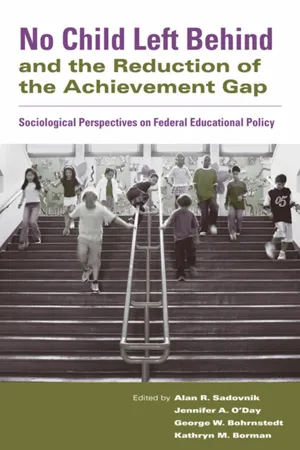
No Child Left Behind and the Reduction of the Achievement Gap
Sociological Perspectives on Federal Educational Policy
- 424 pages
- English
- ePUB (mobile friendly)
- Available on iOS & Android
eBook - ePub
No Child Left Behind and the Reduction of the Achievement Gap
Sociological Perspectives on Federal Educational Policy
About this book
Information
Topic
EducationSubtopic
Education GeneralFederal and State Educational Policy and NCLB
1
No Child Left Behind?
Sociology Ignored!
David Karen
Too many American children are segregated into schools without standards, shuffled from grade-to-grade because of their age, regardless of their knowledge. This is discrimination, pure and simple—the soft bigotry of low expectations. And our nation should treat it like other forms of discrimination. We should end it. One size does not fit all when it comes to educating children, so local people should control local schools. Those who spend tax dollars must be held accountable. When a school district receives federal funds to teach poor children, those children should learn. If they don't, parents should get money to make a different choice.
(Bush 2000)
Except for his inability to include vouchers in the No Child Left Behind Act (NCLB) of 2001, President George W. Bush got Congress to pass legislation that included most of the educational platform that he proposed when he was nominated in August 2000. Decrying the "soft bigotry of low expectations," Bush replaced it with the hard bigotries of inadequate funding,1 poor understanding of the nature of educational and social inequality, and an even worse implementation plan. Despite the president's view that educational problems stem from discrimination, his plans for reforming education have ignored sociological research on the role of schools and communities in challenging or reinforcing discrimination and inequality. Hie goal of this essay is to provide sociologists with a number of ways to enter the debate on NCLB and its central focus: gaps in achievement among students from different backgrounds. Toward that end, I briefly review the history of NCLB and lay out its basic provisions. Then I discuss the research and public-engagement opportunities for sociologists that have been provided by the passage, implementation, and evaluations of NCLB.
Federal involvement in elementary and secondary education in the United States is relatively new and, until recently, has been laissez-faire. Although Washington contributes only $1 out of every $14 that is spent on K-12 education, NCLB insinuates the federal government into every state, school district, school, and even classroom. NCLB is a reauthorization of Public Law 89-10, the Elementary and Secondary Education Act (ESEA), which was signed by President Lyndon B. Johnson in 1965. In thanking Congress for passing the ESEA, Johnson said:
By passing this bill, we bridge the gap between helplessness and hope for more than 5 million educationally deprived children. We put i nto the hands of our youth more than 30 million new books, and into many of our schools their first libraries. We reduce the terrible time lag in bringing new teaching techniques into the Nation's classrooms. We strengthen State and local agencies which bear the burden and the challenge of better education. And we rekindle the revolution—the revolution of the spirit against the tyranny of ignorance.
(Johnson 1965}
Section 201 of P.L. 89-10 specifically recognized the "special educational needs of children of low-income families and the impact that concentrations of low-income families have on the ability of local educational agencies to support adequate educational programs." What was most remarkable about the passage of this legislation was its national focus in an arena that even now is dominated by local and state control (the U.S. Constitution does not mention "education" as a governmental function; education is left to the states). Since its original passage, the ESEA has been reauthorized in various guises approximately every five to seven years. Since 1965, the United States has established a cabinet-level Department of Education and increased federal expenditures on elementary and secondary education by a factor of 14.2 Despite the changes, the goals of our new ESEA are similar to those mentioned by LBJ. Though it is framed as a program for increasing the nations human capital to compete more successfully in the global economy,3 NCLB is also centrally aimed at educational inequality: "We have a genuine national crisis. More and more, we are divided into two nations. One that reads, one that doesn't. One that dreams, one that doesn't" (Bush 2001, 1). President Bush's version of the ESEA tiptoes around the state and local control issues and focuses on bringing new teaching techniques and new technology (computers rather than books) into the classroom. Yet from the perspective of goals, degree of financial involvement, and even strategies, the country has not come far in these decades: plus fa change, plus c'est la meme chose. At the same time, just as the original ESEA represented a sea-change in federal involvement in a state function, NCLB truly kicks it up a notch. Though I cannot, in this short piece, review the complete history of the ESEA's reauthorizations, I will highlight some of the key moments of federal redirection between LBJ's ESEA and Bush's NCLB.
During the Reagan administration, we were warned that the educational foundations of the United States were "being eroded by a rising tide of mediocrity." The report began:
Our Nation is at risk. Our once unchallenged preeminence in commerce, industry, science, and technological innovation is being overtaken by competitors throughout the world.
With a martial tone throughout, the report led us toward a back-to-basics approach in education. Along with a spate of reports from foundations and business groups,4 it appeared that A Nation at Risk was pushing educational reform to be a top agenda item of Reagan's second term. In the context of the fiscal crisis created by tax cuts and defense spending, however, funding for educational reform was given short shrift. Terrell Bell, Reagan's Secretary of Education, resigned when it became clear that the President was cutting educational spending more than he was cutting most other programs (Cross 2004, 82).
George W. Bushs immediate predecessors also proposed major educational initiatives: America 2000 (George H. W. Bush), and, with some revision and elaboration, Goals 2000 (Bill Clinton). To gain both support and publicity for America 2000, G. H. W. Bush met with the nations governors for a two-day education summit at the symbolically important University of Virginia, Thomas Jefferson's public university. The "Charlottesville 51," with Governor Clinton of Arkansas as the Chair of the National Governors Association, hammered out six educational goals for the United States to meet by 2000, including having every child "ready to learn" when they enter school, a 90 percent high-school graduation rate, and the United States in the lead in international tests of science and mathematics. Though America 2000 was never passed as legislation, its nonvoucher components were key parts of Clinton's Goals 2000, which was passed in 1994.
There were a number of major reorientations of federal educational involvement associated with Goals 2000. For the first time, Washington dictated that states were required to set academic standards and districts would be responsible for implementing curricula that met those state standards. Teachers would be provided with professional development so that they could teach the new material. "Finally, new tests [would] be developed that are carefully aligned to the standards, which in turn must be reflected in the curriculum, and adults (and students) [would] be held accountable for learning the material" (Cross 2004, 113). Desperately trying to walk the fine line between providing support and avoiding federal meddling, it appeared that Clintons Goals 2000 had found a proper balance. In theory, perhaps; in practice, by the end of 2000, only one-third of the states had complied with its requirements (Cross, 2004, 119, 124). Even with considerable autonomy to set their own standards and assessments and with federal monies at stake, states balked at implementing the new federal requirements.
NCLB continues, in different ways, many educational initiatives ot Goals 2000. The primary difference is that NCLB's requirements have more bite and explicitly tie the performance of schools and districts, measured by many more standardized tests, to the receipt of federal funds. It is interesting that NCLB has seemingly left laissez-faire behind. By raising the stakes in these ways, it has the potential for producing radical change in U.S. schools. The key questions, ultimately, are these: what kinds of change will occur, and will they actually decrease the gaps in achievement?
Having overseen the supposed "Texas miracle" ot increased achievement on annual tests in Texas,5 Bush pushed for annual testing for accountability to be central to his educational plan, NCLB demands that we attend not only to the average test performance in schools, which can mask underperforming groups, but to all groups of students in the school. "In order to hold schools accountable for improving the performance of all students, ... results must... be reported to the public disaggregated by race, gender,6 English language proficiency, disability, and socioeconomic status" (Bush 2001, 8). In addition, NCLB promises funding for "effective, research-based programs and practices" and increasing teacher quality. NCLB also assures parents that they will have more information about their children's schools and provides them with choice if the school is not performing up to par. Finally, according to the NCLB Overview, there will be less bureaucracy and more flexibility in funding both to states and to school districts.7
The key components of NCLB are as follows:
- Requires annual testing of students in grades 3-8 in reading and math, plus at least one test in grades 10-12; science testing to follow. Graduation rates are used as a secondary indicator of success for high schools.
- Requires states and districts to report school-by-school data on students' test performance, broken down by whether the students are African American, Latino, Native American, Asian American, white non-Hispanic, special education, limited English proficiency (LEP), and/or low income.
- Requires states to set "adequate yearly progress" (AYP) goals for each school. To meet AYP goals, not only must each subgroup make progress in each year in each grade in each subject, but 95 percent of each subgroup must participate in testing. AYP goals must be constructed so that 100 percent of the students reach proficiency by 2014,
- Labels schools that fail to meet AYP goals for two years "in need of improvement" (INOI). Initially, this requirement meant that schools must offer students opportunities to attend other public schools or to receive federally funded tutoring. Funds would also be provided for teachers' professional development. A school that fails to meet future AYP targets will be subject to "restructuring" (firing of the teachers and the principal, the takeover of the school by the state or a private company, and so forth).
- Requires schools to have "highly qualified" teachers for the "core academic subjects" (English, reading or language arts, math, science, foreign languages, civics and government, economics, arts, history and geography) by 2005-6.
One might wonder how Bush was able to bring such overwhelming majorities in Congress (381-41 in the House and 87-10 in the Senate) to support a bill that infringed on the prerogatives of so many, often cross-cutting, constituencies. States, districts, schools, and teachers have lost autonomy. Supporters of vouchers for private schools did not get what they wanted. Supporters of a national curriculum failed as well. Ultimately, it appears, Bush promised enough money to placate the liberals and Democrats and enough accountability and choice to placate the conservatives and Republicans.
A key consideration in the bill was how to keep the 800-pound federal gorilla from inflicting too many constraints on state and local autonomy. Without a national curriculum or national annual tests, the United States cannot compare schools across states and districts. Thus, NCLB allows each state to oversee its districts, with state plans reviewed by the U.S. Department of Education (USDOE). Each state can develop or buy tests that are needed to meet the accountability provisions. Local districts can negotiate with states about how they will abide by the approved state version of NCLB. Experience to date has shown that local districts regularly plead their cases for exceptions, exemptions, and modifications to state departments of education, which, in turn, negotiate with the USDOE about how particular pieces of NCLB are being implemented in ways that do not make sense. Examples include grouping very needy special education students with students who have mild disorders; having LEP students take the same tests as non -LEP students; and encouraging low scorers to drop out, thereby raising a school's and category's proficiency (see Meier and Wood 2004 for an overview of these issues).
President Bush's claim about "the soft bigotry of low expectations" connects with sociologists' concerns with the ways in which students' aspirations and the opportunity structure are mutually reinforcing in students' pursuit of academic and socioeconomic success. Sociologists of education are particularly interested in how these relationships may vary for groups of different racial/ethnic backgrounds or social classes. If we try to unpack all the factors that affect the lack of proficiency throughout the population, as well as the achievement gaps among the groups under study, we move well beyond the focus of NCLB. That is as it should be, and that is where sociologists can help.
Sociologists of education examine social forces that afreet how students learn by examining schools in their many contexts. We study the production of teachers (schools of education) as well as their practices within the classroom. We look at how individual schools organize instruction for different subpopulations. We investigate the sources of inequalities in funding among states, districts within states, schools within districts, classrooms within schools, and students within classrooms (Rothstein 2000). We also study the implementation and effects of social policies. From Coleman e...
Table of contents
- Cover
- Title
- Copyright
- Dedication
- Contents
- Acknowledgments
- Preface
- Introduction
- Part I Federal and State Educational Policy and NCLB
- Part II Accountability and Assessment
- Part III: Teaching and Teacher Quality
- Part IV: School Choice and Parental Involvement
- Part V: Federal Involvement, NCLB, and the Reduction of the Achievement Gap
- Contributors
- Index
Trusted by 375,005 students
Access to over 1.5 million titles for a fair monthly price.
Study more efficiently using our study tools.
Frequently asked questions
Yes, you can cancel anytime from the Subscription tab in your account settings on the Perlego website. Your subscription will stay active until the end of your current billing period. Learn how to cancel your subscription
No, books cannot be downloaded as external files, such as PDFs, for use outside of Perlego. However, you can download books within the Perlego app for offline reading on mobile or tablet. Learn how to download books offline
Perlego offers two plans: Essential and Complete
- Essential is ideal for learners and professionals who enjoy exploring a wide range of subjects. Access the Essential Library with 800,000+ trusted titles and best-sellers across business, personal growth, and the humanities. Includes unlimited reading time and Standard Read Aloud voice.
- Complete: Perfect for advanced learners and researchers needing full, unrestricted access. Unlock 1.5M+ books across hundreds of subjects, including academic and specialized titles. The Complete Plan also includes advanced features like Premium Read Aloud and Research Assistant.
We are an online textbook subscription service, where you can get access to an entire online library for less than the price of a single book per month. With over 1.5 million books across 990+ topics, we’ve got you covered! Learn about our mission
Look out for the read-aloud symbol on your next book to see if you can listen to it. The read-aloud tool reads text aloud for you, highlighting the text as it is being read. You can pause it, speed it up and slow it down. Learn more about Read Aloud
Yes! You can use the Perlego app on both iOS and Android devices to read anytime, anywhere — even offline. Perfect for commutes or when you’re on the go.
Please note we cannot support devices running on iOS 13 and Android 7 or earlier. Learn more about using the app
Please note we cannot support devices running on iOS 13 and Android 7 or earlier. Learn more about using the app
Yes, you can access No Child Left Behind and the Reduction of the Achievement Gap by Alan R. Sadovnik,Jennifer A. O'Day,George W. Bohrnstedt,Kathryn M. Borman in PDF and/or ePUB format, as well as other popular books in Education & Education General. We have over 1.5 million books available in our catalogue for you to explore.