eBook - ePub
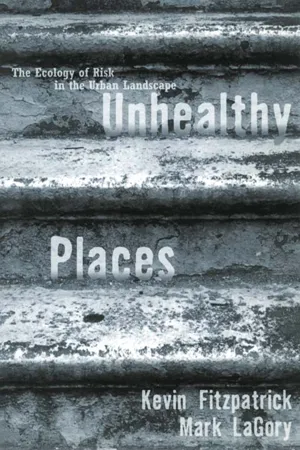
Unhealthy Places
The Ecology of Risk in the Urban Landscape
- 288 pages
- English
- ePUB (mobile friendly)
- Available on iOS & Android
eBook - ePub
About this book
Unhealthy Places focuses on issues of health in today's cities. By arguing that place matters in relation to the population's health, Kevin Fitzpatrick and Mark LaGory make a convincing argument about the general unhealthiness of urban environments and, thus, of the urban dweller. The authors offer a place-oriented approach to health and cover such topics as the ecology of everyday urban life, the sociology of health, needs and risks of the socially disadvantaged, needs and risks of children and the elderly in cities, and strategies for better health services in urban environments.
Trusted by 375,005 students
Access to over 1.5 million titles for a fair monthly price.
Study more efficiently using our study tools.
1
The Importance of Place
Like those of other living things, our structure, development, and behavior arise from a genetic foundation sunk in an environmental context. Yet while we readily accept that a healthy seed can't grow into a plant without the right soil, air, light and water, and that a feral dog won't behave like a pet, we resist recognizing the importance of environment in our own lives.WINIFRED GALLAGHER

Uncertainty surrounding the dangers posed by the fire and by pollutants released into the air and water continued for nearly a week after the fire began. Initially, state and county officials denied that hazardous materials had leaked from the warehouse. As early as the day following the fire's start, however, newspapers reported that nearly 5,000 gallons of a highly concentrated form of Dursban (80 times the over-the-counter concentration) had been released into the water and air. Dursban is an organophosphate pesticide, a low-level nerve agent, believed to cause acute and chronic health problems ranging from birth defects, chronic headaches and neuromuscular pain, short-term memory loss, nausea and vomiting, and breathing problems, to a condition known as multiple chemical sensitivity (U.S. Environmental Protection Agency 1997). Concerns over the safety of Dursban raised by the Environmental Protection Agency (EPA) led its manufacturer, Dow Chemical, to voluntarily restrict its marketing and revise instructions for application and use.
In the first few days after the fire began, residents living in the low-income, mainly African-American neighborhoods near Village Creek reported smelling noxious fumes and experiencing a variety of physical symptoms including headaches and nausea. Dying fish and other signs of serious environmental problems were noticed in the stream that flows through their neighborhoods. It took almost a week, however, before any official response to residents' complaints occurred. Six days after the fire, “no fishing” signs were posted in the area, and test results on water and air samples were finally released by the Alabama Department of Environmental Management. By then, the seriousness of the contamination was obvious. Village Creek had become a flowing stream of dead, rotting fish. Residents living along the creek complained to EPA lawyers about the slow response of local officials to their concerns. They believed that the spill would have been taken more seriously if the damage had occurred in a better-off neighborhood where residents were mostly White. Indeed, it was only after the polluted waters began to wreak devastation further downstream, near those better-off residential areas, that more serious precautionary measures were taken. A temporary filtration dam was built to protect these areas from pollutants, but it failed. In a span of three weeks, almost 30 miles of waterway near residential areas were contaminated and hundreds of thousands of fish killed. The first legal actions were taken only after pollution began to wash ashore near higher-income, mostly White residential areas. Civil suits were filed on behalf of local residents in two of these areas (a residential area near Bay View Lake and one near the Black Warrior River). These suits raised concerns about damage to the water supply and impact on housing values.
Six months after the fire and the largest Dursban spill in history, contamination levels in some areas remained high, although the waterways showed signs of a slow recovery. While a number of reports of medical problems connected with Dursban poisoning have been reported to the County Health Department, little is known about the long-term public health consequences of the spill. Despite media coverage, surprisingly little consideration has been given to the mental health consequences of the event in the Village Creek area. This spill represented a dramatic ecological event, but it was only one instance in a long history of environmental problems. Village Creek is a dumping ground for industrial waste and is prone to other environmental problems such as periodic flooding. Residence here is stressful. The chronic nature of this stress hit home shortly after the fire, when those living along the creek reported strange smells and dramatic changes in the waterway's color; the problems turned out to be a result of industrial pollution from a nearby business. Just another day along Village Creek!
The natural history of this disaster is representative of a larger public health issue in the United States. Persons living nearest to the city center, in areas with large concentrations of poor minorities, are exposed to serious physical and mental health risks (Andrulis 1997; Greenberg 1991). With limited resources to address these risks, residents have found existing agencies incapable or unwilling to deal with the wide range of problems encountered. Risky environments are not usually the ones where politically effective responses occur or where the greatest public efforts are made to address the problem. Yet, in this ineffective response to serious health needs, the health and well-being of the greater whole is affected. As Dr. Martin Luther King Jr. once reminded us: “Of all the forms of inequality, injustice in health is the most shocking and the most inhumane.”
Place Matters
Place is a key element in our identity. Who we are is reflected in the places we occupy and the spaces we control. These places range from nation to region, state, metropolitan area, community, neighborhood, block, and residential dwelling. Each location has profound social meaning for us, and in a literal sense defines not only who we are, but also how we live and die.
Despite the evolution of cyberspace technologies capable of transforming “theres” into “heres,” residence continues to have dramatic consequences for individual health and well-being. The prevalence and incidence of risks for a variety of physical and mental health conditions within metropolitan areas range widely by residential area. Most notably, life and death experiences in the inner city are more similar to people in the Third World than to the experience of suburbanites just a few miles away. Perhaps the most notorious examples of this situation are the neighborhoods of Harlem in New York City and Roxbury in Boston. Mortality rates in these places for Black men under 65 are more than double the rates of U.S. Whites and 50 percent higher than the rates for all U.S. Blacks (McCord and Freeman 1990).
For certain segments of the population, being in the wrong place is not a matter of timing or accident, but rather a function of the social structure. The places we live, work, and play in are fundamental resources, like time or money. The access we have to these resources dramatically affects our well-being. All human beings live in a spatial world where everything and everybody has its place. Everyday lives are spatially structured. At the heart of this structure is a simple fact—there is distance between ourselves and the other actors and objects in our environment. To satisfy basic needs and interests we must find ways of getting objects or actors we have an interest in to either come to us, or find ways of getting to them. Hence, where people live is of great importance.
Place matters in the contemporary world, but for different reasons than in the past. Our ancestors were place-bound by necessity. Indeed, for most of human life on earth we lived as hunters and gatherers, living off the land in small bands so isolated from each other that strangers were met with great suspicion and alarm.
The accounts of early European voyagers to out-of-the-way parts of the globe tell again and again of their being received by the native populations with fear, astonishment, apprehension, ceremonies of propitiation, protective rituals, fainting, and so forth—the exact emotion and behavior of the hosts depending on just what they conceived these strange white objects to be. (Lofland 1973:5)
Dramatic technological revolutions eroded this isolation in ever intensifying waves of change—first, an agricultural revolution 10,000 years ago, then an industrial-urban revolution 9,700 years later. During this vast period of time, the spatial horizons of people broadened as transportation and communication technologies improved, trade expanded, and cities attracted large numbers of culturally heterogeneous populations. We are now in the midst of a microelectronics revolution. This third wave of change is technically capable of ending the isolation between people; yet spatial barriers persist in this post-industrial world where highly segregated cities contain distinct inner-city and outer-city areas. Thus, as we enter a new millennium, space is redefined and reshaped, and for some takes on a new level of significance.
The enduring significance of place is truly remarkable, for technologies now exist to move people and materials vast distances in very short times, while information can be transported almost instantaneously to the most remote regions of the world. Distant places have attained a “hereness” nearly unimaginable a century ago. Marshall McLuhan (1965) describes this new world as a “global village,” but this place has a more distant potential for certain segments of the population. Indeed, when surveying the urban geography, with its vast neighborhood differentials in health risks, the more appropriate spatial analogy may be that of an expanding universe of places moving farther away from each other, rather than closer.
There is good news and bad news contained in the reality of evolutionary trends. While technological developments in transportation, communication, and information processing give humans new capacities to break down spatial barriers, a socially structured spatial environment produces new barriers. These structures are the modern-day equivalent of the medieval city's walls—separating portions of society from one another and preserving vast differences in levels of living and overall well-being. Awareness of the impact of these invisible barriers for the health and well-being of large numbers in our society may make it possible to develop programs to alleviate this spatial penalty. As Melvin Webber has suggested (1964), we have the technological capacity to live in a “nonplace urban realm” where the friction of distance is minimized. At present, however, we live in a bifurcated world of possibility and actuality. There is the potential for a nonplace urban realm, but at the same time there is the reality of a highly segregated city perpetuating an ecology of disadvantage.
While the greatest disadvantages in the urban area clearly accrue to residents of the inner city, place-bound risks are not unique to the ghetto. Urban sprawl on the edge of the metropolis has produced places of numbing “sameness” with no identity or sense of community. The recent rash of suburban school shootings has led some observers to conclude that there may be conditions unique to suburbs that place certain vulnerable groups at risk, particularly youth. A recent New York Times article suggests that suburban design may be failing to provide a safe haven for younger residents.
As quickly as the word “alienation” can be attached to the idea of youth, the image of isolation can be attached to the picture of suburbs. Is there an unexplored relationship between them? It is a question parents and urban planners are raising in the aftermath of the Columbine High School shootings in Littleton, Colorado. At a time when the renegade sprawl of suburbs themselves is being intensely scrutinized, the troubling vision of a nation re-pioneered in vast tracts of disconnected communities has produced uneasy discussion about the psychological disorientation they might house. (Hamilton 1999)
Why an Urban, Place-Based Approach to Health?
There is an ecology of disadvantage in America, and one of its most significant outcomes is the “urban health penalty” (Greenberg 1991). This penalty is important to understand for several reasons. First, we live in an urban society. While a century ago only 25 percent of the population resided in urban areas, now roughly three-fourths live in a metropolitan area consisting of one or more central cities and a ring of suburbs. Second, experts generally agree that the single most important global environmental influence in this century, and for the foreseeable future, is the process of urbanization itself (Gallagher 1993). Today, a little more than 40 percent of the world's population lives in cities, but if world urbanization trends continue, it is estimated that roughly 25 years from now more than two-thirds of the world will be urban (Brockerhoff 1996). The impact on the ecosystem of such an event would be catastrophic, with dramatic increases in pollution, consumption of nonrenewable resources and irretrievable losses of millions of known and unknown animal and plant species (Meadows et al. 1972). Third, the city is a distinct social environment that over time has accentuated great inequities between peoples. Within its boundaries dramatic variation exists in material wealth, personal well-being, and overall quality of life. Finally, the city is an artificially constructed environment, an “intentional” or “built” environment, and thus it can be reengineered to promote more desirable health outcomes. Unlike natural disasters, the disasters befalling some of our inner cities are preventable.
Andrulis (1997) highlights a series of indicators suggesting the health costs of urban residence, particularly residence in one part of the city— the inner city. Among the most striking observations are:
• Residents in the 100 largest cities in the United States fall victim to violence twice as often as others. Murder rates are more than twice as high.
• The infant mortality rate in the 100 largest cities is 25 percent higher than the U.S. average.
• Of the 880 most disadvantaged neighborhoods identified by the Child Welfare League, 99 percent were located in cities.
• Forty percent of urban children live below the poverty level.
• Gang-related homicides rose from 18 percent of total killings in Los Angeles in 1979 to 43 percent in 1994.
• Thirty percent to 50 percent of city children are inadequately immunized.
• The mortality rate for urban children increased by 50 percent between 1980 and 1988.
The health of inner-city residents is significantly worse than in other places in the United States. In the inner city, the circumstances of poverty and minority status are exacerbated by segregation; the spatial concentration of these two characteristics apparently intensifies the disadvantages of low income and minority status. Indeed, the American College of Physicians concludes: “One of the most important characteristics [of the health care challenge] is the interrelationships among health and social and environmental problems. The so-called ‘urban health penalty’—the confluence of circumstances such as poor nutrition, poverty and unemployment with deteriorating housing, violence and loss of services— has created a deepening health crisis in the inner city.” A medical approach, in other words, can no longer be sufficient to reduce the differentials that exist in American health because health risks are spatially and socially structured. Indeed, there is growing realization within medicine and public health that societal forces actually shape and create the disease patterns experienced by a society, and that successful health interventions require addressing the social factors that produce them (Link and Phelan 1996). Place is a critical social factor.
While the concepts of place and environment are essential to understanding physical and mental health outcomes in society, they are rather broad, multidimensional constructs. Place can be defined as a portion of space regarded as measured off or distinct from other spaces. It can be conceptualized as a position or site in space. The environment can be thought of as the totality of surrounding conditions, as an area in which something exists. Both concepts imply a force, which is more than physical in character. As an environment, a place can be seen as a container whose characteristics derive primarily from what is contained within its recognized boundaries. These contents involve physical, cultural, and social components.
As a point or portion of space, spatial coordinates can define a place, and hence it has physical qualities. But it is also a space which is socially, culturally, economically, politically, and psychologically defined. The places occupied by individuals are thus not just physical entities characterized by physical positions in space or by the characteristics of those elements contained within the spaces. They are also mental constructs, psychologically defined by individuals who possess culture and occupy certain positions within society. Each person carries around a set of mental maps that are a product of personal experiences, cultural stereotypes, preferences, objective informa...
Table of contents
- Cover
- Half Title
- Full Title
- Copyright
- Dedication
- Contents
- LIST OF TABLES/FIGURES
- ACKNOWLEDGMENTS
- Chapter 1: The Importance of Place
- Chapter 2: Humans as Spatial Animals
- Chapter 3: The Ecology of Everyday Urban Life
- Chapter 4: The Sociology of Health
- Chapter 5: Cities as Mosaics of Risk and Protection
- Chapter 6: Special Populations in the City: Needs and Risks of the Socially Disadvantaged
- Chapter 7: Special Populations in the City: Needs and Risks of the Young and Old
- Chapter 8: The Ecology of Health Promotion and Service Delivery
- REFERENCES
- INDEX
Frequently asked questions
Yes, you can cancel anytime from the Subscription tab in your account settings on the Perlego website. Your subscription will stay active until the end of your current billing period. Learn how to cancel your subscription
No, books cannot be downloaded as external files, such as PDFs, for use outside of Perlego. However, you can download books within the Perlego app for offline reading on mobile or tablet. Learn how to download books offline
Perlego offers two plans: Essential and Complete
- Essential is ideal for learners and professionals who enjoy exploring a wide range of subjects. Access the Essential Library with 800,000+ trusted titles and best-sellers across business, personal growth, and the humanities. Includes unlimited reading time and Standard Read Aloud voice.
- Complete: Perfect for advanced learners and researchers needing full, unrestricted access. Unlock 1.5M+ books across hundreds of subjects, including academic and specialized titles. The Complete Plan also includes advanced features like Premium Read Aloud and Research Assistant.
We are an online textbook subscription service, where you can get access to an entire online library for less than the price of a single book per month. With over 1.5 million books across 990+ topics, we’ve got you covered! Learn about our mission
Look out for the read-aloud symbol on your next book to see if you can listen to it. The read-aloud tool reads text aloud for you, highlighting the text as it is being read. You can pause it, speed it up and slow it down. Learn more about Read Aloud
Yes! You can use the Perlego app on both iOS and Android devices to read anytime, anywhere — even offline. Perfect for commutes or when you’re on the go.
Please note we cannot support devices running on iOS 13 and Android 7 or earlier. Learn more about using the app
Please note we cannot support devices running on iOS 13 and Android 7 or earlier. Learn more about using the app
Yes, you can access Unhealthy Places by Kevin Fitzpatrick,Mark LaGory in PDF and/or ePUB format, as well as other popular books in Medicine & Sociology. We have over 1.5 million books available in our catalogue for you to explore.