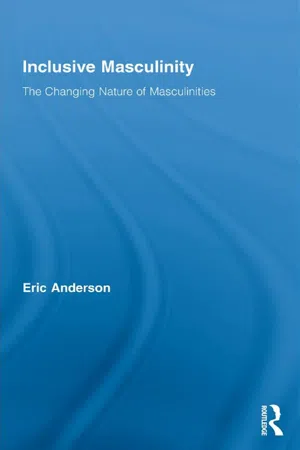
Drawing on qualitative studies of teamsport athletes and fraternity members, this book describes the rapidly changing world of masculinities among men in both the United States and Great Britain. As cultural homophobia decreases, university-aged men are influenced to construct a softer version of masculinity – one that is not predicated in homophobia. Inclusive Masculinity shows that today's youth express decreased sexism, racism and masculine bullying. As Eric Anderson demonstrates, men who value inclusive masculinities are also shown to be more likely to bond in emotional relationships with other men and to embrace a variety of behaviors once coded as feminine, including certain same-sex sexual behaviors. Now available in paperback, this groundbreaking analysis of masculinity and young men will be of interest to students and faculty members within Sociology, Gender Studies, and Sport Studies.
- 196 pages
- English
- ePUB (mobile friendly)
- Available on iOS & Android
eBook - ePub
About this book
Information
Part I
Orthodox Masculinity
1
Orthodox Masculinity and Hegemonic Oppression
Various attributes are associated with sporting participation for boys and men in Western cultures. One of these concerns indoctrination into manhood. Raphael (1988), for example, argues that without historic rites of passage modern men are confused about what it means to be a man, proposing that competitive sports help fill this void. Others view sport as a mechanism for socializing boys into a host of socio-positive psychological characteristics necessary in an industrial culture. Others, like Sage (1990), suggest that sports permit governments to transmit dominant social and political values the way religion once did. Still others suggest that competitive teamsports are an effective solution to many social issues related to the social integration of racialized people (Girginov, Papadimitrious, & Lopez De D’Amico 2006). And, of course, if you ask my first year university students why sports are ‘good’ they will repeat the lore of sports’ mythical attributes: sports promote teamwork, cooperation, fitness, and self-esteem. They might suggest that sports help minorities find employment out of ghettos; that they help promote school attendance; and that sport helps certain athletes earn scholarships to pay for the rising costs of university attendance. There are absurd beliefs, too. Some believe that sports help men (who they perceive as naturally violent) vent their anger in an acceptable manner (cf. McCaughey 2007). While others maintain that sports ‘teach’ boys to win and fail in public view, perhaps letting them learn from their triumphs and tragedies in the process. Somehow failure and it’s public ostracizing even ‘builds character’ in kids too young to understand the rules of a game.
My analysis of sport however is quite critical. This is not to say that sports do not have some socio-positive value, but I reject most of the supposed socio-positive aspects of sport, instead believing them to be far more psychologically and socially damaging than beneficial. Brackenridge (1995) supports this belief, writing that sport:
… has held a special place in the affections of western industrial societies for its supposed virtues and its potential as a tool of economic and social development. The special status of sport has also protected it from critical scrutiny and meant that social inequalities and other problems, such as sexual harassment and abuse, have all-too-often been ignored or tacitly condoned. (p.16)
The socio-negative aspects of sport I highlight in this chapter are not solely because of the competitive nature, or the gender-segregated structure, on which sport is built. It also reflects the masculine ether in which most competitive sports swim. I would love to debunk each of the aforementioned myths—but that’s mostly the project of another book. For now, a more measured claim is to suggest that sports (for males) are a somewhat unique cultural location where boys and men gather to bond over physical joy, pain and labor. In sport, men relate in emotional and physical ways, not acceptable in other cultural spaces. In this chapter, I examine the historical/political project of sports concerning this bonding process, and the importance of segregating women and gay men away from heterosexual men in order to preserve heteromasculine privilege. I show how women and gay men grew to become the ‘other’ upon which heterosexual men are constructed and valued, and the manner in which heteromasculine men are given immense institutional and cultural privilege because of their introduction into sport.
I examine the relationship between homosexuality and masculinity, and the threat that homosexuality poses to the maintenance of patriarchy. I also examine the construction of heterosexual masculinities, and how hegemonic processes of dominance and oppression are used to stratify men. I clarify different forms of masculinity, and highlight how they operate in the masculinized culture of teamsports (and other masculinized arenas). In doing so, I lay the framework necessary to understand the developing relationship between men and masculinity throughout the rest of the book.
SPORT, SEXUALITY, AND THE SECOND INDUSTRIAL REVOLUTION
Although the invention of the machinery and transportation necessary for industrialization began early in the 1700s in Anglo-American cultures, the antecedents of most of today’s sporting culture can be traced to the years of the second industrial revolution—the mid 1800s through early 1900s. During this period, sturdy farmers exchanged their time-honored professions for salaried work. Families replaced their farm’s rent for that of a city apartment, instead. The allure of industry, and the better life it promised, influenced such a migration that the percentage of people living in cities rose from just 25 percent in 1800 to around 75 percent in 1900 (Cancian 1987).
However, just as cities attracted people, the increasing difficulty of rural life also compelled them to leave their agrarian ways. This is because the same industrial technologies that brought capitalism also meant that fewer farmers were required to produce the necessary crops to feed a growing population. With production capacity rising and crop prices falling, families were not only drawn to the cities by the allure of a stable wage and the possibility of class mobility, they were repelled by an increasingly difficult agrarian labor market as well as the inability to own land.
For all the manifestations of physical horror that was factory life, there were many advantages, too. Families were no longer dependent on the fortune of good weather for their sustenance, and industry provided predictable (if long) working hours. Having a reliable wage meant that a family could count on how much money they would have at the end of the week, and some could use this financial stability to secure loans and purchase property. Also, the regularity of work meant that between blows of the factory whistle, there was time for men to play. The concept of leisure, once reserved for the wealthy, spread to the working class during this period (Rigauer 1981). It is the socio-cultural impact of this great migration that is central to the production of men’s sport in Western cultures.
Sport gave boys something to do after school. It helped socialize them into the values necessary to be successful in this new economy, to instill the qualities of discipline and obedience, and to honor the hard work that was necessary in the dangerous occupations of industrial labor and mining (Rigauer 1981). Accordingly, workers needed to sacrifice both their time and their health, for the sake of making the wage they needed to support their dependent families. In sport, young boys were socialized into this value of sacrifice (in this case for team), so that they would later sacrifice health and well-being for family. But most important to the bourgeoisie ruling class, workers needed to be obedient to authority. Sports taught boys this docility. Carter (2006) nicely summarizes these points, saying that sports teach, “a clear hierarchical structure, autocratic tendencies, traditional notions of masculinity and the need for discipline” (p. 5). Accordingly, organized competitive sports were funded by those who maintained power of the reproduction of material goods. And, just as they are today, organized youth sports were financially backed by business, in the form of ‘sponsors.’ This, alongside the inclusion of physical education as part of a compulsory state-run education, was an economical way of assuring a docile and productive labor force.
This shift to industry had other gendered effects, too. Although there was a gendered division of labor in agrarian work, there was less gendering of jobs and tasks compared to industrial life. Here, both men and women toiled in demanding labor. Accordingly, in some aspects, heterosexual relationships were more egalitarian before industrialization. Factory work, however, shifted revenue’s generation from inside the home to outside. Mom’s physical labor no longer directly benefited the family as it once did, and much of women’s labor therefore became unpaid and unseen. Conversely, men’s working spaces were cold, dangerous and hard places. Men moved rocks, welded iron, swung picks and operated steam giants. These environments necessitated that men be tough and unemotional.
Cancian (1987) describes these changes as a separation of gendered spheres, saying that expectations of what it meant to be a man or woman bifurcated as a result of industrialization. Men grew more instrumental not only in their labor and purpose, but in their personalities, too. As a result of industrialization, men learned the way they showed their love was through their labor. Being a breadwinner, regardless of the working conditions upon which one toiled, was a labor of love. Because women were mostly (but not entirely) relegated to a domestic sphere, they were reliant upon their husband’s ability to generate income. Thus, mostly robbed of economic agency, women learned to show their contribution through emotional expressiveness and domestic efficiency. Accordingly, the antecedents of men’s stoicism and women’s expressionism were born during this period.
In one sense, the separation of spheres created a new foundation for masculine power and privilege, especially to the extent that men increasingly came to control the family wage (Hartmann 1976). Men were also given more time away from home and family, as labor both inside and outside the home grew increasingly divided (Hochschild 1989). For example, when discussing the division of masculinity and femininity in doctoring and nursing, Williams (1993) writes that “Prior to this modern division, both men and women performed diagnostic, curative techniques as well as caregiving functions (although on very different clienteles). Separating these functions involved barring women from schools of medicine, and excluding men from nursing programs” (p. 3).
Even today, the work performed seems to be the predominant factor in determining whether a job is coded as masculine or feminine. They are also classed. Lower-class men’s occupations require strength and physical danger, while upper-class men’s occupations require leadership. Oppositely, women almost exclusively work in fields requiring nurturing, caregiving, or those concerned with cleaning up men’s messes. Occupational gender segregation is so profound that Reskin and Hartmann (1986) showed that in order to balance out the gender segregation in the workforce (and make an equal number of men and women in all occupations) more than half of all men or women would have to change their job categories.
Conservative theorists, such as Parsons and Bales (1955) and Simpson and Simpson (1969), have argued that this is a natural outcome of the differences in socialization patterns, while others (Eisenstein 1979; Hartmann 1976) instead looked to patriarchy as the cause. For whatever reasons, however, labor grew divided as a result of the second industrial revolution—and this included child rearing.
During this period, fathers left for work early, often returning home once their sons had gone to bed. Because teaching children was considered ‘women’s work,’ boys spent much of their days in presence of women where they were thought to be deprived of the masculine vapors supposedly necessary to masculinize them. Rotundo (1993:31) writes, “Motherhood was advancing, fatherhood was in retreat … women were teaching boys how to be men.” Messner (1992:14) adds, “With no frontier to conquer … and with urban boys being raised and taught by women, it was feared that men were also becoming ‘soft,’ that society itself was becoming feminized.” A by-product of industrialization, it was assumed, was that it was capable of creating a culture of soft, weak and feminine boys. Boys were structurally, and increasingly emotionally, segregated from their distant and absent fathers. This set the stage for what Filene (1975) called, a crisis in masculinity.
Simultaneous to this, however, was the first wave of women’s political independence (Hargreaves 1986). The city provided a density of women upon which activism was made more accessible. Smith-Rosenberg (1985) suggests that men felt threatened by the political and social advancements of women at the time. Men perceived that they were losing their patriarchal power. The antidote to the rise of women’s agency largely came through sport.
However, a much under-theorized influence on the development and promotion of sport comes through the changing understanding of sexuality during the second industrial revolution. Particularly concerning the growing understanding of homosexuality.
Agrarian life was lonely for gay men. One can imagine that finding homosexual sex and love in pastoral regions was difficult. Conversely, cities collected such quantities of people that gay social networks and even a gay identity could form. This coincided with a growing body of scholarly work from Westphal, Ulrichs and Krafft-Ebing, early pioneers of the gay liberationist movement. These scholars sought to classify homosexual acts as belonging to a type of person; a third sex, an invert, or homosexual (Spencer 1995). From this, they could campaign for legal and social equality. Previously, there were less entrenched heterosexual or homosexual social identities. In other words a man performed an act of sodomy, without necessarily being constructed as a sodomite. Under this new theorizing, however, homosexuality was no longer a collection of particular acts, but instead, as Foucault (1984:43) so famously wrote:
We must not forget that the psychological, psychiatric, medical category of homosexuality was constituted from the moment it was characterized–Westphal’s famous article of 1870 on “contrary sexual sensations” can stand as its date of birth–less by a type of sexual relations than by a certain quality of sexual sensibility, a certain way of inverting the masculine and the feminine in oneself. Homosexuality appeared as one of the forms of sexuality when it was transposed from the practice of sodomy on to a kind of interior androgyny, a hermaphorodism of the soul. The sodomite had been a temporary aberration; the homosexual was now a species.
And while I think Foucault overstates matters, it is evident that the visibility of the homosexual grew during this period. The 1895 conviction of Oscar Wilde for ‘gross indecency’ animated this newly created deviant identity. So extensive was the media coverage and public discussion around the trial of Britain’s celebrated author and playwright, that it breathed public awareness into homosexuality, and consequently engendered elevated social homophobia. In Wilde, homosexuality found a spokesperson.
All of this is to suggest that the cultural awareness that some men existed as a different type of sexual person, a homosexual, came into existence during this period. Thus, one might describe the trials of Oscar Wilde as giving birth to homohysteria. For example, the day news of Wilde’s conviction became public, gay men fled England in droves.
But whereas Wilde put a face on homosexuality, Sigmund Freud explained its etiology. In his Three Essays on the Theory of Sexuality (1905), Freud theorized that sexuality was not innate. Instead he suggested that childhood experiences influenced men to become heterosexual or homosexual, something he called inversion. Homosexuality, Freud said, was a process of gendered wrongdoing, particularly through the absence of a father figure and an over-domineering mother. In one of his footnotes he wrote, “… the presence of both parents plays an important part. The absence of a strong father in childhood not infrequently favors the occurrence of inversion” (p. 146). Freud even gave child-rearing tips to help parents lead their children to heterosexual adjustment.
Freud’s theories are certainly more complex than I present, and my aim is not to paint Freud as homophobic. Freud actually tried to humanize homosexuals by explaining their ‘condition.’ Yet i...
Table of contents
- Routledge Research in Gender and Society
- Contents
- Acknowledgments
- Part I Orthodox Masculinity
- Part II Inclusive Masculinity Theory
- Part III Inclusive Masculinities
- Appendix 1 Methods: Gay Male Athletes Research
- Appendix 2 Methods: Heterosexual Male Cheerleaders Research
- Appendix 3 Methods: Fraternity Research
- Appendix 4 Methods: Rugby Research
- Appendix 5 Methods: Kissing Research
- References
- Index
- About the Author
Trusted by 375,005 students
Access to over 1.5 million titles for a fair monthly price.
Study more efficiently using our study tools.
Frequently asked questions
Yes, you can cancel anytime from the Subscription tab in your account settings on the Perlego website. Your subscription will stay active until the end of your current billing period. Learn how to cancel your subscription
No, books cannot be downloaded as external files, such as PDFs, for use outside of Perlego. However, you can download books within the Perlego app for offline reading on mobile or tablet. Learn how to download books offline
Perlego offers two plans: Essential and Complete
- Essential is ideal for learners and professionals who enjoy exploring a wide range of subjects. Access the Essential Library with 800,000+ trusted titles and best-sellers across business, personal growth, and the humanities. Includes unlimited reading time and Standard Read Aloud voice.
- Complete: Perfect for advanced learners and researchers needing full, unrestricted access. Unlock 1.5M+ books across hundreds of subjects, including academic and specialized titles. The Complete Plan also includes advanced features like Premium Read Aloud and Research Assistant.
We are an online textbook subscription service, where you can get access to an entire online library for less than the price of a single book per month. With over 1.5 million books across 990+ topics, we’ve got you covered! Learn about our mission
Look out for the read-aloud symbol on your next book to see if you can listen to it. The read-aloud tool reads text aloud for you, highlighting the text as it is being read. You can pause it, speed it up and slow it down. Learn more about Read Aloud
Yes! You can use the Perlego app on both iOS and Android devices to read anytime, anywhere — even offline. Perfect for commutes or when you’re on the go.
Please note we cannot support devices running on iOS 13 and Android 7 or earlier. Learn more about using the app
Please note we cannot support devices running on iOS 13 and Android 7 or earlier. Learn more about using the app
Yes, you can access Inclusive Masculinity by Eric Anderson in PDF and/or ePUB format, as well as other popular books in Social Sciences & Gender Studies. We have over 1.5 million books available in our catalogue for you to explore.