- 224 pages
- English
- ePUB (mobile friendly)
- Available on iOS & Android
eBook - ePub
About this book
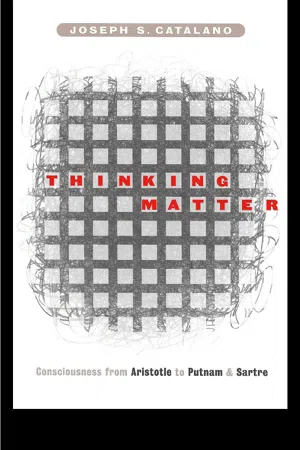
Thinking Matter is an original and provocative look at the nature of consciousness. While many contemporary philosophers have downplayed the significance of the body and subscribed to a brain/body dualism in human consciousness, Joseph S. Catalano argues that it is the entire fleshy body that thinks; the body of the dancer, the hands of the writer, and the eyes of the reader are not merely instruments of thought, but forms of thought itself. Calling for a thorough rethinking of philosophic traditions from Aristotle to Sartre, Catalano offers a holistic view of the bodily nature of consciousness--one that focuses on the total organic body rather than the brain alone.
Information
PART ONE
The Body
and the World
Chapter 1
Matter and
Pure Enquiry
The introductory remarks framed my anthropocentric perspective: our knowledge of the world is one with our bond to things, and this bond is itself a worldmaking. This worldmaking is such that things exist independently of our conceptions and linguistic expressions about them, but not independently of their relation to the fact of our organic conscious existence. Thus, the world arises primarily from matter’s relation to our fleshy organism and secondarily from matter’s relation to our theories and instruments.
There is no way to prove this anthropocentric claim about the world, for there is no neutral position from which I can survey the world. Indeed, one of the points of this chapter is to establish that any quest for a seemingly neutral, bird’s-eye perspective on things already finesses flesh from thought, and thus attempts to remake knowledge and reality to fit our socalled neutral thoughts.
Still, I must give some justification for my own ontological claim. I am tempted simply to ask the reader to be aware of the necessity of his or her organic and fleshy body. Reading this script presupposes the use of eyes, or fingers as in braille, and whereas it seems natural to pass through these fleshy and material constituents to something seemingly immaterial called meanings, the obvious fact of our fleshy eyes and fingers remain. No doubt our brain is also important. However, in this work I wish to challenge the brain-body dualism that I see replacing the old Cartesian mind-body dualism, and thus I emphasize the entire fleshy and organically differentiated body.
One way of indicating the significance of the way our bond to the world is through organs is to imagine what the world would be like if we did not have sight. The blind live in a world constituted by those of us who see. Suppose, however, that consciousness had emerged in such a way that its organic structure did not include vision. I claim that not even our wildest science fiction or thought experiments could sketch what such a world and such an awareness of the world would be like. The world in which we live is structured in relation to an organism for whom sight is an essential bond to matter. Reciprocally, the only consciousness that we know about is one in which sight is an essential aspect, for blindness is the privation of sight. And what is true of sight is true of the other sense organs, including the fleshy texture of the entire body. Regardless of socalled illusions or errors of perception, regardless of interpretations, regardless of how the entire weight of culture bears down on our sense impressions, the world, in its basic differentiation into things, is the way it is because our body is the way it is. And, regardless of whether our science might manufacture a nonfleshy consciousness, that production would be brought about by our fleshy organism and in imitation of it. Consequently, my ontological perspective on knowledge and consciousness regards sense organs not only as revealing the world but also as differentiating matter into a world. We have trees and stars because our body is fleshy and organic in just the way it is. Once given in relation to our body, “natural” things are there to be discovered and investigated. These claims give the general direction of my thought as developed in this work.
It is difficult to highlight the importance of our fleshy bodies because, when they function well, we pass through them in use: seeing, we appear not to have eyes but to be in contact with the world as visible. Still, we do have eyes, and, to repeat, as consciousness takes the form of sight, things are not only revealed to be visible but they are made visible. If we add the relation of matter to our entire body, we have the universe as it is for the most part given to us by our common sense.
It is thus important for me to note that I take the so-called “hard” question of consciousness that is commented upon in much contemporary literature to refer to a secondary explication of our bond to the world. I am only minimally interested in reflecting upon the extent to which our consciousness is unique because it is a self-awareness. That is, I am only incidentally interested in subjectivity. I do not deny the uniqueness of subjectivity; for the most part, I take it for granted. For example, in explaining “our experience of red,” I am not very interested in whether the “experience” may be unique but, rather, to what extent “red” exists in the world as a unique quality, precisely because of its relation to sight. Some scientific materialists do attempt to go all the way and reduce both red and the experience of red to quantitative relations, and I will consider some of their views in the next chapter. Nevertheless, thinkers who normally tend to reduce quality to quantity are usually willing to grant some irreducibility to consciousness. I consider this position not only insufficient but inconsistent. My implied and, to some extent, explicit view is that consciousness can be both material and irreducible to quantity only if qualities such as red exist in the world irreducible to quantity. Indeed, if red can exist in the world as a quality irreducible to quantity, then consciousness is itself a quality irreducible to quantity. The general reason for the connection is my relational realism: if red is a unique quality in the world because of its relation to consciousness as sight, then consciousness as sight has itself a unique quality irreducible to quantity. From this aspect, my relational realism is one with my nonreductive materialism. Of course, I must add that I agree that, in relation to our scientific theories and instruments, both red and the consciousness of red can be perfectly explained quantitatively. To repeat, I am mainly interested in asserting the relative but valid claims of our commonsense experience and the world it reveals.
My goal then is to show that our consciousness of the world is first and foremost our bond with the world. I thus place the human fleshy body in the center of the universe, and I must clarify why this anthropocentrism is not an anthropomorphism. The task is difficult because, having displaced the Earth from the center of the universe, we conceived this feat to be the outcome of our ability to acquire pure knowledge about things. To reinsert the human body within the center of things now seems to be a return to a Ptolemaic, anthropomorphic view of the world. I find it thus necessary to reexamine some of the broad features of our conception of ourselves as minds capable of pure knowledge. Specifically, how did we get the notion that we had a spiritual mind or a body that was like a complicated machine? How did we go about divorcing flesh from knowledge? This effort of unveiling the roots of our view of ourselves as being capable of pure knowledge fitted more for angels than humans is philosophy as demystification, and if it is not my only effort, it is one of my main tasks.
I want to begin by examining some of the origins of our so-called pure knowledge. I am concerned with our belief that knowledge about things should be aimed at grasping how they would be even if we never existed. Although I start with some general reflections on Plato and Aristotle, my main point is to introduce René Descartes as the father of our present scientific thinking about thought and matter. My formal discussion of Aristotle is scattered throughout the later chapters, but it is centered in appendix I.
The direction of my critique of Descartes is to note that he eliminated flesh from thought by abstracting from the long historical practices that forged language and numbers into webs of meanings. He thus began his reflection by encountering a world of meanings that seemed to exist a priori, and he regarded his main task to be one of sifting through these notions. For me, then, the condition for Descartes’s dualism is already given in his ahistorical outlook on knowledge.
MOLDING THE KNOWER TO THE KNOWN
Historically, philosophers like Plato, Aristotle, and Descartes have assumed that something like an absolute conception of reality must be possible, a conception in which things are known as they are in themselves, indepen- dently from any relation to human existence. One way of understanding this effort is to view it as an attempt to mold both the knower and reality in a way that makes pure knowledge possible. Thus, for Plato, the seeker after truth could not be the ugly flesh and bones that was the appearance of Socrates, and, reciprocally, the truth could not be found in the world in which that body lived. The true nature of things exists, rather, in an immaterial realm, and the real knower is itself immaterial: Socrates is a soul, imprisoned in a body. Plato, at least in the traditional interpretation that has come down to us and influenced our Western thinking about ourselves, easily fits the knower to the known by making them both immaterial. Thus, Plato can easily ground our universal notions about mathematics and justice both by placing their objects in another world and by making the knower a true resident of an immaterial realm that exists apart from matter.
If Plato’s inclination to put truth in an immaterial realm arose from the primacy he attributed to mathematics, in which universal truths appeared to have no human source, Aristotle’s naturalistic bent, his interest in physics and biology, can be said to have motivated his search for a truth that existed in this material world. Aristotle then had the task of molding the knower in such a way that it could obtain its universal knowledge from this world. Since we are able to know that an elm is a tree, or in more contemporary language, since we can classify tokens that are different specimens of trees into the general type “tree,” Aristotle begins his philosophical thinking with the belief that both the token and the type must, in some sense, be real.
Thus the naturalistic tendencies of Aristotle inclined him to insist that only individuals exist as entities; there is no quasi-angelic twoness or pure justice existing in some other world. Rather, we obtain our knowledge of numbers and justice by reflecting upon both material things and concrete acts of justice. Still, the shade of his teacher remained. Aristotle followed Plato to the extent that he felt compelled to look for an a priori grounding for our universal notions. There had to be some connection between the individual tree that could be felled by lightning and the universal claim that all trees are plants. In some sense, this tree must be all trees. The qualifica- tion in some sense led to Aristotle’s insistence that something like Platonic Forms exist, but only in matter, as coprinciples of material things. Thus, each material thing was to be seen as a composite of matter and form, somewhat the way a shaped piece of wax is a composite of the wax and the shape.
Aristotle molded the knower to the known in such a way that our universal notions came from matter and yet were not completely reducible to matter, or at least not reducible to the matter of observable things. Aristotle accepted from Plato that some of our universal notions were not totally the result of our historical activities, but were a priori, in the sense that our abstractive powers got in touch with the eternally true natures of things. Predications of the type “Socrates is a rational animal” and “Two and two are four” are, for Aristotle, true, because we abstract fourness from the way two sets of two things form one quantitative arrangement, and because we can dig below Socrates’s appearances and get to know the special way his matter embodies his soul.
If Aristotle was not able to note the historical formation of our ideas, he did recognize that universality as such is a human product; that is, precisely as tree and four are classes containing individual examples of things, they exist only in the human intellect. This claim, however, leaves open the question of how to explain the workability of our judgements of the type “This tree is a plant,” since the subject is singular and the predicate is universal. More generally, the Aristotelian notion of abstraction requires us to explain just how our universal notions that exist formally only in the intellect conform to the singular things that exist in the material world.
The Aristotelian answer is “I think,” most clearly seen in Thomas Aquinas’s explicit formulation. The correspondence between this tree and a plant is grounded, for Aquinas, in the indifference of the nature of plant to having either a singular or universal mode of existence. The predication “This tree is a plant” expresses a truth, even though the subject, “this tree” is individual and the predicate “plant” is universal: the strain is taken off the “is” because the identity carried by “is” refers to the nature of plant as such, a nature indifferently singular or universal.1
There is, however, a price to pay for molding our thought so that it grasps the essence of things as they are in themselves. It is a price that I sus- pect Aristotle would be willing to pay, for it provides the proper foundation for his notion of abstraction. To see what is at stake, we simply have to ask what great fortune allows us to believe that the nature that exists as individual in matter is the same that our mind abstracts.
Aquinas forces us to face honestly the foundation of the correspondence theory of truth. The general Aristotelian-Thomistic answer to the workability of knowledge is that knowers and natures are part of a grand totality, Nature. In Nature, we find a hierarchy from minerals to plants to animals and then to animals that can think. The forms in each, while individual, are also less “material” as we go up the ladder. The human form, or soul, is so immaterial that it can be united with other forms, can be other forms, without the soul losing its identity as this form in this matter. Abstraction is thus a natural process like digestion, and like digestion, knowledge is guided by the same laws that keep all things working harmoniously together.
If we press further and ask why Nature should work in such harmony with the human intellect, Aristotle has recourse to separated substances, which guide, however loosely, the working of the material universe. And if we are in a stubborn mood and continue asking what directs the separated substances, Aristotle gives us the Prime Mover, Who, by being actuality rather than merely possessing it, supposedly answers an infinite series of whys.
Although Aristotle seemed to hedge on the spiritual makeup of the human soul and the personhood of the Prime Mover, this doubt gave Aquinas enough logical space in which to describe the form of Socrates as so immaterial that it was spiritual, immortal, and ripe for baptism, and the Prime Mover as the caring God. Nevertheless, Aquinas remains an Aristotelian to the extent that he insists that the form of Socrates is not Socrates. For a Platonist like Augustine, a good Christian prays for Socrates that he might arrive in heaven; but for an Aristotelian, like Aquinas, one prays for the soul of Socrates and looks for the resurrection of the body in order for Socrates to live whole again as an individual.
Thus, for Aquinas, the body is essential to the human reality, and yet, the soul can exist apart from the human body. The knower is molded to the known in a way that neatly fits Christian beliefs: the human knower is half spiritual, and that half is the more important half, for it is the seat of our abstractive faculties; correspondingly, truth is half spiritual, for the ultimate bedrock of all true judgments is found in the Mind of God. Thus, logical truth, the truth of judgments, is founded on ontological truth, the truth of a thing having a nature, and this, in turn, is founded on the Idea of that nature in God’s Mind, and from this perspective, one has to ask, “How far have we really progressed from Plato?”
When Descartes attempts both to weave his way through this hierarchy of forms provided by his Jesuit scholastic training and to fi...
Table of contents
- COVER PAGE
- TITLE PAGE
- COPYRIGHT PAGE
- ACKNOWLEDGMENTS
- INTRODUCTION: THE PERSPECTIVE
- PART ONE: THE BODY AND THE WORLD
- PART TWO: ON THINGS AND NAMES
- CONCLUSION: THE ANTHROPOCENTRIC UNIVERSE
- APPENDICES
- APPENDIX I: THE SNUB AND THE POPULATION QUESTION
- APPENDIX II: ON NAMES
- NOTES
- SELECTED BIBLIOGRAPHY
Trusted by 375,005 students
Access to over 1.5 million titles for a fair monthly price.
Study more efficiently using our study tools.
Frequently asked questions
Yes, you can cancel anytime from the Subscription tab in your account settings on the Perlego website. Your subscription will stay active until the end of your current billing period. Learn how to cancel your subscription
No, books cannot be downloaded as external files, such as PDFs, for use outside of Perlego. However, you can download books within the Perlego app for offline reading on mobile or tablet. Learn how to download books offline
Perlego offers two plans: Essential and Complete
- Essential is ideal for learners and professionals who enjoy exploring a wide range of subjects. Access the Essential Library with 800,000+ trusted titles and best-sellers across business, personal growth, and the humanities. Includes unlimited reading time and Standard Read Aloud voice.
- Complete: Perfect for advanced learners and researchers needing full, unrestricted access. Unlock 1.5M+ books across hundreds of subjects, including academic and specialized titles. The Complete Plan also includes advanced features like Premium Read Aloud and Research Assistant.
We are an online textbook subscription service, where you can get access to an entire online library for less than the price of a single book per month. With over 1.5 million books across 990+ topics, we’ve got you covered! Learn about our mission
Look out for the read-aloud symbol on your next book to see if you can listen to it. The read-aloud tool reads text aloud for you, highlighting the text as it is being read. You can pause it, speed it up and slow it down. Learn more about Read Aloud
Yes! You can use the Perlego app on both iOS and Android devices to read anytime, anywhere — even offline. Perfect for commutes or when you’re on the go.
Please note we cannot support devices running on iOS 13 and Android 7 or earlier. Learn more about using the app
Please note we cannot support devices running on iOS 13 and Android 7 or earlier. Learn more about using the app
Yes, you can access Thinking Matter by Joseph S. Catalano in PDF and/or ePUB format, as well as other popular books in Philosophy & Mind & Body in Philosophy. We have over 1.5 million books available in our catalogue for you to explore.