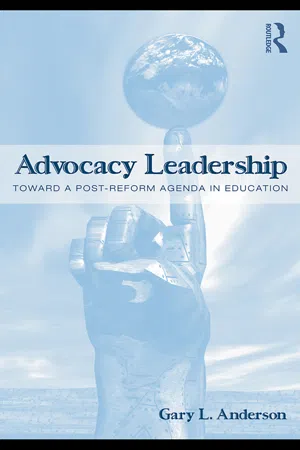
In this timely and important new book, Gary Anderson provides a devastating critique of why a managerial role for educational leaders is counterproductive, especially for improving opportunities for low-income students and students of color, and instead proposes ways of re-theorizing educational leadership to emphasize its advocacy role. Advocacy Leadership lays out a post-reform agenda that moves beyond the neo-liberal, competition framework to define a new accountability, a new pedagogy, and a new leadership role definition. Drawing on personal narrative, discourse analysis, and interdisciplinary scholarship, Anderson delivers a compelling argument for the need to move away from current inauthentic and inequitable approaches to school reform in order to jump-start a conversation about an alternative vision of education today.
- 216 pages
- English
- ePUB (mobile friendly)
- Available on iOS & Android
eBook - ePub
About this book
Information
1
School Reform, Authenticity, and Advocacy
As a young, idealistic teacher in Harlem in the late 1970s, like many urban teachers I struggled with how to integrate my political commitments to poor and working class students with my teaching. Having myself grown up working class and having struggled academically in school, I saw myself in many of my students. The alternative school I taught in was located in the old Hotel Theresa in New York City, a high rise building in central Harlem that at one time was an elegant hotel where jazz greats like Duke Ellington and political figures like Fidel Castro stayed. In those days it housed mostly city offices and our community-based school called College Adapter Program (CAP). It was a “second chance” school for youth who had dropped out of their high schools but showed promise. Our job was to get them ready for nearby City College, which at the time had open admissions and free tuition.
In those years as a teacher in Harlem, I struggled with the age-old problem of rigor and relevance. I knew I needed to teach students the skills to succeed in college. At the same time, I wanted them to have a relevant and empowering education. In the five years I taught there, I learned that students can be taught rigorous skills using an empowering curriculum, and Harlem was alive with relevant history. I remember teaching The Autobiography of Malcolm X in a classroom that was rumored to have once been Malcolm’s office.
I hadn’t chosen to teach in Harlem. Newly arrived in New York City, I didn’t even know I was in Harlem until someone told me during my interview. I wondered how my mainly African-American and Puerto Rican students would view me. I was young, White, and from the Midwest, with only two years of teaching experience. I had read about the need to put on a tough front for so-called “innercity” kids. I was never good at posturing and was far from “hip,” so I decided to just be myself, hoping that being authentic would set a tone in which my students could be authentic with me. I used a lot of humor, poking fun at myself and joking about my lack of urban sophistication. As one of the few White teachers in this alternative school, I think I was a bit of a curiosity.
These were not only kids of color; they were uptown kids who felt out of place downtown (where they seldom ventured). In the Manhattan of the 1970s, the designations “uptown” and “downtown” had class and race implications. As I laced my teaching with stories of my own struggles in school and with a sense of not measuring up, my students, especially the male students’ tough fronts (necessary body armor for urban survival) melted away. As they saw my vulnerabilities, they also began showing me theirs. They laughed at my stories about growing up in Iowa, and their own stories flowed into the journals they kept for class. In many ways, I was their conduit to the mysterious White world they had little contact with, other than through the media. It was during those years in the old Hotel Theresa that I fell in love with my students and with teaching.
During those years, I learned how to teach a rigorous and empowering curriculum in spite of standardized tests. I taught English and knew that their success in college would depend on their ability to write competent papers. But since most of my students also had to pass the GED exam, a standardized test of high school academic skills, I learned how to help them demystify the exam and taught them the skills they would need to pass it. I told them not to confuse test prep with education, and we bonded around our plot to outwit the test. Together we were “getting over” on the system. Though at the tender age of 25, I was, in many ways, naïve and paternalistic, I saw myself as their advocate in a world in which few were looking out for their welfare. But, at a broader level, I had only a partial understanding of the vast economic and political changes that were occurring around us during the 1970s and 1980s, changes we would later refer to with terms like the new economy, new capitalism, and neoliberalism.
As a political activist and veteran of Students for a Democratic Society (SDS) and the anti-Vietnam war movement, I knew that the country was moving to the political right. New York City went bankrupt during this time, and while the financiers were bailed out, the city took a huge hit (Harvey, 2005). Nationally resources were being reallocated away from Great Society programs. This tendency culminated in Reagan’s massive tax cuts for corporations and individuals as part of a “revolution” that resulted in the most massive reallocation of wealth upward, the country had seen since the 1920s. The top tax rate for individuals was reduced from 78 to 28% and tax adjustments on depreciations on investments for corporations allowed many corporations to pay no taxes at all. Just as African Americans were finally beginning to enjoy the benefits of the welfare state, including programs like CAP, it was coming under attack.
During the years I was teaching, I also worked some evenings with an organization led by Michael Harrington, author of The Other America, a book that helped inspire John Kennedy’s war on poverty in the early 60s and later Lyndon Johnson’s Great Society programs. In the 1970s his Democratic Socialist Organizing Committee (DSOC), which was also led by Cornel West and Gloria Steinem, worked within the Democratic Party to bring about prolabor policies. But I was never able to understand the connections between my work with DSOC and my work with my students in Harlem. I saw them as two separate worlds. By day, I tried to provide my students with the skills and cultural capital they would need to have any chance of success in an unequal system; by night, I worked to try to stop the unraveling of social gains achieved by decades of social activism, an unraveling that would leave an even more unequal society. Little did I know then how unequal we would become as a nation.
Around 1980, the funders of CAP mandated a shift from college preparation to vocational training and our funding was severely cut. The CAP acronym stayed the same, but instead of College Adapter Program, we became Career Advancement Program. Instead of teaching English classes to prepare students for college, I began teaching business English. We prepared keypunch operators just as the job was becoming obsolete. At CAP we had worked hard to “pump up” students psychically for a future that included a college education. Now, that excitement was gone. I left CAP to direct a program in the South Bronx, but the America that I had grown up in was changing in ways few of us grasped at the time.
Authenticity and Advocacy are Inseparable
I had struggled in those years with the twin themes of authenticity and advocacy that are central to this book—themes that seem lacking in our current discourse on teaching, leading, and reforming schools. I learned that authentic teaching wasn’t essentially about cognition, learning theory, and teaching methods, though good teachers know these things. It was essentially about relationality and connecting in authentic ways with students. It was both the cognitive and noncognitive dimensions of teaching that were essential. Good teachers figure out how to relate to kids in authentic ways—despite differences of class, race, or gender, and without giving up their authority as teachers.
But I also sensed that building authentic relationships with students was not enough. Authentic teaching could not make up for inauthentic institutions or an inauthentic society in which discourses of equity contradicted vast and growing inequities. To paraphrase Paulo Freire (1970), being authentic with students means helping them to read the word and the world. To be authentic with lowincome students, teachers needed to help them develop curiosity about the world, including why some struggle while others enjoy obscene privilege. As Freire has argued, this cannot be a pedagogy of answers. Such a pedagogy is indoctrination, no matter what side of the political spectrum it is taught from.
Beware of the leader who has lots of answers and few questions. Many administrators are taught to problem solve, not problem pose. There are entire courses in educational administration programs in universities on “decision making,” which is largely an exercise in solving problems. But seldom are the skills of problem posing taught. And yet we know that how a problem is framed or understood will determine the way we go about resolving it. And even when problem posing is taught, problems are seldom understood in a social or historical context.
The moral of these stories is that it is hard to separate authenticity and advocacy. Authenticity at the interpersonal level is exceedingly difficult unless we create authentic institutions and an authentic society in which the values of equity and democracy can be practiced. Building relationships in schools, whether with students or teachers, becomes more difficult as reforms demand more scripted classrooms and more stressful workplaces.
Zero tolerance policies are a good example of divorcing authenticity from advocacy. We think we can solve problems by “getting tough” instead of doing the hard work of using teachable moments with children and youth. Increasingly in schools, incidents that in the past would have been handled with a meeting of principals, parents, teachers, and the students involved, are too often handled by the juvenile justice system. Once the police are on the scene—and their presence is ubiquitous in urban schools—the principal’s authority is usurped. Not only do students miss out on the opportunity to be taught moral and ethical lessons by caring adults, they are getting criminal records at earlier ages, entering what is now being called the pipeline to prison. These youth are also disproportionately poor and of color.
I myself have struggled and continue to struggle with how to link authenticity and advocacy. My own teaching and leadership in Harlem was aimed at helping individual students become upwardly mobile, and our program was successful in sending many struggling students to college. Yet political forces occurring at another level were chipping away at the collective gains of 40 years of social struggle, and our program became a victim of those very forces.
Today as we struggle to get more students to graduate from high school, public funding for higher education is decreasing, leaving fewer affordable seats for low-income students. The average public subsidy for higher education has plummeted from over 30% to an average of 12%. State subsidies have dropped so low that what we used to call state-funded universities are now referred to as state-assisted, and in cases like Virginia, where state subsidies represent a mere 7% of budgets, some are referring to them as “state-located” universities.
While I tried to teach an empowering curriculum in Harlem, exposing students to writers of the Harlem Renaissance and the history of the civil rights movement, I’m not sure how well I got across the notion of becoming empowered democratic citizens in the political context in which my students were living. Juggling teaching, leadership, and advocacy is an ongoing puzzle to solve, and is best done collectively with other professionals struggling with the same issues.
We didn’t have participatory action research or learning communities in those days, and many of these teacher and principal support groups today are more about feeding the system than challenging it. But the potential is there. Once leaders decide to take seriously the challenge of being an authentic advocate for low-income children of color, they will need the support of other colleagues to work through the complex dilemmas such advocacy will unearth.
Authenticity, Advocacy, and School Reform
In Harlem, my teaching experience ultimately morphed into administration as I became a bilingual coordinator, a program director in the Bronx, and ultimately took a principalship elsewhere. As an administrator, as in the classroom, I found I was sometimes able to create authentic spaces with teachers and students and advocate for the things I cared about. I learned to recognize when a window of opportunity opened up in the bureaucracy, and I could slip through some policy or practice that supported the kids with the least power. Later, I went on to do a doctorate, and in my early years working as a professor in the ivory tower, I often missed the adrenaline rush of being in a school with all of the sense of busy accomplishment one felt at the end of the day. Sometimes I had secret fantasies of returning to work in schools. As a professor I have spent a lot of time with aspiring and practicing principals, enviously listening in my classes to their stories about their teaching and leadership dilemmas, interviewing them for research projects, or visiting them as they interned in schools.
About seven or eight years ago though, when I was teaching at a university in Los Angeles, I began to notice a shift in the dilemmas I was hearing from my students. Both teachers (who were aspiring principals) and practicing administrators were beginning to frame their dilemmas differently. Whereas before they were confident that they could transform their schools along a vision that they believed in strongly, now they seemed discouraged and less hopeful—even cynical. This was particularly true of those teachers and administrators who saw themselves as advocates for those in the system who were most marginalized. Despite the rhetoric of decentralization and school autonomy, teachers reported that new reforms were forcing them to eliminate those activities they and their students most enjoyed and around which they were able to bond. I found my own fantasies of returning to work in schools dissipate. It didn’t look like fun anymore, and the few authentic spaces in schools where one could create a true learning community seemed to be drying up. These teachers and principals, mostly in low-income schools in the Los Angeles Unified School district, were struggling with mandated reforms that involved scripted curricula, constant testing and an obsession with test scores, greater surveillance of their work, fewer opportunities for creativity, overcrowded schools, and the constant implementation of new policies, often through ballot initiatives.
For the most part, these students of mine were overachievers who were highly committed to their students. Most of them chose to work in low-income areas where their students’ lack of access to social, cultural, and economic forms of capital made their work overwhelming but rewarding. Now it seemed that society was exclusively holding them accountable for low student performance. They expected to be held accountable and wanted all mediocre teachers and principals to be held accountable as well. But this new system was not accountability in the authentic sense that any professional expects to be held accountable; rather it was a kind of accountability that was punitive and humiliating, like an angry mob searching for a scapegoat. How did school reform so effectively reach behind the classroom door, and with such problematic results?
Scapegoating School Professionals
Public schools for low-income kids have never been very good, and being a teacher or administrator in such schools was never easy. Teachers, principals, and superintendents are generally known for their resilience and their famous “high tolerance for ambiguity.” Teachers survive a succession of principals—some good, some bad. They’ve seen many reforms and innovations come and go—some useful, most not. While some teachers are incompetent, even racist, and should be removed, the vast majority do the best they can under circumstances that are often less than ideal. In low-income neighborhoods, some of their students are homeless, have serious health problems, are recruited by gangs, or are victims of other forms of violence. Teachers in those schools often have children with special needs and English language learners in their classes. Even teachers in middle- and upper-class neighborhoods endure many privileged students and parents who treat teachers with disdain, and problems of drugs and stress-related illnesses are prevalent among students in these communities as well. In addition, teachers work under the anonymity of a profession with low status and low pay. While the range of good and not-so-good teachers is probably similar to the range of good and not-so-good doctors, nurses, CEOs, and lawyers, good teachers manage to do amazing things with children and youth in their classrooms.
Principals and superintendents are also resilient. They live in the crossfire of multiple constituencies, all with different needs and demands. They are expected to mediate these conflicting demands on a daily basis. They are middle managers, increasingly getting their marching orders from city, state, and federal-level mandates. In spite of layers of bureaucracy and limited autonomy, good principals have always somehow managed to create amenable work environments for teachers, a welcoming atmosphere for parents, and a safe and stimulating school culture for students.
But it has always been a given that this good work of teachers and administrators was done in spite of, not because of the largely problematic institutions they worked in. For decades reformers have decried “a grammar of schooling” that creates a dysfunctional workplace for teachers and administrators and a fragmented, monotonous, and tracked educational experience for students, especially in middle and high schools, and especially in low-income schools (Tyack & Cuban, 1997). Reforms that have attempted to “restructure” schools or target the inequities of the system through such policies as compensatory education, more equitable financing formulas, and desegregation plans have had only limited success.
Our best scholars and practitioners have worked long and hard to understand how to break open the grammar of schooling in ways that would create more effective and equitable public schools. Many critical scholars, including this author, have argued over the years that public schools not only could not ameliorate social inequalities, but that in fact, they may contribute to them though practices, such as tracking, that helped to reproduce an inequitable social order. But everyone, from Left to Right, from the academy to the school house, was optimistic that public schools could be made to work better for teachers and for children and that they could be changed. In fact, a whole new field of study, “educational change,” was created to better understand how to break the code of the seemingly intractable grammar of schooling. But until recently, it was assumed that however we succeeded in improving schooling, it would be in the context of core values of a system of public schooling aimed at making opportunity available to all American children. There were some groups that favored deschooling society, free schools, Afrocentric schools, and other experiments outside of the public bureaucracy, but none of those were pushing privatization per se. Whether you railed at the public schools from the left, the right, or the center, the core value of a rigorous, equitable, and public school system open to all was largely assumed.
During the 1980s and into the 1990s, school reforms continued along two parallel tracks that often coexisted in considerable tension; one harking back to John Dewey and the other to Edward Thorndike (Donmoyer, 2005). The Dewey track moved toward “authentic” reforms involving authentic assessments, participatory decision making, teaching the whole child, project methods, learning communities, small schools, and child-centered teaching. Reforms such as the Coalition of Essential Schools exemplified this approach. The Thorndike track found these reforms too unstructured and fragmented and sought more “systemic” change, relying on more centralized pressures for change, more standardized accountability systems, and more teacher directed learning.
Many scholars of color felt that neither the Deweyian nor the Thorndike approach was effective for low-income children and children of color. Delpit (1995) and others argued that so-called progressive reforms often failed to understand the needs of children who were not White or middle class. More importantly, these scholars of color felt left out of the school reform conversation.
Most teachers and administrators were also left out of these academic and policy conversations, or were having conversations of their own that were more focused on how they were coping with the day-to-day implications of school reform policies. But mostly, they didn’t pay too much attention to these early debates over reform, since many were already suffering from policy overload. Teachers could usually hunker down and wait out the worst effects within the enclaves of their classrooms. Principals became experts at buffering good teachers from the latest innovation. They had seen so many reforms come and go that the skepticism was often palpable. They went to the workshops and retreats, used what they could, but were largely absorbed by the day-to-day work that anyone who has taught in or led a school knows is all consuming. Besides, teachers who work together all day need to get along, and many of these debates, particularly concerning teaching methods, were seen as divisive.
Then during the second half of the 1990s something changed. It’s hard to pinpoint the exact moment. A few scholars and some practitioners had warned the change was coming, but because the changes were taking place largely over the heads and outside the typical education discourse, few people noticed. Early warnings came from a shift to outcomes-based assessment. This shift in focus from inputs to the statistical measurement of outputs, a concept borrowed from business management, became a centerpiece of the Goals 2000: Educate America Act passed in 1994. In Texas, there was some debate about the Texas accountability system before it was essentially transferred to Washington under former Texas governor, George W. Bush. This debate had more to do with how the TAAS test and the use of scores to punish schools were viewed (Anderson, 2001; McNeil, 2000, Skrla & Scheurich, 2004). Other early warnings came from British scholars’ experiences under Thatcherism and the increasing marketization of schools under a neoliberal economic system (Gewirtz, Ball, & Bowe, 1995). There were rumblings about the Business Roundtable and local and nat...
Table of contents
- Cover Page
- Title Page
- Copyright Page
- Series Editor Introduction
- Foreword Advocates, Managers, Leaders, and Social Entrepreneurs? The Future of Educational Leadership
- Acknowledgments
- Introduction
- 1 School Reform, Authenticity, and Advocacy
- 2 Authentic Leadership
- 3 The New Economy of Schooling
- 4 Disciplining Leaders Mediating the New Economy
- 5 Toward an Authentic Distribution of Leadership
- 6 Toward a Post-Reform Agenda
- Appendix A
- Notes
- References
Trusted by 375,005 students
Access to over 1.5 million titles for a fair monthly price.
Study more efficiently using our study tools.
Frequently asked questions
Yes, you can cancel anytime from the Subscription tab in your account settings on the Perlego website. Your subscription will stay active until the end of your current billing period. Learn how to cancel your subscription
No, books cannot be downloaded as external files, such as PDFs, for use outside of Perlego. However, you can download books within the Perlego app for offline reading on mobile or tablet. Learn how to download books offline
Perlego offers two plans: Essential and Complete
- Essential is ideal for learners and professionals who enjoy exploring a wide range of subjects. Access the Essential Library with 800,000+ trusted titles and best-sellers across business, personal growth, and the humanities. Includes unlimited reading time and Standard Read Aloud voice.
- Complete: Perfect for advanced learners and researchers needing full, unrestricted access. Unlock 1.5M+ books across hundreds of subjects, including academic and specialized titles. The Complete Plan also includes advanced features like Premium Read Aloud and Research Assistant.
We are an online textbook subscription service, where you can get access to an entire online library for less than the price of a single book per month. With over 1.5 million books across 990+ topics, we’ve got you covered! Learn about our mission
Look out for the read-aloud symbol on your next book to see if you can listen to it. The read-aloud tool reads text aloud for you, highlighting the text as it is being read. You can pause it, speed it up and slow it down. Learn more about Read Aloud
Yes! You can use the Perlego app on both iOS and Android devices to read anytime, anywhere — even offline. Perfect for commutes or when you’re on the go.
Please note we cannot support devices running on iOS 13 and Android 7 or earlier. Learn more about using the app
Please note we cannot support devices running on iOS 13 and Android 7 or earlier. Learn more about using the app
Yes, you can access Advocacy Leadership by Gary L. Anderson in PDF and/or ePUB format, as well as other popular books in Education & Education General. We have over 1.5 million books available in our catalogue for you to explore.