![]()
The original Language for Learning book was first published in 2004, winning the NASEN and Times Educational Supplement (TES) Book Award for Teaching and Learning in 2005. The book has proved to be highly popular with practitioners as it offers an easy-to-use format, is quickly accessible and packed with practical ideas to support primary-aged children experiencing speech, language and communication needs (SLCN). Sue Hayden and Emma Jordan have worked in partnership for over ten years within the wider Language for Learning project, developing practical training and resources to support practitioners working in mainstream settings. This self-funding, not-for-profit project is jointly owned by Worcestershire County Council and Worcestershire PCT, supporting a joint, collaborative approach towards meeting SLCN.
As highlighted by the recent Bercow Review (DCSF 2008), the demands and challenges continue as children with SLCN move from primary to secondary school. However, there is minimal evidence of on-going support or services at secondary age. In response to the Bercow Review, there has been an increase in availability of supporting literature for secondary schools, produced by The Communication Trust. This has been supported by a developing evidence base (Joffe 2011; Wilson et al. 2010; Stringer 2006).
This book has been developed to provide a practical guide for secondary school practitioners, utilising the same easy-to-use format as Language for Learning.
It aims to help readers to:
understand speech, language and communication skills;
increase their awareness of SLCN at secondary age;
recognise and identify students experiencing SLCN;
understand the link between language and behaviour, social and emotional development;
understand the roles and responsibilities of secondary staff;
consider the language and communication demands within the secondary curriculum;
make use of a wide range of positive strategies to support access to the curriculum and social opportunities.
Key to Symbols
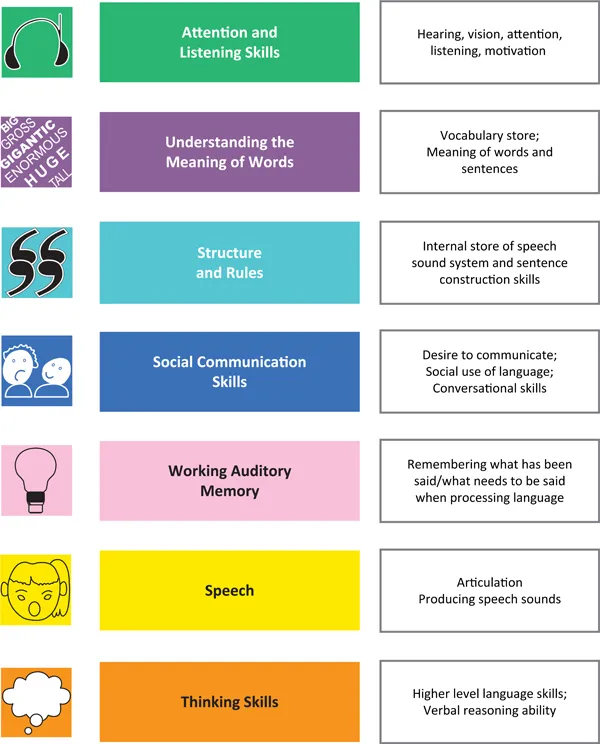
Areas of Speech, Language and Communication
Within Chapter 2, areas of speech, language and communication are identified and described. For ease of reference, these areas are both colour- and symbol-coded throughout the book.
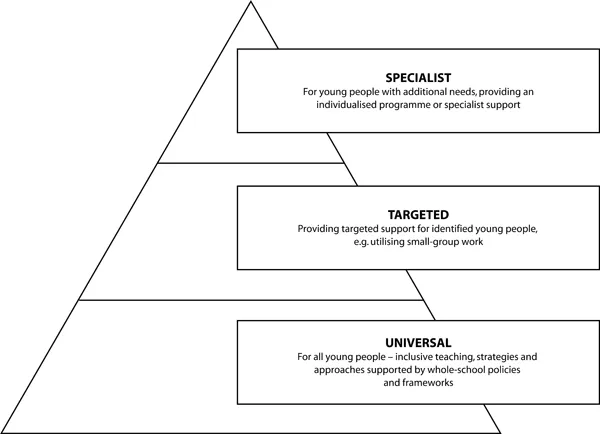
Levels of Support
This book provides an extensive range of strategies and approaches to support practitioners in meeting the needs of young people with SLCN. To intervene in a systematic way, it is necessary to consider different levels of support. The concept of a tiered system at a universal, targeted and specialist level provides a framework for supporting young people (DfES 2003). Throughout the book, the level at which strategies and approaches can be used will be identified:
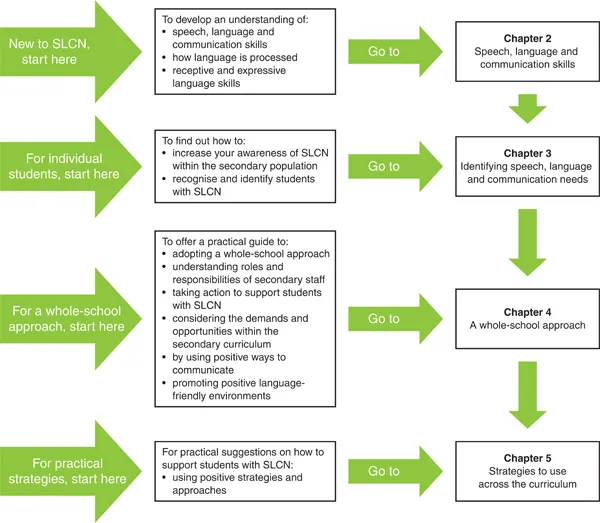
Making Practical Use of this Book
The structure of the book can be seen below to allow readers ease of access, whether considering how to meet the individual needs of a student or planning a whole-school approach.
![]()
| Speech, Language and Communication Skills |
This chapter aims to provide practitioners with an understanding of speech, language and communication skills and a shared language to talk about language. It describes the theoretical Language for Learning model of speech, language and communication skills; identifies and defines areas of speech, language and communication; describes how language is processed; and explains the difference between receptive and expressive language skills.
The Language for Learning Model of Speech, Language and Communication Skills
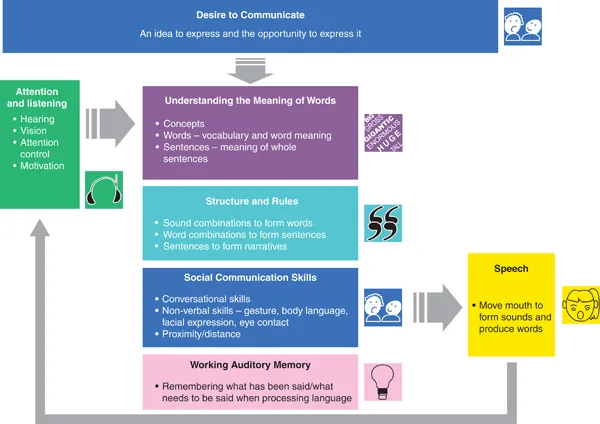
The process of understanding and using language is a complicated one, involving a range of different skills. The Language for Learning model provides a structured approach – a framework for thinking and talking about speech, language and communication skills. The model provides a shared language to talk about language skills; this prevents confusion and can help break down communication barriers created by the use of terminology, particularly by outside agencies. Often, teaching staff simply do not know where to begin to support a student with SLCN. The model can be used to make sense of observations and assessments, pinpointing specific needs and strengths. As specific areas of language are identified, it is possible to identify areas for development and intervention with confidence. Each area of language is colour- and symbol-coded, allowing all subsequent chapters to give reference to the model.
The Language for Learning model of speech, language and communication skills can be seen here.
A Model to Represent Speech, Language and Communication Skills
The boxes on the model represent different skills:
This is a fundamental communication skill – the desire to communicate an idea to someone else for either social reasons or to meet a personal need. Young people need an idea to communicate, the desire to communicate this idea to another person and the opportunity to do so. This skill is part of ‘social communication skills’, as described below.