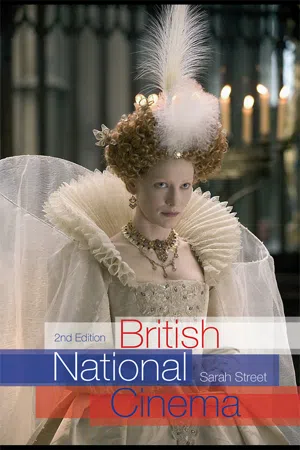
The first substantial overview of the British film industry with emphasis on its genres, stars, and socioeconomic context, British National Cinema by Sarah Street is an important title in Routledge's new National Cinemas series. British National Cinema synthesizes years of scholarship on British film while incorporating the author' fresh perspective and research. Street divides the study of British cinema into four sections: the relation between the film industry and government; specific film genres; movie stars; and experimental cinema. In addition, this beautifully illustrated volume includes over thirty stills from every sphere of British cinema. British National Cinema will be of great interest to film students and theorists as well as the general reader interested in the fascinating scope of British film.
- 248 pages
- English
- ePUB (mobile friendly)
- Available on iOS & Android
eBook - ePub
British National Cinema
About this book
Information
Chapter 1
The fiscal politics of film
THE EVOLUTION OF AN INDUSTRY
Cinema was born in the 1890s, the ‘last machine’ of Victorian invention.1 British inventors had been involved in experiments with photography and Thomas Edison’s ‘peep show’ kinetoscope was developed in America with the assistance of Englishman W. K. Dickson. The first public cinema exhibition in Britain is recorded as being organised by a representative of the French producers, the Lumière brothers, at Marlborough Hall in Regent Street, London, on 21 February 1896. British manufacturer Robert Paul invented the first film projector to be placed on the open market, also in 1896. It was not yet clear that America would dominate the world’s cinema screens and for a time British manufacturers of projectors and cameras were able to hold their own against foreign competition. Concentrating on supplying its vast home market, the American film industry had not yet begun its aggressive export drive. It was not until the early 1900s that American manufacturers began to take the entrepreneurial initiative, in close competition with the French companies Gaumont and Pathé. In many ways, however, the history of early film was about international experiment, with similar techniques and developments towards the institutional mode of representation occurring in many different countries at different times.2 The popular themes used in magic lantern exhibitions featured in early films and there was a great deal of thematic and stylistic repetition, particularly in early French, American and British productions.
Music halls were the first real home of the commercial cinema and during the years 1896–1906 many thousands of short films were produced in Britain, including innovative work by Cecil Hepworth, William Haggar, G. A. Smith, James Williamson, R. W. Paul and the Sheffield Photo Company. Most film-makers sold their films outright to travelling showmen and music-hall exhibitors. ‘Moving pictures’ were so popular that new premises had to be built: 1907–8 saw the erection of the first theatres entirely devoted to showing films. In 1908 there were only three exhibition companies registered, but by the end of 1914 there were 1,833 (PEP, 1952: 26). The number of cinemas also rose dramatically from 1,600 in 1910 to 3,500 by 1915 (Perelli, 1983: 375). The industry was evolving from a proliferation of small companies into a more or less tripartite structure, determined by the functions of production, distribution and exhibition which became increasingly distinct by 1914. It was not until around 1910 that exclusive (as opposed to open market) rental contracts came into being, escalating film prices and increasing competition.3 Exhibitors had to bid for the most popular films but once booked they were entitled to exclusive exhibition rights in their local area: the films could not be shown concurrently at other cinemas. Distribution became the most crucial element in film supply. Films were hired on increasingly competitive terms which encouraged product differentiation: for example, if a film was unusually long or if it required a limited run it was offered for a high price. This chain of relations gave distributors enormous power, as Michael Chanan (1990: 187) has explained: ‘A process began to unfold which step by step propelled them towards better control over the terms and conditions of supply and demand than either producers or exhibitors’. Once this trend was entrenched British producers were unable to keep pace with Hollywood’s quick turnover of cheap, popular films which distributors clamoured to hire.
Despite the innovative work of British producers and the increasing capitalisation of the exhibition sector, in 1910 only 15 per cent of films released in Britain were of British origin. Box office profits were used to hire American films rather than finance British production. During the years 1906–11 the pioneer producing companies did not consolidate or make advances on their early promising start. From 1911–14 there was a brief revival of the British industry, fuelled by a spate of longer films, mostly adaptations of plays and novels, but on the whole the most startling development was the success of America’s film export strategies. Kristin Thompson (1985) has shown how from 1909 American producers concentrated on distributing their films abroad. Britain was an especially important market because of London’s position as the centre for international trade and the world’s clearing house for films. The expansion of exhibition was also an incentive, together with the popularity of American films in Britain. By contrast, British producers had little success with their films in America and could not afford to compete with Hollywood’s high production values or turnover. This difficult situation was exacerbated by accusations that British films were primitive compared with Hollywood and the elaboration of myths about British cinema being uncinematic, tedious and too reliant on the theatre. This is not the place to examine these criticisms in detail, but it is clear that early British cinema needs to be examined on its own terms and in a European context rather than solely in relation to Hollywood. But from an economic standpoint, it is incontestable that American films enjoyed a highly advantageous position in the British market from an early stage. This had an impact on British producers in terms of creating an example of the stylistics of popular cinema and on audiences in terms of inculcating codes of generic expectation and viewing habits.
HOLLYWOOD’S EXPANSION AND QUOTA PROTECTIONISM
America was a leading force in the British market before 1914 and the First World War merely consolidated that hegemonic position. In 1914, 25 per cent of films shown in British cinemas were British, but by 1923 this figure had fallen to 10 per cent. In 1924 the total number of British films shown was 56 and in 1926 there were only 37 (Low, 1971: 156). America dominated its home market and the major film companies had amalgamated to become vertically integrated, uniting production, distribution and exhibition interests, with box-office profits providing their studios with production finance and cinemas guaranteeing automatic outlets for their films. Most of the majors had distribution subsidiaries abroad. In 1920 amongst the 14 leading distributors in Britain were Famous-Lasky (Paramount), Jury’s Imperial (MGM), Fox (Twentieth-Century Fox), Vitagraph (Warner Brothers) and Goldwyn (MGM). Between them these companies offered 310 American and British films but only 15 of these were British (PEP, 1952: 40). Films were particularly suited for world-wide distribution since almost the entire cost was incurred in making the first copy–by comparison marketing costs were very low. Hollywood could therefore supply its vast home market and the rest of the world’s cinema screens: there were 22,000 cinemas in the USA in the mid-1920s and 4,000 in Britain (Dickinson and Street, 1985: 10). This unbalanced relationship did not facilitate an exchange. The vertically integrated structure of the American industry made the American market a virtually closed one to foreign films, as an American study explained in 1926:
This market can now be profitably reached only through one or more of a group of not more than ten American distributors of pictures each of which is busily engaged in marketing its own brand of pictures through the theatres owned, controlled or operated by one or more of this group.
(Seabury, 1926: 195)
American producers also had the advantage of an effective trade organisation, the Motion Picture Producers and Distributors of America (MPPDA), which devoted considerable energy to researching the export of motion pictures.
Vertical integration, the foundation of American domination at home and abroad, did not develop in the British industry until the late 1920s and early 1930s. The outstanding development in the British industry in the 1920s was the growth of cinema circuits which formed the basis of the major combines of the 1930s, the Associated British Picture Corporation (ABPC) and the Gaumont-British Picture Corporation (GBPC). In the 1920s, exhibition was the most profitable element of the British industry: attendances were rising, American films were cheap and in plentiful supply, and in the ultimate distribution of box-office receipts exhibitors retained by far the lion’s share, while producers received a very small percentage. In 1925 economist Simon Rowson calculated that out of £35 million invested in the British film industry, producers only received £500,000 (Rowson, 1925: 41). When British exhibition interests linked up with production units in the 1930s there was always a tension between the need to produce more British films and the temptation to rely on American. Hollywood further consolidated its hold over exhibition by means of booking practices known as blind and block booking. Renters would agree to hire out a popular film only if the exhibitor agreed to take with it a series of unseen, often as yet unmade films which tied the exhibitor to one or more renters for a long period, leaving scant screen space for British films.
The Cinematograph Films Act, 1927, aimed to foster production by encouraging the exhibition of British films. The Act imposed a statutory obligation on renters and exhibitors to acquire and show a quota of British films. In the first year the renters’ quota was 7.5 per cent and the exhibitors’ was 5 per cent (the renters’ was higher so that exhibitors would be able to exercise an element of choice). Both were to increase by stages to 20 per cent by 1936, and to remain at that level until 1938 when the Act expired. A British film was defined as one made by a British subject or company, but the definition did not specify that control had to be in British hands, only that the majority of the company directors should be British. All studio scenes had to be shot within the Empire, and not less than 75 per cent of the labour costs incurred in a film’s production, excluding payments for copyright and to one foreign actor, actress or director, had to be paid to British subjects, or to persons domiciled in the Empire. The scenario had to be written by a British author, and the Act attempted to abolish blind and block booking. The Board of Trade was to register British films and to consult with a trade-dominated Advisory Committee.
The Act was the result of some fascinating debates on the role of film as an industrial commodity and as propaganda. The first active steps were taken by the government in 1925 in response to agitation from producers. A Joint Trade Committee was established to report to the Board of Trade on possible remedies for the decline in production. It was known that some members of the Conservative Party, back in office after the fall of the Labour Government in 1924, were sympathetic towards protection for industry, even though at the time Britain pursued a policy of free trade. Even though the Conservatives had lost the 1906 and 1923 elections over tariff reform, and Baldwin had pledged not to introduce a general tariff in his 1924 election address, many hoped that a measure of protection for the film industry might be secured. There was no question of a subsidy for producers or an import duty on American films: a quota, however, was considered to be an appropriate option. The debate on the protection of the film industry was therefore caught up in wider debates about the protection of British industry against foreign competition, and the propaganda elements of film were uppermost in official concern to counter the Hollywood invasion. Viscount Sandon, a Conservative MP, was hostile towards Hollywood films and on 25th January 1927 wrote an impassioned letter to The Times:
Children and young men and women, who pour nightly into the cinemas in the UK, see perpetually stories of divorce, of running away with other men’s wives, distorted home life, burglaries, murders, revolvers, produced as a matter of course by all and sundry … evidence of police, judges, school teachers, all accumulates to prove the disastrous effect of this on the rising generation.
Comments like this were common as increasing cultural and ideological alarm was expressed about American films. Another argument frequently put forward was that trade ‘followed the film’: Britain and the Empire were in danger of over-exposure to screen advertisement of American goods and lifestyles. Concern over the propaganda value of film and anti-Americanism therefore played a large part in securing the passage of the Cinematograph Films Act, 1927.
THE 1930s: CONSOLIDATION AND EXPANSION
The Act’s provisions afforded some protection for producers but did not seriously threaten box-office takings for popular American films. According however to Political and Economic Planning, the years 1927–30 were ‘the most momentous in the history of the British film industry’ (PEP, 1952: 45) because of state protection, the coming of sound and the formation of vertically integrated combines. State protection encouraged optimism about British production and as a consequence a plethora of companies were formed immediately after the Films Bill became law. The increased capital available to film producers enabled many to buy equipment for the conversion to sound, a process which, while not without its problems, was achieved with relative success by 1933 (see Murphy, 1984). The most far-reaching development was the formation of GBPC 1927 and ABPC 1928, highly capitalised, vertically integrated companies whose films were guaranteed an exhibition outlet. Financed by the Ostrer brothers, GBPC was an amalgamation of the interests of Gaumont, Ideal Films, the W. & F. Film Service and some cinema circuits. ABPC was the creation of Scottish solicitor John Maxwell, an amalgamation of British International Pictures, Wardour Films, First-National Pathé and several important cinema circuits including Provincial Cinematograph Theatres, the largest circuit in the 1920s. The Films Act’s promise of increased production further encouraged the growth of exhibition: between 1927 and 1932 715 new cinemas were built (Dickinson and Street, 1985: 35). The late silent period and the early years of sound films also fostered international co-operation between European cinemas, culminating in the ‘Film Europe’ movement which was formed to combat Hollywood’s domination and for a few years at least provided some evidence of pan-European cinema activity at the level of trade congress discussions and co-productions (Higson and Maltby, 1999). Relations between the film industries of Britain and Germany were particularly fruitful, as well as co-operation that was encouraged by the Multi-Language-Version (MLVs) industry when versions of the same film were made in several different languages.
The Films Act required American renters to handle British films. Many did this by sponsoring quota quickies, cheap films made purely to satisfy the letter of the law without providing serious competition for American films. Much maligned, quota quickies nevertheless provided work for British technicians and valuable experience for directors, and there is evidence that some were popular with regional audiences (ibid.: 45–46 and Chibnall, 2007). In 1931 the seven major American distributors had their 44 quota films supplied by 36 different British producers. Exhibitors exceeded their quota requirements, indicating that British films did fair business: in 1934 Simon Rowson discovered that in the year ending September 1934 exhibitors showed 26.4 per cent British films, when their statutory liability was only 15 per cent (Rowson, 1936: 118). The recovery and expansion of British production in the early 1930s has also been documented by Sedgwick (1994 and 2000) and success with exporting British films in the 1930s by Street (2002).
THE QUOTA, FILM FINANCE AND HOLLYWOOD
In 1938 a second Cinematograph Films Act was passed, modifying the basic framework of its predecessor and making some important changes. The legislation had been preceded by a report of a Committee chaired by Lord Moyne (Cmd. 5320, 1936), which drew attention to the shortcomings of the 1927 Act, including quota quickies, the need for a shorts quota and the persistence of booking offences. The 1938 Act continued protectionism via quotas for a further ten years and introduced a quota for short and documentary films. To encourage quality, a cost test was instituted whereby long films had to have cost a minimum of £1 a foot with a minimum total of £7,500 a film. A controversial system of double and treble quotas was available to facilitate American production of expensive feature films in Britain. The motives involved in the Cinematograph Films Act 1938 were in many respects similar to those of a decade earlier: an economic and ideological imperative to foster an alternative to Hollywood. But there were also two crucial developments in the 1930s resulting in a government policy which encouraged a new alignment with the American film industry: film finance and the international situation. These factors became essential determinants of the film industry’s future during the rest of the century.
Production expanded well into the 1930s. New companies were formed, 640 between 1935 and 1937 (Dickinson and Street, 1985: 76). The boom was encouraged by the international success of Alexander Korda’s The Private Life of Henry VIII, a film which made £500,000 on its first world run and was still earning £10,000 a year ten years later (Kulik, 1975: 89). The American success of Henry VIII can be largely explained by the link between Korda’s company, London Film Productions, and United Artists. Most other British companies did not have access to American cinemas via an astute distributor and, in retrospect, Henry VIII might be seen as an isolated case of a British film conquering international markets. On the other hand, some films during the 1930s managed to gain distribution outlets in America including The Ghost Goes West (1935), musicals starring Jessie Matthews and films with imperial themes such as The Drum (1938) whose paths were eased via agreements between the larger British companies such as Gaumont-British and Hollywood studios (Street, 2002: 43–90). But as far as the domestic industry was concerned, by 1937 the boom was over and the industry was in dire financial straits. Short-term, unstable methods of film finance had facilitated the mid-1930s boom but, when many of the films lost money, financiers withdrew their support and company after company went into liquidation. Film business had always been risky business and the crisis confirmed the City’s formerly cautious attitude. The Prudential Assurance Company had backed Korda, only to regret its investment when the company lurched from crisis to crisis throughout the 1930s (see Street, 1986). When the Films Act was being debated in Parliament the industry’s financial plight was therefore a major concern.
The severity of the 1937 crash, and the government’s unwillingness to encourage proposals for a Film Bank (ibid.: 81–88), prompted the Board of Trade to look to Hollywood to finance British films, initiating a policy which had a profound impact on the industry’s subsequent history. Hollywood was highly capitalised and deals with American companies brought with them the promise of access to the closed American market. The Moyne Committee had expressed concern about control passing abroad, but as yet there was little evidence of American companies with sinister motives towards the British industry. In 1935 United Artists purchased a 50 per cent interest in Odeon Cinemas, the third largest circuit, but Odeon’s owner, Oscar Deutsch, retained the casting vote and control. J. Arthur Rank hoped that a deal between the General Cinema Finance Corporation (GCFC) and Universal in 1936 would facilitate access to American cinema screens and be of considerable benefit to the British industry. The group’s distribution company, General Film Distributors (GFD) also handled Universal’s product in Britain. Dismissing the conspiracy theory of an American takeover, the Board of Tr...
Table of contents
- Cover Page
- Title Page
- Copyright Page
- List of plates
- Acknowledgements
- Introduction: British national cinema
- 1 The fiscal politics of film
- 2 Studios, directors and genres
- 3 Genres from austerity to affluence
- 4 Genres in transition: 1970s to 1990s
- 5 Contemporary British cinema
- 6 Acting and stars
- 7 Borderlines I: Modernism and British cinema
- 8 Borderlines II: Counter-cinema and independence
- Conclusion
- Notes
- Bibliography
Trusted by 375,005 students
Access to over 1.5 million titles for a fair monthly price.
Study more efficiently using our study tools.
Frequently asked questions
Yes, you can cancel anytime from the Subscription tab in your account settings on the Perlego website. Your subscription will stay active until the end of your current billing period. Learn how to cancel your subscription
No, books cannot be downloaded as external files, such as PDFs, for use outside of Perlego. However, you can download books within the Perlego app for offline reading on mobile or tablet. Learn how to download books offline
Perlego offers two plans: Essential and Complete
- Essential is ideal for learners and professionals who enjoy exploring a wide range of subjects. Access the Essential Library with 800,000+ trusted titles and best-sellers across business, personal growth, and the humanities. Includes unlimited reading time and Standard Read Aloud voice.
- Complete: Perfect for advanced learners and researchers needing full, unrestricted access. Unlock 1.5M+ books across hundreds of subjects, including academic and specialized titles. The Complete Plan also includes advanced features like Premium Read Aloud and Research Assistant.
We are an online textbook subscription service, where you can get access to an entire online library for less than the price of a single book per month. With over 1.5 million books across 990+ topics, we’ve got you covered! Learn about our mission
Look out for the read-aloud symbol on your next book to see if you can listen to it. The read-aloud tool reads text aloud for you, highlighting the text as it is being read. You can pause it, speed it up and slow it down. Learn more about Read Aloud
Yes! You can use the Perlego app on both iOS and Android devices to read anytime, anywhere — even offline. Perfect for commutes or when you’re on the go.
Please note we cannot support devices running on iOS 13 and Android 7 or earlier. Learn more about using the app
Please note we cannot support devices running on iOS 13 and Android 7 or earlier. Learn more about using the app
Yes, you can access British National Cinema by Sarah Street in PDF and/or ePUB format, as well as other popular books in Social Sciences & Film & Video. We have over 1.5 million books available in our catalogue for you to explore.