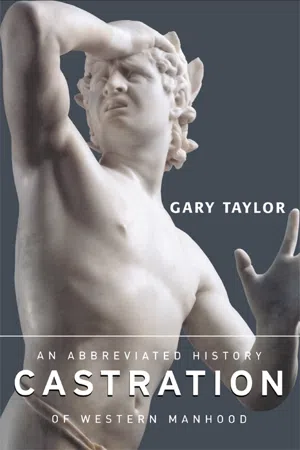
Castration is a lively history of the meaning, function, and act of castration from its place in the early church to its secular reinvention in the Renaissance as a spiritualized form of masculinity in its 20th century position at the core of psychoanalysis.
- 318 pages
- English
- ePUB (mobile friendly)
- Available on iOS & Android
eBook - ePub
Notes
To the reader: These notes are extensive, because no previous history or theory of castration has been adequately documented, and because analysis of the subject must draw upon many scholarly disciplines. The notes are keyed to page numbers and names or topic phrases in the text; when the note identifies a quoted passage, I generally give the final words followed by closing quotation marks (as in raspberry swirl”). This system enables you to track my sources; but it also allows you to browse the notes without having to flip back and forth constantly between different parts of the book. Full references are given only on the first occurrence of a title; but if you are intrigued by an abbreviated reference and don’t want to trawl backward through all the notes to find the full details, you can find that first occurrence in the Index.
Four texts are central to this book. Throughout these notes, references to Freud cite volume and page numbers of The Standard Edition of the Complete Psychological Works of Sigmund Freud, tr. James Strachey et al., 24 vols. (1955–1974). I use the Latin text of Augustine’s De Civitate Dei in William M. Green’s edition of The City of God against the Pagans, 7 vols. (1963); I do not generally follow his translation, however, preferring either my own or John Healey’s translation, Of the City of God, rev. W.Crashawe (1620). References to A Game at Chess, unless otherwise noted, correspond to the text of “A Later Form” in The Collected Works of Thomas Middleton, gen. ed. Gary Taylor (Oxford University Press, 2001); citations of other works by Middleton adopt the text, titles, line numbering, chronology, and canon of that edition. The Bible is cited (unless otherwise noted) from the so-called “King James” or “Authorized” translation, first published in 1611. Throughout the book, I have modernized the spelling and punctuation of quotations.
What Does Manhood Mean?
1 Charles Ancillon, Traité des Eunuques (1707), tr. Robert Samber and published anonymously as Eunuchism Display’d (1718), x.
1 1999 hit single Christina Aguilera, “Genie in a Bottle,” on Christina Aguilera (1999).
2 Pointer Sisters, “Slow Hand,” on Black and White (1981).
2 Snap, “Believe in It,” on The Madman’s Return (1992).
2 raspberry swirl” Tori Amos, “Raspberry Swirl,” on From the Choirgirl Hotel (1998).
3 “star-fuckers” Tori Amos, “Professional Widow,” on Boys for Pele (1996).
3 Germaine Greer, The Female Eunuch (1970), 307.
3 challenge and possess” Middleton, A Game at Chess, 1.1.171.
4 birth control On the central role of women in braking birth rates, see Angus McLaren, A History of Contraception: From Antiquity to the Present Day (1990), 193–251.
4 fifty percent Leslie Lafayette, Why Don’t You Have Kids? Living a Full Life without Parenthood (1995), 18. She has an excellent chapter on men’s resistances to fatherhood (132–154).
5 on my back” Alanis Morissette, “Right Through You,” on Jagged Little Pill (1996).
5 restaurant Alanis Morissette, “I was hoping,” on Supposed Former Infatuation Junkie(1998).
5 playing God Morissette appeared as God in the film Dogma (1999), directed by Kevin Smith.
6 office as a fashion runway Nancy Friday, The Power of Beauty (1996), 377–449.
6 cosmetic surgery Edisol Wayne Dotson, Behold the Man: The Hype and Selling of Male Beauty in Media and Culture(1999), 103–111.
6 Hollywood films Celia R.Daileader, “Nude Shakespeare,” in Shakespeare and Sexuality, ed. Stanley Wells (forthcoming).
6 gay subculture Naomi Wolf, The Beauty Myth: How Images of Beauty Are Used against Women (1991), 288–289; Susan Faludi, Stiffed: The Betrayal of the American Man (1999), 505–529.
7 chastity movements Eric Werner, “The Cult of Virginity,” Ms. (March/ April 1997), 40–44; Adam Davidson, “The Joy of No Sex,” Rolling Stone (October 15, 1998), 81–82.
8 Michel Foucault, The History of Sexuality, volume I: An Introduction, tr. Robert Hurley (1978), 43.
8 modes of affectation” John Cleland, Memoirs of a Woman of Pleasure (1749), ed. Peter Sabor (1985): There is “a plague-spot visibly imprinted on all” men “of that stamp,” who are “stript of all the manly virtues of their own sex, and fill’d up with only the very worst vices and follies of ours,” producing thereby a “monstrous inconsistency” (159–160).
8 Eve Sedgwick, Between Men (1985).
8 Marjorie Garber, Vice Versa: Bisexuality and the Eroticism of Everyday Life (1995), 167–206. The particular quotation comes from Freud’s last case study, “The Psychogenesis of a Case of Homosexuality in a Woman” (1920), 18:157; but in fact Freud suffuses Garber’s book, and is its central figure.
8 Lee Edelman, Homographesis: Essays in Gay Literary and Cultural Theory (1994), 173–191.
9 Susan Faludi, Stiffed, 9. This (unanalyzed) image of “emasculation” is often reiterated: 144, 507, 524, 529, 532, etc.
9 “Me and a Gun” Tori Amos, on Little Earthquakes (1991).
10 more than a dildo” Greer, Female Eunuch, 307.
11 Mesopotamian myth “The Descent of Ishtar,” in Ancient Near Eastern Texts Relating to the Old Testament, ed. James B.Pritchard, 2nd ed. (1955), 109; also in Myths from Mesopotamia, ed. Stephanie Dalley (1989), 159. This Akkadian version is first attested to in Late Bronze Age texts (c. 1650–1150 B.C.E.), but most scholars believe that the cuneiform tablets redact much earlier oral traditions. “The shadow of a wall” was a stereotypical locale for prostitutes; taverns were also brothels; so the eunuch is being cursed to the life of a homosexual male whore, whose drunken customers beat him (“smite your cheek”).
12 Albert Camus, The Stranger, tr. Matthew Ward (1988), 92.
13 Plato, Euthyphro, tr. Benjamin Jowett, in The Trial and Death of Socrates: Four Dialogues (1992), 12; for the Greek text (and commentary), see Plato’s Euthyphro, ed. Ian Walker (1984), 12a7.
14 Augustine, Of the City of God, tr. John Healey, rev. W.Crashawe (1620), 271, 285. This “corrected” second edition differs from the first (1610) edition, which does not contain the phrase “what does that mean now” (188).
14 enigmatic passage twice Augustine, Confessions, tr. F.J.Sheed, intro. Peter Brown (1993), II.2 (p. 24), VIII.1 (p. 130).
15 emasculate the world” Tertullian, De cultu feminarum, II.9.7; On the Apparel of Women, tr. Edwin A.Quain, in Disciplinary, Moral and Ascetical Works (1959), 142.
15 hostile to life” Friedrich Nietzsche, “Morality as Anti-Nature,” 1–3, in The Twilight of the Idols (1889), tr. R.J.Hollingdale, in A Nietzsche Reader (1977), 163.
16 federal intellectual space Gary Taylor, “Farrago,” Textual Practice 8 (1994), 33–42.
16 Edward O.Wilson, Consilience: The Unity of Knowledge (1998).
17 Entmannung Freud rarely used the German word equivalent to the English “unmanning.” See Konkordanz zu den Gesammelten Werke von Sigmund Freud, ed. Samuel A.Guttman et al., 6 vols. (1995), and Gesammelten Werke, ed. Marie Bonaparte, Anna Freud, et al., 18 vols. (1968–1978): Interpretation of Dreams, 4:256 (entmannt) and 4:256, note 1 (Entmannung). More often, he used the word Kastration even when his sources more precisely use Entmannung: See Jay Geller, “Freud v.Freud: Freud’s Readings of Daniel Paul Schreber’s Denkwürdigkeiten eines Nervenkranken,” in Reading Freud’s Reading, ed. Sander L.Gilman et al. (1994), 180–210.
17 history of the eunuch Twentieth-century histories of the eunuch include: Peter Browe, Zur Geschichte der Entmannung: eine religions-und rechts-geschichtliche Studie (1936); Peter Tompkins, The Eunuch and the Virgin (1962); Charles Humana (pseudonym of Joseph Jacobs), The Keeper of the Bed: The Story of the Eunuch (1973); Victor T.Cheney, A Brief History of Castration (1995). The three most recent “histories” were all written by amateur scholars with sometimes peculiar agendas. Tompkins, for instance, systematically championed the eccentric sexual theories of Wilhelm Reich (including the “orgone”); Jacobs included sixteen (mostly soft-porn) illustrations, uncritically accepted the universal validity of Freud’s castration theories, and began and ended his book deploring “the certainty” of vasectomy becoming “compulsory in a future era” (8), thereby producing “dull generations of future sterile males” and “submissively sterile” husbands (198). There is, of course, no evidence that vasectomies produce dullness or submissiveness. Cheney is a retired Air Force officer who advocates judicial castration “as a remedy for serious sex offenders” (viii); his own sexual politics can be inferred from statements like “homosexuals…and other sexual deviates” (8), or “polygamy evolved with the laudable objective of safeguarding the continuation of the family and the racial strain” (25– 26). Typically, these books collect references to castration in many cultures (often cited at second hand, and usually without documentation of any kind), but they do little to analyze the textual sources or the historical phenomena, and they pay little attention to current scholarship on the texts they cite or the cultures they describe; they are essentially sensational and anecdotal.
17 treatise on e...
Table of contents
- Cover Page
- Title Page
- Copyright Page
- Timeline
- What Does Manhood Mean?
- Contest of Texts Christianity, Freudianity, Humanism
- Contest of Males the Power of Eunuchs
- Contest of Organs Genital Plural
- Contest of Gods Dream Divination
- Contest of Reproductions the Rise of the Penis, the Fall of the Scrotum
- Contest of Genders Castrating Women
- Contest of Races Castrated White Men
- Contest of Kinds Confusing Categories
- Contest of Signs Branded and Domesticated Male Animals
- Contest of Times What Would Jesus Do?
- The Future of Man
- Appendix Thomas Middleton and a Game at Chess
- Acknowledgments
- Notes
Trusted by 375,005 students
Access to over 1.5 million titles for a fair monthly price.
Study more efficiently using our study tools.
Frequently asked questions
Yes, you can cancel anytime from the Subscription tab in your account settings on the Perlego website. Your subscription will stay active until the end of your current billing period. Learn how to cancel your subscription
No, books cannot be downloaded as external files, such as PDFs, for use outside of Perlego. However, you can download books within the Perlego app for offline reading on mobile or tablet. Learn how to download books offline
Perlego offers two plans: Essential and Complete
- Essential is ideal for learners and professionals who enjoy exploring a wide range of subjects. Access the Essential Library with 800,000+ trusted titles and best-sellers across business, personal growth, and the humanities. Includes unlimited reading time and Standard Read Aloud voice.
- Complete: Perfect for advanced learners and researchers needing full, unrestricted access. Unlock 1.5M+ books across hundreds of subjects, including academic and specialized titles. The Complete Plan also includes advanced features like Premium Read Aloud and Research Assistant.
We are an online textbook subscription service, where you can get access to an entire online library for less than the price of a single book per month. With over 1.5 million books across 990+ topics, we’ve got you covered! Learn about our mission
Look out for the read-aloud symbol on your next book to see if you can listen to it. The read-aloud tool reads text aloud for you, highlighting the text as it is being read. You can pause it, speed it up and slow it down. Learn more about Read Aloud
Yes! You can use the Perlego app on both iOS and Android devices to read anytime, anywhere — even offline. Perfect for commutes or when you’re on the go.
Please note we cannot support devices running on iOS 13 and Android 7 or earlier. Learn more about using the app
Please note we cannot support devices running on iOS 13 and Android 7 or earlier. Learn more about using the app
Yes, you can access Castration by Gary Taylor in PDF and/or ePUB format, as well as other popular books in History & Social History. We have over 1.5 million books available in our catalogue for you to explore.