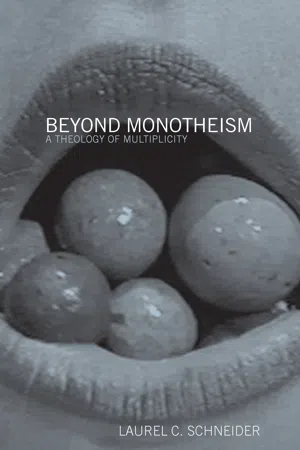
Laurel Schneider takes the reader on a vivid journey from the origins of "the logic of the One" - only recently dubbed monotheism - through to the modern day, where monotheism has increasingly failed to adequately address spiritual, scientific, and ethical experiences in the changing world. In Part I, Schneider traces a trajectory from the ancient history of monotheism and multiplicity in Greece, Israel, and Africa through the Constantinian valorization of the logic of the One, to medieval and modern challenges to that logic in poetry and science. She pursues an alternative and constructive approach in Part II: a "logic of multiplicity" already resident in Christian traditions in which the complexity of life and the presence of God may be better articulated. Part III takes up the open-ended question of ethics from within that multiplicity, exploring the implications of this radical and realistic new theology for the questions that lie underneath theological construction: questions of belonging and nationalism, of the possibility of love, and of unity. In this groundbreaking work of contemporary theology, Schneider shows that the One is not lost in divine multiplicity, and that in spite of its abstractions, divine multiplicity is realistic and worldly, impossible ultimately to abstract.
the whole is not given, and things are always starting up again in the middle, falling together in another, looser way…one thus has nothing of the sense of a well-planned itinerary; on the contrary, one is taken on a sort of conceptual trip for which there pre-exists no map.
John Rajchman1
The logic of the One, which has governed the era of European expansion, has tendrils stretching back as far as thirty-five centuries into the reign of Akhenaten in Egypt, though it did not become dominant and flourish until much later in Persia, Israel, and Greece. The logic of the One—only very lately dubbed monotheism—has functioned powerfully on behalf of exiles and emperors alike, and it has framed a whole scientific methodology. For all of its success, however, the logic of the One simply doesn’t work well enough any more to satisfy far-reaching questions about either divinity or the world. The logic of the One is not wrong, except, ironically, when it is taken to be the whole story. Rather than false, it is incomplete. The logic of the One (and the concept of God that falls within it) is simply not One. There is always less, and more, to the story.
To paraphrase Luce Irigaray’s wonderfully double-edged notion, this is a book about the divinity “which is not One.”2 What is more, it is a book about divine “being” and “presence,” both of which are topics that have sunk far more learned and accomplished theologians than myself. There is, however, some comfort in knowing that we need not fear sinking (or foundering, or stumbling, or falling into contradiction, or any number of like disasters that normally stump the systematic theologian). Sometimes these mishaps are the best way to move forward. As Gilles Deleuze once happily declared, “An impasse: So much the better.”3 The “ship” of theology, particularly of Christian theology, is full of holes and always has been. Sinking may be precisely the way to proceed.
The deceptively simple claim of this book is that divinity beyond the logic of the One, beyond monotheism, occurs. This idea of occurring divinity—divine multiplicity—sins against the ideologies of eternity and stasis required of oneness and so recognizes leaks in the Christian empire’s God Who Is and Ever Shall Be. It also sins against ideologies of linear progress, as if there is a single goal or telos toward which the rich manyness of the embodied cosmos must “process,” in flight from itself as it is. Instead, the idea of occurring divinity pursues incarnation in terms of bodies (which may seem a straightforward notion but, sadly, in Christian theology it is not), and this means affirming what Marcella Althaus-Reid calls “the dissonant and multiple in theology” as much as, if not more than, the ordered and unified.4 While not opposed to unity in a proximal sense (that would be merely a new either/or, which depends on the logic of the One) there is an epistemological challenge in this affirmation that comes directly from feminism. Not only is the question of incarnation a feminist one because it takes up the messy variability of bodies, but because, as Claire Colebrook points out, “feminism has always been more than a quibble regarding this or that value or prejudice within an otherwise sound way of thinking.”5
What is more, this theology emerges out of a specific time and place of political uncertainty, prolonged wars with unclear rationales, and global shifts in power. Guerilla attacks by “terrorists” and massive, devastating retribution by wealthy “nations” are impossible to unravel in traditional terms of border disputes, royal lines of succession, or access to industrial wealth. The economics and emerging sociology of globalized capital are less and less tied to the idea of “nations,” meaning that both war and peace conceived in national terms are less coherent and less effective. And theology is as mixed up in politics and the effects of global economics today as it ever has been in history. This is particularly evident in the United States and in the countries of the Middle East, all of which are intimately bound together in struggles for power that, as often as not, are framed in the languages of religious ideologies of monotheism. Theology, particularly theology emerging out of the United States, cannot avoid these struggles over the One God because it is implicated in and made complicit by the effects of American actions on the world and on ourselves.
Theologies of the One and divinity which is not One therefore occur today in the context of what Ania Loomba, Suvir Kaul, and others call the “rapidly proliferating defenses of empire (not simply de facto but de jure).”6 Schooled in theologies of the One, we can only glimpse the divinity which is not One in retrospect or foreshadowed as the excess, temporality, and partiality of the imperial One and Same that at the same time fails at oneness, that cannot actually tolerate flesh, that suffocates in the closures of the Whole, even when it is conceived in triplicate. Only a divinity not constrained to ultimacy, eternal oneness, or numerical systems can actually come, can actually “dwell among us.” But it is all too easy to miss such a divinity entirely, if eyes are focused only on the gilt frames of church authority. A different logic is required—perhaps an affirmative one—for following Rajchman’s Deleuze “to affirm is not to assert or assume, but to lighten, to unground, to release the fresh air of other possibilities, to combat stupidity and cliché.”7 A logic of multiplicity en route to a better theological understanding and affirmation of incarnation is what this particular search for divinity beyond the logic of the One is about.
Bread and stones: tools for the journey
I do not travel this road alone or without help. There are runes in the stones on every side, signs of ancient wisdom that exceed the totalizing drive of the One. They spill out of the unfinished and multiple biblical stories as well as the fragments and ruined returns of philosophy and poetry from the outer edges of the ancient empires of Africa, Asia, and the Mediterranean and the modern empires of Europe and the Americas. Layers of complication point to a depth that cannot be written but that funds every beginning-again. A bit breathlessly, therefore, I try to read what I can of these signs while following contemporary teachers whose own work guides them toward divinity beyond the logic of the One. I know, in other words, that a “theology of multiplicity” means nothing if it travels solo. There are strong strains here of Catherine Keller’s own dive into the Tehom (the Deep) in search of tehomic divinity,8 as there are of Marcella Althaus-Reid’s search for the God made indecent by totalitarian theologies: the bacchanalian tail of the queerly migrant divine.9 Kwok Puilan, Wohnee Anne Joh, James W.Perkinson and most of my students point toward divinity that does not embody or bless the powers of empire but traverses its unstable borderlines, haunted by slavery, hunted by homeland security, illegal and unassimilated—the unwhitewashed body of God.10 There is also here A.Okechukwu Ogbonnaya’s determination to hold off the curse of solitude in divinity, along with Kathryn Tanner’s search for the excessive, profligate divine in love with the world.11 Delores Williams, Ellen Armour and Sharon Welch guide me in a determination to stay accountable for the myriad privileges and recapitulations that accompany any white feminist project while Gilles Deleuze and Thomas King open pathways to a hermeneutic of empire-toppling humor, story-telling, and border-crossing joy.12
There are also many other teachers and guides whose ideas shape this work, at times critically and at other times constructively, because it is part of a swelling movement in theology that seeks to resist the intertwining and co-constitutive dynamics of racism, sexism, heterosexism, classism, and nationalism. These dynamics—tools of colonialism and imperial theology—do not dissipate in theologies of resistance just because they are named. Sexism, racism, classism, heterosexism, ethnocentrism, and nationalism all constitute each other in the colonial and postcolonial context and ride incognito in word choices, imagination, dream, and story; they slide into each other when pressed, and so can reinscribe themselves in even the most “liberationist” of theologies.13 The privileges that accompany these dynamics in any of their many forms are sticky and resilient. There is no purity in resistance, including the resistances attempted in this project, which is why it travels in the company of others, critics and supporters alike. It is therefore appropriate, by way of beginning, that I follow the decidedly impure Mary Daly in seeking to pick up certain tools necessary for this work. She names them the “Courage to See” and the “Courage to Sin…Big.”14
Some of the resources and challenges before this project lie in the richly complicated history of Christian theology in relation to structures of empire. History is never simple, and the logic of the One has served both to shore up imperial aspirations to absolute power and, at times, to stand in judgment of those aspirations. The genealogy of monotheistic morals with regard to empire is not uniform, though the overwhelming tendencies toward totalizing claims in the religions of the One God suggest the very critique that this study undertakes. When theology provides divine orientation for empire (and what empire has not had its servant theologians?) resistance to empire also needs be in some part theological. Empire theology, to paraphrase Jacques Derrida, therefore constitutes a “prosthetic origin” and legitimation for both imperial rulers and citizens.15 Access to citizenship in a nation endowed with divine right and heroic origins allows the citizens access to imperial largess and to tell their story in such a way that they forget that they were themselves once poor, once criminal, homeless, illegal, or slaves.
Deployed through the centuries since Constantine by rulers in search of a divine mirror for their totalitarian dreams of state or of church power, Christian monotheism is empire theology. I am by no means alone in this claim, nor did I come up with the idea. Early in the twentieth century Erik Peterson wrote an influential essay on the political consequences of monotheism entitled “Monotheism as a Political Problem” which many later theologians found persuasive, marking a resurgent interest both in the political consequences of monotheism and in the importance of the idea of Trinity for Christian theologians who sought to criticize the ease with which monotheistic ideas find purchase in totalitarian political regimes.16 Among the most vigorous of contemporary theologians to take up this challenge are Leonardo Boff and Jürgen Moltmann, famous for their critiques of “monarchical monotheism” and for their interest in social concepts of the Christian doctrine of Trinity.17
I come to the problem of imperial Christian monotheism, however, not from a presupposition that Trinity should be the resolution, although some may well conclude with Boff, Moltmann, LaCugna, Tanner, Jennings, and others that it should be. Instead I come to the problem with the presupposition that incarnation, taken seriously, voids all numerical reckoning. I have therefore elected to think toward divinity in multiplicity, in which multiplicity is an ontological gesture rather than a mathematical equation and in which multiplicity indicates actual presences and relations. Multiplicity exceeds abstract principles (even attractive ones like “becoming”) whenever those principles eclipse presence.
Put another way, I am attempting a logic, or posture, that resists reduction to the One and resists reduction to the Many while affirming a more supple and effective (rather than absolute) unity. This book is therefore not about “God or the gods,” because the answer to monotheism’s totalitarian limitations is not polytheism. Polytheism is monotheism’s supporting cast and neither polytheism nor monotheism can attend to the uncompromising thereness of incarnate divinity. Incarnation is, after all, about bodies. And bodies, in their own uncompromising thereness, queerness, and susceptibility to revolt, are always a problem for abstract theologies, which function foundationally on principles that tend toward stasis. Bodies are also a recurrent problem for empires, which function on principles of progress and the abstraction of bodies into useful social categories (like legions, classes, races, and nations). To the extent that “empire” is a kind of shorthand not only for globalized consolidations of power in the hands of a few but also for the logic of the One writ large, it stands in opposition to “gospel” as a mobile and always contextualized message of good news to the poor and disenfranchised. Divine embodiment—incarnation—therefore becomes a kind of shorthand for the undoing of imperial pretensions to totality and final solutions. This is what makes incarnation the key to rethinking the logic of the One toward a Christian theology that is constituted again in relation to its understanding of God-among-us, a divine reality not only implicated in but explicated out of the very fabric of the worlds we inherit and incorporate. Incarnation in this theological sense is not just the event of a man named Jesus who is affirmed in the Nicene creed as “true God from true God made man.” Incarnation is instead a basic theological posture and starting place, an orientation toward reality that, in its attention to the mutability of bodies, undoes the logic of the One and its pretensions.
Throughout Christian history, the arguments of theologians reflect, on the whole, a shared concern. They almost all endeavor to articulate understandings of the divine, a concept of which may include or even follow scripture, creed, or tradition, in light of the needs of the day. In other words, theologians everywhere are concerned to clarify how the content of theology, the λ
γος (logos) about θε
ς (theos), has what Theodore Jennings calls a “context of plausibility” or “point of contact” in the world.18 Theologians have always had to ask how we can speak of divine presence in such a way that its possibility is not so implausible or wholly alien as to be lost to recognition altogether. This is what sets theology apart from other kinds of modern intellectual enterprises: there is an utter investment in translating core symbols and claims of faith into contexts of plausibility that link the profundity of the symbols to the effective meaning structures of lived experiences and cultures. Theology that pretends a distance from the everyday world is both elite and irrelevant. Theology that pretends a distance from prayer is fooling itself.
So, because theology is concerned intimately with the divine,19 and the language, ideas, and images for Christian divinity overwhelmingly have been shaped and formed out of the long process of religious sedimentation from pre-Christian to Christian sources in the ancient Near East, Africa and the Greco-Roman empire, theology must take account of its own recurring origins or suffer a true lack of profundity. Catherine Keller has made the excellent point that “theology has no choice but to return recurrently and critically to its originative discourses—unless it wants to create theology ex nihilo,” the doctrine of which she rightly takes a dim view.20 Wh...
Table of contents
Contents
Preface
Acknowledgments
1 Introduction
Part I The logic of the One
Part II Toward divine multiplicity
Part III Ethics and postures of multiplicity
Notes
Bibliography
Index of names and subjects
Index of biblical references
Trusted by 375,005 students
Access to over 1.5 million titles for a fair monthly price.
Study more efficiently using our study tools.
Frequently asked questions
Yes, you can cancel anytime from the Subscription tab in your account settings on the Perlego website. Your subscription will stay active until the end of your current billing period. Learn how to cancel your subscription
No, books cannot be downloaded as external files, such as PDFs, for use outside of Perlego. However, you can download books within the Perlego app for offline reading on mobile or tablet. Learn how to download books offline
Perlego offers two plans: Essential and Complete
Essential is ideal for learners and professionals who enjoy exploring a wide range of subjects. Access the Essential Library with 800,000+ trusted titles and best-sellers across business, personal growth, and the humanities. Includes unlimited reading time and Standard Read Aloud voice.
Complete: Perfect for advanced learners and researchers needing full, unrestricted access. Unlock 1.5M+ books across hundreds of subjects, including academic and specialized titles. The Complete Plan also includes advanced features like Premium Read Aloud and Research Assistant.
Both plans are available with monthly, semester, or annual billing cycles.
We are an online textbook subscription service, where you can get access to an entire online library for less than the price of a single book per month. With over 1.5 million books across 990+ topics, we’ve got you covered! Learn about our mission
Look out for the read-aloud symbol on your next book to see if you can listen to it. The read-aloud tool reads text aloud for you, highlighting the text as it is being read. You can pause it, speed it up and slow it down. Learn more about Read Aloud
Yes! You can use the Perlego app on both iOS and Android devices to read anytime, anywhere — even offline. Perfect for commutes or when you’re on the go. Please note we cannot support devices running on iOS 13 and Android 7 or earlier. Learn more about using the app
Yes, you can access Beyond Monotheism by Laurel Schneider in PDF and/or ePUB format, as well as other popular books in Teologia e religione & Teologia cristiana. We have over 1.5 million books available in our catalogue for you to explore.