eBook - ePub
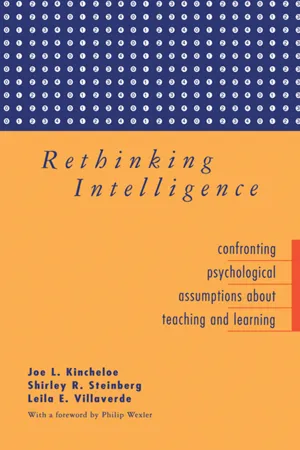
Rethinking Intelligence
Confronting Psychological Assumptions About Teaching and Learning
- 288 pages
- English
- ePUB (mobile friendly)
- Available on iOS & Android
eBook - ePub
Rethinking Intelligence
Confronting Psychological Assumptions About Teaching and Learning
About this book
Arguing that a comprehensive theoretical overhaul of mainstream educational psychology is long overdue, Rethinking Intelligence suggests criteria upon which new models can be developed. The contributors reconceptualize educational psychology through a democratic vision of inclusivity that takes into account the culturally inscribed nature of research. They offer a theoretical and historical critique of how intelligence is measured in ways that exclude or ignore other criteria. By doing so, they hope to encourage educators and researchers to imagine new forms of intelligence, education, and life.
Information
Chapter 1
The Foundations of a Democratic Educational Psychology
Joe L.Kincheloe
The concepts of intelligence and cognitive development often used by mainstream educational psychology are relics from another era. Rethinking Intelligence: Confronting Psychological Assumptions About Teaching and Learning maintains that a comprehensive theoretical overhaul of mainstream educational psychology is well overdue. Making use of dramatic changes in social theory and the development of critical pedagogies over the last twenty years, we propose to begin the task of rethinking intelligence. This reconceptualization of educational psychology is grounded on a democratic vision of inclusivity that refuses to view “others” only through the lenses of dominant (often white, Western European, male, middle- or upper-middle class) culture. This democratic vision moves psychologists to document and validate types of reasoning and intelligence that differ from those now recognized by the field and the instruments used to measure them. Such a practice democratizes intelligence by admitting new members to the exclusive community of the talented. In this reconceived context, the central criterion for aptitude no longer involves simply how closely the individual comes up to “our norms.” Such a turn holds profound consequences for educators, who often learn from prevailing forms of educational psychology to view difference as a deficit. With such a democratic idea in mind, educators gain the capacity to learn alternative models of cognitive development from students previously dismissed as incapable.
Such a democratized view is made visible by our understanding of the culturally inscribed nature of research, psychological research in particular. Cognitive and educational psychologists look for traits of intelligence with which they are familiar. Unknown attributes of intelligence cannot be measured by psychology and are thus ignored. As a result, only a culturally specific set of indicators of aptitude is sought. In this way the intelligences of both individuals from cultures different from the psychologists’ and unique thinkers or geniuses from any sociocultural background—such as an Albert Einstein—are dismissed. In a political context, those who deviate from the accepted norms of psychology fail to gain the power of psychological and educational validation so needed in any effort to gain socioeconomic mobility and status in contemporary Western societies.
The discipline of educational psychology and the educational leaders it informs have had difficulty understanding that the poor and the non-white are not stupid. Often children from working-class and lower- socioeconomic-class homes do not ascribe the same importance to the mental functions required by intelligence tests or achievement tests and academic work in the same way as do middle- and upper-middle-class students. In this context, the difference between cultural disposition and intellectual ability is lost upon the field of educational psychology. Working-class and poor students often see academic work as unreal, as a series of short-term tasks rather than something with a long-term relationship to their lives. Real work, they believe, is something you get paid for after its completion. Without such compensation or long-term justification, many times these students display little interest in school. This lack of motivation is often interpreted by mainstream educational psychologists, of course, as inability or lack of intelligence. Poor performance on standardized achievement tests scientifically confirms the “inferiority” of the poor students (Oakes, 1988; Nightingale, 1993; DeYoung, 1989; Woods, 1983).
It happens every day. Educators and psychologists mistake lower-socioeconomic-class manners, attitudes, and speech for a lack of academic and cognitive ability. Researchers report that many teachers place students in low-ability groups or recommend their assignment to vocational tracks because of their class background (DeYoung, 1989). Their rationale involves the lower-socioeconomic-class student’s social discomfort around students from higher-status backgrounds—lower-socioeconomic-class students should be with their own kind. The standard practices of American schooling are too often based on a constricted view of the human capacity and an uninformed understanding of human diversity. Intelligence in this view is defined operationally as one’s performance on an IQ test, not as the unique and creative accomplishments one is capable of in a variety of venues and contexts. The social context and power relations of the culture at large and the school culture in particular are central in the attempt to understand the class and cultural dynamics of student performance (Block, 1995).
Research on the education of low-status groups in other countries provides important insight into the psychological assessment and educational performance of marginalized students in American schools. In Sweden, Finnish people are viewed as inferior—the failure rate for Finnish children in Swedish schools is very high. When Finnish children immigrate to Australia, however, they do well—as well as Swedish immigrants. Koreans do poorly in Japanese schools, where they are viewed as culturally inferior; in American schools, on the other hand, Korean immigrants are very successful (Zweigenhaft & Domhoff, 1991). The examples are numerous, but the results generally follow the same pattern: racial, ethnic, and class groups who are viewed negatively or as inferiors in a nation’s dominant culture tend to perform poorly in that nation’s schools. Educators, parents, and citizens must attend to the lessons of these findings in their attempt to undermine the class bias that consumes their students. Such research helps dispose of the arguments that school failure results from the cultural inferiority of the poor or the marginalized. It teaches us that power relations between groups (based on class, race, ethnicity, gender and so on) must be considered when various students’ performance is studied. Without the benefits derived from such understandings, brilliant and creative young people from marginalized backgrounds will continue to be relegated to the vast army of the inferior and untalented. Such an injustice is intolerable in America. There is something wrong with a discipline that cannot discern the impact of the social on the psychological, that claims neutrality and objectivity but fails to appreciate its own sociocultural embeddedness, and that consistently rewards the privileged for their privilege and punishes the marginalized for their marginalization.
Developing the Vision to see through the Cognitive Fog
In the spirit of Paulo Freire, the democratic vision we use to counter the elitism of educational psychology is based on an effort to rewrite the world. In this political struggle, teachers, progressive psychologists, theologians, and cultural workers create a new history, a radical commitment to a social recontextualization of those processes often represented as indi-vidualistic phenomena. Grounded on a conception of solidarity with marginalized peoples, our democratic vision seeks to connect with progressive organizations dedicated to a cultural politics of emancipatory change. In such contexts, teachers, students, and community members can become part of social movements grounded on new forms of analysis, research, and knowledge production. This is what we are attempting to do in this book: to use compelling forms of analysis, research, and knowledge production to challenge the decontextualized and antidemocratic practices of experts hiding behind the mantle of objective science. Such a critique emerges as a product of democratic cooperation, a manifestation of what happens when cognition is questioned in the light of historical consciousness intercepting personal experience. Drawing upon William Pinar’s conception of currere, postformalists begin this ambitious task (Pinar, 1994).
In this informed context, democratic teachers can begin to expose hidden forms of subordination in “validated knowledges.” Such oppressive dynamics, progressive students of educational psychology understand, create inequities among racial, class, and gendered groups. Exposé, however, is merely this first step of this democratic process. As progressive educational psychologists and teachers open a new conversation about such concepts, this book seeks to facilitate their ability to imagine more just and cognitively challenging perspectives. Learning from untapped forms of intelligence and ways of seeing, all of us come to view the world and our relationship to it in unprecedented and multidimensional ways. This process of psychological reconceptualization initiates the long process of making possible new ways of being human that are more humane, more connected, wiser, and more reflective. Grounded by our democratic vision we carefully begin to understand the limits of Cartesian-Newtonian formal thinking.
Mainstream educational psychology operating in the tradition of the modernist scientific revolution fails to recognize the kind of beings that we are: culturally embedded entities wracked by the unpredictable dynamics of rationality and irrationality, struggling to make our way and understand our actions in the complex interactions of everyday life. Without an appreciation of such realities, widely accepted psychological explanations of human behavior in general and of learning in particular are misleading. Indeed, the types of educational practices that are spun off from such explanations can be harmful on a variety of levels. In this context, the cognitivism that has dominated the field of educational psychology over the last few decades, brilliant though it has been at times, is marred by its disconnection from a more complex view of being, its own historicity as a socially constructed way of seeing, and a democratic vision to guide the questions it asks.
At the basis of this cognitivism, of course, is the work of Jean Piaget, who theorized formal thinking as the highest order of human thought. Such thinking implies an acceptance of a Cartesian-Newtonian mechanistic worldview that is caught in a cause-effect, hypothetical-deductive system of reasoning. Unconcerned with questions of power relations and the way they structure our consciousness, formal operational thinkers accept an objectified, unpoliticized way of knowing that breaks an economic or educational system down into its basic parts in order to understand how it works. Emphasizing certainty and prediction, formal thinking organizes verified facts into a theory. The facts that do not fit into the theory are eliminated, and the theory developed is the one best suited to limit contradictions in knowledge. Thus, formal thought operates on the assumption that resolution must be found for all contradictions. Schools and the makers of standardized tests, assuming that formal operational thought represents the highest level of human cognition, focus their psychometric efforts on its cultivation and measurement. Little thought is given to either the cultural dynamics at work in the construction of these cognitive theories or the political dynamics shaping who is punished and rewarded by these assumptions.
Making New Forms of Human Being Possible
It is in this critique of cognitivism’s formal intelligence that Shirley Steinberg’s and my theory of postformalism emerges. In the name of democratizing intelligence, we ask what type of thinking might surface as individuals operate outside the boundaries of formalism. Utilizing recent advances in social and educational theory, we have attempted to construct a sociopolitical cognitive theory that understands the way our consciousness, our subjectivity, is shaped by the world around us. Such a perspective grants us a new conception of what “being smart” might entail. This postformal view of higher-order thinking induces psychologists and educators to recognize the politicization of cognition in a manner that allows them to desocialize themselves and others from mainstream psychology’s and school-based pronouncements of who is intelligent and who is not. Postformalism, as the various authors of this book use it, is concerned with questions of justice, democracy, meaning, self-awareness, and the nature and function of the social context. Such concerns move postformal thinkers to a meta-awareness of formalist concerns with “proper” scientific procedure and the certainty it must produce. In this manner, postformalism grapples with purpose, devoting attention to issues of human dignity, freedom, power, authority, domination, and social responsibility.
The point being made here involves the recognition that the postformal vision is not only about revealing the humanly constructed nature of all talk about cognition (postformal talk included), but also about creating new forms of human being and imagining better ways of life. Democratizing intelligence involves the political struggle to reshape educational psychology in the service of progressive values. As it lurks in the shadows of pseudo-objectivity, educational psychology denies its political complicity. In contrast, postformalism embraces its own politics and imagines what the world could become. As Gaile Cannella puts it in her chapter, human possibility is enhanced when the tyranny of dominant ideology, formalist reason, and Cartesian-Newtonian science is removed. Moving into the conversation from another philosophical locale, Aostre Johnson contends in her chapter that cognitive formalism undermines the expression of human multidimensionality by excluding spiritual dimensions of being. Cognitivism, she maintains, subverts our vision of human possibility by proclaiming the individual rational mind as the central organizing dynamic in cognition and action.
The new forms of democratic living that postformalism attempts to make possible are indelibly linked to an alternative rationality. Contrary to the claims of some of our critics in mainstream educational psychology, postformalism does not seek to embrace irrationalism or to reject the entire enterprise of empirical research. We borrow the phrase “alternative rationality” from Stanley Aronowitz (1988), whose critique of mainstream science helps shape our vision of postformalism. In this schemata, new rationalities employ forms of analysis sensitive to signs and symbols, the power of context in relation to thinking, the role of emotion and feeling in cognitive activity, and the value of the psychoanalytical process as it taps into the recesses of (un) consciousness. The effort to democratize intelligence extends Aronowitz’s powerful alternatives by asking ethical questions of cognition and action. Such inquiries induce educational and cognitive psychologists to study issues of purpose, meaning, and ultimately worth. Do certain forms of thinking undermine the quest for justice? Do certain forms of research cause observers to view problematic ways of seeing as if they involved no issues of power and privilege (Shotter, 1993; Usher & Edwards, 1994; Cannella, 1997; Schleifer, Con Davis, & Mergler, 1992)?
Educational psychology has simply never encouraged a serious conversation about the reasons humans engage in certain behavior, about the purposes of so-called higher-order thinking, or about the social role of schooling in a democratic society. For the most part, the discipline has never considered the implications that Paulo Freire’s notion of conscientization holds for the work of practitioners. What happens in the realm of cognition when individuals begin to gain a new consciousness via the process of (1) transforming themselves through changing their reality, (2) grasping an awareness of the mechanisms of oppression, and (3) reclaiming their historical memory in order to gain an awareness of their social construction, their social identity (Freire, 1970)? Understanding the implications of this process, Phillip Wexler (1997) describes an alternative rationality that involves the effort to move beyond the limitations imposed by the discipline of psychology. In recent scholarship on the ethnography of being, alternative rationalities emerge as analysts study altered states of consciousness. In such moments of transcendence, individuals gain insight into the constructed nature of what is labeled normal Western consciousness—an insight that allows for a reframing of experience in exciting new ways. Postformalism has much to learn from Wexler’s work, as it brings together questions of knowledge (epistemology) with questions of being (ontology). Such a synthesis moves scholars to consider critical analyses of power’s role in shaping consciousness vis-à-vis the effort to live more fully—Wexler calls it the process of enlivenment. In the synergistic fusion of these compelling considerations, postformalism opens new paths to human development and insight.
Democratic Empowerment via the Expansion of the Boundaries of Intelligence: Getting Smarter
One of the key ways to rethink intelligence is to expand the boundaries of what can be called sophisticated thinking. When such boundaries are expanded, those who had been excluded from the community of the intelligent seem to cluster around categories based on race (the nonwhite), class (the poor), and gender (the feminine). Mainstream educational psychology tends to construct intelligence as fixed and innate—a mysterious quality found only in the privileged few. Such a view has stressed biological fixities that can be altered only by surgical means. Such an authoritarian view is a psychology of hopelessness that locks people into rigid categories that follow them throughout their lives (Bozik, 1987; Lawler, 1975; Maher & Rathbone, 1986). When we begin to challenge these perspectives in the process of democratizing intelligence, dramatic changes occur in our perceptions of who is capable of learning. Such a challenge moves educators to take a giant first step in the effort to make schooling a democratic enterprise.
Such a democratic move is furthered by embracing the simple psychological notion that not only is intelligence expressed in diverse ways, but it is learnable. In many ways it is amazing that such an argument would need to be made at the end of the sec...
Table of contents
- Cover
- Half Title
- Title Page
- Copyright
- Dedication
- Contents
- Foreword
- Chapter 1: The Foundations of a Democratic Educational Psychology
- Chapter 2: Developmentalism Deconstructed
- Chapter 3: The Personality Vacuum: Abstracting the Social from the Psychological
- Chapter 4: An Exchange of Gazes
- Chapter 5: Eugenics, Evolution, and Deaf Education
- Chapter 6: Teaching as Sacrament
- Chapter 7: Practicing Eternity: Socialization, Development, and Social Life
- Chapter 8: Postformal Thought as Critique, Reconceptualization, and Possibility for Teacher Education Reform
- Chapter 9: Preparing Postformal Practitioners: Pitfalls and Promises
- Chapter 10: The Power of Classroom Hegemony: An Examination of the Impact of Formal and Postformal Teacher Thinking in an Inner-City Latina/o School
- Chapter 11: Informally Speaking: A Continuing Dialogue on Postformal Thinking
- Chapter 12: Politics, Intelligence, and the Classroom: Postformal Teaching
- Chapter 13: Postformal Research: A Dialogue on Intelligence
- Contributors
- Index
Trusted by 375,005 students
Access to over 1.5 million titles for a fair monthly price.
Study more efficiently using our study tools.
Frequently asked questions
Yes, you can cancel anytime from the Subscription tab in your account settings on the Perlego website. Your subscription will stay active until the end of your current billing period. Learn how to cancel your subscription
No, books cannot be downloaded as external files, such as PDFs, for use outside of Perlego. However, you can download books within the Perlego app for offline reading on mobile or tablet. Learn how to download books offline
Perlego offers two plans: Essential and Complete
- Essential is ideal for learners and professionals who enjoy exploring a wide range of subjects. Access the Essential Library with 800,000+ trusted titles and best-sellers across business, personal growth, and the humanities. Includes unlimited reading time and Standard Read Aloud voice.
- Complete: Perfect for advanced learners and researchers needing full, unrestricted access. Unlock 1.5M+ books across hundreds of subjects, including academic and specialized titles. The Complete Plan also includes advanced features like Premium Read Aloud and Research Assistant.
We are an online textbook subscription service, where you can get access to an entire online library for less than the price of a single book per month. With over 1.5 million books across 990+ topics, we’ve got you covered! Learn about our mission
Look out for the read-aloud symbol on your next book to see if you can listen to it. The read-aloud tool reads text aloud for you, highlighting the text as it is being read. You can pause it, speed it up and slow it down. Learn more about Read Aloud
Yes! You can use the Perlego app on both iOS and Android devices to read anytime, anywhere — even offline. Perfect for commutes or when you’re on the go.
Please note we cannot support devices running on iOS 13 and Android 7 or earlier. Learn more about using the app
Please note we cannot support devices running on iOS 13 and Android 7 or earlier. Learn more about using the app
Yes, you can access Rethinking Intelligence by Joe L. Kincheloe, Shirley R. Steinberg, Leila Villaverde, Joe L. Kincheloe,Shirley R. Steinberg,Leila Villaverde in PDF and/or ePUB format, as well as other popular books in Education & Education General. We have over 1.5 million books available in our catalogue for you to explore.