In Fifty Key British Films, Britain's best known films such as Clockwork Orange, The Full Monty and Goldfinger are scrutinised for their outstanding ability to articulate the issues of the time. This is essential reading for anyone interested in quality, cult film.
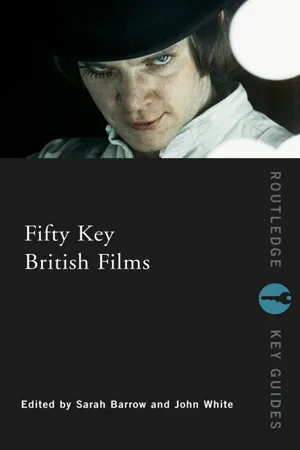
- 272 pages
- English
- ePUB (mobile friendly)
- Available on iOS & Android
eBook - ePub
Fifty Key British Films
About this book
Information
FIFTY KEY BRITISH FILMS
RESCUED BY ROVER (1905)
[Production Company: Hepworth. Director: Lewin Fitzhamon. Producer: Cecil Hepworth (also as ‘the Father’).]
THE ? MOTORIST (1906)
[Production Company: Paul’s Animatograph Works. Director: Walter Booth. Producer: Robert Paul.]
If there are any familiar images of early British cinema to match the workers filmed leaving the Lumière factory in 1895 or the Western gunman of The Great Train Robbery (1903), they may well be either the sheepdog star of Cecil Hepworth’s Rescued by Rover (1904), or a vintage jalopy circling Saturn’s rings in Robert Paul’s The ? Motorist (1906). Both of these films were considerable successes in their own day, and testify to a thriving British industry, before American cinema became the universal diet of filmgoers in most countries.
During the mid-twentieth century, early films were usually considered ‘primitive’ examples of what cinema would eventually become; it is not too hard to imagine Rescued by Rover being described as an early version of the family adventure, or The ? Motorist as a shape-shifting fantasy anticipating the flying car of Chitty-Chitty Bang Bang (1968). The very terms once used to describe early film – ‘silent’, ‘flickering’, ‘black and white’ – all suggest something missing, not yet achieved. Such attitudes persist, but early film is now more widely seen in good conditions, thanks to presentations of ‘live silents’ and high-quality DVD restorations.1
More recently, historians of early media have also argued that early films need to be seen as part of the world that created and consumed them, since their themes and stories are often ‘intermedial’, or shared across different media.2 Another key concept is the idea of a ‘cinema of attractions’, rather than one of narrative efficiency.3 From this standpoint, such films used devices and strategies to give exhibitors the material to attract audiences and hold their attention. Their aim may be to surprise, amuse, or shock – and only incidentally to tell a story. Straightforward storytelling as the main function of cinema would come later, after 1907, and it would involve losses as well as gains – especially loss of the variety in a mixed programme of short film that early audiences expected.
To place these two landmarks of early British cinema, then, we need to realise that they belong to the second decade of moving picture entertainment, coming after the early years of brief comedies and ‘actualities’. This is also just before the time of specialised cinema buildings, when films are being shown as part of music hall programmes, at fairgrounds, and in every kind of hall imaginable, from town halls and assembly rooms to church halls. Some of these programmes were long – up to two hours in the case of Mitchell and Kenyon’s shows of local films.4 They could also be highly topical, covering national and international events, such as the Anglo-Boer War, or the comings and goings of royalty. But with films such as Rescued by Rover and The ? Motorist, experienced producers were reaching beyond simple attractions and anecdotes towards a more ambitious kind of story film with something of the complexity of the short fiction that was then common in newspapers and magazines.
Rescued by Rover manages to combine a number of familiar motifs in what would prove to be a winning formula. One of these, a maid’s rendezvous with her soldier beau in the park, had already been filmed twice by Paul, in 1896 and 1898.5 In Hepworth’s film, a nursemaid is taking baby for an outing in the pram near a park, but is more interested in the soldier she meets (‘every afternoon’, we learn from Hepworth’s catalogue). Her distraction allows a beggar-woman, whom she has just snubbed, to take the infant from the pram, which would have chimed with the widespread belief that gypsies commonly stole babies.6 These two components, the careless maid and the callous kidnapper, lay the groundwork for the film’s main ‘attraction’: the family’s faithful dog discovering the child and alerting the father.
Stories about dogs’ powers of detection and extraordinary devotion had been popular for decades, especially in dog-loving Britain. In Conan Doyle’s second Sherlock Holmes novel, The Sign of Four (1890), it is Toby, ‘a queer mongrel with the most amazing power of scent’, that leads Holmes and Watson to the heart of the mystery. As for stories of canine devotion to children, the most recent example would have been Nana, a Newfoundland who acts as the Darling family’s nursemaid in J. M. Barrie’s play Peter Pan and Wendy, which had its premiere in December 1904. These stories, together with countless more anonymous ones on similar themes, would have made Rescued by Rover an up-to-date version of the ever-popular rescue narrative – as featured in a film like James Williamson’s Fire! (1901), where a fireman rescues a baby from a burning house.
Here it is the family’s collie, Rover, and no fewer than 16 of the 22 shots that make up this fast-moving film show Rover’s mission: setting off from his master’s suburban house, swimming across a river, and searching a terrace of mean hovels, before he finds the baby in the old woman’s garret, then makes the return journey to bring his master. We see the same journey three times – although when the husband uses a convenient boat to cross the river, we catch sight of a bridge that both dog and man could have taken, but with less dramatic effect. For drama is what Rescued by Rover concentrates on delivering, by means of showing motive and generating narrative momentum. After an appealing close-up of the baby at the centre of the story, the first scene shows how the nursemaid’s refusal of the beggar’s appeal leads to an opportunistic kidnapping. And after Rover intuits the reason for the distress of the nursemaid and his mistress, a series of five varied shots show him moving constantly towards us in his search.
The garret scene offers a sharp contrast with the comfortable family home of the baby and its parents with roof timbers and bare brick exposed and a jumble of rags on which both baby and beggar sleep. But the action is also purposeful, establishing motive, as the kidnapper first removes the baby’s plentiful clothes, and takes a swig from a bottle of something undoubtedly alcoholic. After the father has rescued the baby, the old woman will content herself with still having the clothes to sell, no doubt funding another bottle. But it is the handling of the three legs of the rescue journey that has been best remembered about this film, essentially because Hepworth’s ‘director’ (although the term was not yet in use), Lewin Fitzhamon, uses a highly fluent grammar of narrative, with Rover seen consistently moving away from the camera in his journey back, and the third leg, as he leads his master, following the same route, suitably varied and accelerated by means of shorter shots.
Rover indeed proved to be a runaway success leading to so many orders that Hepworth had to re-shoot the film twice to make new negatives. Rover would also return, two years later, to co-star with a horse in Dumb Sagacity, another film celebrating animal instinct. This might suggest that Hepworth had turned his back on modern subjects of the kind that British film-makers needed to make to remain internationally competitive; and indeed he would be increasingly identified with traditional English stories. But it might be more accurate to say that he failed to realise the full potential of animal-centred adventure films, in view of the enormous success enjoyed by the Rin-Tin-Tin series, produced in Hollywood between 1923 and 1931, and the later Lassie films.
Hepworth had actually made several early motoring comedies, but it was another pioneer British film-maker and motorist, Robert Paul, who would produce an eccentric manifesto for the freedom offered by the new horseless carriage. The ? Motorist begins as if anticipating an adventure serial, with a speeding motorist and his female companion running over a policeman who tried to stop them. But it quickly turns fantastic when they escape by driving straight up the side of a building and off into space, orbiting the moon and Saturn. They crash land through the roof of ‘Handover Court’, scattering the lawyers, and make another fantastic escape from the law by turning briefly into a horse and cart, before triumphantly driving away. The car used in the film was Paul’s own, a 1903 model, and his own experience of the law’s hostility towards ‘horseless carriage’ drivers may have inspired the film as a kind of fantasy revenge.7 Another inspiration was probably Georges Méliès, Paul’s one-time client and now competitor.8 Méliès’ The Impossible Journey / Voyage à travers l’impossible (1904) similarly transported its travellers through a nursery-style solar system, while his 1905 version of a madcap road race from Paris to Monte Carlo may have prompted Paul’s own motoring fantasy.
This may be primarily a ‘trick film’ showing off what Paul and his ex-magician collaborator Walter Booth could achieve with a combination of live-action shooting and model work in Paul’s Muswell Hill studio. But it’s also a film inspired by the new freedom of motoring and the friction this caused in Edwardian society, as would be reflected in the ambiguous treatment of Mr Toad’s reckless driving in The Wind in the Willows (1908). And at a time when English producers still enjoyed worldwide export markets, it made a strong impression on at least one distinguished spectator – the Russian Symbolist writer Andrei Bely, best known for his modernist novel Petersburg. In a 1907 essay, Bely wrote of a car that crashes through a wall, rushes up another wall, ‘defying the laws of gravity’, and ‘zooms up into the sky’, dodging meteors, then rather bizarrely described the driver as ‘death in a top hat, baring his teeth and rushing towards us’.9 Here Bely seems to be linking the imagery of the film with his own apocalyptic view of modernity. And set alongside the conservative social world of Rescued by Rover, Paul’s Motorist is a reminder of how anarchic, even avant-garde, early film-making could be, before feature-length storytelling dictated a more sober realism.
Notes
1 Abel Gance’s Napoleon was shown in London with an orchestral score in 1979. Many festivals now show silent-era films in this way, including the annual ‘Giornate del Cinema Muto’ in Sacile, Italy, and ‘Bristol Silents’, specialising in comedy film. The two films discussed here are available on the DVD, Early Cinema: Primitives and Pioneers (BFIVD643).
2 On ‘intermediality’, see the introduction and various essays in Rick Altman and Richard Abel (eds) The Sounds of Early Cinema, Bloomington, Indiana University Press, 2001.
3 A term coined by André Gaudreault and Tom Gunning. See Gunning, ‘The Cinema of Attractions: Early Film, Its Spectator and the Avant-Garde’, in Thomas Elsaesser and Adam Barker (eds) Early Cinema: Space, Frame, Narrative, London, BFI, 1989.
4 See Vanessa Toulmin et al. (eds) The Lost World of Mitchell & Kenyon:Edwardian Britain on Film, London, BFI, 2004.
5 The second of these is included on a DVD, R. W. Paul: the Collected Films 1895–1908, BFI (BFIVD642).
6 The kidnapper here is not strictly a gypsy, since we see her attic lair, but this would not prevent her being associated with supposed gypsy behaviour. On the persistent belief that gypsies abduct babies see, for instance, A. T. Sinclair, ‘Notes on the Gypsies’, The Journal of American Folklore, Vol. 19, No. 74, Jul.–Sep., 1906, pp. 212–213.
7 Paul’s conviction for speeding in the same car used in the film appeared in The Barnet Press, 10 August 1907, p. 8. He admitted he had been to a ‘club meet’ – presumably a motoring club – in Hatfield, and knew that ‘the police were timing cars’, but claimed his car could not exceed the speed limit.
8 Méliès bought a batch of projectors from Paul in 1896, and converted one of these into his first camera. By 1901 both were leading producers of elaborate trick films.
9 On Bely’s reaction to this film, see Yuri Tsivian, Early Cinema in Russia and its Cultural Reception, London and New York, Routledge, 1994, pp. 150–151.
Further reading
Ian Christie, The Last Machine: Early Cinema and the Birth of the Modern World, London, BFI/BBC, 1994.
Thomas Elsaesser and Adam Barker (eds) Early Cinema: Space, Frame, Narrative, London, BFI, 1989.
Simon Popple and Joe Kember, Early Cinema: From Factory Gate to Dream Factory, London, Wallflower, 2003.
IAN CHRISTIE
THE LIFE STORY OF DAVID LLOYD GEORGE (1918)
[Production company: Ideal Film Company. Director: Maurice Elvey. Screenwriter: Sir Sidney Low. Producer: Simon Rowson. Cast: Norman Page (David Lloyd-George), Ernest Thesiger (Joseph Chamberlain), Alma Reville (Megan Lloyd-George), Douglas Munro (Benjamin Disraeli).]
How can a film that doesn’t appear in any history of British cinema be a ‘key British film’? The story behind The Life Story of David Lloyd George is as remarkable as the film itself, and helps to explain why British film history now needs to take account of its biggest discovery from the silent era. If this ambitious film had been released at the end of 1918, it might have changed the reputation of film-making in Britain. Instead it lay forgotten in an attic, until Lord Tenby, grandson of its subject, brought it to the attention of the Wales Film and Television Archive, which led to its restoration and a premiere in 1996, delayed by nearly 80 years.
Why then was it not released in 1918? During the First World War, film had come to play an increasingly important role in public life. It delivered propaganda of different kinds, against the enemy and on behalf of the war effort. It communicated news of major events; and with the official film The Battle of Somme (1916), it contributed to boosting national morale after the huge losses in this battle. Film also provided welcome distraction from the war, for civilians and service personnel alike, with films ranging from the ‘Ultus’ adventure serials to Charlie Chaplin’s knockabout comedies.1 With the end of the war widely anticipated, there were various plans to make major commemorative films, one of which was D. W. Griffith’s Hearts of the World (1918), following America’s entry into the war in 1917. The British company Ideal, led by Harry and Simon Rowson, had already enjoyed success with several speciality films, such as Masks and Faces (1917), featuring an all-star cast of famous stage actors, and decided to make a biography of Britain’s war leader, the Prime Minister David Lloyd George.
The working title for the film was The Man Who Saved the Empire, and the film press carried increasingly impressive advertisements for the film during late 1918. In December, these stopped abruptly and the film that was to mark the climax of Ideal’s ambitions disappeared. What had happened was that a blustering journalist, MP and convicted swindler, Horatio Bottomley, had attacked the Rowsons in his influential paper John Bull, suggesting that because they had changed their name from ‘Rosenbaum’ and had employed some foreign-born extras to play the parts of soldiers in the film’s war scenes, their motives in making the film were less than patriotic.2 The Rowsons retaliated with a writ for libel, but in the meantime were informed that Lloyd George now wanted the film suppressed. According to Harry Rowson, an agent called at Ideal’s offices with £20,000 in cash to cover the production costs – a high figure for this period in Britain – and took away the negative and a print, which were never seen again.
Many questions remain unanswered, even after the film’s discovery and restoration. Lloyd George appears to have supported the production initially. With war over, was he advised that appearing in a film might harm his chances in the forthcoming general election? Was he afraid of the slur in Bottomley’s scurrilous article, implying that the Rowsons had not only concealed their German background but their Jewishness? Or even, as Lloyd George’s ...
Table of contents
- Cover
- Title
- Copyright
- Contents
- Chronological list of contents
- Alphabetical list of contents
- Contributors
- Introduction
- Fifty Key British Films
- Index
Trusted by 375,005 students
Access to over 1.5 million titles for a fair monthly price.
Study more efficiently using our study tools.
Frequently asked questions
Yes, you can cancel anytime from the Subscription tab in your account settings on the Perlego website. Your subscription will stay active until the end of your current billing period. Learn how to cancel your subscription
No, books cannot be downloaded as external files, such as PDFs, for use outside of Perlego. However, you can download books within the Perlego app for offline reading on mobile or tablet. Learn how to download books offline
Perlego offers two plans: Essential and Complete
- Essential is ideal for learners and professionals who enjoy exploring a wide range of subjects. Access the Essential Library with 800,000+ trusted titles and best-sellers across business, personal growth, and the humanities. Includes unlimited reading time and Standard Read Aloud voice.
- Complete: Perfect for advanced learners and researchers needing full, unrestricted access. Unlock 1.5M+ books across hundreds of subjects, including academic and specialized titles. The Complete Plan also includes advanced features like Premium Read Aloud and Research Assistant.
We are an online textbook subscription service, where you can get access to an entire online library for less than the price of a single book per month. With over 1.5 million books across 990+ topics, we’ve got you covered! Learn about our mission
Look out for the read-aloud symbol on your next book to see if you can listen to it. The read-aloud tool reads text aloud for you, highlighting the text as it is being read. You can pause it, speed it up and slow it down. Learn more about Read Aloud
Yes! You can use the Perlego app on both iOS and Android devices to read anytime, anywhere — even offline. Perfect for commutes or when you’re on the go.
Please note we cannot support devices running on iOS 13 and Android 7 or earlier. Learn more about using the app
Please note we cannot support devices running on iOS 13 and Android 7 or earlier. Learn more about using the app
Yes, you can access Fifty Key British Films by Sarah Barrow,John White in PDF and/or ePUB format, as well as other popular books in Social Sciences & Film & Video. We have over 1.5 million books available in our catalogue for you to explore.