An important guide to the major techniques for generating coherent light in the mid-infrared region of the spectrum
Laser-based Mid-infrared Sources and Applications gives a comprehensive overview of the existing methods for generating coherent light in the important yet difficult-to-reach mid-infrared region of the spectrum (2–20 ?m) and their applications.
The book describes major approaches for mid-infrared light generation including ion-doped solid-state lasers, fiber lasers, semiconductor lasers, and laser sources based on nonlinear optical frequency conversion, and reviews a range of applications: spectral recognition of molecules and trace gas sensing, biomedical and military applications, high-field physics and attoscience, and others. Every chapter starts with the fundamentals for a given technique that enables self-directed study, while extensive references help conduct deeper research.
Laser-based Mid-infrared Sources and Applications provides up-to-date information on the state-of the art mid-infrared sources, discusses in detail the advancements made over the last two decades such as microresonators and interband cascade lasers, and explores novel approaches that are currently subjects of intense research such as supercontinuum and frequency combs generation. This important book:
• Explains the fundamental principles and major techniques for coherent mid-infrared light generation
• Discusses recent advancements and current cutting-edge research in the field
• Highlights important biomedical, environmental, and military applications
Written for researchers, academics, students, and engineers from different disciplines, the book helps navigate the rapidly expanding field of mid-infrared laser-based technologies.
Infrared radiation was unknown before the year 1800 when Friedrich Wilhelm Herschel – a German‐born musician, who moved to England to work as a music band conductor, but later became obsessed with astronomy and eventually landed the position of the King's Astronomer − discovered infrared radiation. He made this finding while exploring sunlight, dispersed into its colors by a glass prism, with the aid of a liquid thermometer with a blackened bulb to absorb radiation (a prototype of a modern microbolometer). His experimentation led to the conclusion that there must be an invisible form of light beyond the visible spectrum [1].
Further experiments showed that this invisible radiation is electromagnetic radiation with a lower frequency than the red in the visible spectrum. Modern science further divides the infrared spectral region into near‐infrared, mid‐infrared, and far‐infrared.
According to the Encyclopedia Britannica, the “middle infrared” (mid‐infrared or mid‐IR) region of the electromagnetic spectrum covers, in wavelength, the portion between 2.5 and 50 μm (6–120 THz in frequency or 200–4000 cm−1 in wavenumbers).1 (The wavenumber is the inverse of the vacuum wavelength, λ, expressed in cm−1; it is also equal to the optical frequency divided by the speed of light, ν/c.)
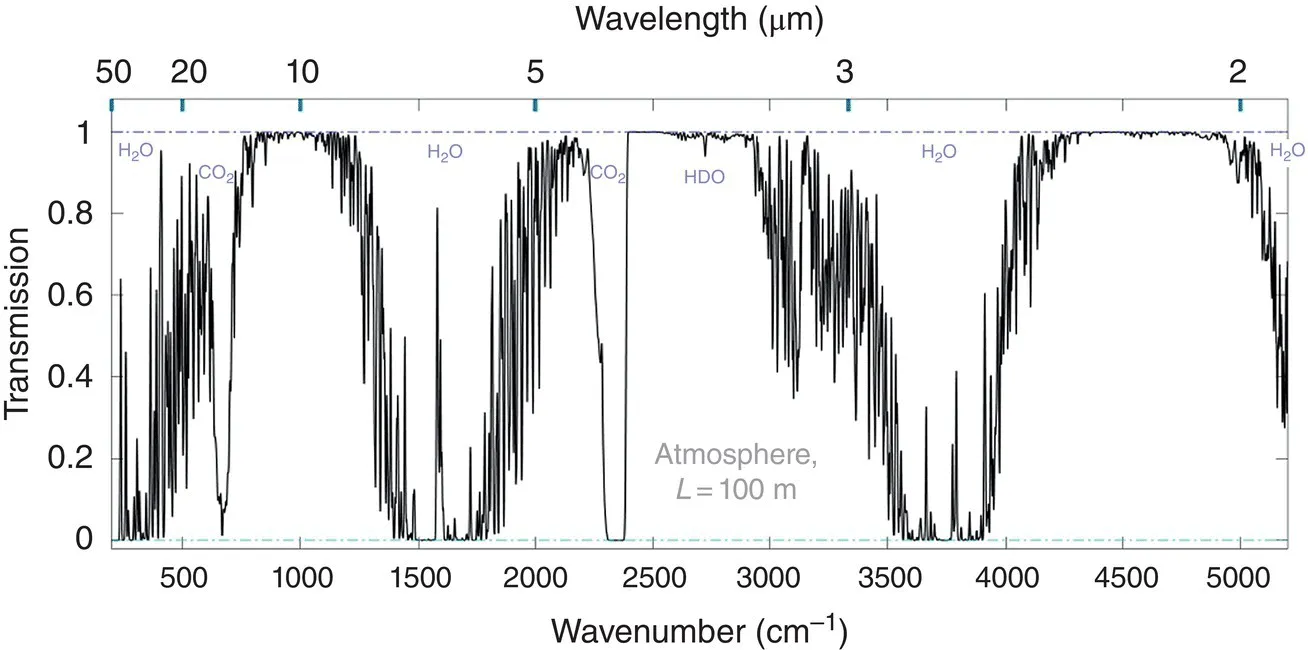
However, the definitions of the “mid‐IR” vary substantially in the technical literature, depending on a field‐specific community. For example, the detector‐based community subdivides the IR into four spectral bands, based on transmission windows of the atmosphere,2 as can be seen in Figure 1.1: shortwave infrared (SWIR), 1–3 μm; mid‐wave infrared (MWIR), 3–5 μm; longwave infrared (LWIR), 8–14 μm; and very‐long wave infrared (VLWIR), 14–30 μm.
Figure 1.1 Transmission spectrum of a 100‐m path in the “standard” atmosphere (spectral resolution 4 cm−1). The plot uses data from the HITRAN database (US model, mean latitude, summer, and zero elevation) [2]. The labels indicate the molecules that are responsible for transmission dips in the corresponding spectral regions.
Also, it is not uncommon in the current literature to refer to mid‐IR as “multi‐terahertz range,” especially when the authors generate few‐cycle mid‐IR transients combined with electro‐optic methods of their detection, which is typical for terahertz science.
This book loosely defines the mid‐IR range as 2–20 μm. This definition allows, on the short‐wavelength side, to encompass a few categories of solid‐state and fiber lasers, as well as certain types of microresonator‐, nonlinear fiber‐, and waveguide‐based sources. On the long‐wavelength side, 20 μm is a suitable practical limit set by the atmospheric transparency.
Heat energy is often transferred in the form of infrared radiation, which is given off from an object as a result of atomic and molecular motion. The mid‐IR region overlaps with the spectral range of heat (blackbody) radiation at temperatures close to room temperature. Based on the Planck's law, the peak of the infrared radiation (in terms of power per unit wavelength) emitted by a human body at 310 K is at λ ≈ 9.35 μm. Overall, our body emits 52 mW of mid‐IR radiation per square centimeter; that radiation can be easily detected by a thermal microbolometer‐based camera, as shown in Figure 1.2.
However, this book is about coherent laser sources, and the difference between the diffuse light of a heated body and a monochromatic laser‐like beam is that the latter has a well‐defined frequency and phase.
Figure 1.2 This is what the author's laboratory looks like in the mid‐IR at 8–12 μm.
1.2 The World's Second Laser
Interestingly, the world's second laser – after the Maiman's ruby laser – was a mid‐IR solid‐state laser based on trivalent uranium‐doped calcium fluoride (U3+:CaF2) [3]. It was operating at a wavelength λ = 2.49 μm and was developed by Peter Sorokin and Mirek Stevenson at the IBM research labs, in the same year as the Maiman's ruby laser, 1960.
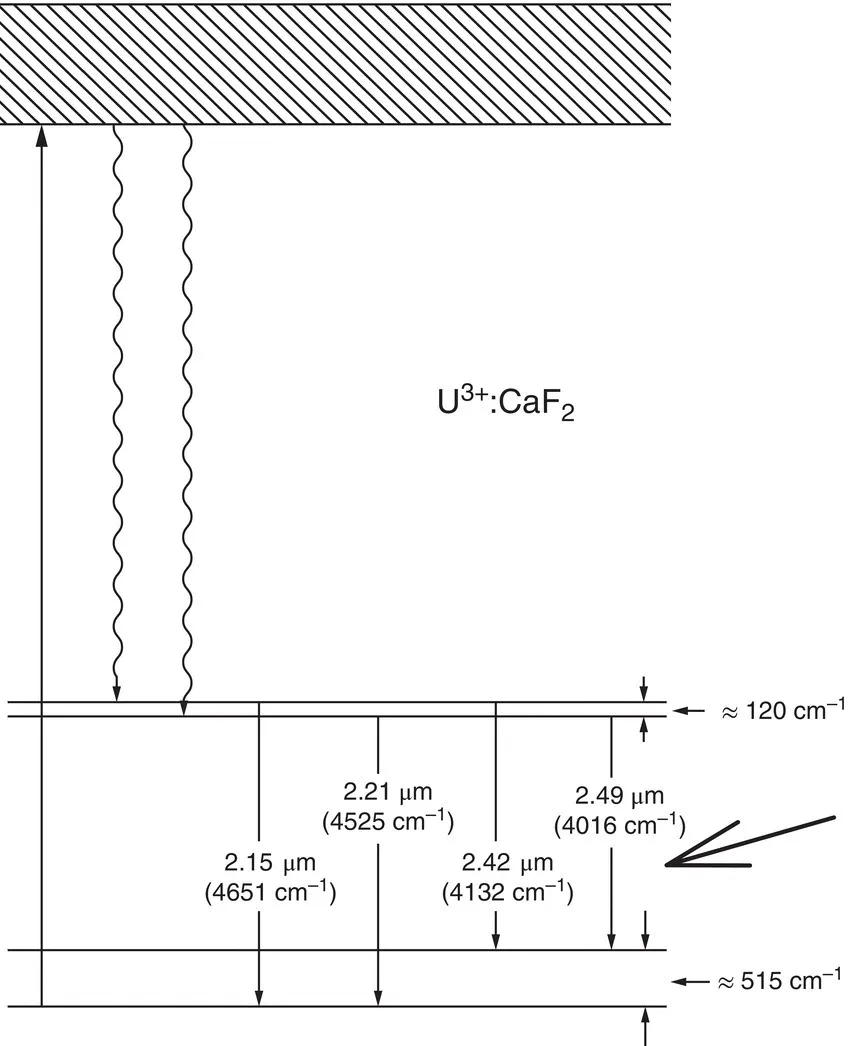
The laser was pumped by a pulsed flashlamp and was cooled by liquid helium. The energy‐level diagram of U3+:CaF2 is shown in Figure 1.3. Broadband pumping in the visible part of the spectrum causes transitions to excited U3+ bands. These pumping transitions are followed by rapid, nonradiative transitions to the two metastable upper laser levels. The thick arrow shows the 2.49‐μm laser transition observed by the authors. The laser oscillation takes place in a transition from a metastable state to a level that is approximately 515 cm−1 above the ground state. At liquid helium temperatures, this state is depopulated by at least a factor of 1010 relative to the ground state. Hence, this was the first demonstration of a four‐level solid‐state laser.
Figure 1.3 Energy‐level diagram of trivalent uranium in calcium fluoride [3]. Broadband pumping light applied in the blue and green visible spectrum causes transitions to excited bands. These pumping transitions are followed by rapid, nonradiative transitions to the two metastable upper laser levels. The thick arrow shows the 2.49 μm laser transition observed by the authors.
Source: reproduced from figure 1 of [3], with permission of APS.
Furthermore, the 1960 work by Sorokin a...
Table of contents
Cover
Table of Contents
About the Author
Preface
1 Mid‐IR Spectral Range
2 Solid‐state Crystalline Mid‐IR Lasers
3 Fiber Mid‐IR Lasers
4 Semiconductor Lasers
5 Mid‐IR by Nonlinear Optical Frequency Conversion
6 Supercontinuum and Frequency Comb Sources
7 Mid‐IR Applications
Index
End User License Agreement
Trusted by 375,005 students
Access to over 1.5 million titles for a fair monthly price.
Study more efficiently using our study tools.
Frequently asked questions
Yes, you can cancel anytime from the Subscription tab in your account settings on the Perlego website. Your subscription will stay active until the end of your current billing period. Learn how to cancel your subscription
No, books cannot be downloaded as external files, such as PDFs, for use outside of Perlego. However, you can download books within the Perlego app for offline reading on mobile or tablet. Learn how to download books offline
Perlego offers two plans: Essential and Complete
Essential is ideal for learners and professionals who enjoy exploring a wide range of subjects. Access the Essential Library with 800,000+ trusted titles and best-sellers across business, personal growth, and the humanities. Includes unlimited reading time and Standard Read Aloud voice.
Complete: Perfect for advanced learners and researchers needing full, unrestricted access. Unlock 1.5M+ books across hundreds of subjects, including academic and specialized titles. The Complete Plan also includes advanced features like Premium Read Aloud and Research Assistant.
Both plans are available with monthly, semester, or annual billing cycles.
We are an online textbook subscription service, where you can get access to an entire online library for less than the price of a single book per month. With over 1.5 million books across 990+ topics, we’ve got you covered! Learn about our mission
Look out for the read-aloud symbol on your next book to see if you can listen to it. The read-aloud tool reads text aloud for you, highlighting the text as it is being read. You can pause it, speed it up and slow it down. Learn more about Read Aloud
Yes! You can use the Perlego app on both iOS and Android devices to read anytime, anywhere — even offline. Perfect for commutes or when you’re on the go. Please note we cannot support devices running on iOS 13 and Android 7 or earlier. Learn more about using the app
Yes, you can access Laser-based Mid-infrared Sources and Applications by Konstantin L. Vodopyanov in PDF and/or ePUB format, as well as other popular books in Technology & Engineering & Electrical Engineering & Telecommunications. We have over 1.5 million books available in our catalogue for you to explore.