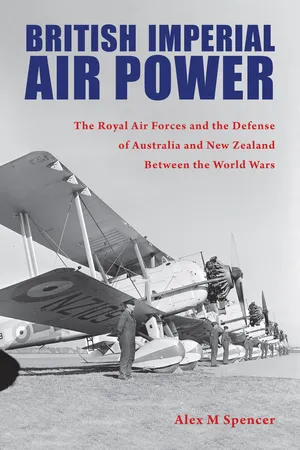
British Imperial Air Power examines the air defense of Australia and New Zealand during the interwar period. It also demonstrates the difficulty of applying new military aviation technology to the defense of the global Empire and provides insight into the nature of the political relationship between the Pacific Dominions and Britain. Following World War I, both Dominions sought greater independence in defense and foreign policy. Public aversion to military matters and the economic dislocation resulting from the war and later the Depression left little money that could be provided for their respective air forces. As a result, the Empire's air services spent the entire interwar period attempting to create a strategy in the face of these handicaps. In order to survive, the British Empire's military air forces offered themselves as a practical and economical third option in the defense of Britain's global Empire, intending to replace the Royal Navy and British Army as the traditional pillars of imperial defense.
eBook - ePub
British Imperial Air Power
The Royal Air Forces and the Defense of Australia and New Zealand Between the World Wars
- 309 pages
- English
- ePUB (mobile friendly)
- Available on iOS & Android
eBook - ePub
British Imperial Air Power
The Royal Air Forces and the Defense of Australia and New Zealand Between the World Wars
About this book
Information
CHAPTER 1
THE FIRST IMPERIAL AIR DEFENSE SCHEMES, 1918–1919
It will be appreciated that the complexity of the problem is increased by the fact that in the case of the Royal Air Force there is no pre-war experience to which reference can be made.1
—Lord William Douglas Weir
At the end of World War I, Britain’s leaders had to reconsider the traditional pillars of imperial foreign policy: a balance of power on the European continent, free and clear trade routes to imperial possessions and the Dominions, and superiority of the Royal Navy on the seas. Germany’s defeat, along with the revolution in Russia, created a power vacuum in Europe. Decimated by four years of war, the European powers could not fill this void, though some tried. The rising influence of the United States and imperial Japan tipped the balance of power away from Britain in the Pacific, although Britain may well have lost its influence before the war in its efforts to counter the growing threat of the Imperial German Fleet in European waters.
To add to the British circumstances, Britain’s global territorial responsibilities actually expanded in the war’s aftermath. By the end of 1918, a military expedition to assist the White Russians against the Bolsheviks, control of new Middle Eastern mandates, and the suppression of nationalist movements throughout the empire placed additional military burdens on Britain. Labor unrest, mutinies, and the Irish uprising further complicated Britain’s postwar military circumstances at home. Winston Churchill summed up the situation when he stated, “I cannot too strongly press on the Government the danger, the extreme danger, of His Majesty’s Army being spread all over the world, strong nowhere and weak everywhere.”2 The huge national debt, created by the war, limited many military options that had been available in the past. Chief of the Air Staff Sir Hugh Trenchard echoed Churchill’s warnings from the air force’s perspective:
The necessity for economy remains unchanged, but the peaceful conditions hoped for have been far from realized. So great a portion of the world has been pervaded by the spirit of unrest, and so largely have the commitments of the Empire been increased by the results of the war … 3
The Dominions further compounded Britain’s foreign and military policy difficulties. During the war, the Dominions’ prime ministers demanded and were promised inclusion in policy decisions that potentially affected their respective states. At the same time, Australia and New Zealand pursued courses of action that ran counter to traditional British interests, such as claiming mandate responsibility over regional Pacific islands that were of no interest in London. This placed the British Empire in direct competition with Japan. While the Dominions demanded greater independence with regard to their emerging foreign policies, they insisted that Great Britain remain committed to their defense.
With Germany defeated and Russia enmeshed in civil war, British leaders found a new threat to the empire: Britain’s Pacific ally, Japan. The Anglo-Japanese Naval Alliance, signed in January 1902, allowed the Royal Navy to remain concentrated in European waters to counter the growth of the Imperial German Navy. In addition, the agreement helped to defend against any threat to British and Japanese interests in the Pacific from Russian expansion. During the war, the agreement proved its value when Japanese warships provided escorts to the troopships filled with Australians and New Zealanders on their way to the Middle Eastern and Western fronts and even suffered some losses in the Mediterranean. However, in the postwar environment, could the agreement remain intact? Many thought not.
In assessing the postwar world, Trenchard remarked about the Japanese:
It is not improbable after the storm in Europe, the centre of pressure of unrest will move eastwards and that the future will find it located in China and Japan. There would appear, therefore, to be grounds for an increase of our naval strength in the Pacific and pari passu for the building up of a suitable air force.These considerations have already been weighted in Australia and New Zealand, and both dominions have intimated their desire for air services.4
Australian prime minister William “Billy” Hughes did not help Britain’s relationship with Japan. While making his way to Europe in June 1918, he made a speech in New York City in which he proposed a new vision for the future of Pacific security:
In order to ensure the existence of Australia as a commonwealth of federal states of free people, the Australians must be provided with a strong guarantee against invasion, and such a guarantee might be found in an Australian Monroe doctrine in the South Pacific.To ensure the safety of Australian territory, it is important that control over the islands on the eastern and northern coasts of Australia should either be taken over by Australia herself, or entrusted to some brave and civilized State. It is the United States to which the Australians look for assistance in the matter.5
Hughes’s comments were as unpopular in Britain as they were in Japan. For the first time Australians looked to a power other than Britain for their security. Hughes imagined an American Pacific Monroe Doctrine backed up by American naval and military power or at the very least the creation of a “hands off the Australian Pacific” policy. This position staked out by Hughes in New York continued to be his steadfast posture at the Versailles Peace Conference. During the war, Australia and Japan expanded their spheres of influence in the Pacific. The Australians, who felt threatened by the German presence in New Guinea, took control of the island early in the war. In addition, a joint Australian and New Zealand force captured Samoa. Meanwhile, the Japanese, taking advantage of the German weakness, moved south and occupied the Marshall and Caroline island groups.
These actions disrupted the peace discussions at Versailles in January 1919. When Prime Minister Hughes arrived in Paris, he fully intended to maintain Australian sovereignty over New Guinea. He believed that all of the northern islands were essential for Australian security. Hughes’s claims to the islands and “Pacific Monroe Doctrine” directly clashed with President Wilson’s “just peace” based on his Fourteen Points and position that no nation should benefit from victory. Concerning Australian claims in the Pacific, Hughes’s reaction was recorded in the minutes of the Imperial War Cabinet meeting that took place on December 30, 1918. Hughes opposed Wilson’s position of independence for the former German colonies and argued that Wilson did not understand how essential these islands were for Australia’s own security.6
In January 1919, the meetings at Versailles addressed the topic of Germany’s Pacific colonies. At a meeting of the Council of Ten, Hughes stated his uncompromising position:
Strategically the Pacific Islands encompass Australia like a fortress … this is a string of islands suitable for coaling and submarine bases, from which Australia could be attacked. If there were at the very door of Australia a potential or actual enemy, Australia could not feel safe. The islands are as necessary to Australia as water to a city. If they were in the hands of a superior, there would be no peace for Australia.7
Hughes’s concerns did not impress President Wilson who believed that the old notions of national security would not be applicable in the postwar world and that Hughes’s position was “based on a fundamental lack of faith in the League of Nations.”8 On this point, Hughes agreed with President Wilson, for Hughes placed little faith in the league’s ability to control “bad neighbors.”9 Because of Wilson’s position, Hughes likely viewed the U.S. support in Pacific security as unreliable and returned to the position that Australian security was still best served within the British imperial system.
The stance taken by Hughes at Versailles placed British prime minister David Lloyd George in a difficult position between attempting to sustain imperial unity by supporting Australian territorial claims and at the same time maintaining a constructive relationship with Wilson. South African prime minister Ian Smuts proposed a compromise. Smuts designed the mandate system, which placed the former German colonies into three categories based on their social and economic development and geographical location. The Smuts compromise became Article 22 of the League of Nations Compact. Under a Class “C” mandate classification, the administration of New Guinea became Australia’s responsibility:
Owing to the sparseness of their population, their small size, or their remoteness from centers of civilisation, or their geographical continuity to the territory of the Mandatory, and other circumstances, can best be administered under the laws of the Mandatory as an integral portion of its territory.10
The only power remaining in the Pacific that threatened peace, from the Dominions’ perspective, was Japan. Whereas Australia and New Zealand considered their own actions as defensive, they viewed Japanese annexation of the Marshall and Caroline Islands as aggressive expansionism. New Zealand’s defense minister, Sir James Allen, believed that the British Empire would “regret” letting the Japanese remain in control of the two island groups.11
In a cable, Monroe Furguson, governor general of Australia, also expressed concerns that Japanese expansionism was a threat to the newly formed League of Nations and the agreements made at Versailles. In Furguson’s opinion, the Japanese expansion into the central Pacific was challenging decisions made at Versailles because “she is a powerful nation having at her disposal great military resources [and] cannot be allowed to flout the solemn decision of the Conference.”12
With the emerging diplomatic tension between the British and Japanese empires exacerbated by Australia’s political leadership, Britain’s military began to evaluate how to defend the Pacific. Early in 1919, former First Sea Lord Admiral John Jellicoe left on an imperial cruise with instructions to determine the naval defense of the empire. At the same time, the leadership of the Royal Air Force began to examine their service’s future role in peacetime defense of the empire. The process of the transition to peacetime operations would be more difficult for the Royal Air Force compared to the army or navy. Created during the war by combining the Royal Flying Corps and Royal Naval Air Service, the RAF had no peacetime tradition such as providing security in some remote outpost of the empire or showing the flag during a diplomatic cruise. The new service faced a hostile army and navy wanting to break apart the RAF and reclaim their respective air branches that were taken from them during the war. The air force’s leadership looked to the emerging antagonism with the Japanese as a basis to formulate its future responsibilities in defense of the empire.
The president of the Air Council, Lord Weir, asserted in December 1918 that the Royal Air Force would take an important part in imperial defense. Weir argued that aviation had proved its value during the war but its future potential was unclear because the current state of aircraft development was still in its “infancy.” For Weir, air power in time would become an equal partner in imperial defense alongside the army and the navy, and “it will be necessary to provide an Air Force of such strength as will amply meet the needs of the Empire.”13
Less than a month following the signing of the Armistice on November 11, 1918, Trenchard, newly appointed chief of the Air Staff, issued a memorandum outlining the RAF’s vision of postwar defense:
The Imperial aspects of the question [of air defense] cannot be overrated and must be considered equally with those pertaining to purely national requirements; the foundations of the air power of the British Empire must be well and truly laid.14
From the scale and scope of the memorandum, it appears that the Air Staff was clearly working on the imperial air defense issues well before the war’s end. Trenchard’s memorandum delineated how the RAF would participate in and potentially come to dominate the defense responsibilities for the empire. The Air Staff examined how to utilize the air force in small and large conflicts while maintaining its independence from the navy and army. It outlined specific force structures and dispositions throughout the empire and argued that the Dominions’ air services would need to play a direct and vital role in the future air defense of the empire.
The flying distances were truly daunting, especially for the limited capabilities of the aircraft of the day. Trenchard recognized that the state of aviation technology limited the effectiveness of air power and force projection, “owing to the comparatively short radius of action of contemporary aircraft.”15 The Air Ministry plotted a route from London to Australia that required 59 stops—one every 200 miles—and covered the 11,500 miles to Darwin. Nevertheless, this did not deter Trenchard’s belief in the future potential of air power: “we possess a rapid and economical instrument by which to ensure peac...
Table of contents
- Cover Page
- Halftitle Page
- Title Page
- Copyright Page
- Dedication
- Contents
- Introduction
- Chapter 1: The First Imperial Air Defense Schemes, 1918–1919
- Chapter 2: The Formation of the Royal Australian Air Force and the First Reassessments of Pacific Defenses, 1920–1921
- Chapter 3: The Empire’s Air Defense: The Geddes Cuts of 1922, and the 1923 Imperial Conference and Their Influence on the Empire’s Air Defense, 1922–1923
- Chapter 4: The Royal Air Force and Postwar Air Transport Defense Planning and the Airmail Scheme, 1919–1939
- Chapter 5: Airships and the Empire: Defense, Schemes, and Disaster, 1919–1930
- Chapter 6: Air Defense and the Labour Party: Singapore Naval Base and the 1926 Imperial Conference, 1924–1926
- Chapter 7: Imperial Air Mobility, the Salmond Report, and Air Marshal Trenchard’s Last Salvo, 1927–1929
- Chapter 8: Depression and Disarmament, 1929–1933
- Chapter 9: The International Crises and Imperial Rearmament, 1934–1936
- Chapter 10: The Final Preparations, 1937–1940
- Epilogue
- Notes
- Bibliography
- Index
- About the Author
Trusted by 375,005 students
Access to over 1.5 million titles for a fair monthly price.
Study more efficiently using our study tools.
Frequently asked questions
Yes, you can cancel anytime from the Subscription tab in your account settings on the Perlego website. Your subscription will stay active until the end of your current billing period. Learn how to cancel your subscription
No, books cannot be downloaded as external files, such as PDFs, for use outside of Perlego. However, you can download books within the Perlego app for offline reading on mobile or tablet. Learn how to download books offline
Perlego offers two plans: Essential and Complete
- Essential is ideal for learners and professionals who enjoy exploring a wide range of subjects. Access the Essential Library with 800,000+ trusted titles and best-sellers across business, personal growth, and the humanities. Includes unlimited reading time and Standard Read Aloud voice.
- Complete: Perfect for advanced learners and researchers needing full, unrestricted access. Unlock 1.5M+ books across hundreds of subjects, including academic and specialized titles. The Complete Plan also includes advanced features like Premium Read Aloud and Research Assistant.
We are an online textbook subscription service, where you can get access to an entire online library for less than the price of a single book per month. With over 1.5 million books across 990+ topics, we’ve got you covered! Learn about our mission
Look out for the read-aloud symbol on your next book to see if you can listen to it. The read-aloud tool reads text aloud for you, highlighting the text as it is being read. You can pause it, speed it up and slow it down. Learn more about Read Aloud
Yes! You can use the Perlego app on both iOS and Android devices to read anytime, anywhere — even offline. Perfect for commutes or when you’re on the go.
Please note we cannot support devices running on iOS 13 and Android 7 or earlier. Learn more about using the app
Please note we cannot support devices running on iOS 13 and Android 7 or earlier. Learn more about using the app
Yes, you can access British Imperial Air Power by Alex M Spencer in PDF and/or ePUB format, as well as other popular books in History & 20th Century History. We have over 1.5 million books available in our catalogue for you to explore.