John Gribbin, author of
Six Impossible Things, shortlisted for the Royal Society Insight Investment Science Book Prize, presents a tour of seven fundamental scientific truths that underpin our very existence.
These 'pillars of science' also defy common sense. For example, solid things are mostly empty space, so how do they hold together? There appears to be no special 'life force', so how do we distinguish living things from inanimate objects? And why does ice float on water, when most solids don't? You might think that question hardly needs asking, and yet if ice didn't float, life on Earth would never have happened.
The answers to all of these questions were sensational in their day, and some still are. Throughout history, science has been able to think the unthinkable - and Gribbin brilliantly shows the surprising secrets on which our understanding of life is based.
eBook - ePub
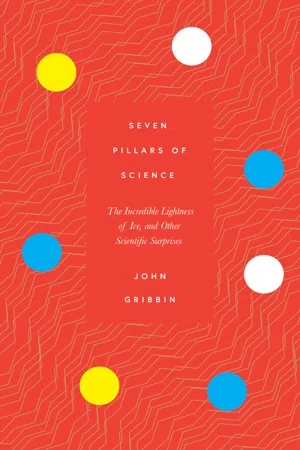
Seven Pillars of Science
The Incredible Lightness of Ice, and Other Scientific Surprises
- 160 pages
- English
- ePUB (mobile friendly)
- Available on iOS & Android
eBook - ePub
Seven Pillars of Science
The Incredible Lightness of Ice, and Other Scientific Surprises
About this book
Information

Solid Things Are Mostly Empty Space
Solid objects are empty. Although this is an often cited example of the non-commonsensical nature of the world, it still brings you up short if you stop to think about it. Things like the ‘solid’ keyboard I am typing on and the fingers doing the typing are made up of tiny particles spread through relatively huge volumes of space, held together by electric forces. This is such an important and mind-blowing idea that Richard Feynman said it was the most significant fact that science had discovered about the world. As on so many topics, it is worth quoting him verbatim:
If, in some cataclysm, all of scientific knowledge were to be destroyed, and only one sentence passed on to the next generation of creatures, what statement would contain the most information in the fewest words? I believe it is the atomic hypothesis (or the atomic fact, or whatever you wish to call it) that all things are made of atoms – little particles that move around in perpetual motion, attracting each other when they are a little distance apart, but repelling upon being squeezed into one another. In that one sentence, you will see, there is an enormous amount of information about the world, if just a little imagination and thinking are applied.2
Few physicists, however, have the power of imagination (or better, physical insight) and thinking that Feynman had, and the debate about whether the world is really made of such particles was not resolved until the early years of the twentieth century, although the idea of atoms had been suggested much earlier.
Popular accounts of the atomic theory (or whatever you wish to call it) usually start out with a nod to Democritus, who lived in the fifth century BCE, and Epicurus, who was around between about 342 BCE and 271 BCE. But their idea of little objects moving about in ‘the void’ and interacting with one another was never more than a minority opinion, ridiculed by philosophers such as Aristotle who rejected the idea of a void. It wasn’t until 1649 that Pierre Gassendi revived the idea and suggested that atoms had different shapes and could join together through a kind of hook-and-eye mechanism. He stressed that there was nothing at all in the gaps between atoms. This was the beginning of a debate that rumbled on for more than two hundred years. On one side there was what we might call the Newtonian school of thought, after Isaac Newton, which favoured the atomic hypothesis; on the other, the Cartesian school, after René Descartes, who abhorred the idea of a void, or vacuum. Things came to a head in the nineteenth century.
From the 1850s onward, building on the earlier work of John Dalton, chemists increasingly accepted the idea of atoms, with atoms of different elements having different weights, and joining together to make molecules, so that a molecule of water, for example, was regarded as a combination of two hydrogen atoms with one oxygen atom. They could measure the weights (strictly speaking, masses) of atoms of different elements compared with that of hydrogen, the lightest element. And they were even able to calculate how many particles (atoms or molecules) there must be in a sample of any element that contained its atomic (or molecular) weight in grams – 1 gram of hydrogen, 12 grams of carbon, 16 grams of oxygen, and so on. Each such sample would have the same number of particles. This number became known as Avogadro’s number, after the pioneer who developed the theory behind it, and it is very big. But before I go into how big it is, I should spell out the opposition to these ideas that persisted even at the beginning of the twentieth century, and which highlights how sensational the idea of atoms really is.
The opposition came from physicists and philosophers who pointed out what they saw as a fatal flaw in the idea of large numbers of tiny particles moving around in empty space, bouncing off each other and going merrily on their way in accordance with the laws of motion spelled out by Isaac Newton. The relevant thing about Newton’s laws is that they are reversible. The standard way of highlighting this is to think of a collision between two pool balls. One ball moves in from, say, the left, hits a stationary ball and stops, while the other ball moves off to the right. If you made a movie of this event and ran it backwards, it would still look entirely OK. A ball would move in from the right, collide with a stationary ball and stop while the other ball moved off to the left. Newton’s laws do not contain an ‘arrow of time’. But the real world does have a direction of time built in to it. If we now imagine the cue ball striking the pack of pool balls in a break so that they scatter in all directions, the situation is not reversible, even though every single collision between the balls obeys Newton’s laws. ‘Running the movie backwards’ produces a sequence never seen in the everyday world – balls arriving from all directions, colliding and settling into a neat pack while just one ball zooms off towards the cue.
The irreversibility of the everyday world was expressed by nineteenth-century scientists in terms of heat – the science of thermodynamics. They pointed out that heat always flows from a hotter object to a colder one. An ice cube placed in a glass of warm water gains heat from the water and melts; we never see water in a glass spontaneously getting warmer while a lump of ice forms in the middle. But both this scenario and the ‘reversed’ pool ball break are entirely allowed by Newton’s laws. The initial conclusion of the nineteenth-century thermo-dynamicists was that things could not really be made of tiny particles bouncing around in accordance with those laws. But then the dilemma was resolved.
No fewer than three great thinkers independently found the solution. They realised that the behaviour of large numbers of particles interacting in accordance with Newton’s laws had to be described in statistical terms, and they worked out the equations to calculate how very large numbers of particles would behave – the laws of what became known as statistical mechanics. This tells us, in a rigorous mathematical way, that although there is nothing in the laws of physics to prevent ice cubes forming in glasses of warm water, such an event is extremely unlikely, and will only occur once in a very, very long time – a time which can be calculated if you know how many particles are involved.* The first two scientists to appreciate this and work out the laws of statistical mechanics can be excused for not knowing about each other’s work. Ludwig Boltzmann worked in Europe, while Willard Gibbs worked in the USA, and even at the turn of the nineteenth century scientific ideas took a while to cross the Atlantic. The third inventor (or discoverer) of statistical mechanics had less excuse, not least since he came on the scene a little later. But he was notorious for not bothering to keep up with what other people were doing, preferring to work everything out for himself. His name was Albert Einstein, and it is a sign of how the atomic theory of matter had failed to become established that at the beginning of the twentieth century he set out to find evidence ‘which would guarantee as much as possible the existence of atoms of definite finite size’.3 His version of statistical mechanics appeared in a series of three extraordinary papers, published between 1902 and 1904, which would have assured him of scientific fame, if only he had been first on the scene. But in 1905, among other things he did produce the scientific paper which finally established the reality of atoms and molecules to all but a few die-hard philosophers. It’s also much easier for non-mathematicians to grasp, so I shall cast statistical mechanics to one side and focus on the physics.
The physics harks back to an old piece of work which Einstein was at least aware of, but only in a vague sort of way. And it wasn’t the jumping-off point for his own work, because once again he was working it out from first principles, this time trying to calculate how a small piece of material – such as a dust grain – suspended in a liquid – such as a glass of water – would move as it was buffeted about by atoms and molecules striking it from all sides. This kind of motion had been studied by the Scottish botanist Robert Brown back in the 1820s. His interest stemmed from observations, made using microscopes, of pollen grains dancing about in water in a jittery kind of motion, like running on the spot. The natural explanation at the time was that the pollen grains were alive, and moving under their own steam. But Brown tested this by looking at grains of ground-up glass and granite in water, and found that they danced in the same way. This established that the dancing had nothing to do with life, and it became known as Brownian motion.
Einstein started out by calculating how atoms and molecules would make inanimate dust grains move in a liquid, but starting from the bottom up, not from the top down. In the first paragraph of the paper on the subject he produced in 1905, he says:
It is possible that the motions to be discussed here are identical with so-called Brownian molecular motion; however, the data available to me on the latter are so imprecise that I could not form a judgement on the question.
The ‘data available’ were ‘so imprecise’ because he couldn’t be bothered to look them up; and there must be a strong suspicion that this sentence was added after some friend read a draft of the paper and pointed out to him the link to Brownian motion. But whatever his motivation, Einstein explained Brownian motion with one of those pieces of insight that geniuses come up with, but which then make you wonder why nobody else thought of it, backed up by calculations which gave the experimenters something to test.
Particles large enough to be seen using contemporary microscopes – grains like pollen, or ground-up glass – were, Einstein realised, far too small to be moved visibly by the impact of a single atom or molecule. But in a liquid, such particles are constantly being bombarded on all sides by large numbers of atoms and molecules. This bombardment cannot be perfectly even. At any instant, a few more impacts will occur on one side, and a few less on another. The particle will shift a little in the direction of fewer impacts. But then the balance will change, and it will be nudged in a different direction. The overall effect is that it jitters about, not quite running on the spot but jogging in a zigzag path and gradually getting further away from where it started. The path is now known as a random walk; and this was Einstein’s key insight.
Einstein showed that wherever the particle starts from, the distance it moves away from that point depends on the square root of the time that has passed. So if it moves a certain distance in one second it will move twice as far in four seconds (because 2 is the square root of 4), four times as far in sixteen seconds, and so on. But it doesn’t keep going in the same direction. After four seconds it is twice as far away, but in a random and unpredictable direction; after sixteen seconds it is four times as far away in another random direction. This is called ‘root mean square’ displacement, and it was possible for experimenters to test the prediction. Plugging in Avogadro’s number from other studies, Einstein concluded that a particle with a diameter of 0.001mm in water at 17°C would shift position by six millionths of a metre from its starting point in one minute. The modern calculation of Avogadro’s number, the number of molecules in the molecular weight of a substance in grams, is equal to 6.022140857 × 10²³, or roughly a 6 followed by 23 zeroes. This gives you some idea of why the statistical behaviour of matter overwhelms the individual reversible interactions to produce effects like melting ice cubes and Brownian motion.† As Einstein summarised:
If the prediction of this motion were to be proved wrong, this fact would be a far-reaching argument against the molecular-kinetic conception of heat.
Of course it was not proved wrong, and this was taken as clinching evidence of the reality of atoms and molecules. But there’s more – more even than Einstein realised in 1905.
The molecular-kinetic theory of heat that Einstein mentioned explains the division of everyday things into solid, liquid, or gaseous states. A gas is the archetypal example of atoms moving in the void, with nothing between them. A liquid is envisaged as a collection of atoms (or molecules) sliding past one another fairly freely, with no space between them. And in a solid, the particles are pictured as set firmly in an array, touching one another, again with no spaces between the atoms or molecules. So why did I describe my keyboard and my fingers as mostly empty space? This was a really sensational discovery, and it was made by researchers in Manchester at the end of the first decade of the twentieth century, little more than a hundred years ago.
The people who actually did the experiments were Hans Geiger and Ernest Marsden, working under the supervision of Ernest Rutherford. Rutherford was one of the key figures in the development of physics around this time. He came from New Zealand, and in the 1890s worked in Cambridge, England, where he investigated the behaviour of the newly-discovered X-rays, then in 1898 moved on to McGill University in Montreal where he investigated the other great discovery of the time, radioactivity. He settled in Manchester in 1907. Within a year, his team had established that one form of this radiation, called alpha radiation, is actually a stream of particles, each one identical to a helium atom which has lost two units of negative electric charge (two electrons, we now know). Because this leaves the stripped helium atoms, also known as alpha particles, with two units of positive charge, they can be manipulated with electric and magnetic fields, steered into beams and accelerated; it’s a sign of how fast physics was progressing in the first decade of the twentieth century that by 1909 the Manchester team was using alpha particles produced by natural radioactivity and manipulated in this way to probe the structure of matter.
...
Table of contents
- Praise
- Title Page
- Contents
- About the Author
- Acknowledgements
- List of Illustrations
- Epigraph
- PREFACE: Seven Pillars of Wisdom
- PROLOGUE: Worlds Beyond: Maybe We Are Not Alone
- PILLAR 1: Solid Things Are Mostly Empty Space
- PILLAR 2: The Stars Are Suns and We Know What They Are Made Of
- PILLAR 3: There is No Life Force
- PILLAR 4: The Milky Way is a Warehouse Stocked with the Raw Ingredients of Life
- PILLAR 5: The Carbon Coincidence
- PILLAR 6: The Book of Life is Written in Three-letter Words
- PILLAR 7: The Incredible Lightness of Ice
- EPILOGUE: Bottlenecks: Maybe We Are Alone
- Notes
- Further Reading
- Also by John Gribbin
- Copyright
Trusted by 375,005 students
Access to over 1.5 million titles for a fair monthly price.
Study more efficiently using our study tools.
Frequently asked questions
Yes, you can cancel anytime from the Subscription tab in your account settings on the Perlego website. Your subscription will stay active until the end of your current billing period. Learn how to cancel your subscription
No, books cannot be downloaded as external files, such as PDFs, for use outside of Perlego. However, you can download books within the Perlego app for offline reading on mobile or tablet. Learn how to download books offline
Perlego offers two plans: Essential and Complete
- Essential is ideal for learners and professionals who enjoy exploring a wide range of subjects. Access the Essential Library with 800,000+ trusted titles and best-sellers across business, personal growth, and the humanities. Includes unlimited reading time and Standard Read Aloud voice.
- Complete: Perfect for advanced learners and researchers needing full, unrestricted access. Unlock 1.5M+ books across hundreds of subjects, including academic and specialized titles. The Complete Plan also includes advanced features like Premium Read Aloud and Research Assistant.
We are an online textbook subscription service, where you can get access to an entire online library for less than the price of a single book per month. With over 1.5 million books across 990+ topics, we’ve got you covered! Learn about our mission
Look out for the read-aloud symbol on your next book to see if you can listen to it. The read-aloud tool reads text aloud for you, highlighting the text as it is being read. You can pause it, speed it up and slow it down. Learn more about Read Aloud
Yes! You can use the Perlego app on both iOS and Android devices to read anytime, anywhere — even offline. Perfect for commutes or when you’re on the go.
Please note we cannot support devices running on iOS 13 and Android 7 or earlier. Learn more about using the app
Please note we cannot support devices running on iOS 13 and Android 7 or earlier. Learn more about using the app
Yes, you can access Seven Pillars of Science by John Gribbin in PDF and/or ePUB format, as well as other popular books in Biological Sciences & Science History. We have over 1.5 million books available in our catalogue for you to explore.