'A lively and readable account'
Spectator
'A fine book ... well-written and well-researched'
Washington Times
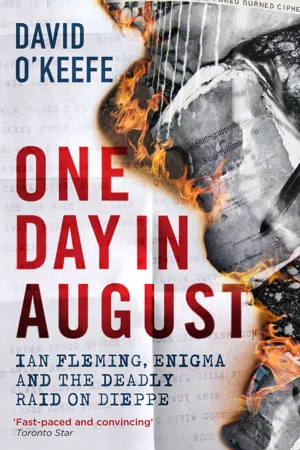
In less than six hours in August 1942, nearly 1,000 British, Canadian and American commandos died in the French port of Dieppe in an operation that for decades seemed to have no real purpose. Was it a dry-run for D-Day, or perhaps a gesture by the Allies to placate Stalin's impatience for a second front in the west?
Historian David O'Keefe uses hitherto classified intelligence archives to prove that this catastrophic and apparently futile raid was in fact a mission, set up by Ian Fleming of British Naval Intelligence as part of a 'pinch' policy designed to capture material relating to the four-rotor Enigma Machine that would permit codebreakers like Alan Turing at Bletchley Park to turn the tide of the Second World War.
'A fast-paced and convincing book ... that clears up decades of misinformation about the ignoble raid'
Toronto Star
- 496 pages
- English
- ePUB (mobile friendly)
- Available on iOS & Android
eBook - ePub
About this book
Information
CHAPTER 1

The ‘Canadian’ Albatross
This was too big for a raid and too small for invasion: What were you trying to do?
German interrogator to Major Brian McCool, August 1942
During his intensive interrogation in the days following his capture, the exhausted prisoner, Major Brian McCool, the Principal Military Landing Officer for the Dieppe Raid, was subjected repeatedly to one burning question from his German interrogator: ‘What were you trying to do?’ Still at a loss, the bewildered McCool lifted his head and replied, ‘If you could tell me … I would be very grateful.’
For nearly three-quarters of a century, that same query has remained unanswered despite numerous attempts by historians, journalists and politicians to explain the reasons behind the deadliest amphibious raid in history. The veterans of that fateful day have themselves never understood the abject failure they experienced and the staggering loss of life their comrades suffered on the blood-soaked beaches of Dieppe. Over the decades since, a pitiful legacy of sorrow, bitterness and recrimination has developed to frame the collective Canadian memory of an operation seemingly devoid of tangible purpose and intent.
The cost to Canada of Operation Jubilee, as the Allies’ raid on Dieppe on August 19, 1942, was code-named, was appalling: 907 men killed – roughly one man every 35 seconds during the nine-hour ordeal – a rate rivalled only by the charnel-house battles on the western front in the First World War. Adding to that sobering toll, a further 2,460 Canadian names filled the columns of the wounded, prisoners of war and missing in the formal casualty returns. By nightfall, a total of 3,367 men – 68 per cent of all the Canadian young men (mostly in their teens and early twenties) who made the one-day Channel crossing to France – had become official casualties in some form. Units such as the Royal Regiment of Canada from Toronto, which suffered 97 per cent casualties in less than four hours of fighting on Blue Beach at Puys, virtually ‘ceased to exist.’1 To varying degrees, the same was true of the other units of the raiding force: bodies of men from army regiments in Quebec, Ontario, Alberta, Saskatchewan and Manitoba fell in piles alongside men from the east and west coasts who toiled in the signals, medical, provost, intelligence or service corps.
The catastrophe would strike a deep chord throughout Canada, seared into the country’s psyche as both our greatest historical mystery and our supreme national tragedy. For decades, Dieppe has been Canada’s albatross.
The losses on that day in August 1942 represented a snapshot of Canadian society. The lasting images were stark and unforgiving: the dead – once husbands, fathers, sons, brothers, managers, janitors, students, fishermen, farmworkers and clerks, who had risked their lives in the name of Canada – lay motionless on the pebbled beaches or slumped along the narrow streets of the town, their often mangled bodies used as fodder for German propaganda. Brothers in arms for that campaign, they now rest in the cemetery close by for eternity, bonded and branded by the name ‘Dieppe.’ For those fortunate enough to be taken prisoner, their reward was almost three years of harsh captivity, their hands and feet shackled night and day for the first eighteen months, and a cruel forced death-march in the winter of 1945 over the frozen fields of Poland and Germany. Only after that did the survivors among them reach home.
For many, coming home did not end their Dieppe experience. By then the units they had once viewed as family had rebuilt, and they found few there who had shared their particular experience. Unlike so many other veterans, they had no ‘band-of-brothers’ stories to share – of storming the beaches on D-Day, slugging it out in Normandy, liberating French and Belgian towns, or delivering the Dutch from the twin evils of starvation and Nazi Germany – and therefore nothing dislodged the Dieppe stigma. A few of the lucky ones managed to move on, reminded of the ‘shame and the glory’ only at chilly Remembrance Day ceremonies, on muggy August anniversaries or by recurring night terrors. Without proper care for what we now recognize as Post-Traumatic Stress Disorder (PTSD), some who could not exorcise the Dieppe demons found temporary solace by lashing out in numerous and at times self-destructive ways instead.
The raid, it should be remembered, was not strictly ‘Canadian’: it was conducted under the overall command of Lord Louis Mountbatten’s Combined Operations Headquarters, and close to 5,000 other Allied soldiers, sailors and airmen, mostly from the United Kingdom, with a smattering of Americans, French, Poles, Belgians and Norwegians, shared the same fateful ordeal in Operation Jubilee. They too were left with lingering frustration about the apparent lack of purpose behind the raid, a vexation captured on the web page of the Juno Beach Centre in Normandy – one of Canada’s military history ambassadors to the world: ‘Dieppe was a pathetic failure,’ it reads, ‘a bizarre operation with no chance of success whatsoever and likely to result in a huge number of casualties.’2

The historical struggle that followed has proven almost as nasty and inconclusive as the battle itself, with the finger-pointing beginning not long after the sounds of conflict faded. Accusations ranged from incompetent leadership to Machiavellian intent after those involved with the planning and conduct of the raid offered up what many felt were deeply unsatisfactory excuses for the disastrous results. The central issue remains, as it has since that raid, the lack of any clear rationale for the intent behind the controversial operation. That absence has left a legacy not only of sorrow but of suspicion, intrigue, mistrust and conspiracy. The common denominator throughout public discourse – that Canadian men had been sacrificed for no apparent or tangible reason – led to a sentiment of unease that quickly built up steam in historical accounts, in the press and in public discussion.
Attempting to rationalize what has defied rationalization, researchers and commentators over the decades have sought to make sense out of the seemingly nonsensical. Historians have searched valiantly through the Allied planning papers, after-action reports, personal and official correspondence, and other ancillary documents available in the public domain, looking for any scrap of evidence that would lead to discovering the driving force or imperative behind the Dieppe Raid. Although the planning documents revealed a list of desired objectives for the raid, they remained nothing more than a grocery list of targets that offered little clue to what achieving them would actually mean in the end.
Officially, Prime Minister Winston Churchill would maintain that the raid was merely a ‘reconnaissance in force’ or a ‘butcher and bolt raid’ – explanations that Mountbatten and others associated with the planning and implementation of the raid expanded upon. Before long, another standard excuse emerged: the Dieppe Raid was simply launched to test Hitler’s vaunted Festung Europa (Fortress Europe) and, as such, it was the necessary precursor to future amphibious operations such as the D-Day landings. After that came the ‘sacrificial’ excuses: the Dieppe Raid had been designed by Great Britain specifically to placate its new ally, the beleaguered Soviet Union, by creating the ‘second front now’ that the Russians were demanding, and thereby drawing German air and land forces away from the East and into Western Europe. From there it moved to questions of deception and intrigue and then on to an attritional contest where the raid was conducted to draw the Luftwaffe out into a great blood match with the RAF. These excuses never satisfied the soldiers involved and led to a healthy scepticism among professional and amateur historians alike. Soon, fingers began to point, with suggestions that the leading players in the Dieppe saga all had something to hide.
They were indeed a motley crew, some highly distinguished, others less so, and the reputations of these men have only added to the furore. Lord Louis Mountbatten, the chief of the Combined Operations Headquarters, is traditionally pegged as the main culprit, not so much for his headquarters’ handling of the planning and conduct of the raid – as ‘inexperienced enthusiasts’ – but more for his personality and royal bloodlines.3 A vainglorious and ambitious character without a doubt, ‘Dickie’ Mountbatten is traditionally accused of operating far above his ceiling, a man primarily interested in courting the press for favourable headlines designed to put him and his headquarters on the map. But nobody in the chain of command has been spared – all have been painted to varying degrees with the same brush of suspicion, guilt and incompetence. Were the force commanders who called the shots from the distant bridge of the headquarters ship HMS Calpe, offshore from Dieppe, responsible – Canadian Major General John Hamilton ‘Ham’ Roberts and Royal Navy Captain John ‘Jock’ Hughes-Hallett? Or were the highest authorities in wartime Britain, the Chiefs of Staff Committee and, ultimately, Prime Minister Winston Churchill, to blame?
It’s a truth of human nature that any void in our understanding tends to force open a Pandora’s box of wild, seductive and intriguing theories. In this case, they span the spectrum from bureaucratic bungling and inflated ambition to treasonous intent; from impotent claims that the raid was conducted simply for ‘the sake of raiding’ to the intentional tipoff of the Germans as an act of betrayal by the French to gain favour with their occupiers. Or perhaps, some surmise, Dieppe was part of a clever game of foxes – an Allied deception to cover the upcoming invasion of North Africa – or, alternatively, an unauthorized action by Mountbatten to win praise and secure his place in history. Some commentators, citing the relative lack of firepower in the raid, for instance, and the overreliance on the element of surprise, coupled with the unprofessional approach to planning and execution, suggest that the entire operation was sacrificial in nature, intended to fail right from the start, to demonstrate the foolhardiness of American and Soviet calls for a second front in 1942.
Some theories are merely silly and irresponsible, such as the urban legend making the rounds in the cafés along Dieppe’s beachfront today that the raid was an ‘anniversary present’ from Winston Churchill to his beloved wife, Clementine, who in her youth had summered in that delightful Channel port town – a favourite seaside holiday spot for English families.
Despite all these efforts to make sense of the Dieppe Raid, however, the mystery has remained intact for over seven decades, taunting us with the pain of its legacy.
That was my own experience long ago in 1995, when I called up a recently declassified file in the British National Archives in London. This wartime British Admiralty file, which at first did not appear to have any connection with the Dieppe Raid, contained an appendix to an ‘Ultra Secret’ classified report concerning the exploits of a highly secret Intelligence Assault Unit (IAU) that, because of its clandestine activities, was known during the war by a variety of names, most notably No. 10 Platoon, X Platoon, 30 Commando or 30 Assault Unit (30 AU). Until the release of that file, there had been nothing to confirm the commando unit’s existence, rumoured to be the brainchild of Royal Naval Volunteer Reserve Commander Ian Fleming. Barely a decade later, Fleming would forge another lasting creation – the super-spy James Bond, the most famous, enduring character in espionage literature. The Intelligence Assault Unit was raised and trained with one specific purpose in mind: to steal, or ‘pinch,’ the most sensitive of intelligence materials from the Germans, items needed to break their top-secret codes and ciphers, including the Enigma ciphering machine, allowing the Allies to read enemy message traffic and to wage war effectively.
It was a short passage in the fourth paragraph that started me on my journey of discovery: ‘As regards captures, the party concerned at DIEPPE did not reach their objective.’ The connection was startling: for the first time here was direct evidence that linked one of the greatest and most closely guarded secrets of the entire Second World War – Enigma – with the deadliest day in Canadian military history. Never before had anything similar appeared in the vast corpus of literature dealing with the Dieppe saga. Something that had remained classified as ‘Ultra Secret’ for over half a century by British intelligence appeared to be lurking beneath the veneer of the traditional interpretations of Dieppe.
In June 1941, British intelligence adopted the term ‘Ultra’ as a security classification for intelligence derived from tapping into enemy communications, most notably their encrypted radio and later teleprinter traffic. Considered prize intelligence – or, as Winston Churchill called it, his ‘golden eggs’ – ‘Ultra Secret’ went above the traditional top-level classification of Most Secret, or, as the Americans referred to it, Top Secret. Logically enough, the term quickly became a security ‘catch-all’ that not only denoted the end product used by Churchill and his commanders to formulate their decisions on the field of battle, but also extended to the technology, processes, policies, operations and even history centred around the secret British code-breaking facility known as Bletchley Park.
Purchased by the Secret Intelligence Service (SIS, or MI6 as it became popularly known) at the outset of the war, this sprawling Victorian estate in Buckinghamshire, just an hour’s drive north of London, was the main site for the Government Code and Cypher School (GC&CS), which was responsible for signals intelligence (SIGINT) and code-breaking. By military standards, it was a most unusual place: the requirements of the job called for the utmost in intellectual prowess, which meant recruiting some of the most ‘beautiful’ minds that Great Britain, and later the Allies, could offer. The head of operations, Alastair Denniston, had served in British intelligence during the First World War, and now he recruited ‘men of the professor type,’ as he called them, for the new challenge. Drawn mostly from elite universities such as Oxford or Cambridge, these men and women came from a variety of disciplines – mathematics, the sciences, linguistics, classics, history, to name but a few – literally the best and the brightest of the academic world. In this large mansion, they joined forces with gifted intelligence officers (again British and later Allied) from the navy, the air force and the army to produce something that up to that point no other country in history could boast: a relatively consistent and comprehensive ability to tap into a direct information pipeline to monitor their enemy’s strengths, weaknesses, intentions, capabilities, hopes, fears, desires and dreams. As Frank Birch, the head of Bletchley’s Naval Section who had served as a cryptanalyst in the First World War, suggested: ‘There lingered until the end of the war in certain elevated and rarified atmospheres, several of the old popular superstitions about SIGINT (signals intelligence). A familiar one was the belief that codes and ciphers were broken by a few freakish individuals with a peculiar kink, no help, and very little material except for the damp towels round their heads.’4
As those in the ‘rarified atmosphere’ would soon learn, Bletchley formed the most potent weapon for a nation at war, and as their importance to the cause increased, so too did the size of Bletchley Park. Soon, numerous numbered ‘huts’ began to spring up around the grounds; these nondescript plywood barracks housed the offices of the naval, air, military and diplomatic sections, which toiled not only to break into, or decrypt, enemy messages intercepted by the many radio intercept stations located around the British Empire, but then to turn what they intercepted and decrypted into sensible and accurate intelligence to be used by the decision-makers...
Table of contents
- Praise
- Title Page
- Contents
- About the author
- List of Illustrations
- Dedication
- Note on Sources
- Map
- Prologue
- 1: The ‘Canadian’ Albatross
- 2: A Very Special Bond
- 3: A Ruthless Start
- 4: Annus Mirabilis
- 5: Swimming With Sharks
- 6: Fade to Black
- 7: Kick at the Darkness
- 8: ‘Authorized Looters’
- 9: Darkness to Daylight
- 10: All the King’s Men
- 11: Dieppe by Design
- 12: All Essential Features
- 13: Of Blood and Thunder
- 14: All In on the Main Beach
- Epilogue: Recalibration
- Abbreviations
- Glossary
- Bibliography
- Acknowledgements
- Photo Credits
- Permissions
- Notes
- Index
- Plates
- Copyright
Trusted by 375,005 students
Access to over 1.5 million titles for a fair monthly price.
Study more efficiently using our study tools.
Frequently asked questions
Yes, you can cancel anytime from the Subscription tab in your account settings on the Perlego website. Your subscription will stay active until the end of your current billing period. Learn how to cancel your subscription
No, books cannot be downloaded as external files, such as PDFs, for use outside of Perlego. However, you can download books within the Perlego app for offline reading on mobile or tablet. Learn how to download books offline
Perlego offers two plans: Essential and Complete
- Essential is ideal for learners and professionals who enjoy exploring a wide range of subjects. Access the Essential Library with 800,000+ trusted titles and best-sellers across business, personal growth, and the humanities. Includes unlimited reading time and Standard Read Aloud voice.
- Complete: Perfect for advanced learners and researchers needing full, unrestricted access. Unlock 1.5M+ books across hundreds of subjects, including academic and specialized titles. The Complete Plan also includes advanced features like Premium Read Aloud and Research Assistant.
We are an online textbook subscription service, where you can get access to an entire online library for less than the price of a single book per month. With over 1.5 million books across 990+ topics, we’ve got you covered! Learn about our mission
Look out for the read-aloud symbol on your next book to see if you can listen to it. The read-aloud tool reads text aloud for you, highlighting the text as it is being read. You can pause it, speed it up and slow it down. Learn more about Read Aloud
Yes! You can use the Perlego app on both iOS and Android devices to read anytime, anywhere — even offline. Perfect for commutes or when you’re on the go.
Please note we cannot support devices running on iOS 13 and Android 7 or earlier. Learn more about using the app
Please note we cannot support devices running on iOS 13 and Android 7 or earlier. Learn more about using the app
Yes, you can access One Day in August by David O'Keefe in PDF and/or ePUB format, as well as other popular books in History & World War II. We have over 1.5 million books available in our catalogue for you to explore.