- 224 pages
- English
- ePUB (mobile friendly)
- Available on iOS & Android
eBook - ePub
About this book
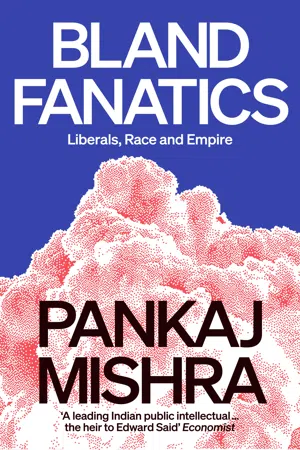
Decades of violence and chaos have generated a political and intellectual hysteria-ranging from imperial atavism to paranoia about invading or hectically breeding Muslim hordes-that has affected even the most intelligent in Anglo-America. In Bland Fanatics, Pankaj Mishra examines this hysteria and its fantasists, taking on its arguments and the atmosphere in which it has festered and become influential. In essays that grapple with colonialism, human rights, and the doubling down of liberalism against a background of faltering economies and weakening Anglo-American hegemony, Mishra confronts writers from Jordan Peterson and Niall Ferguson to Salman Rushdie and Ayaan Hirsi Ali. With a newly written introduction, these essays provide a vantage point from which to look seriously at the current crisis.
Information
1
Watch this Man
On Niall Ferguson and Neo-imperialism
‘Civilisation’s going to pieces,’ Tom Buchanan, the Yale-educated millionaire, abruptly informs Nick Carraway in The Great Gatsby. ‘I’ve gotten to be a terrible pessimist about things. Have you read The Rise of the Colored Empires by this man Goddard? … The idea is if we don’t look out the white race will be – will be utterly submerged.’ ‘Tom’s getting very profound,’ his wife Daisy remarks. Buchanan carries on: ‘This fellow has worked out the whole thing. It’s up to us, who are the dominant race, to watch out or these other races will have control of things.’ ‘We’ve got to beat them down,’ Daisy whispers with a wink at Nick. But there’s no stopping Buchanan. ‘And we’ve produced all the things that go to make civilisation – oh, science and art, and all that. Do you see?’
‘There was something pathetic in his concentration,’ Carraway, the narrator, observes, ‘as if his complacency, more acute than of old, was not enough to him any more.’ The scene, early in the novel, helps identify Buchanan as a bore – and a boor. It also evokes a deepening panic among America’s Anglophile ruling class. Wary of Jay Gatz, the self-made man with a fake Oxbridge pedigree, Buchanan is nervous about other upstarts rising out of nowhere to challenge the master race.
Scott Fitzgerald based Goddard, at least partly, on Theodore Lothrop Stoddard, the author of the bestseller The Rising Tide of Color against White World-Supremacy. Stoddard’s fame was a sign of his times, of the overheated racial climate of the early twentieth century, in which the Yellow Peril seemed real, the Ku Klux Klan had re-emerged, and Theodore Roosevelt worried loudly about ‘race-suicide’. In 1917, justifying his reluctance to involve the United States in the European war, Woodrow Wilson told his secretary of state that ‘white civilisation and its domination over the world rested largely on our ability to keep this country intact’.
Hysteria about ‘white civilisation’ gripped America after Europe’s self-mutilation in the First World War had encouraged political assertiveness among subjugated peoples from Egypt to China. Unlike other popular racists, who parsed the differences between Nordic and Latin peoples, Stoddard proposed a straightforward division of the world into white and coloured races. He also invested early in Islamophobia, arguing in The New World of Islam that Muslims posed a sinister threat to a hopelessly fractious and confused West. Like many respectable eugenicists of his time, Stoddard later found much to like about the Nazis, which marked him out for instant superannuation following the exposure of Nazi crimes in 1945.
The banner of white supremacism has been more warily raised ever since in post-imperial Europe, and very rarely by mainstream politicians and writers. In the United States, racial anxieties have been couched either in such pseudo-scientific tracts about the inferiority of certain races as The Bell Curve, or in big alarmist theories like Samuel Huntington’s ‘clash of civilisations’. It’s not at all surprising that in his last book Huntington fretted about the destruction by Latino immigration of America’s national identity, which is apparently a construct of ‘Anglo-Protestant culture’. As power ostensibly shifts to the East, a counterpoise to dismay over the West’s loss of authority and influence is sought in a periodic ballyhooing of the ‘transatlantic alliance’, as in Philip Bobbitt’s Terror and Consent, which Niall Ferguson in an enthusiastic review claimed will ‘be read with pleasure by men of a certain age, class and education from Manhattan’s Upper East Side to London’s West End’.
Ferguson himself is homo atlanticus redux. In a preface to the UK edition of Civilisation: The West and the Rest, he writes of being seduced away from a stodgy Oxbridge career, early in the 2000s, to the United States, ‘where the money and power actually were’. The author of two previous books about nineteenth-century banking, Ferguson became known to the general public with The Pity of War, a long polemic, fluent and bristling with scholarly references, that blamed Britain for causing the First World War. According to Ferguson, Prussia wasn’t the threat it was made out to be by Britain’s Liberal Cabinet. The miscalculation not only made another war inevitable after 1919, and postponed the creation of an inevitably German-dominated European Union to the closing decades of the twentieth century; it also tragically and fatally weakened Britain’s grasp on its overseas possessions.
This wistful vision of an empire on which the sun need never have set had an immediately obvious defect. It grossly underestimated – in fact, ignored altogether – the growing strength of anti-colonial movements across Asia, which, whatever happened in Europe, would have undermined Britain’s dwindling capacity to manage its vast overseas holdings. At the time, however, The Pity of War seemed boyishly and engagingly revisionist, and it established Ferguson’s reputation: he was opinionated, ‘provocative’ and amusing, all things that seem to be more cherished in Britain’s intellectual culture than in any other.
In retrospect, The Pity of War’s Stoddardesque laments about the needless emasculation of Anglo-Saxon power announced a theme that would become more pronounced as Ferguson, setting aside his expertise in economic history, emerged as an evangelist-cum-historian of empire. He was already arguing in The Cash Nexus, published a few months before the terrorist attacks of 11 September 2001, that ‘the United States should be devoting a larger percentage of its vast resources to making the world safe for capitalism and democracy’ – if necessary by military force. ‘Let me come clean,’ he wrote in the New York Times Magazine in April 2003, a few weeks after the shock- and-awe campaign began in Iraq, ‘I am a fully paid-up member of the neoimperialist gang.’
Empire: How Britain Made the Modern World, Ferguson’s next book, appeared in America with a more didactic subtitle: ‘The Rise and Demise of the British World Order and the Lessons for Global Power’. The word ‘empire’ still caused some unease in the US, whose own national myths originated in an early, short-lived and selective anti-imperialism. An exasperated Ferguson – ‘the United States’, he claimed, ‘is an empire, in short, that dare not speak its name’ – set out to rescue the word from the discredit into which political correctness had apparently cast it. Britain’s nineteenth-century empire ‘undeniably pioneered free trade, free capital movements and, with the abolition of slavery, free labour. It invested immense sums in developing a global network of modern communications. It spread and enforced the rule of law over vast areas.’ ‘Without the spread of British rule around the world’, he went on, in a typical counterfactual manoeuvre, colonised peoples, such as Indians, would not have what are now their most valuable ideas and institutions – parliamentary democracy, individual freedom and the English language.
America should now follow Britain’s example, Ferguson argued, neglecting to ask why it needed to make the modern world if Britain had already done such a great job. He agreed with the neocon Max Boot that the United States should recreate across Asia the ‘enlightened foreign administration once provided by self-confident Englishmen in jodhpurs and pith helmets’. ‘The work needs to begin, and swiftly,’ he wrote, ‘to encourage American students at the country’s leading universities to think more seriously about careers overseas.’
Ferguson’s proposed ‘Anglobalisation’ of the world was little more than an updated version of American ‘modernisation theory’, first proposed as an alternative to communism during the Cold War, and now married to revolutionary violence of the kind for which communist regimes had been reviled. It makes for melancholy reading in 2011. But in the first heady year of the global war on terror, easy victories over the ragtag army of the Taliban ignited megalomaniacal fantasies about the ‘Rest’ across a broad ideological spectrum in Anglo-America, from Ann Coulter arguing that ‘we should invade their countries, kill their leaders and convert them to Christianity’ to the unctuous ‘Empire-Lite’ of Michael Ignatieff and the ‘liberal imperialism’ peddled by Robert Cooper, one of Blair’s fly-by-night gurus. ‘Islamofascism’ seemed as evil as Nazism, Saddam Hussein was another Hitler, a generation-long battle loomed, and invocations of Winston Churchill – ‘the greatest’, according to Ferguson, ‘of all Anglo-Americans’, his resolute defence of English-speaking peoples commemorated by a bust in the Bush White House – seemed to stiffen spines all across the Eastern Seaboard.
The reception a writer receives in a favourable political context can be the making of him. This applies particularly well to Ferguson, whose books are known less for their original scholarly contribution than for containing some provocative counterfactuals. In Britain, his bluster about the white man’s burden, though largely ignored by academic historians, gained substance from a general rightward shift in political and cultural discourse, which made it imperative for such apostles of public opinion as Andrew Marr to treat Ferguson with reverence. But his apotheosis came in the United States, where – backed by the prestige of Oxbridge and, more important, a successful television series – he became a wise Greek counsellor to many aspiring Romans. He did not have to renounce long-held principles to be elevated to a professorship at Harvard, prime-time punditry on CNN and Fox, and high-altitude wonkfests at Davos and Aspen. He quickly and frictionlessly became the most conspicuous refugee from post-imperial Britain to cheerlead Washington’s (and New York’s) consensus.
To a reader from the world the British supposedly made, Empire belonged recognisably to the tradition of what the Chinese thinker Tang Tiaoding bluntly described in 1903 as ‘white people’s histories’. Swami Vivekananda, India’s most famous nineteenth-century thinker, articulated a widespread moral disapproval of the pith-helmeted missionaries of Western civilisation celebrated by Ferguson:
Intoxicated by the heady wine of newly acquired power, fearsome like wild animals who see no difference between good and evil, slaves to women, insane in their lust, drenched in alcohol from head to foot, without any norms of ritual conduct, unclean … dependent on material things, grabbing other people’s land and wealth by hook or by crook … the body their self, its appetites their only concern – such is the image of the western demon in Indian eyes.
In 1877, decades before anti-colonial leaders and intellectuals across Asia and Africa developed a systematic political critique of colonialism, the itinerant Muslim activist Jamal al-Din al-Afghani was attacking ‘the trap of duplicity’ in British accounts of India. The British had invested immense sums in developing a global network of modern communications simply in order, al-Afghani wrote, ‘to drain the substance of our wealth and facilitate the means of trade for the inhabitants of the British Isles and extend their sphere of riches’. Two generations of Western historians have essentially confirmed the early Asian and African arguments that the imperatives of ‘free trade’, whether imposed, as on China, by gunboats, or as on India, by outright occupation, had a devastating effect. The Indian Declaration of Independence in 1930 inadvertently summed up the multifarious damage inflicted on a swathe of subjugated countries from Ottoman Turkey and Egypt to Java:
Village industries, such as hand spinning, have been destroyed … and nothing has been substituted, as in other countries, for the crafts thus destroyed.Customs and currency have been so manipulated as to bring further burdens on the peasantry. British manufactured goods constitute the bulk of our imports. Customs duties betray partiality for British manufacturers, and revenue from them is not used to lessen the burden on the masses but for sustaining a highly extravagant administration. Still more arbitrary has been the manipulation of the exchange ratio, which has resulted in millions being drained away from the country … All administrative talent is killed and the masses have to be satisfied with petty village offices and clerkships … the system of education has torn us from our moorings.
Ferguson did not entirely ignore the more egregious crimes of imperialism: the slave trade, the treatment of Australian aborigines or the famines that killed tens of millions across Asia. But he offered a robust defence of British motives, which apparently were humanitarian as much as economic. Transporting millions of indentured Asian labourers to far-off colonies (Indians to the Malay Peninsula, Chinese to Trinidad) was terrible, but ‘we cannot pretend that this mobilisation of cheap and probably underemployed Asian labour to grow rubber and dig gold had no economic value’. And he challenged the ‘fashionable’ allegation that ‘the British authorities did nothing to relieve the drought-induced famines of the period’. In any case, ‘whenever the British were behaving despotically, there was almost always a liberal critique of that behaviour from within British society’. He sounds like the Europeans described by V.S. Naipaul – the grandson of indentured labourers – in A Bend in the River, who ‘wanted gold and slaves, like everybody else’, but also ‘wanted statues put up to themselves as people who had done good things for the slaves’.
~
Ferguson’s next book, Colossus: The Rise and Fall of the American Empire, a selective history of American imperial interventions, showed him to be increasingly concerned with the capability rather than the legitimacy of the American empire. He was convinced that domestic social welfare programmes like Medicare and Medicaid had to be cut drastically in order to build more foreign outposts for jodhpur-clad Americans. But Americans, it turned out, were not rushing to Abercrombie & Fitch to equip themselves for life in the tropics. Some zealous young Republicans in Baghdad’s Green Zone were busy dismantling the Iraqi state, but they clearly did not impress Ferguson. ‘America’s brightest and best’, he complained, ‘aspire not to govern Mesopotamia but to manage MTV; not to rule the Hejaz but to run a hedge fund.’
‘If one adds together the illegal immigrants, the jobless and the convicts,’ he argued, ‘there is surely ample raw material for a larger American army.’ But by 2006, the worst year of the anti-American insurgency, Ferguson was convinced that America was not up to the ‘labour-intensive’ task of occupying and governing Iraq. Recalling Gibbon for the readers of Vanity Fair, he identified some alarmingly diverse portents of the decline and fall of Western civilisation: they included America’s dependence on ‘Asian central banks and Middle Eastern treasuries’ for its wars; Muslim immigrants (Ferguson was an early exponent of ‘Eurabia’); feminism, which had caused Europe’s demographic decline; and the fact that ‘girls no longer play with dolls; they are themselves the dolls, dressed according to the dictates of the fashion industry.’ Americans were overweight, while Europeans, turning their back on Christianity and warfare and sponging on the welfare state, were degenerate idlers. ‘Endlessly gaming, chatting and chilling with their iPods,’ Ferguson wrote, ‘the next generation already has a more tenuous connection to “Western civilisation” than most parents appreciate.’
It didn’t seem too abrupt when Ferguson abandoned transatlanticism in late 2006, instead investing his intellectual faith and energy in ‘Chimerica’, a necessary and apt alliance, as he saw it, between China and America, a veritable G2. Throughout his forays into ‘provocative’ imperial history, Ferguson had maintained his high reputation as an economic historian. ‘So vast is America’s looming fiscal crisis,’ he had written as early as 2004, ‘that it is tempting to talk about the fiscal equivalent of the perfect storm – or the perfect earthquake.’ But now, awed by the ‘rise of China’, he saw ‘the two halves of Chimerica’ as wonderfully ‘complementary’:
Profligate West Chimericans cannot get enough of the gadgets mass-produced in the East; they save not a penny of their income and are happy to borrow against their fancy houses. Parsimonious East Chimericans live more humbly and cautiously. They would rather save a third of their own income and lend it to the West Chimericans to fund their gadget habit – and keep East Chimericans in jobs.
This was ‘the secular summer of Sino-American symbiosis’, Ferguson explained with typical exuberance in early 2007. ‘Chimerica, despite its name, is no chimera.’
Speaking at Chatham House in 2011, Ferguson claimed that Chimerica had appealed to him because ‘it was a pun’, adding that it was not ‘true anymore, if it ever was true’. What happened? As he put it, the ‘West has suffered a financial crisis that has damaged not only the wealth of the Western world, but perhaps more importantly the legitimacy, the credibility, even the self-esteem of the West.’ With the ‘Chinese Century’ now imminent, and Muslims knocking yet again at the gates of Europe, the important thing for British and American elites is to prepare themselves for a dramatically altered world. ‘We are’, as he argues in Civilisation, ‘living through the end of 500 years of Western ascendancy.’
This makes it especially deplorable, in Ferguson’s view, that ‘major universities have ceased to offer the classic “Western Civ” history course to their undergraduates.’ Assaulted by politically correct intellectuals and cultural relativists, who regard ‘all civilisations as somehow equal … the grand narrative of Western ascent has fallen out of fashion’ precisely when it is most needed. ‘Maybe,’ Ferguson proposes, ‘the real threat is posed not by the rise of China, Islam or CO2 emissions, but by our own loss of faith in the civilisation we inherited from our ancestors.’
Ferguson’s outbursts against Britain – ‘Get me to the airport,’ he told the Telegraph, ‘I just want to get back to the US’ – may have lost him some of his audience among right-wing broadsheets and tabloids in this country. But the anchors of America’s cable news networks remain deferential. And Michael Gove, one of the Tories’ me-too neocons, has enlisted him to help devise a new history curriculum. For those young men and women willing to swap their iPods for a reassuringly expensive lecture in ‘Western Civ’, he will also be available periodically at A. C. Grayling’s New College of the Humanities. Civilisation gives a fair sample of the intellectual and spiritual tonic he would offer there.
Of the various things Tom Buchanan thinks ‘go to make civilisation – oh, science and art, and all that’, Ferguson is indifferent to the art, mocking Kenneth Clark’s TV series, and his ‘de haut en bas manner’. He aims ‘to be more down and dirty than high and mighty’. For him, civilisation is best measured by the ability to make ‘sustained improvement in the material quality of life’, and in this the West has ‘patently enjoyed a real and sustained edge over the Rest for most of the previous 500 years’. Ferguson names six ‘killer apps’ – property rights, competition, science, medicine, the consumer society and the work ethic – as the operating software of Western civilisation that, beginning around 1500, enabled a few small polities at the western end of the Eurasian landmass ‘to dominate the rest of the world’.
To explain the contingent, short-lived fac...
Table of contents
- Cover Page
- Title Page
- Copyright Page
- Contents
- Introduction
- 1. Watch this Man
- 2. The Culture of Fear
- 3. The Religion of Whiteness
- 4. The Personal as Political
- 5. The Man of Fourteen Points
- 6. Bland Fanatics
- 7. The Age of the Crisis of Man
- 8. Free Markets and Social Darwinism in Mumbai
- 9. The Lure of Fascist Mysticism
- 10. What Is Great about Ourselves
- 11. Why Do White People Like What I Write?
- 12. The Mask It Wears
- 13. The Final Religion
- 14. Bumbling Chumocrats
- 15. The Economist and Liberalism
- 16. England’s Last Roar
- 17. Flailing States
- 18. Grand Illusions
- Index
Trusted by 375,005 students
Access to over 1.5 million titles for a fair monthly price.
Study more efficiently using our study tools.
Frequently asked questions
Yes, you can cancel anytime from the Subscription tab in your account settings on the Perlego website. Your subscription will stay active until the end of your current billing period. Learn how to cancel your subscription
No, books cannot be downloaded as external files, such as PDFs, for use outside of Perlego. However, you can download books within the Perlego app for offline reading on mobile or tablet. Learn how to download books offline
Perlego offers two plans: Essential and Complete
- Essential is ideal for learners and professionals who enjoy exploring a wide range of subjects. Access the Essential Library with 800,000+ trusted titles and best-sellers across business, personal growth, and the humanities. Includes unlimited reading time and Standard Read Aloud voice.
- Complete: Perfect for advanced learners and researchers needing full, unrestricted access. Unlock 1.5M+ books across hundreds of subjects, including academic and specialized titles. The Complete Plan also includes advanced features like Premium Read Aloud and Research Assistant.
We are an online textbook subscription service, where you can get access to an entire online library for less than the price of a single book per month. With over 1.5 million books across 990+ topics, we’ve got you covered! Learn about our mission
Look out for the read-aloud symbol on your next book to see if you can listen to it. The read-aloud tool reads text aloud for you, highlighting the text as it is being read. You can pause it, speed it up and slow it down. Learn more about Read Aloud
Yes! You can use the Perlego app on both iOS and Android devices to read anytime, anywhere — even offline. Perfect for commutes or when you’re on the go.
Please note we cannot support devices running on iOS 13 and Android 7 or earlier. Learn more about using the app
Please note we cannot support devices running on iOS 13 and Android 7 or earlier. Learn more about using the app
Yes, you can access Bland Fanatics by Pankaj Mishra in PDF and/or ePUB format, as well as other popular books in Politics & International Relations & International Relations. We have over 1.5 million books available in our catalogue for you to explore.