eBook - ePub
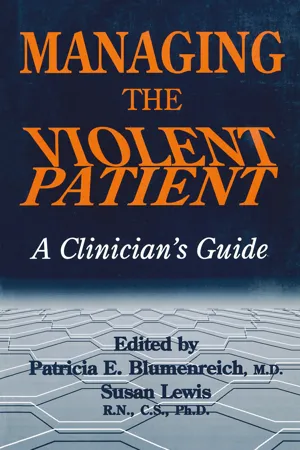
Managing The Violent Patient
A Clinician's Guide
- 176 pages
- English
- ePUB (mobile friendly)
- Available on iOS & Android
eBook - ePub
Managing The Violent Patient
A Clinician's Guide
About this book
This important book equips mental health professionals with sound and practical strategies for responding effectively to disruptive or violent patients. The authors identify the warning signals of potential violence and offer detailed guidelines on assessment; verbal, pharmacological, and physical intervention; use of seclusion and restraints; and management of hostage situations. Of particular value is the emphasis on ways of preventing a potentially dangerous person from erupting into physical violence. Full consideration is also given to institutional responses to violent incidents.
Information
1

Introduction
The incidence of violence in our society is on the rise. From 1989 to 1990 the overall rate of violent crime showed an increase of 11% (Index of Crime, 1990). This is an issue of importance for psychiatric professionals. Rates of assaultiveness and acting-out behavior are higher among psychiatric patients than previously thought. Some 33% to 40% of psychiatric admissions are preceded by violence (Parks, 1990). Assaultiveness in emergency psychiatric patients has been reported to be as high as 60% (Parks, 1990), although this figure may be somewhat lower in many settings.
Violence in psychiatric patients results from a complex interaction of multiple factors. Not only must the patient be considered in the context of the diagnosis or illness, but also in a broader perspective of physical, psychological, and sociocultural factors. The addition of immediate situational stress complicates matters further.
Patients generally are violent for identifiable reasons and give warning signals in advance of acting out. Clinicians can react to threats of personal harm in several ways. They can deny, ignore, or fail to recognize it, or they can freeze, panic, or respond therapeutically.
This book focuses on various aspects of dealing with disruptive patients. Guidelines for verbal, pharmacological, and physical intervention are discussed. Many of the physical management techniques presented in this volume are adapted from those originally developed by the Department of Veterans Affairs Medical Center and Physical Crisis Institute (PCI) in Cleveland, Ohio. When working with dangerous or potentially dangerous persons, prevention is the key. early intervention with interpersonal and/or chemical means can prevent a situation from erupting into physical violence.
Clinicians need to be able to recognize cues in the patient’s history, physical condition, mental status, differential diagnosis, and behavior that indicate a potential for violence. And they must be aware of their own feelings of fear and anger that signal caution. Once this potential is identified, staff members need to know how to prevent violence and to minimize its damaging effects if violence should occur (Factor, 1991). No matter how skilled the practitioner, there is always a chance of injury to patients or staff members when physical contact takes place.
Knowledge of the principles of the prevention and management of disruptive behavior and thorough assessment tempered with common sense can avert a crisis. In emergency rooms, admitting areas, and other treatment units, the milieu should be structured to minimize risk. A warm, comfortable decor is more soothing. The area should be free of sharp and other objects that can be thrown or used as weapons. Escape routes should be accessible, as should ways of summoning additional staff. Crowding and noise should be kept to a minimum.
The staff members’ demeanor should communicate respect, confidence, and a willingness to help. Both professionals and non-professionals need to be aware of ways in which they may provoke patients and ways in which they can defuse anger. The staff must be constantly “tuned in” to the level of tension in the clinical setting. Threats of harm to the patient’s self or others should be taken seriously. A disturbed patient needs to be allowed expanded personal space.
Every treatment area should have policies and procedures specifying health and safety measures. There should be a sufficient number of well-trained staff members available to deal with possible crises. The presence of permanent staff members can facilitate the prevention of violence whereas the use of temporary staff can increase its likelihood (Haven & Piscitello, 1989). A prearranged signal to summon assistance should be designated. Ongoing training and review of techniques are essential. In addition, it is crucial that staff members function as a team when responding to violence.
After each incident, staff members should hold debriefing sessions. The object of these is not to place blame, but to evaluate what happened and improve methods.
It is difficult to predict violence over the long term; however, predictions of the potential for short-term violence can be fairly accurate. Diagnosis, a history of violence, the presence of drugs and alcohol, and current behavior can alert the clinician to the level of risk. The most effective way to deal with violent and/or assaultive behavior is to prevent it from ever happening.
REFERENCES
Factor, R. (1991). Managing the violent patient in the emergency department. Emergency Care Quarterly, 7(1), 82—93.
Haven, E., & Piscitello, V. (1989). The patient with violent behavior. In S. Lewis, R. Grainger, W. McDowell, R. Gregory & R. Messner (Eds.), Manual of psychosocial nursing interventions (pp. 187—204). Philadelphia: Saunders.
Index of Crime (1988). Vital statistics of the United States (DHHS Publication, Vol. 2, Part 18). Washington, D.C.: U.S. Government Printing Office.
Parks, J. (1990). Violence. In J.R. Hillard (Ed.), Manual of clinical emergency psychiatry (pp. 147-160). Washington, D.C.: American Psychiatric Press.
2
Epidemiology
Dangerousness has become a concern for our entire society, especially since crime has steadily increased in incidence over the past 30 years. The health professions have a stake in the issue as up to 50% of human services workers become victims of violence at some time during their careers. Deadly assaults on physicians are rare, but they raise community concerns, particularly if the assaulter is identified as a “mental patient.”
Whether persons with a psychiatric disorder have more aggressive behavior than those without has long been a controversy. Studies linking violence and mental disorders have provided inconsistent results, partly because of methodological bias. What constitutes violence has been defined differently by different researchers—ranging from threats to actual crimes, including both violent and nonviolent acts. Some investigators have included individuals who were arrested for their crimes, whereas others have focused on only those who were convicted. Most often, perpetrators were identified as patients only if they had a history of contacts with the public mental health system where they had received a psychiatric diagnosis. A significant number of violent acts are never reported, and when they are, the offenders may not be arrested, or convicted, or even identified, decreasing the reliability of the data even further. For example, rapes are 50% unreported according to a police estimate arrests are made in only half of the reported cases. Among those arrested, two thirds are prosecuted, with a 47% conviction rate. Therefore, 200 actual incidents may result in only 15 convictions (Rabkin, 1979). As for the identification of psychiatric patients, not all get into public health-care systems. Such characteristics as sex, age, race, socioeconomic status, and distance from services influence their entry into treatment (Jarvis, 1866). The same applies to severity of illness: individuals with psychosis, depression, and dementia are more likely to have received attention in public facilities, with aid from social and legal agencies. They are more likely to be arrested and convicted if involved in a crime, if only because of poor cooperation with their lawyers. These populations are not a true reflection of either dangerousness or mental illness.
The relationship between aggression and psychiatric disorders has been examined using data from a 1984 Epidemiologic Catchment Area Survey (Swanson, Holzer, Ganju, & Jono, 1990). Adult diagnoses were attained through responses to the Diagnostic Interview Schedule (DIS). To count as a positive case, the respondents had to meet the diagnostic criteria for a given disorder during the 12 months preceding the interview. Five specific questions on the DIS address violence:
1. Did you ever hit or throw things at your wife/husband/ partner? (If so) were you ever the one who threw things first, regardless of who started the argument? Did you hit or throw things first on more than one occasion?
2. Have you ever spanked or hit a child (yours or anyone else’s) hard enough to cause a bruise, injury, or need to see a doctor?
3. Since age 18, have you been in more than one fight that involved exchanging blows, other than those with your husband/wife/partner?
4. Have you ever used a weapon such as a stick, knife, or gun in a fight since you were 18?
5. Have you ever gotten into physical altercations while drinking?
Only violent episodes that occurred within 12 months were included in the study. The persons interviewed lived in the community and the diagnosis did not depend on a treatment, in order to avoid the entry of selection skew. Dangerousness was not assessed through arrests or conviction documents, but through personal disclosure. While self-reporting is not always accurate, such errors are thought to impart less systematic bias than do legal factors.
The results showed that the one-year incidence of violence in 10,059 persons interviewed was 3.7%, that is, 368 people responded positively to at least one item. Being male, young, and of low socioeconomic status was associated with aggressiveness. Men (5.29%) were more than twice as violent as women (2.2%), and people 18 to 29 years of age reported twice as much violence (7.3%) as the age group 30—44 (3.6%). Among people under 45, rates of violence were about three times higher for those in the lowest socioeconomic group than for those in the highest socioeconomic group.
Among the 368 violent responders, 55.5% met the criteria for a psychiatric disorder as compared with 19.6% of the nonviolent persons. Substance abuse was identified 10 times more often among dangerous persons; affective disorders and schizophrenia were three times more common. The assessment of patients by diagnostic category reveals that the proportion of violence is relatively similar at about 11% across most diagnoses, except for phobia and substance abuse. Only 2% of the respondents with no psychiatric history admitted to violence; approximately 5% of phobic individuals reported dangerousness, and yet 25% of the substance abusers did. As to the type of assaults reported, hitting a child was the least common at 0.2% and fights with persons other than a spouse the highest (1.8%), and weapons were used in 1% of incidents. Striking a spouse was revealed by 1.4% and fighting while drinking also by 1.4%. Having had only one incident of combativeness was reported by 2.4%, and two or more incidents by 1.3%. No one admitted five or more occasions of dangerousness.
There is an almost linear relationship between the number of diagnosed conditions and the incidence of aggression: 2.1% for no diagnosis, 6.8% for one diagnosis, 17.5% for two diagnoses, and 22.4% for three or more. This may be indicative of any of the following: (1) polydiagnoses with significant psychopathologies that induce combativeness; (2) substance abuse, which heralds dangerousness; (3) endorsement of multiple symptoms associated with overreporting of violence; (4) use of psychiatric symptoms as an excuse for behavior; and (5) abuse of drugs in an attempt at self-medication. All five hypotheses probably contain some truth.
The question of the severity or frequency of violence and the severity or polymorphy of mental disorders has been addressed. In fact, 77% of the people with no psychiatric diagnosis who reported violence reported only one instance. About 50% of those with a psychiatric diagnosis answered positively on two or more items, hinting at a relationship between mental disorders and the frequency of aggression. Diagnoses with a high proportion of dangerousness, such as substance abuse, are associated with positive responses on multiple violence-related items.
In summary, there is clear evidence that people with mental disorders or substance-abuse problems report more assaultive behavior than do those without them. Anxiety and affective disorders, when they are the sole diagnosis, do not greatly increase the risk of aggression. Alcohol and substance abuse and the presence of more than one other diagnosis greatly elevate the risk. Aside from mental illness, male sex, young age, and lower socioeconomic status increase the chances of aggression substantially. People with schizophrenia do indulge in violence (12.7%), particularly if they are also drug abusers. When schizophrenia is the only diagnosis, the proportion falls to 8.4%. Since there are fewer schizophrenics than there are alcoholics in the population, citizens run a much larger risk of being attacked by an alcoholic than by a schizophrenic. These findings have important implications for community agencies, legal and judicial authorities, and mental health planners.
The information about the characteristics of dangerous patients in treatment has been gathered from a variety of settings, through different methods, and has yielded contradictory conclusions. Violent incidents in treatment settings tend to be underreported. In a Maryland state hospital, only 18% of assaults were formally reported (Lion, Snyder, & Merrill, 1981). Only ...
Table of contents
- Front cover
- Half Title
- Title Page
- Copyright
- Dedication
- Contents
- Foreword by Steven B. Lippmann, M.D
- Acknowledgments
- Contributors
- 1. INTRODUCTION
- 2. EPIDEMIOLOGY
- 3. ETIOLOGY
- 4. ASSESSMENT
- 5. VERBAL INTERVENTION
- 6. PHARMACOTHERAPY OF VIOLENCE
- 7. PHYSICAL TECHNIQUES
- 8. RESTRAINT AND SECLUSION
- 9. HOSTAGE SITUATIONS AND THE MENTAL HEALTH PROFESSIONAL
- 10. INSTITUTIONAL RESPONSES TO VIOLENT INCIDENTS
- 11. LEGAL ISSUES
- Name Index
- Subject Index
Trusted by 375,005 students
Access to over 1.5 million titles for a fair monthly price.
Study more efficiently using our study tools.
Frequently asked questions
Yes, you can cancel anytime from the Subscription tab in your account settings on the Perlego website. Your subscription will stay active until the end of your current billing period. Learn how to cancel your subscription
No, books cannot be downloaded as external files, such as PDFs, for use outside of Perlego. However, you can download books within the Perlego app for offline reading on mobile or tablet. Learn how to download books offline
Perlego offers two plans: Essential and Complete
- Essential is ideal for learners and professionals who enjoy exploring a wide range of subjects. Access the Essential Library with 800,000+ trusted titles and best-sellers across business, personal growth, and the humanities. Includes unlimited reading time and Standard Read Aloud voice.
- Complete: Perfect for advanced learners and researchers needing full, unrestricted access. Unlock 1.5M+ books across hundreds of subjects, including academic and specialized titles. The Complete Plan also includes advanced features like Premium Read Aloud and Research Assistant.
We are an online textbook subscription service, where you can get access to an entire online library for less than the price of a single book per month. With over 1.5 million books across 990+ topics, we’ve got you covered! Learn about our mission
Look out for the read-aloud symbol on your next book to see if you can listen to it. The read-aloud tool reads text aloud for you, highlighting the text as it is being read. You can pause it, speed it up and slow it down. Learn more about Read Aloud
Yes! You can use the Perlego app on both iOS and Android devices to read anytime, anywhere — even offline. Perfect for commutes or when you’re on the go.
Please note we cannot support devices running on iOS 13 and Android 7 or earlier. Learn more about using the app
Please note we cannot support devices running on iOS 13 and Android 7 or earlier. Learn more about using the app
Yes, you can access Managing The Violent Patient by Patricia Blumenreich, Susan Lewis, Patricia Blumenreich,Susan Lewis in PDF and/or ePUB format, as well as other popular books in Psychology & Clinical Psychology. We have over 1.5 million books available in our catalogue for you to explore.