- 278 pages
- English
- ePUB (mobile friendly)
- Available on iOS & Android
eBook - ePub
About this book
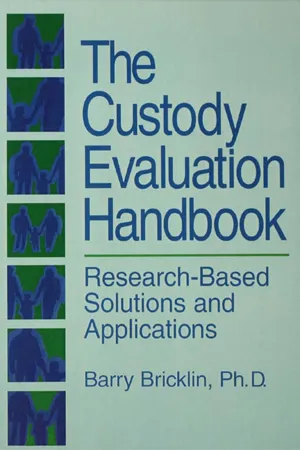
Joint custody. Same?sex custody. Young children with the mother. Which is the best arrangement? Unfortunately, for those who seek a trustworthy solution, research has proven that there is no single best arrangement for all children. This timely volume, however, does offer a practical and realisic methodology with which to confront the challenging and often confusing issues facing the custody evaluator. THe only book of its kind, The Custody Evaluation Handbook offers a strikingly helpful model for evaluating and assigning weight to the mountains of disparate information accumulated during a custody suit. Written by an unparalleled expert in the field of custody evaluation, the book eschews what the author calls the negative incident model in which each parent responds to the custody process by compiling a long list of grievances against the hated opponent. It advocates, instead a test?based approach that measures how successful each parent actually is at the job of parenting. The book describes numerous tests and tools for eliciting reliable information from both children and parents. With an eye to learning the actual impact a parent has on a child rather than what a given parent may or may not be doing, the book emphasizes obtaining measurements from the involved child. Parent tests are designed to reflect the effectiveness with which a parent responds to typical childcare situations, and the degree to which a parent truly knows ? and can satisfy the needs of ? a particular child. The volume also sets forth concepts derived from extensive research that are particularly helpful in understanding parent?child interactions, and provides a specific system of nonadversary communication strategies that can be used and modeled in all interchanges with evaluation participants, and in the wording of all written reports. Readers will also welcome the numerous suggestions from evaluators all over the country on specific custody dilemmas they have faced. The book is based on many years' meticulous research and is informed by a number of conceptual approaches that include: The proven premise that whatever certain parents intend to communicate is often not what their children are, in fact, perceiving and reacting to The Utilization Model of Milton E. Erikson The Thomas, Chess, and Birch goodness?of?fit model of parent?child interaction Bandler and Grinders' assertion that the meaning of a communication is the response it elicits, regardless of the intentions of the sender Clearly, spelling out the targets of a truly comprehensive and reliable evaluation, The Custody Evaluation Handbook will be an invaluable handbook for custody evaluators and marriage and family therapists, as well as other involved mental health professionals.
Information
Chapter One
Loving the Courtroom
Forensic psychologist Reid Meloy (1993) believes people either love the excitement of court or hate it. My observations are similar. This chapter is about how the custody evaluator, who often winds up there, can make certain he or she will end up in the former category.
Although books and articles on custody evaluations typically put their “going to court” sections at the end of their works, I have chosen to put it first.
Anyone who does forensic work should have the court in mind from the very first instant of contact with a particular case. I'm talking about a topic not frequently mentioned: the controlled paranoia anyone who would serve in a forensic area must learn to adopt—and shed! The custody evaluator must learn at all points during the comprehensive evaluation to inwardly ask: “How would whatever I am currently doing or concluding appear if an aggressive and brilliant attorney were asking me about this in a courtroom?” (And nowadays, “What must I do to decrease the probability of an ethics complaint?”)
There is no other endeavor quite the same as a forensic one for encouraging the inward asking of why one is choosing to do, or not do, some specific thing.
No one comes into our clinical offices and asks us to explain why and how we chose to use a certain test or psychotherapeutic strategy, or how and why we came to each and every conclusion.
But this is exactly what can happen in a forensic context.
It is best to keep such a scenario in mind from the very moment one enters a case.
Just as in a chess game where the opening few moves can prove decisive, so too with a court-related procedure. How one positions oneself in relation to the task at hand is crucial. Legal, ethical, and psychological issues must be ascertained accurately. The tools and tests chosen for use must be relevant to these issues. One must decide who among potential participants needs to be evaluated extensively, as well as identify those whose evaluations can be more limited in scope. One must especially be aware that any eventual testimony will need to be justified by what is done during the evaluation. Hence, if there is a particular area one wishes to address via testimony, one must make sure that information that is both credible and relevant is gathered.
This chapter is laid out in three major sections. The first considers science, as a whole, in court; the second, the mental health professional in court; and the third, the custody evaluator in court.
The comfort and excitement promised in the title of this chapter will in large part depend on how well you can feel psychologically aligned with, and excited by, many of the concepts to follow. There is also an “access code state-of-arousal” exercise offered in Chapter Thirteen (in the section on testifying in court) that is not only useful for dealing with cross-examinations, but also to get into, and out of, the ultracautious attitude often necessary during forensic evaluations and/or courtroom testimony.
SCIENCE IN COURT
The “law,” while in actuality constantly evolving and striving to satisfy diverse and often conflicting goals (e.g., establish blame and assign guilt, punish, rehabilitate, protect society, be an agent for explicit and implicit moralities, seek social fairness, etc.), at any given moment is philosophically a closed system assumed to require no further input and operates with an absolutistic (moral) authority.
Science, essentially the notion that there are optimal ways to ask the world questions such that the answers lend themselves to proof and systematization, does not claim that any specific answer or outcome is morally “best” or necessarily lasting. Science is characterized by an open-ended, never-ceasing asking of such questions, followed by answers, followed by new questions.
This was essentially the message the Delphic Oracle gave to Socrates and his companion, Chaerephon, when it identified the “wisest person” as the one who realizes there will always be new questions to ask. The epistemologically minded members of a field strive to delineate what constitutes legitimate questions, and which forms valid answers to such questions might take. Every few years, there is a so-called “paradigm shift,” which changes the rules of the game, so to speak, as to what constitutes legitimate questions and answers.
From a very practical perspective, a mental health professional who would aid the court should be familiar with critical philosophical differences between science and the law. These differences are particularly important in regard to how “truth” is discovered in each field. For example, mental health professionals are often upset at the adversarial nature of the legal process. But the pursuit of scientific truth is also an adversarial process. The manner in which the members of a given science present data, opinions, and information to other members and the manner in which these persons respond are strikingly similar to what happens in a court of law, i.e., people challenging and responding to each other. (In fact, as any random reading of the “comments” section of the American Psychologist would show, the pursuit of scientific truth is often more adversarial and filled with name-calling than is the pursuit of justice.)
Other important considerations here are the time constraints of a legal process (science has no such thing), the hearsay evidence restriction in a courtroom (science can seek data wherever it wishes), and the court's jaundiced eye regarding statistics (Tribe, 1971; Stromberg et al., 1988).
Melton, Petrila, Poythress, & Slobogin (1987, pp. 3–13), among others, call the following differences to our attention: the supposedly ultraconservative view of attorneys as opposed to the more liberal view of mental health professionals (which they dispute); difficulties that arise when a deterministic model of the world is pitted against a free-will model (since the law seeks to punish people, it needs a “blame’ concept, hence people “choose” their actions); the law's fear of group statistics in individual cases; and law's penchant to ask the mental health professional unanswerable questions (e.g., one of the authors was asked to contrast the effects of a child's spending one week per year with his mother as against two weeks).
A mental health professional's effectiveness in court is greatly enhanced if he or she has some concise, but complete, notion of the scientific process. This affords a much-needed “mental structure” for the offering of information in court.
Science may be thought of as a set of propositions about the real world formulated in the belief that they are probably true. Any given science ends up being a collection of potentially true generalizations, which are constantly being improved or enlarged or simplified or proven. Science is generally “ordered knowledge about reality” (Piotrowski, 1957, p. 12). It is important that the knowledge be ordered because if this were not the case, it could not be mentaliy assimilated and very small amounts of it would be remembered. This need for order and logic constitutes utilitarian goals; they are the result of human intellectual limitations.
Piotrowski divides the scientific process into activities that take place within four separate categories. The first has to do with concepts. The second deals with the formation of principles. A principle defines the logical relationships that exist between various concepts. A third category refers to “empirical referents,” the “real life” exemplifications of concepts that are considered to exist in the real world and to be accessible through the human senses. The fourth category has to do with validation, the process of ascertaining the degree of correspondence between principles and the relations that exist among relevant empirical referents. “Propositions about reality are ‘true’ if the observed relations among the empirical referents of concepts correspond closely to the relations among concepts as stated in the principles” (p. 13).
When psychiatrists and/or psychologists and/or clinical social workers argue over whether or not an individual is “depressed,” it is usually because each subscribes to a different set of “empirical referents” in terms of which depression is to be recognized in the sensory world, and this in turn is based upon conflicting values and goals in what is sought from the concept and/or “definition” of depression. (A fuller discussion of these issues can be found in C.W. Churchman's important book, Prediction and Optimal Decision, 1961.)
The point here is that the difficulty of predicting, say, “dangerousness” or “insane behavior” has to do not only with the huge array of variables that interact in creating such behaviors, but also with differences in the goals society seeks regarding each type of individual and the resulting differential markers one looks for to identify examples of each. For example, to the degree that one's concept of dangerousness places a high premium on the protection of others, the easier it becomes to predict “dangerousness” (high levels of false positives would be acceptable).
Summarizing, the manner in which science and the law approach the discovery of “truth” are in many instances very similar. Further, many of the so-called “limitations” of the behavioral sciences, especially in the legal system, have less to do with nonremediable aspects of these sciences, and more to do with conflicting goals in the concepts used to study the materials in these fields, leading to subtle disagreements in what constitutes the “empirical referents” or “evidence in the real world” of these concepts. Another way of saying this is that what we seek in the concepts we employ to look at the world, will, in very large part, determine how we draw boundary lines around the world. This, in terms, will influence not only what we call a “fact,” but also the degree of certainty we demand to prove any given proposition about these “facts.” Further, just as it is very difficult to predict what a single individual will “do,” it is also very difficult—impossible, according to quantum mechanics—to predict what a single electron will do. Hence, in the psychological sciences as in the physical world, it is easier to make accurate statements about the prospects of large collections of things (“group statistics”) than about individual things. My conclusion? The criticism that psychology is a “soft science” is misleading.
THE MENTAL HEALTH PROFESSIONAL IN COURT
This section of Chapter One will deal with general issues surrounding the mental health professional in a courtroom setting. The next section will deal with the same kinds of issues that are more specific to the mental health professional serving as a custody evaluator.
If one frames the theoretical issues in a debate via broad concepts, one will easily find “facts” in the real world to represent them.
It is into this “sweeping generalizations” category that I would place the aura created by the assertions of critics such as David Faust and Jay Ziskin who are interpreted as saying that mental health professionals do not belong in court. The resulting controversy has become a “Yes, mental health professionals belong in court” versus a “No, they don't” kind of argument. It is important to note that in any event the key question, if one subscribes even in part to an operational philosophy, is not really whether their assertions are “true,” but whether they are useful. I believe they are, and that this is the intention of the Faust-Ziskin works (Ziskin, 1993).
Perhaps the most cogent remarks on this issue have come from Heilbrun (1992, p. 257). He summarizes the position of members of the Faust-Ziskin camp—the camp critical of the usefulness of psychological assessment procedures in court—as follows: “Critics have described such (psychological) assessment procedures as ‘controversial’ and ‘of doubtful validity and applicability in relation to forensic issues’” (Ziskin, 1981, p. 225; see also Faust & Ziskin, 1988, 1989; Ziskin & Faust, 1988).
Heilbrun goes on to make the very important point that amidst all this controversy, supposedly made on research bases, there exists “…virtually… (no) normative data on the uses and abuses of psychological testing in the forensic context” (1992, p. 258).
Let us now look at some of the issues surrounding the appearance of a mental health professional appearing as an expert witness in a courtroom.
Stromberg et al. (1988) remind us of the basics that all mental health professionals who practice in a forensic area should know: “Federal Rule of Evidence 702 (1984) states the basic rule on the admissibility of expert testimony: (I)f scientific, technical, or other specific knowledge will assist the trier of fact (the judge or jury) to understand the evidence or to determine a fact in issue, a witness qualified as an expert by knowledge, skill, experience, training or education, may testify thereto in the form of an opinion or otherwise” (p. 647). In order that testimony from an expert be admitted, it is necessary that the judge or jury should need assistance concerning the issues at hand, the scientific foundations permitting the testimony should be sufficiently reliable to permit generalizations to be made on their bases, and the specific witness must be qualified as an appropriate expert on the subject. (The Federal Rules of Evidence have been adopted in many states. It is important to know what your own jurisdiction considers admissible evidence.)
Regarding the question of what is a “legitimate” contribution, Federal Rule of Evidence 403 warns that the value to a decision maker of “opinion testimony” must be greater than its “prejudicial value.” This suggests that critical decision makers may be predisposed to believe what experts say. Rule 403 cautions that the basis upon which an expert offers information should be stronger than this predisposition.
Stromberg et al. go on to note that under Federal Rule of Evidence 703, in order for testimony to be admissible, the expert's opinion must be based on any of the following: direct observation; facts acquired by hearing (or reading) the testimony offered at a given trial; materials that are gotten through books, literature, or “…experience to which the expert has access” (p. 647). Further, an expert may rely on hearsay or evidence ordinarily not permissible in a courtroom, “if it is of the type ordinarily relied on by persons in his profession” (p. 647).
A key issue, on which participants in the legal process still do not agree, has to do with the area of the so-called “ultimate issue.” In a custody context, this would mean that while an evaluator who served as an expert witness could offer lots of facts and information about a given case, he or she could not address the “ultimate” legal issue, that is, who should serve as the primary caretaking or custodial parent. (An “ultimate issue” is essentially the legal matter that must finally be answered or resolved in a given case.) “However, this distinction was gradually seen as artificial and unworkable since the judge or jury easily inferred the ultimate conclusion from the expert's testimony anyway” (Stromberg et al., 1988, p. 648).
Federal Rule of Evidence 704 was engendered to deal with this issue and provided that testimony that in fact is given in the form of an opinion or inference would be legitimate even if it embraced an ultimate issue that was to be eventually decided by the trier of fact. Stromberg and associates note their own objections or, at least, caveats to this, while I would argue that the expert should never address the ultimate issue. We will make the argument that to refrain from doing so obviates many of the controversial issues surrounding the feasibility of a mental health professional's appearing in a court. (However, one can address this issue if what is presented is offered as information. See the remarks that follow a bit later.)
For many years, the question of just what kind of facts a scientist or expert could testify about in court was controlled by the so called Frye standard (Frye v. United States, 293F, 1013, 1014 D.C. Cir. 1923). It essentially stated that anything “scientific” the scientist testified about had to have general acceptance within the field of which he or she was a member.
This rule has been subject to much debate. The essential argument against the Frye standard is that it is overly restrictive. So long as one follows acceptable scientific practice, one shou...
Table of contents
- Cover
- Half Title
- Full Title
- Copyright
- Contents
- About the Authors
- Foundations: Leaps, Halos, and Bitterness
- Chapter One Loving the Courtroom
- Chapter Two Postdivorce Issues: Relevant Research (with Gail Elliot)
- Chapter Three Congruent Communications: The Vital Roles of Symbol Systems and Information-Processing Strategies
- Chapter Four Bricklin Perceptual Scales (BPS) : Child-Perception-of-Parents Series
- Chapter Five The Perception-of-Relationships Test (PORT)
- Chapter Six The Parent Awareness Skills Survey (PASS)
- Chapter Seven The Parent Perception of Child Profile (PPCP)
- Chapter Eight Getting Accurate Information
- Chapter Nine Areas of Assessment
- Chapter Ten Creating a Custody Plan: Aggregating and Weighting the Variables (with Michael H. Halbert)
- Chapter Eleven Communicating the Results of a Custody Evaluation
- Chapter Twelve Validity and Reliability Issues
- Chapter Thirteen Dilemmas in Child Custody Evaluations
- References
- Name Index
- Subject Index
Trusted by 375,005 students
Access to over 1.5 million titles for a fair monthly price.
Study more efficiently using our study tools.
Frequently asked questions
Yes, you can cancel anytime from the Subscription tab in your account settings on the Perlego website. Your subscription will stay active until the end of your current billing period. Learn how to cancel your subscription
No, books cannot be downloaded as external files, such as PDFs, for use outside of Perlego. However, you can download books within the Perlego app for offline reading on mobile or tablet. Learn how to download books offline
Perlego offers two plans: Essential and Complete
- Essential is ideal for learners and professionals who enjoy exploring a wide range of subjects. Access the Essential Library with 800,000+ trusted titles and best-sellers across business, personal growth, and the humanities. Includes unlimited reading time and Standard Read Aloud voice.
- Complete: Perfect for advanced learners and researchers needing full, unrestricted access. Unlock 1.5M+ books across hundreds of subjects, including academic and specialized titles. The Complete Plan also includes advanced features like Premium Read Aloud and Research Assistant.
We are an online textbook subscription service, where you can get access to an entire online library for less than the price of a single book per month. With over 1.5 million books across 990+ topics, we’ve got you covered! Learn about our mission
Look out for the read-aloud symbol on your next book to see if you can listen to it. The read-aloud tool reads text aloud for you, highlighting the text as it is being read. You can pause it, speed it up and slow it down. Learn more about Read Aloud
Yes! You can use the Perlego app on both iOS and Android devices to read anytime, anywhere — even offline. Perfect for commutes or when you’re on the go.
Please note we cannot support devices running on iOS 13 and Android 7 or earlier. Learn more about using the app
Please note we cannot support devices running on iOS 13 and Android 7 or earlier. Learn more about using the app
Yes, you can access The Custody Evaluation Handbook by Barry Bricklin in PDF and/or ePUB format, as well as other popular books in Psychology & Mental Health in Psychology. We have over 1.5 million books available in our catalogue for you to explore.