Gender Articulated is a groundbreaking work of sociolinguistics that forges new connections between language-related fields and feminist theory. Refuting apolitical, essentialist perspectives on language and gender, the essays presented here examine a range of cultures, languages and settings. They explicitly connect feminist theory to language research.
Some of the most distinguished scholars working in the field of language and gender today discuss such topics as Japanese women's appropriation of "men's language," the literary representation of lesbian discourse, the silencing of women on the Internet, cultural mediation and Spanish use at New Mexican weddings and the uses of silence in the Anita Hill-Clarence Thomas hearings.
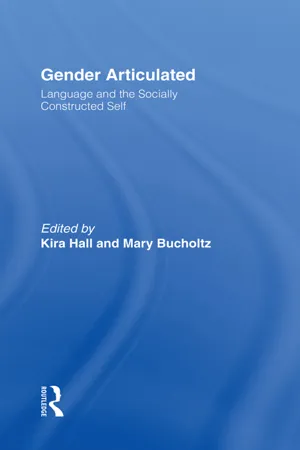
eBook - ePub
Gender Articulated
Language and the Socially Constructed Self
- 528 pages
- English
- ePUB (mobile friendly)
- Available on iOS & Android
eBook - ePub
Gender Articulated
Language and the Socially Constructed Self
About this book
Information
Part One
_____
Mechanisms of Hegemony and Control
1
_
Cries and Whispers
The Shattering of the Silence
Feminists have devoted a great deal of attention over the past quarter century to speech and its effect on gender and power relations.1 Less consideration has been given to its complement, the absence of speech, or silence, and that much more recently.2 This lack of attention to the meanings and functions of silence in gender relations is not really surprising. It is easier to perceive what is there as meaningful, as opposed to discerning meaning in the absence of a phenomenon. What is explicit and apparent responds to analysis more readily than what must be inferred. So it is not surprising that there exists within linguistics, to my knowledge, only a single collection of papers on silence (Tannen & Saville-Troike 1985). Silence is popularly equated with the absence of content, although we also recognize, if subliminally, the uses of silence in power relations. Adults demand answers of children, superiors of subordinates. The powerless cannot choose to be silent, any more than they can choose to speak, or choose the meaning of their speech.
To my knowledge, the earliest explicit discussion of the communicative functions of silence is that of the psychoanalyst Robert Fliess (1949). Traditional analysts use their own silence as a means of forcing patients to speak, because silence is heavily dispreferred in all Western cultures as a violation of what Harvey Sacks, Emanuel Schegloff, and Gail Jefferson (1974) refer to as the “basic rule” of conversation: one party at a time, no more and no less. As is true in nonlinguistic contexts as well, power implies the right to violate rules unilaterally. So the analyst’s silence is perceived as “normal,” part of the process, but the analysand’s is interpretable in any of several ways.3 Fliess suggests an “oral” or hungry silence, representing a desire to take in warmth and love from the other; an “anal” or retentive silence, the refusal to give anything to the hearer; and (of course) a “phallic” silence, an attempt to maintain power and control. We may smile at the reductionistic clarity of this trichotomy, but what is useful in the discussion is the recognition that (like any form of communication) silence is ambiguous; its meaning is discernible only through an understanding of the context in which it occurs.
Silence in discourse can be interpreted from both semantic and pragmatic perspectives. The former, a nonpolitical stance, looks at the absence of speech in terms of its contribution to the meaning participants in a discourse construct for it. The work of conversation analysts on “attributable silences” (gaps, lapses, and pauses) is essentially a semantic account of silence. A pragmatic perspective views nonspeech as the result of the process of “silencing,” interactively organized and functional as well as meaningful. The ability of one party in a discourse to prevent another from fully participating (“silencing”) arises out of the disparate powers and roles of each, and contributes to the further imbalancing of those roles. The pragmatic perspective does not imply that all attributable silences are necessarily political in intention or effect, but it does require that the analyst consider that possibility.
Pragmatic silencing can be broadly divided into two subcategories based on discourse genre: private (or conversational) versus public (or persuasive). Private discourse is normally dyadic, informal, and without explicit intended function beyond the socializing capacity of the conversation itself. Hence any commentary on how it is proceeding (including complaints about interruptions or silences) is generally considered inappropriate.
Public discourse includes all kinds of talk in public settings (e.g., courtrooms, workplaces, political arenas, and media settings) from reciprocal dyads to speeches intended for mass audiences. Unlike private discourse, it is consequential—that is, it is expected to have effects beyond that of mere socialization—and it uses some version of formal style or elaborated code, with the consequent absence of any assumption of mutual trust. The superficial forms of silencing that occur in the private arena may also occur in public settings, but although the form may be identical, the function and consequences are often more serious for the silenced person, and more permanent, in public.
Types of Silencing
Interruption and Topic Control
Because most linguistic attention to discourse has tended to focus on private dyadic conversation, it is not surprising that silencing studies have also been centered there. Two forms of conversational silencing have received a good deal of attention: interruption and topic control (cf. Zimmerman & West 1975; West & Zimmerman 1983; Leet-Pellegrini 1980). Deborah James and Sandra Clarke (1993) have provided a valuable review and critique of many of the interruption studies. They find that the majority of studies of conversational interruption do not corroborate the asserted tendency of men to interrupt women. They note several problems in prior studies. Because traditional conversation analysts eschew statements of function or intention, it becomes impossible for them to distinguish among types of violations of the “one party at a time” or “no gap, no overlap” rule where more than one speaker occupies the floor. Only some types have political (that is, power-related) consequences. One that does not, for instance, is the “cooperative overlap” discussed by Tannen (1981), in which one speaker begins speaking over the end of the previous participant’s turn, behavior that is technically interruptive but done in the interest of solidarity rather than control. Additionally, some attempts to take over the floor through interrupting are successful, others not. James and Clarke argue that researchers have been less careful than is desirable in the classification and analysis of conversational interruption. It should be noted that James and Clarke do not disclaim the existence of men’s aggressive interruption of women. They merely suggest that the field’s currently predominant research paradigm makes corroboration of such assertions very difficult or impossible.
Like interruption, topic choice as a control mechanism presents research problems of interpretation (cf. Leet-Pellegrini 1980), but in the case of topic choice it is even more severe because ethnomethodology frowns on interpretive approaches, and it is impossible to determine topic development meaningfully without recourse to semantic analysis. Scholars recognize intuitively that interruption in conversation is encouraged by, and encourages, power imbalance. But it is much harder to define the behaviors referred to broadly as “interruptions,” to isolate them and to measure and analyze them so as to demonstrate the reality behind the intuitions.
Nonresponse
Control is often more subtly achieved by a third technique, silencing by silence, or nonresponse. Like other forms of silencing, it is most effective when employed by the more powerful against the less powerful; in the other direction, it tends to have no real effect or can be countermanded. Nonresponse is often observed at business meetings, when a female executive makes a suggestion to which her male colleagues do not respond even minimally.4 Nonresponse is not infrequent in classrooms: even when a female student raises her hand and is recognized, her comment often receives no response, especially if the instructor is male.5 In both types, the same suggestion or comment is often recycled by a male participant a few minutes later, to approbation and serious consideration by the others present.6
Annoying and discouraging as interruption is, at least someone who is interrupted knows that she exists and has been noticed. Nonresponse is by contrast annihilating; it signifies that the speaker does not exist, that her utterance did not happen at all. It is the lineal descendant of the Victorian tactic of “cutting”: the deliberate failure to acknowledge acquaintance with another person (by withholding verbal salutations, eye contact, or hat-tipping, upon meeting in public, for instance) as a way of signifying serious disapproval of really bad behavior, and thus cutting the recipient out of society, in effect dehumanizing her or him.7
These three methods of discourse control (interruption, topic control, and nonresponse) are all explicit and thus directly observable by participants, including their targets. The first two differ from the third in being active, but their shared explicitness means that victims of all three can learn to recognize them and take countermeasures (although the passive and silent nature of nonresponse makes that somewhat more difficult).
The Two-Cultures Theory
Because most analysis of gender-linked inequities in access to discourse has been based on private, dyadic conversation, some theorists have suggested that any differences that are observed can be attributed not to any power imbalance between the sexes but to cultural differences between them that create different communicative strategies (cf. Maltz & Borker 1982). In this perspective, males’ greater access to conversational participation is explained not by their illegitimate use of their greater power but by the (accidental) coincidence between male styles of discourse and successful floor-gaining strategies. Culture-based theories of conversational imbalance can account for observed interruption and topic-control patterns (if indeed these do exist), but they cannot account for the prevalence of nonresponse, because that is a passive rather than an active strategy, representing not so much a style as a metacomment on the prior speaker’s utterance. Still less does it account for the unequal valuation of contributions (ignoring the woman’s but valuing the man’s), especially in public discourse, the functions and forms of which are predicated on the formal connections among participants—that is, the absence of personal relationship—and yet contributions formed according to characteristically feminine patterns are typically judged dismissively on purely stylistic grounds, as indicative of their speakers’ lesser rationality or seriousness. What the two-cultures approach defines as the male strategy is implicitly taken as the right way to talk in public, and this fact is itself demonstrative of the need for a power-imbalance model alongside a culturally based one.
Interpretive Control
Interruption, topic control, and nonresponse are obvious ways of keeping potential participants from contributing to private or public discourse. But the same result can be accomplished even more subtly and thoroughly by maintaining power over the making of meaning: interpretive control. Women may be permitted to speak, may even receive response to their speech, but it will be up to men (typically, men of the politically dominant group) to determine what both their own and women’s communications are to mean. The control of meaning includes the right to name oneself and others; the right to assess one’s own behavior and that of others; the right to decide what form or style of language is “good” or “right” or “appropriate”; and the right to determine what a speaker means to say.
Interpretive control is covert and potent, both psychologically and politically. It is often hard to recognize because it can be done silently by those who already have cultural hegemony. It is not blatantly violative, like interruption, or obviously inconsiderate, like nonresponse. Indeed, it is so deeply rooted in our cultural expectations that it becomes hard to notice at all, like those optical illusions in which figure and background blend. Interpretation of the less powerful by the more powerful has been taken for granted in this and many other cultures for so long that it requires special awareness to notice it and novel responses to deal with it.
Silence is analogous to invisibility. Western feminists are apt to pity and scorn women of ancient or non-Western groups whose cultures require them to be literally or symbolically invisible in public. Thus in ancient Athens women of the upper classes were not supposed to appear in public at all (literal public invisibility); in fundamentalist Muslim societies, women must be veiled in public (symbolic public invisibility). We pride ourselves on our liberation from those humiliating constraints. We tend not to realize how recent and partial our liberation really is.
Until the end of the nineteenth century in this and other Western countries, public woman was synonymous with prostitute, and women who went out in public unescorted, especially at night, were fair game to be treated as prostitutes. (Even today mujer pública is a euphemism for ‘prostitute’ in Spain.) Even after literal invisibility ceased, symbolic forms persisted into the 1960s. In the 1950s, when I was growing up, no proper woman appeared in public without a hat, which typically had a veil attached. True, the veil was short, ending around the bridge of the nose, and flimsy; it might be called metasymbolic. If purdah truly conceals but only symbolically renders the wearer invisible (she is, after all, a perceptible object on the street), the mid-twentieth-century American veil symbolized a more serious veiling. Women were told that the veil made them mysteriously alluring—an interesting idea to be sure (invisibility makes a woman more attractive), but undoubtedly not the full truth.
In the same way, during the early twentieth century women went from literally having no public voice (no vote, no entree into the professions, and so on) to having no symbolic public voice, that is, no interpretive control. As long as that was the case, conservative elements in society had little to fear. The suffrage was no threat as long as women could elect only men or male-identified women (with very rare exceptions); had no way to pressure officeholders to represent their interests; could not participate as full members of institutions (except under very special circumstances, and with great insecurity); could not propose policy, governmental or institutional, and be taken seriously by those empowered to make changes.
Women in Public Discourse
But things are changing. Over the past several years women have begun to achieve true public desilencing, the appropriation of interpretive control. Those who have traditionally held control unilaterally are (quite properly) alarmed at the signs of change. Many of the stories to which the media have devoted immense amounts of attention since 1991 reflect this struggle. In each case, total victory has not been achieved, but the very fact that the issue of interpretive control (not, of course, explicitly under that name) has been raised so oft...
Table of contents
- Cover Page
- Half Title Page
- Title Page
- Copyright Page
- Dedication
- Contents
- Acknowledgments
- Introduction Twenty Years after Language and Woman's Place
- Part I: Mechanisms of Hegemony and Control
- Part II: Agency through Appropriation
- Part III: Contingent Practices and Emergent Selves
Trusted by 375,005 students
Access to over 1.5 million titles for a fair monthly price.
Study more efficiently using our study tools.
Frequently asked questions
Yes, you can cancel anytime from the Subscription tab in your account settings on the Perlego website. Your subscription will stay active until the end of your current billing period. Learn how to cancel your subscription
No, books cannot be downloaded as external files, such as PDFs, for use outside of Perlego. However, you can download books within the Perlego app for offline reading on mobile or tablet. Learn how to download books offline
Perlego offers two plans: Essential and Complete
- Essential is ideal for learners and professionals who enjoy exploring a wide range of subjects. Access the Essential Library with 800,000+ trusted titles and best-sellers across business, personal growth, and the humanities. Includes unlimited reading time and Standard Read Aloud voice.
- Complete: Perfect for advanced learners and researchers needing full, unrestricted access. Unlock 1.5M+ books across hundreds of subjects, including academic and specialized titles. The Complete Plan also includes advanced features like Premium Read Aloud and Research Assistant.
We are an online textbook subscription service, where you can get access to an entire online library for less than the price of a single book per month. With over 1.5 million books across 990+ topics, we’ve got you covered! Learn about our mission
Look out for the read-aloud symbol on your next book to see if you can listen to it. The read-aloud tool reads text aloud for you, highlighting the text as it is being read. You can pause it, speed it up and slow it down. Learn more about Read Aloud
Yes! You can use the Perlego app on both iOS and Android devices to read anytime, anywhere — even offline. Perfect for commutes or when you’re on the go.
Please note we cannot support devices running on iOS 13 and Android 7 or earlier. Learn more about using the app
Please note we cannot support devices running on iOS 13 and Android 7 or earlier. Learn more about using the app
Yes, you can access Gender Articulated by Kira Hall, Mary Bucholtz, Kira Hall,Mary Bucholtz in PDF and/or ePUB format, as well as other popular books in Languages & Linguistics & Linguistics. We have over 1.5 million books available in our catalogue for you to explore.