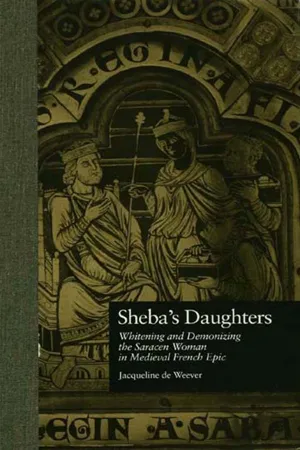
Exploring how the depiction of otherness or alterity during the Middle Ages became problematic in the aesthetics of the Romance epics written during the centuries of the Crusades, this book offers a vital contribution to the growing interest in the way foreign women are presented in the texts of the Latin West and will be of consuming interest to students in women's studies, cultural studies, and medieval literature.The texts considered are written in the major European languages of the time and range from the Song of Songs through Geoffrey of Vinsauf's Poetria Nova to such epics and romances as Erec et Enide,Doon de Maience, Fierabras, La Prise d'Orange, Ars Versificatoria, The Sowdone of Babylone, and Parzifal.
eBook - ePub
Sheba's Daughters
Whitening and Demonizing the Saracen Woman in Medieval French Epic
- 292 pages
- English
- ePUB (mobile friendly)
- Available on iOS & Android
eBook - ePub
Sheba's Daughters
Whitening and Demonizing the Saracen Woman in Medieval French Epic
About this book
Information
CHAPTER ONE
Whitening the Saracen: The Erasure of Alterity
Trahit ars ab utroque facetum
Principium, ludit quasi quaedam praestigiatrix Et facit ut fiat
res postera prima, futura
Praesens, transversa directa, remota propinqua;
Rustica sic fiunt urbana, vetusta novella,
Publica privata, nigra Candida, vilia cara.
(Geoffrey of Vinsauf, Poetria nova, ll. 120–125, ed. Gallo, p. 20.)[Art can draw a pleasant beginning out of either [the end or the middle of a work]. It plays about almost like a magician, and brings it about that the last becomes first, the future the present, the oblique direct, the remote near; thus rustic matters become polished, old becomes new, public private, black white, and vile precious. Trans. E. Gallo, p. 21]1
The power of art, the magician, to “bring about that black becomes white,” among other transformations of the undesirable to the desirable, is precisely the theme of this study. The purpose of the erasure of alterity in these texts is precisely to make black white but with a twist that Geoffrey could not foresee—the assimilation of the desirable Other. The portraits of Saracen women who marry Frankish princes in the chansons de geste vividly exemplify the aesthetics and the power of artifice at work in poetry, especially the ability to erase alterity, all that makes for Otherness. When the conventional portrait is applied to the Saracen woman, the attributes of beauty acquire a different dimension. The representation of the Saracen woman in the conventional portrait of the French heroine becomes the eraser, rubbing out difference.
When Geoffrey of Vinsauf wrote his treatise on poetic theory (c.1215), much of what became his new poetics had already been practised, especially the art of cataloguing the lady's beauty. Indeed, Matthew of Vendôme had already, before 1175, produced the portrait of Helen in his Ars Versificatoria as the example to be followed.2 Matthew's treatise from the late twelfth century, contemporaneous with many of the poems discussed in this study, demonstrates the co-existence, in some cases, of Latin poetic theory and vernacular poetic practice in medieval poetics, while some treatises from the early thirteenth century are contemporaneous with Geoffrey's Poetria nova. While Matthew codified existing practice, Geoffrey seems to have followed Chrétien in producing his description of the beautiful woman.3
More than rhetoric, however, evidently determines the Saracen's portrait. Poetic praxis does not exist in a vacuum. Since the action of the poems is directed against the Saracen enemy, since the poems are loudly and partisanly Christian against the infidel Saracen, since the poems deal with wars which help the Franks gain a kingdom (Orange), political and religious agendas clearly underly the poems. The agendas are political because these poems deal with empire building; religious because Christians attack Muslims in claims for rule and possession of the Holy Land. One feature of the poems is the frequency of declarations of the Christian Creed, signalling that Christianity's battle with paganism is part of the subtext. Speaking of the Middle English variants of the French poems, Dorothee Metlitzki defines them as “essentially vehicles of fanatical propaganda in which the moral ideal of chivalry is subservient to the requirements of religion, politics, and ideology.”4 Poetry's rhetoric combines with the ideologies of religion and conquest to determine the appearance of the Saracens and to erase alterity of personality.
As Alice Colby points out in her discussion of twelfth-century portraits, some elements suggested by the Latin rhetoricians are excluded from the vernacular portraits, while others not mentioned in the Latin manuals appear in the vernacular portraits.5 While Colby is certainly on target in pointing out that the details of vernacular portraits differ from those in the Latin manuals, the main qualities and the overall impression of the portraits—blond hair plaited and bound with gold threads and ornaments, sparkling eyes, white skin—appear in both Latin theory and vernacular poems. In this both Latin theory (high art) and vernacular practice (folk art) mesh firmly. The boundaries between them collapse on this one subject. The heroine is white, blond, and lively of expression. What happens when this ideal is transferred to foreign women who may be expected to differ in appearance? This is the question this study asks and seeks to answer while it investigates the ideal in relation to the Saracen woman, the quintessential Other in the medieval epic.
Seventeen of the twenty-one princesses who appear in the poems written between 1150 and 1300 fall into the category of the white Saracen princess, the most famous of all being Orable/Guibourg of the Guillaume cycle. Other portraits are equally intriguing, for example, those of Nubie in La Prise de Cordres et de Sebille (1190–1195), Floripas in Fierabras (c.1170), Malatrie in both Le Siège de Barbastre (1180) and Buevon de Conmarchis (1269–1285), Mirabelle in Aiol (c.1200), and Rosamonde in Elie de Saint Gille (after 1200).6 All of them betray the kings their fathers and their countries in one way or another and marry the Frankish knight, a treachery minimized by the masking and erasure of their Saracen identity. The exceptions appear in Les Enfances Ogier by Adenet le Roi, in the portrait of Gloriande, daughter of the Saracen king Corsuble, and in La Bâtard Bouillon (late fourteenth century), where Ludie, forcibly married to the French knight, returns to her Saracen lover. When La Bâtard finally captures her, he burns her at the stake for her treachery. Gloriande in Les Enfances Ogier is betrothed to the Saracen prince Carahuel, and she is loyal both to her father and her fiancé, betraying neither one. She does not convert to Christianity. These two women compel the question the other portraits avoid because their descriptions as French heroines are not concomitant with treachery to father and country that the other descriptions affirm. Her loyalty, contrary to expectation, interrogates the ideology informing the portraits of the other Saracen women. In these two portraits lie the coherence of appearance and behavior; the meshing of effictio or physical description with notatio or habitus, of portrait and character which Matthew of Vendôme presents in his Ars versificatorio. Adenet le Roi, in particular, thus disdains the practice of identifying the white Saracen with treachery and in this way avoids the ideology inherent in the political portrait.
Since it is instructive to lay out what the portrait of the lady demands of poetic composition, Chrétien's portrait of Enide in his romance Erec et Enide (c.1164) will serve as the paradigm of poetic vernacular theory (complete portrait in Appendix). The portrait begins with the indescribability topos, in Nature's surprise at her creation:
Ele meïsmes s'an estoit | Nature herself had marveled |
plus de cine cenz foiz mervelliee | more than five hundred times |
comant une sole foiee | how she had been able to make |
tant bele chose fere sot, | such a beautiful thing just once, |
car puis tant pener ne so pot | for since then, strive as she might, |
qu'ele poïst son essanplaire | she had never been able to duplicate |
an nule guise contrefaire. | in any way her original model. |
(ll. 414–420, pp. 18 and 20) | (Trans. C.W. Carroll, pp. 19 and 21) |
The details of her beauty echo some of the prescriptions of both Geoffrey of Vinsauf and Matthew of Vendôme, especially the description of her eyes. First, not even Iseult's hair is as golden as Enide's (ll. 424–425). Her face and forehead are fairer than the lily (ll. 427–429); her eyes glow with the brightness of two stars (ll. 433–434), echoing Geoffrey's suggestion that the lady's eyes are like a constellation and comparing eyes to stars in Matthew's manual.7 The portrait ends with the statement:
| qu'an se poïst an li mirer | for one might gaze at her |
| ausi com an un mireor. | just as in a mirror. |
| (ll. 440–441, p. 20) | (Trans. C.W. Carroll, p. 21) |
The portrait is short on specifics and describes only three features of Enide's—her hair, her eyes, and her skin. When Queen Guinevere clothes Enide, however, the portrait extends to 34 lines devoted to descriptions of fabric, jewels, and court fashion (ll. 1575–1609). Clothing becomes the badge of acceptance within the court circle. As we shall see, the narrative voice which describes the Saracen women devotes more time to their dress than to their physical features, although many lines may be devoted to face and body. The vagueness of the physical description is intentional however, since Enide is transparent and translucent: one may see himself in her as in a mirror. Nevertheless, some of her qualities, when transferred to the Saracen woman, appear in a very different light and give a completely new dimension to the portrait.
Enide's personality is also vague, but she grows after she has left Arthur's court by her decisions to disobey Erec's commands. Erec blames Enide for his loss of face among the knights and commands her not to speak to him as they ride along the way. She warns him several times, however, of upcoming danger. Erec triumphs every time, but he berates her cruelly, doubts her loyalty, and repeats his command that she remain silent (ll. 2765–3930). She never takes part in the skirmishes Erec fights but stands by, wringing her hands, full of anxiety. The Saracen women are as beautiful as Enide. Their behavior, however, is the opposite of hers, for while Enide is passive and accepts Erec's insults, the Saracen women are part of the action; they even attempt parricide, match insult for insult, and are liable to appear on the battlefield among the Saracen hosts.
The change from the couplets of Chrétien's poem to the laisse structure of the portrait in the chanson de geste provides the poet with a technique of isolating the portrait in three ways: in stanza form, the portrait-laisse stands out from...
Table of contents
- Cover
- Half title
- Full title
- Copyright
- Dedication
- Contents
- Acknowledgments
- Introduction
- Chapter One: Whitening the Saracen: The Erasure of Alterity
- Chapter Two: Demonizing the Saracen: The Inscription of the Monstrous Other
- Chapter Three: Subversions of Treachery and the Beautiful Easterner
- Chapter Four: Paradox and the Discourse of Protest
- Chapter Five: Conclusion
- Appendix: Portraits and Translations
- Bibliography
- Index
Trusted by 375,005 students
Access to over 1.5 million titles for a fair monthly price.
Study more efficiently using our study tools.
Frequently asked questions
Yes, you can cancel anytime from the Subscription tab in your account settings on the Perlego website. Your subscription will stay active until the end of your current billing period. Learn how to cancel your subscription
No, books cannot be downloaded as external files, such as PDFs, for use outside of Perlego. However, you can download books within the Perlego app for offline reading on mobile or tablet. Learn how to download books offline
Perlego offers two plans: Essential and Complete
- Essential is ideal for learners and professionals who enjoy exploring a wide range of subjects. Access the Essential Library with 800,000+ trusted titles and best-sellers across business, personal growth, and the humanities. Includes unlimited reading time and Standard Read Aloud voice.
- Complete: Perfect for advanced learners and researchers needing full, unrestricted access. Unlock 1.5M+ books across hundreds of subjects, including academic and specialized titles. The Complete Plan also includes advanced features like Premium Read Aloud and Research Assistant.
We are an online textbook subscription service, where you can get access to an entire online library for less than the price of a single book per month. With over 1.5 million books across 990+ topics, we’ve got you covered! Learn about our mission
Look out for the read-aloud symbol on your next book to see if you can listen to it. The read-aloud tool reads text aloud for you, highlighting the text as it is being read. You can pause it, speed it up and slow it down. Learn more about Read Aloud
Yes! You can use the Perlego app on both iOS and Android devices to read anytime, anywhere — even offline. Perfect for commutes or when you’re on the go.
Please note we cannot support devices running on iOS 13 and Android 7 or earlier. Learn more about using the app
Please note we cannot support devices running on iOS 13 and Android 7 or earlier. Learn more about using the app
Yes, you can access Sheba's Daughters by Jacqueline de Weever in PDF and/or ePUB format, as well as other popular books in Literature & Literary Criticism. We have over 1.5 million books available in our catalogue for you to explore.