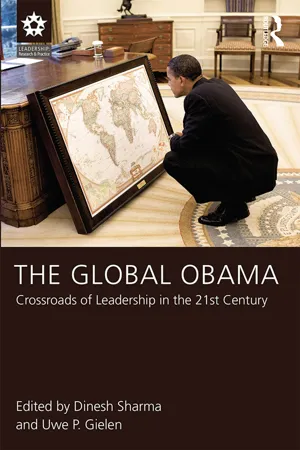
The Global Obama examines the president's image in five continents and more than twenty countries. It is the first book to look at Barack Obama's presidency and analyze how Obama and America are viewed by publics, governments, and political commentators around world. The author of Barack Obama in Hawaii and Indonesia: The Making of a Global President (Top 10 Black History Book) scaled the globe to gather opinions – cultural, historical, and political analyses – about Obama's leadership style. Writers, journalists, psychologists, consultants, and social scientists present their views on Obama's leadership, popularity, and many of the global challenges that still remain unresolved. As a progress report, this is the first book that tries to grasp 'the Obama phenomenon' in totality, as perceived by populations around the world with special focus on America's leadership in the 21st Century.
eBook - ePub
The Global Obama
Crossroads of Leadership in the 21st Century
- 344 pages
- English
- ePUB (mobile friendly)
- Available on iOS & Android
eBook - ePub
The Global Obama
Crossroads of Leadership in the 21st Century
About this book
Information
Obama as a Global Leader
1
Introduction: Obama’s Adventures in Globalization
“The President is at liberty, both in law and conscience, to be as big a man as he can.”
—Woodrow Wilson
“I came here purposefully to underscore that in today’s global world, there is no longer anything foreign about foreign policy. More than ever before, the decisions that we make from the safety of our shores don’t just ripple outward; they also create a current right here in America.”
—John Kerry
“The world’s greatest shortage is not of oil, clean water or food, but of moral leadership.”
—Jeffrey Sachs
This book is an exploration of the global Obama, the image, the perception, and the record of the forty-fourth president of the United States of America as viewed by people around the world. The central questions we explore are the following: What does the Obama phenomenon mean around the world? What does it represent, and how is it perceived? How and why has the Obama image changed the American image abroad? Conversely, how has the American image remained static or deteriorated in countries and world regions where the United States is still fighting long-standing wars? In essence, this book is as much about the changing American image abroad as it is about the American president at the beginning of the twenty-first century.
When Obama was elected in 2008, his approval ratings around the world were extremely high, and they continue to remain high in 2013 except for the Middle Eastern Muslim world. Obama clearly does not lack vision or audacity: “When Obama was sworn into office in January 2009, he had already developed an activist vision of his foreign policy destiny. He would refurbish the United States’ image abroad, especially in the Muslim world; end the wars in Iraq and Afghanistan; offer an outstretched hand to Iran; ‘reset’ relations with Russia as a step toward ridding the world of nuclear weapons; elicit Chinese cooperation on regional and global issues; and make peace in the Middle East. By his own account, Obama sought nothing less than to bend history’s arc in the direction of justice and a more peaceful, stable world” (Indyk, Lieberthal, and O’Hanlon 2012).1 The question remains: How has Obama’s America fared abroad in the past four years? Has he reclaimed the trust and faith in American ideals and values around the world?
The Obama presidency represents a paradigmatic moment in the history of the United States and the emerging global civilization given the first African-American politician has been re-elected to the highest office and to the most powerful executive position in the world (Sharma 2011). His first election may have been driven by “the Bush fatigue,” demographic changes in the US population, and new forms of social media; indeed, it can be argued that Obama is our first multiracial and Internet president within the context of newly formed social media networks and transmuted notions of race and ethnicity (Sharma 2011).2
In the 2012 reelection, he won against the odds—i.e., in spite of a high unemployment rate, anemic job growth, and a deeply divided electorate—where the chances of a clean victory were at best fifty–fifty: almost all of the earlier election polls fell within the margin of error. While Pew Research has shown that Obama’s perceived political effectiveness and image have waxed and waned domestically, many of the surveys show he has remained a far more popular American president in most parts of the world than his predecessor (Sharma 2011). What are the reasons for this global popularity? What are the leadership attributes that define the president’s personality traits?
There are many theories of leadership development. With over a century of writing and research on the topic, many have tried to understand the rise of a great leader from obscurity. From the “great man theory” to “transactional theory” and “cross-cultural theory,” we try to cover a range of theoretical frameworks. We analyze the Obama presidency at the midpoint of its tenure. The president has been reelected with a significant margin, even if—as many have argued—the challenger Mitt Romney may not have been a particularly strong candidate. Furthermore, the economic challenges and the long-term foreign policy conundrums that Obama had to battle were unparalleled in breadth and scope. The reelection of the forty-fourth president speaks to his special charisma, his evolving leadership style, and the turbulent times we are living through. The big question is: How is America perceived internationally after Obama’s first term—with clearly a new style of leadership—while remaining a superpower as well as the world’s largely self-appointed “policeman” (with cowboyish tendencies)? We examine this question in five continents and approximately twenty countries.
Great Man of History or a Great President?
In chapter 6, Ali Mazrui, a legend in African studies belonging to the same generation of postcolonial intellectuals as Obama’s father, Barack Obama Sr., has boldly predicted that Obama will go down as “a great man in history.” He has claimed this in the sense that the Scottish writer Carlyle famously suggested, “The history of the world is but the biography of great men.” However, it remains to be seen whether Obama is also a great president, as Mazrui clarified immediately, and many social observers would agree with this claim. The elevation of Obama has been completed twice over by American voters of diverse backgrounds and, at least in spirit, by people around the world. Yet, many are waiting with anticipation and considerable, though cautious, hope for “the second act” of the Obama presidency.
In his chapter on Obama in Africa, Mazrui suggests Obama is a great man because he fulfills two longstanding prophecies made by Mahatma Gandhi and Robert Kennedy, respectively. First, he fulfills the hopes enunciated by Gandhi about the rise of black consciousness in Africa, and second, he completes Kennedy’s vision of the rise of African-Americans in the United States. Both prophecies have come true in Obama’s election.
Mazrui muses openly, “Will he be the first president to not take America into a global conflict and war, following Gandhi’s and King’s precepts of non-violence?” There have been several American presidents who, as both great men and great presidents, managed to change the course of history. Will Obama be such a president? Will his second term reclaim the enthusiasm he generated in 2008, critical to his legacy as a great leader, or will he go the way of other presidents such as Jimmy Carter who could not fully rise to their inherent potential due to their outsider status and lack of experience in Washington?
Ali Mazrui suggests that Obama has most if not all of the prerequisites to be a great president, because he is a great man in history. Can the wheels of history grind out a generous verdict in Obama’s favor? Is the latter condition, that is, to be “a great man in history,” sufficient to enter the former category, to be “a great president?” Contributors to this volume offer differing opinions on the president’s tenure in office. For instance, within Mazrui’s context of African diaspora, Paul Zeleza and Cassandra Veney argue in chapter 7 that while the president is an integral part of the deep and rich history of African immigration in America, especially through his father’s immigrant journey as a student, his immigration policies toward Africans have been almost the same as those of the Bush administration policies, and that means they are rather disappointing.
Yet, many experts in this volume argue that Obama is uniquely qualified to become a great president especially if in his second term he should prove able to achieve legislative victories on behalf of the American people and his admiring masses around the world. In his first term, he achieved some landmark victories, above all the healthcare reform bill, yet he has faced stern opposition on many issues within the US Congress. In his second term, will he be able to cement his legacy as a transformational leader and reformer achieving a breakthrough with Iran on the international front and a balanced budget at home? At the start of his second term, he faced many challenges that will test his style of, and capacity for, leadership and determine his legacy. Here are a few critical global challenges in the second term that are being tracked throughout this book:
- fulfilling his campaign pledge to pull US combat troops out of Afghanistan by 2014
- controlling the use of drones in Pakistan, Yemen, and possibly elsewhere
- confronting successfully Iran’s nuclear challenge
- dealing with the enduring challenges of Middle East peace, unrest, and the Syrian civil war
- focusing on Asia and rebalancing in the Pacific region
- dealing with China’s economic and military rise
- weathering economic-political crises in the Eurozone (e.g., Greece, France, Germany)
- negotiating major new trade agreements with the European Union and with South Asian and Pacific countries
- supporting global effects to improve women’s rights while enhancing their political economic, and social position
- reforming America’s immigration system with a special focus on Latin American and Asian American immigrants
- dealing with the ongoing and long-term threat of climate change.
While the president has to deal with a Republican-controlled House again, the development and outcome of these issues and challenges will have a lasting effect on how he is perceived as a leader. In regards to the controversy surrounding the lethal use of drones in some situations, we have witnessed the president losing ground in the international press and among the people of many nations at the start of his second term, although new documentation has been released in the media seemingly justifying the use of drones. This became evident in the polls conducted by Pew Research prior to the 2012 election.3
Barack Obama’s tenure as president of the United States has coincided with several intersecting global trends that have led to major challenges and opportunities for his leadership: the threat of radical Islam in the post–September 11 world, the rising economic-political power of China, and a trend toward American economic decline caused in part by the two long wars in Iraq and Afghanistan. Obama has weakened the terrorist elements in parts of the Islamic world significantly, as described in the chapter by Arturo Muñoz from RAND Corporation. This success, however, has left a huge shadow on his global image, especially on the Muslim street as reported by several chapter authors and surveys conducted by Pew Research. Many are openly wondering: Who is the real Obama? Is he someone who seems to have transformed himself “from dreams to drones”—a pragmatic politician who is more of a Realpolitiker than a transformational leader? Obama has been “bent by history” in Afghanistan, argues Muñoz in chapter 16, and he sees Afghanistan for what it is, “a graveyard of empires” to be handled with caution.
However, the economic rise of China during the global financial crisis triggered off by the misguided policies of Obama’s predecessor has left the worldwide US image somewhat deflated. Many US allies now see China as the steadily rising economic superpower, while the US economy is only recovering slowly. A large majority of Germans, English, French, and Spanish citizens now identify China as the leading engine of economic growth, according to the Pew report. Here, in chapter 18, Benjamin Shobert, an American business consultant who works with Chinese firms, provides an invaluable analysis of Obama’s image in China and the role China-bashing plays in the American political theater, unfortunately furthering negative views of both our president and of democracy. In many ways, the first-half of the twenty-first century promises to spawn a textbook match-up between the United States and China—individualism vs. collectivism, bottom-up vs. top-down change, and classical innovative capitalism vs. mercantilist state-capitalism. In reality, however, this does not need to be a zero-sum game, because both models can be winners.
Every idealization is followed by some form of disillusionment. This psychological truism applies to politics as well, where an invisible bond ties ordinary citizens or followers to an extraordinary leader. It is not surprising that after almost four years of unrelenting obstructionism from Republicans on the domestic issues, the toll of the drawdown of the wars in Iraq and Afghanistan, and the great global economic recession, the approval of President Obama around the world has come down to earth, according to the latest poll by Pew Research. In his chapter on “inclusive leadership,” Edwin Hollander describes in considerable depth the challenges Obama has faced at home and abroad in maintaining legitimacy in the face of sustained and often bitter political opposition, in continuing to build a loyal following, and in trying to gain greater resonance among an increasingly diverse electorate.
It is somewhat surprising that internationally the disillusionment with Obama did not happen sooner. Today, many persons abroad have gained a somewhat more realistic view of his limited powers in office, and a better understanding of the considerable powers of persuasion he possesses as a leader. Although Obama has received more appreciation abroad than his predecessors, the overall confidence in him and in the US global presence has slipped. While traditional allies remain confident throughout Europe, Latin America, and Japan, Obama’s approval has declined in part because of many of his tough policy decisions especially in the military realm.
Many Muslim populations have become predictably more critical of him, rooted in frequently intense disillusionment with his policies, as described by Ramadan Ahmed in his analysis of “Arab Images of Obama and the United States: An Egyptian Perspective,” Mohammad Masad’s chapter on “Great Disappointments in the Arab World during Obama’s First Term,” and Pepe Escobar’s analysis of “Obama, Iran, and the New Great Game in Eurasia: A Journalist’s Perspective.” In the world of Middle Eastern Muslims, an unclenched hand of friendship is now perceived by many as an unmanned drone threatening to kill them. While milder forms of disappointment characterize overall ratings for the United States in most member states of the European Union, the US image there remains largely positive and trustworthy as also holds true in many parts of Latin America and sub-Saharan Africa. In Japan, the ratings have actually improved due to America’s military guardianship role vis-à-vis China, especially in light of the recent military tensions between Japan and China. In Egypt, Jordan, and Turkey, however, US power is unpopular and not trusted. Moreover in Pakistan, approval ratings of the United States have reached a nadir.
Obama’s image has also suffered in China, where confidence in the US president has declined by 24 percentage points, while the approval of his policies has dropped by 30 points. While many at home fear US economic decline, overseas people continue to worry about the role of the US military under the Obama administration. Despite the real changes the administration has brought to the country’s image abroad, “there remains a widespread perception that the US acts unilaterally and does not consider the interests of other countries,” according to the Pew Report (2012).
In most Muslim nations, anti-terrorism efforts are seen as nefarious and overreaching. There is nearly unanimous opposition to the way the Obama administration has executed its antiterrorism policy using the drone strikes. Pew Research reports that in seventeen of twenty countries, a majority disapprove of US drones targeting extremist groups in Pakistan, Yemen, and Somalia.
While Americans at home approve of the drone strikes—Republicans overwhelmingly so (74%), as do a majority of independents (60%) and Democrats (58%)—the view on the Muslim street and generally around the world is that they demonstrate a misuse of US power leading to the death of many innocent bystanders.
However, despite disillusionment with Obama’s image and policies, he maintains a deep reservoir of ...
Table of contents
- Cover Page
- Fm Page
- Half Title page
- Series Page
- Title Page
- Copyright Page
- Dedication
- Contents
- About The Editors
- About The Contributors
- Series Foreword
- Preface
- Part I Obama as a Global Leader
- 1 Introduction: Obama's Adventures in Globalization
- 2 President Obama and American Exceptionalism: Is the United States an Indispensable Nation in a Multipolar World?
- 3 Obama's Leadership in the Era of Globalization: A Critical Examination
- 4 Barack Obama and Inclusive Leadership in Engaging Followership
- 5 Obama, Hillary and Women's Voices: Legacy of Ann Dunham
- Part II Africa
- 6 Afro-Optimism from Mahatma Gandhi to Barack Obama: A Tale of Two Prophecies
- 7 African Diasporas, Immigration, and the Obama Administration
- Part III The Americas
- 8 Love as Distraction: Canadians, Obama, and African-Canadian Political Invisibility
- 9 Changing Times and Economic Cycles: President Obama—The Southern Continent, Mexico, and the Caribbean
- Part IV Europe
- 10 Is Obamamania over in Europe?
- 11 Obama's French Connection
- 12 A Relationship of Hope and Misinterpretation: Germany and Obama
- Part V The Middle East and Israel
- 13 Arab Images of Obama and the United States: An Egyptian Perspective
- 14 Obama, Iran, and the New Great Game in Eurasia: A Journalist's Perspective
- 15 Great Disappointments in the Arab World During Obama's First Term
- Part VI Asia-Pacific Region
- 16 Bent by History in Afghanistan
- 17 Between Popularity and Pragmatism: South Korea's Perspectives on Obama's First Term
- 18 The Chinese View of President Obama
- 19 Radical Manhood and Traditional Masculinity: Japanese Acknowledgments for Literary Obama1
- Part VII Conclusion
- 20 A View from Israel: A Critical Commentary on Obama's Leadership Style
- 21 A Commentary from South Africa
- 22 Obama's Leadership Paradigm in India: A Personal Reflection
- 23 President Obama: A Commentary from Russia
- 24 America's Asian Century: A Mirage or Reality?
- Index
Trusted by 375,005 students
Access to over 1.5 million titles for a fair monthly price.
Study more efficiently using our study tools.
Frequently asked questions
Yes, you can cancel anytime from the Subscription tab in your account settings on the Perlego website. Your subscription will stay active until the end of your current billing period. Learn how to cancel your subscription
No, books cannot be downloaded as external files, such as PDFs, for use outside of Perlego. However, you can download books within the Perlego app for offline reading on mobile or tablet. Learn how to download books offline
Perlego offers two plans: Essential and Complete
- Essential is ideal for learners and professionals who enjoy exploring a wide range of subjects. Access the Essential Library with 800,000+ trusted titles and best-sellers across business, personal growth, and the humanities. Includes unlimited reading time and Standard Read Aloud voice.
- Complete: Perfect for advanced learners and researchers needing full, unrestricted access. Unlock 1.5M+ books across hundreds of subjects, including academic and specialized titles. The Complete Plan also includes advanced features like Premium Read Aloud and Research Assistant.
We are an online textbook subscription service, where you can get access to an entire online library for less than the price of a single book per month. With over 1.5 million books across 990+ topics, we’ve got you covered! Learn about our mission
Look out for the read-aloud symbol on your next book to see if you can listen to it. The read-aloud tool reads text aloud for you, highlighting the text as it is being read. You can pause it, speed it up and slow it down. Learn more about Read Aloud
Yes! You can use the Perlego app on both iOS and Android devices to read anytime, anywhere — even offline. Perfect for commutes or when you’re on the go.
Please note we cannot support devices running on iOS 13 and Android 7 or earlier. Learn more about using the app
Please note we cannot support devices running on iOS 13 and Android 7 or earlier. Learn more about using the app
Yes, you can access The Global Obama by Dinesh Sharma, Uwe P. Gielen, Dinesh Sharma,Uwe P. Gielen in PDF and/or ePUB format, as well as other popular books in Psicologia & Psicologia applicata. We have over 1.5 million books available in our catalogue for you to explore.