African fortunes
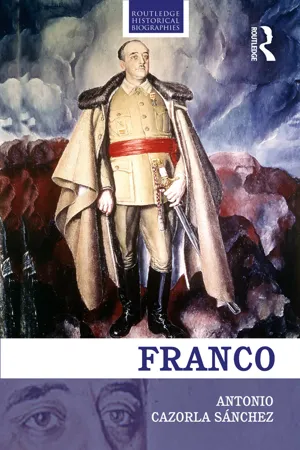
Francisco Franco’s public persona, the military hero that we think we know, was constructed shortly after the Spanish Civil War began in July 1936, using elements of truth, to be sure, but also elements of false recollection and outright invention. The construction of this image was part of a wider process set in motion at the time by the propaganda apparatus of the nascent rebel state. This narrative was placed in the service of contemporary political and cultural needs, and in particular to serve the burgeoning cult of the Caudillo. The double process of re-interpreting and inventing Franco’s life was not limited to manipulating the past by either creating events by selecting or removing them from their context. On the contrary, it also included erasing the memory of the people who made possible his meteoric rise through the ranks of the Army. These people had no place in what was intended to be a unique career pre-ordained by Providence, which led to the supreme moment of heroism: the beginning of the Civil War. Separating truth from fiction, this chapter explains the life and times of Franco, the military officer, before the birth of the myth.
Francisco Franco Bahamonde was born in 1892 into a military family in El Ferrol, then a remote naval base located in the northern region of Galicia. He was the second of three brothers (Nicolás, the elder, and Ramón, the younger). There was also a sister (Pilar). The parents did not get along well, and when Franco was a teenager, his father, Nicolás, an officer in the Navy’s administrative branch, decamped to Madrid, where he took up with his common-law wife. Franco’s mother, also named Pilar, was a smart, conservative woman with a keen sense of Christian values, who confronted her painful situation with dignity. Franco always felt close to his mother and rejected by his father. As a boy he wanted to be a sailor, like his father, but it was not to be. The Naval Academy had closed after the sinking of most of the Spanish Navy during the 1898 Spanish–American War. The defeat resulted in the loss of what was left of the Spanish Empire: Cuba, Puerto Rico, the Philippines and some islands in the Pacific. Instead of joining the Navy—he would long for the sea the rest of his life—the young Franco had to settle for the Infantry, one of the less prestigious branches of the Spanish Army. At the military academy in Toledo he was a mediocre cadet, graduating in 1910, 251st out of a class of 312. He was, nonetheless, an ambitious young soldier, recognizing that if he wanted to move up through the ranks there was only one road open to him: to fight in Africa. It was dangerous, but it was the right moment for it.
Franco arrived in Morocco in 1912, where he joined the Regulares (more on this unit later in the chapter). Four years later, in 1916, he was nearly killed in a minor skirmish not far from Ceuta. This serious wound was the only one he would ever receive in action (in December 1961 he would accidentally shoot himself while on a Christmas hunting outing near his palace). Unlike hundreds of other young officers seeking fame and promotion, he survived and prospered. Moreover, this timid, mediocre student with a weak physical constitution would discover in Africa’s brutal lottery of death, of minor skirmishes and major setbacks, his fortune and his public persona. In battle, he showed leadership, cold courage and tactical skill. His superiors trusted him. His soldiers, mostly Moroccan mercenaries, were said to have a blind faith in his “baraka”, an Arab word that implies both blessing and good luck. Like many other young officers of his generation fighting in Morocco, Franco rapidly earned several highly prized decorations and promotions. As we shall see in this chapter, these achievements—in spite of what it will be said in the future, after Franco became the Caudillo—were not exceptional at the time. By the time Franco was reposted to the Iberian Peninsula, to a placid garrison in Asturias in 1917, the fragile and seemingly not-so-bright second lieutenant had become a twenty-four-year-old major, and a local celebrity, albeit a very minor one.
While the context in which Franco’s career developed was very European, circumstances in Spain were significantly different from those of the major powers. In the late nineteenth and early twentieth centuries, Europeans—and North Americans, too—justified their military and economic hegemony by pointing to supposedly unique racial and cultural traits: it was from these traits, many argued, that certain nations derived the moral, not to mention practical, superiority with which to colonize much of the non-European world. However, there was one minor problem with this explanation: what of the European nations that failed to gain an empire? By the beginning of the twentieth century Spain had joined the ranks of these under-achievers. While it had once possessed the world’s greatest empire, in the late nineteenth century it had shrank and virtually disappeared. One explanation for this decline, according to some, was that a decadent, racially mixed and intolerant Catholic Spain did not quite belong to Europe. Spain was thought of as an oriental country: inscrutable, violent, and even seductive. Indeed, Rudyard Kipling’s famous poem “The White Man’s Burden”, was inspired by Spain’s swift defeat in the 1898 war against the United States (Spaniards were not “white” people back then). Many Spaniards agreed that the nation was in fatal decline. Following the 1898 defeat, the “Disaster” as many Spaniards called it, the debate over the nation’s decadence was intense, even if it did not lead to any substantial change in the country’s political trajectory.
For many commentators, however, the nation’s re-birth was going to begin in Morocco. There were many justifications for Spain’s presence in Northern Africa in the early 1900s. In reality, however, three principal objectives determined Spain’s policy in the region: securing the long-held garrison towns of Ceuta and Melilla, reversing national decline by gaining an empire, and profiting from the supposed wealth of Morocco. What eventually allowed Spain to conquer the territory was not its military might or racial strength but, paradoxically, the fact that it was a weak state. Britain was concerned with keeping its Empire’s sea lines safe; it did not want France or Germany to control the Moroccan territory just across from the Gibraltar Strait. The presence there of a seemingly feeble Spain was, for the British, the lesser of several evils. For the French, conceding Spain this unruly little portion of its new colony in North Africa was a relatively small price to pay for strengthening the new rapprochement with Britain at the expense of hated Germany. The 1906 Algeciras Conference and the 1912 Treaty of Fez ratified the interests of both Great Powers and Spain’s future role in Northern Morocco. As a result, Spain got 20,000 square kilometres of a territory where central authority had long collapsed and where tribes (kabila), bandits, and, increasingly, nationalists were restive, and generally eager to resist the unwelcomed presence of a new colonial master.
Spaniards got the first taste of their colonial “burden” in 1909 when a small army composed of untrained conscripts suffered a bloody defeat just outside the gates of Melilla. This incident not only revealed the difficulties of conquering and securing the new territory, but also illustrated how the war in North Africa was tearing Spanish society apart. The urgent call for reservists caused a revolution in Barcelona and other Catalan towns known as the Tragic Week. In general, the lower classes, democrats, and representatives of the left opposed the Moroccan adventure and how it was carried out while conservatives, business groups, most of the military, and the Crown enthusiastically supported colonial policy. A key element in this disagreement was the draft, which the upper classes were able to avoid through either social connections or payment. Being sent to Morocco thus became the poor man’s destiny, which more often than not meant death by illness rather than an enemy’s bullet. The draftees-to-be, however, did not necessarily accept their fate: many young men emigrated, deserted, or used other strategies to avoid being sent to North Africa. The poor’s man suffering had its opposite in the colonial officers’ booming careers and in the profits of those who had invested financially in the Moroccan operation. King Alfonso XIII (ruled 1902–1931) was certainly very close to most of the senior officers posted in Africa. Moreover, the left accused him and some of his ministers of personally profiting from the conquest of Morocco.
The war accentuated the nation’s political problems. During the Restoration period (1875–1923) Spain was not just a parliamentary monarchy but, on paper at least, a democratic one. It had adopted universal male suffrage in 1891. In theory, the Spanish parliament was more representative than Britain’s. In reality, however, caciquismo— electoral manipulation and political bossism—corrupted elections, and power was divided between the rather fractious Conservative and Liberal parties that succeeded each other in power. To make matters worse, King Alfonso XIII continuously meddled in the country’s politics and, not unlike like “cousin” Kaiser William II in Germany, he considered the Army to be his exclusive realm. Republicans, democrats, socialists, anarchists and other sectors of political opinion were excluded from the system; and a general political cynicism among the public was exacerbated by official corruption and nepotism. However, in spite of all its shortcomings, Spain’s was nonetheless a liberal political system, and there was ample room for the expression of dissent. One of the principal venues for the airing of public opinion was the press. The other was the street. Parties, unions and organizations used demonstrations, civic ceremonies, and political rallies to denounce authorities and policies they could not check in parliament. As the opposition saw the disappearance of legal venues in which it could influence the government, it began resorting to protest, often of a violent kind. In 1909 and again in 1917, Spain almost went through a revolution. Particularly after 1917, anarchist-inspired terrorism, matched by state brutality, increased the public’s opinion that the parliamentary monarchical system could not cope with the new phenomenon of mass politics.
Spain had another serious problem in the making: the Army officers fighting in Morocco, usually called the Africanists. Many of these officers came to see themselves as the gatekeepers of Spain’s colonial mission, and thus as a cure for the social ills behind the country’s weakness. They, the monarchy, and the media that propagated their views—perhaps most significantly the promonarchist newspaper ABC—formed the core of the Morocco lobby. For the Africanists and their supporters, any criticism of the Army, the war or how it was conducted was a betrayal of the motherland. Yet, while they had the enthusiastic support and patronage of the royal palace, Africanist officers frequently complained of having their hands tied by the politicians in Madrid. They saw themselves as heroes who were misunderstood and mistreated by a society and a political regime that were indolent and ineffective. They considered themselves to be a new aristocracy in a time of confusion and mass politics. In sum, they were, so they thought, hero-victims who knew best what the country needed. At the same time, they never seriously considered the poverty of Spain’s material resources, or the reasons behind their recruits’ reluctance to risk their lives in Africa. In full agreement with these ideas and prejudices was the most successful of all Africanists: Francisco Franco. After years of relative anonymity, his (and other’s) great opportunity would come in 1921. However, it was not caused by a feat of strength, but rather its opposite: one of the most devastating military humiliations suffered by Europeans at the hands of a native population. The desire for revenge would do the rest.
The place was Annual, near Melilla, in the eastern region of Northern Morocco, and the date was July 22, 1921. General Manuel Fernández Silvestre’s forces, advancing from Melilla, had tried to connect too quickly with the forces advancing from the west in an attempt to encircle the Berber troops of the Republic of the Rif, whose president was Muhammad Abd-el-Krim al-Jattabi (1882–1963). What was supposed to be a simple pincer movement against lightly armed “barbarians” became, first a chaotic Spanish retreat, and then a succession of massacres that allowed the enemy to reach the gates of the practically defenceless and panic-stricken city of Melilla. Following this initial shock, Spanish troops continued to suffer setbacks for several weeks at a total cost of approximately 10,000—some authors say 15,000—dead or missing soldiers, several hundred prisoners, and the almost complete loss of the eastern portion of the Moroccan “protectorate”. After this shocking disaster, those Spaniards who read newspapers heard for the first time the name of a young officer, Major Francisco Franco, who led one of the Foreign Legion units that hastily arrived to save Melilla.
The defeat at Annual was accompanied by many stories of the Spaniards’ heroic and desperate deeds, most of which ended in failure and death. To these could be added many more shameful, cowardly and negligent acts. The defeat brought Spanish public opinion face to face with the cost of the Moroccan adventure. The debate that followed was largely predicated on a racist contempt for, and subsequent desire for vengeance against, the “Moor”. The most hated among them was Abd-el-Krim, the man who had so shamefully humiliated the Spanish Army. After 1921, Abd-el-Krim’s name would arouse fear, hatred, and in some cases, even, a certain sinister attraction. However, he was no barbarian. Before becoming president of the Republic of the Rif, he had studied at the University of Salamanca (his brother and right-hand man studied in Madrid) and had worked for various Spanish newspapers. Moreover, he was a modernizer, a patriot who did not hate the West, a warrior who did not target civilians, and whose behaviour was often more humane than that of his enemies. Ultimately, he had too many enemies to prevail: principally, the two colonial powers, Spain and France, and also the Sultan of Fez, from whose empire the Rif Republic had broken away. In today’s Morocco, a centralist, monarchical and authoritarian state, Abd-el-Krim’s memory occupies a problematic position within the nation’s official history, to say the least.
Franco was one of the Spanish officers who was sent to destroy the Republic of the Rif and to punish its people in the wake of the disaster at Annual. Through a series of fortuitous coincidences he would find himself in the right place, at the right moment in time and in the right military unit to accomplish this task. As fate would have it, while in Asturias Franco courted his future wife, Carmen Polo y Martínez Valdés. Her social standing was higher than his; also, Franco’s philandering father cast a shameful stigma over the prospective groom. At the time, Major Franco’s career was going nowhere. However, in the interim the future Caudillo became friends with Lieutenant-Colonel José Millán Astray, whom he had met during a training course near Madrid. The two men were very different in many respects: Franco was a shy, moralistic puritan, while Millán was an outspoken womanizer. However, both were ambitious and ruthless. At the urging of Millán, Franco joined the newly founded Legion (Tercio de Extranjeros) on October 10, 1920, as second-in command. Until that day, Major Franco had been just another young and ambitious career soldier with combat experience in Africa—one whose future prospects were not particularly bright. The charismatic and sinister Millán was the real star, a student of bushido, the Japanese Samurai code, and a darling of the news correspondents whom he fêted and for whom he provided, by means of his almost suicidal behaviour in combat, plenty of exciting material to write about. From Millán, Franco would learn the important lesson on how to cultivate a mutually beneficial relationship with the press.
When the ineptly led Spanish Army was smashed at Annual, Franco was in Ceuta, at the other end of the colony, training the newly-created crack military unit that would be urgently called upon to save Melilla. This occasion was the beginning of Franco’s climb to the higher posts of the Spanish Army. Less than five years later, in 1926, not yet thirty-four years old, he would be promoted to brigadier general. As his propagandists would later insist, only Napoleon Bonaparte, a similar man of destiny, had risen so quickly. This was nonsense: there were other, more spectacular cases in nineteenth-century Spain. (For example, Baldomero Espartero, 1793–1879, a general and politician, reached the rank of brigadier at thirty, having started as a private. Like Franco, he profited both from colonial wars abroad and civil wars at home. Unlike the reactionary Franco, he was also a liberal.)
At any rate, Melilla was crucial to Franco’s fate. Today, the last existing public monument to Franco in democratic Spain still stands there, just outside the old city’s walls. It was erected in 1977, two years after the dictator’s death. The conservative local authorities have repeatedly refused to remove it, in spite of state laws demanding the dismantling of monuments to the perpetrators of the July 1936 coup. They argue, falsely, that it is a monument not to the dictator, but to the man who saved the city in 1921. The inscription below the statue says: “To the Legion Major Franco Bahamonde 1921–1977.” In reality this monument is the product of a historical fabrication; like so many others erected under the dictatorship—and since withdrawn from public view. All formed part of the elaborate political myth that surrounded the Caudillo, and which consisted in presenting the dictator’s Afric...