eBook - ePub
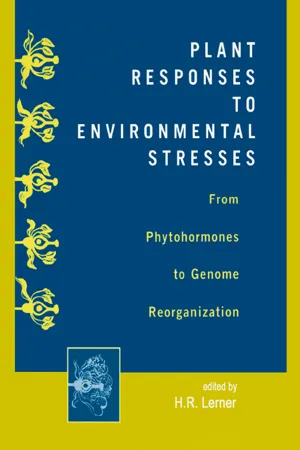
Plant Responses to Environmental Stresses
From Phytohormones to Genome Reorganization: From Phytohormones to Genome Reorganization
- 750 pages
- English
- ePUB (mobile friendly)
- Available on iOS & Android
eBook - ePub
Plant Responses to Environmental Stresses
From Phytohormones to Genome Reorganization: From Phytohormones to Genome Reorganization
About this book
Emphasizing the unpredictable nature of plant behaviour under stress and in relation to complex interactions of biological pathways, this work covers the versatility of plants in adapting to environmental change. It analyzes environmentally triggered adaptions in developmental programmes of plants that lead to permanent, heritable DNA modifications.
Information
1
Introduction to the Response of Plants to Environmental Stresses
The Hebrew University of Jerusalem, Jerusalem, Israel
I. | Fundamental Considerations | ||
A. | Time, space, and matter | ||
B. | The outcome of an experiment is determined by a set of possibilities | ||
C. | Correlations | ||
D. | The property of the whole is not necessarily the sum of the properties of its parts | ||
E. | Phasic development in plants, developmental windows and acquired competence | ||
F. | Role of phytohormones in development (differentiation and source-sink activity) and the response to environmental changes and to stress | ||
G. | Genome rearrangement as a function of development and in the response to changes in the environment | ||
H. | Evolution of the universe and of organisms | ||
I. | The living state of energy-matter | ||
II. | Conclusion Concerning the Responses of Plants to Stress | ||
III. | A Few Comments About the Book | ||
References | |||
I. FUNDAMENTAL CONSIDERATIONS
After having worked on problems of salinity since 1974, I am sometimes surprised by concepts either found or omitted by authors in the literature in this field. One of the problems in the life sciences is the compartmentalization of research in a multitude of isolated fields, for a wide background of information is necessary to understand a biological problem that becomes comprehensible only in the light of physics and chemistry as well as the many other fields of biology. In this book I have tried to assemble the opinion of many authors in an attempt to arrive at generalizations, as well as to present my point of view, which I have already partially expressed previously (see Lerner et al. 1994).
Just to present an example of an omission, the review article of Greenway and Munns (1980) Mechanisms of Salt Tolerance in Nonhalophytes not even once mentions the role of phytohormones, although many publications had appeared on the fundamental role played by phytohormones during stresses. Just to cite a few, see Itai et al. (1968), The Role of Root Cytokinin During Water and Salinity Stress, this article specifically deals with salinity; Mizrahi and Richmond (1972), Abscisic Acid in Relation to Mineral Deprivation; Rajagopal and Rao (1974), Changes in the Endogenous Level of Auxins and Gibberellin-like Substances in the Shoot Apices of Nitrogen-Deficient Tomato Plants (Lycopersicon esculentum Mill); Goldbach et al. (1975), Influence of N-Deficiency on the Abscisic Acid Content of Sunflower Plants; Vaadia (1976), Plant Hormones and Water Stress; Salama and Wareing (1979), Effect of Mineral Nutrition on Endogenous Cytokinins in Plants of Sunflower (Helianthus annuus L.).
On the other hand Greenway and Munns point to the real problem in their quotation: “Hsiao (1973) has emphasized that many different types of adverse conditions, such as nutrient deficiencies and water deficits, eventually lead to the same type of metabolic disturbance, i.e. our measurements reflect only too often the consequences rather than the cause of reduced growth.” Unfortunately, this is only a minor comment on the last page of the review. What Hsiao is saying is that the focus of research is not on the relevant parameters. Perhaps comments on a review article from almost 20 years ago may be thought to be irrelevant; however, what is relevant is not so much the details as the attitude, which is not limited to these authors only.
An example of a concept that I have difficulty in accepting is the often repeated statement that Na˖ or Cl- are toxic. As Watad et al. (1985) were able to grow tobacco cells in medium containing 500 mM NaCl and Binzel et al. (1985) in medium containing 600 mM, it seems that if tobacco cells can be grown in medium containing 0.5 M NaCl, whereas this would be lethal to the tobacco plant, that the deleterious effect of salt on the whole plant can hardly be due to an intrinsic toxic effect of Na˖ or CP. The concept that NaCl is toxic originates from experimental data showing that glycophytes exposed to a saline medium, stop growing, accumulate Na˖ and Cl- in their stems and leaves, and eventually die. This correlation is translated into an assumption of a cause-effect relation. This assumption in not necessarily correct, another factor may be responsible for the decline in growth, accumulation of Na˖ and Cl−, and death of the plant; it could be the change in the phytohormonal balance of the plant. The increase in abscisic acid (ABA) and decrease in cytokinin may well be responsible for the effects of salinity, since these changes cause decrease in shoot growth, probably increase in membrane permeability and induce dormancy or senescence.
Although many of the chapters in this book do not require any explanation because they deal with plants exposed to stress, some chapters do not refer to plants, but are important because they present examples that may shed light on types of phenomena that may be occurring in plants. Other chapters refer to plants, but not to stress, because the response of plants to stress is very similar to the response to changes in the environment that are not stressful and, in fact, the mechanisms of both of these responses are quite similar to the mechanisms affecting plant development.
In this chapter I would like to present ideas that I think are important to keep in mind when trying to understand the response of plants to stress and, in fact, to any problem in biology.
A. Time, Space, and Matter
It is most important that biologists be aware of the limits of our knowledge. These limits are explained in books written by physicists for nonspecialists, such as The Mystery of the Quantum World, by E. J. Squires (1994); About Time: Einsteinʼs Unfinished Revolution, by P. Davies (1995); Concepts of Space: The History of Theories of Space in Physics, by M. Jammer (1993). I very much recommend to all those involved in science to read such books. As Squires states
[A]ll sciences, from cosmology to biology, are, at their most fundamental level, branches of physics.
And goes on by saying
[T]he very foundation of contemporary theoretical physics is mysterious and incomprehensible.… In a deterministic theory the future behavior of an isolated physical system is uniquely determined by its present state. If, however, the world is correctly described by quantum theory, then, even for simple system, this deterministic property is not valid. The outcome of any particular experiment is not, even in principle, predictable, but is chosen at random from a set of possibilities.… at its very heart, quantum mechanics is totally inexplicable…. In specialized books the … highly elaborate and symbolic treatment. … give the impression that problems have been solved when, in fact, they have merely been hidden…. We have learned how to observe the world, in ever more precise details, how to classify and correlate the various observations and then how to explain them as being caused by a … world behaving according to certain laws. These laws have been deduced from our experience, and their ability to predict new phenomena … This beautifully consistent picture is destroyed by quantum phenomena…. It is no longer true that different methods of observation give results that are consistent with … a reality … that had previously been assumed…. It will be asked … why such an important fact is not immediately evident and well known…. The reason is that, on the scale of magnitudes to which we are accustomed, the new, quantum effects are too small to be noticed. … too insignificant for us to have to take them into account when we describe our experience.
This is why it is often thought that quantum mechanics applies to only microscopic (molecular or smaller) objects, but not to macroscopic objects. However, the difficulty in understanding energy-matter interactions are as important in the macroscopic world as it is in the microscopic world.
Davies discusses different aspects of time and reaches the “conclusion … that we are far from having a good grasp of the concept of time.” Jammer concludes the chapter on Concept of Space in Modern Science with “… our knowledge of large-scale as well as of small-scale properties of physical space is intimately related to the progress in cosmology and microphysics, respectively. And as long as these branches of scientific research fail to offer satisfactory solutions to their fundamental questions the problem of space have to be classed as unfinished business.” From the discussions of Squires (1994), Davies (1995), and Jammer (1993) we can understand that matter, time and space are still not clearly understood entities. These uncertainties concerning most basic parameters in physics should caution biologist concerning dogmas in biology. I suppose that many biologists will be of the opinion that such considerations are philosophical and that they do not apply to their research. This, however, is incorrect, it is not possible to arrive at correct conclusions from incorrect assumptions.
In conclusion, we are still far from understanding the world we live in, and probably many phenomena will always remain not understood, which should prompts use to remain modest in our interpretations.
B. The Outcome of an Experiment Is Determined by a Set of Possibilities
In experimental science it is often thought that by repeating an experiment many times and taking average values a correct picture of reality is obtained. This is true when the differences (the variability) in the data are due to errors in measurements. However, often the differences are not due to errors, but rather are part of the reality. For example, Morrison and Boyd (1992) tell us that nitration of benzenesulfonic acid yields 21% ortho-nitration, 7% para-nitration, and 72% meta-nitration. It is evident to all that this does not mean that each molecule is nitrated at a level of 21% at its ortho-position, 7% at its para-position, and 72% at its meta-position, but rather, that 21% of all the molecules are nitrated only in ortho, 7% of all the molecules are nitrated only in para, and 72% of all the molecules are nitrated only in the meta-position. If we remember from quantum mechanics that “the outcome of any particular experiment is not, even in principle, predictable, but is determined randomly from a set of possibilities …” we can understand the result of nitration of benzenesulfonic acid; it means that the probability of nitration at the ortho-position is 0.21, that of nitration at the para-position is 0.07, and that of nitration at the meta-position is 0.72, and calculation of an average value is meaningless. Obviously, quantum mechanics is not the only way to explain this phenomena. Another explanation could be used, such as that the rate at each reaction site is a function of different affinities. Or classic mechanics can be invoked by saying that all collisions between benzenesulfonic acid molecules and are not identical in space, and that the different probabilities of a reaction occurring at a precise position is a function of the angle of the encounter of the particles at the precise site.
In organic chemistry there are many reactions that yield multiple products. It would perhaps be useful to give an example of a unimolecular (decomposition) reaction. In such an instance, the reaction is not influenced by the geometry of the collision between substrate molecules. Rapid distillation of citric acid yields labile aconitic acid, which decomposes to citraconic anhydride plus itaconic anhydride (Karrer 1950).
What is important to remember is that there is more than one possible reaction product, and that averaging the results may mask reality. If this is true of organic reactions, why should it not also be true of biological phenomena (see Chapter 2).
C. Correlations
It seems to me that there are several obstacles to progress in stress research owing to misconceptions of what science can reveal, as well as to the compartmentalization of research into isolated fields.
In my opinion, science is a philosophy that attempts to explain the world in which we live. It is based on an interpretation, as logical as possible, of empirical observations, free of preconceived ideas. Interpret...
Table of contents
- Cover
- Half Title
- Title Page
- Copyright Page
- Table of Contents
- Foreword
- Preface
- Contributors
- PART I General Concepts
- PART II Plant Responses to Particular Stresses or Interactions with Other Organisms or Viruses
- Index
Trusted by 375,005 students
Access to over 1.5 million titles for a fair monthly price.
Study more efficiently using our study tools.
Frequently asked questions
Yes, you can cancel anytime from the Subscription tab in your account settings on the Perlego website. Your subscription will stay active until the end of your current billing period. Learn how to cancel your subscription
No, books cannot be downloaded as external files, such as PDFs, for use outside of Perlego. However, you can download books within the Perlego app for offline reading on mobile or tablet. Learn how to download books offline
Perlego offers two plans: Essential and Complete
- Essential is ideal for learners and professionals who enjoy exploring a wide range of subjects. Access the Essential Library with 800,000+ trusted titles and best-sellers across business, personal growth, and the humanities. Includes unlimited reading time and Standard Read Aloud voice.
- Complete: Perfect for advanced learners and researchers needing full, unrestricted access. Unlock 1.5M+ books across hundreds of subjects, including academic and specialized titles. The Complete Plan also includes advanced features like Premium Read Aloud and Research Assistant.
We are an online textbook subscription service, where you can get access to an entire online library for less than the price of a single book per month. With over 1.5 million books across 990+ topics, we’ve got you covered! Learn about our mission
Look out for the read-aloud symbol on your next book to see if you can listen to it. The read-aloud tool reads text aloud for you, highlighting the text as it is being read. You can pause it, speed it up and slow it down. Learn more about Read Aloud
Yes! You can use the Perlego app on both iOS and Android devices to read anytime, anywhere — even offline. Perfect for commutes or when you’re on the go.
Please note we cannot support devices running on iOS 13 and Android 7 or earlier. Learn more about using the app
Please note we cannot support devices running on iOS 13 and Android 7 or earlier. Learn more about using the app
Yes, you can access Plant Responses to Environmental Stresses by H.R. Lerner,Lerner in PDF and/or ePUB format, as well as other popular books in Biological Sciences & Biology. We have over 1.5 million books available in our catalogue for you to explore.