eBook - ePub
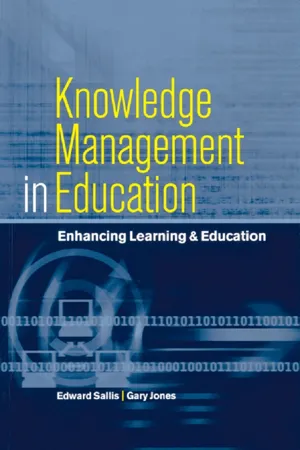
Knowledge Management in Education
Enhancing Learning & Education
- 160 pages
- English
- ePUB (mobile friendly)
- Available on iOS & Android
eBook - ePub
Knowledge Management in Education
Enhancing Learning & Education
About this book
Knowledge Management (KM) is the technique of using the information and knowledge that is supplied to, generated by and inherent in any organization or institution, to improve its performance. This volume demonstrates how KM can be used in education to improve learning.
Information
1 What is knowledge management?
‘Knowledge is our most important engine of production.’
Alfred Marshall, Economist
This chapter explores the dimensions of knowledge management and the key concepts that underpin it. It looks at why knowledge is so important to 21st-century organizations and asks why there is a need for an emerging knowledge discipline. It investigates the nature of knowledge and identifies the two important concepts, namely explicit and tacit knowledge, which are crucial to understanding knowledge management and which form the basis for managing organizational knowledge. It concludes with some of the implications that knowledge management insights can have for educational institutions.
Knowledge – the 21st-century resource
Knowledge is the key resource of the information age. Today, the importance of managing knowledge and know-how is a categorical organizational imperative. Without understanding their own process for knowledge creation, organizations are unlikely to continue as functioning enterprises. The successful 21st-century organizations – schools, small businesses or corporate giants – will be those that make the best use of their information and knowledge and use them to create sustained additional value for their stakeholders.
While the power of knowledge has always been seen as important (witness the role of the spy), businesses and public bodies today make use of knowledge in a very different manner. The emphasis is shifting from secrecy to sharing. Where once knowledge was scarce, and hoarded as a source of power and influence, today the power of knowledge is in its communication and in its use as a positive, creative force. Where once knowledge was the province of the few – the rich and the powerful – today, the power of the Internet means that vast amounts of knowledge are potentially the province of everyone.
The problem today is not how to find information, but how to manage it. We have moved from the age of secrecy to the age of information overload. The challenge for organizations is how to process knowledge, sorting out what is important from what is not, and use the best of it creatively. If an organization does not or cannot learn from its own store of knowledge it stands little chance of survival. Making the best use of its own knowledge makes an organization successful.
Knowledge-based organizations are the likely winners in the new economic order. They are the ones with all or most of the following characteristics:

Origins of knowledge management
Knowledge is a vastly intriguing and important subject. Knowledge is at the heart of civilization, underlying all that we think, believe and do, and questions about its nature are as old as civilization itself. Knowledge has brought our technologies into being and has transformed our world. Knowing and understanding things and being creative are the basis of our learning, as well as our political, educational and business life.
And yet, while knowledge as a discipline is as old as recorded history, knowledge management is a relatively new discipline. It has come to prominence because of the sheer volume of the information available in the modern world. As a major discipline it is barely a decade old, and yet its roots can be found in philosophy and psychology, as well as business and management theory. Its intellectual origins can be traced back to the industrial revolutions of the 18th and 19th centuries and to the management thinking that accompanied the rise of mass production and large-scale manufacturing. Knowledge management has its origins in the need for companies to harness the scientific, human and intellectual capital at their disposal. Its emergence as a separate discipline can be attributed to the change from managing muscles to managing brains, and to the vast growth of knowledge caused by the combined technologies of the computer, scientific research, telecommunications, digital television and the Internet.
Knowledge management is still in its infancy, and there is a considerable element of novelty about it. Nevertheless, interest in it is expanding at an enormous rate. Until comparatively recently, the term ‘knowledge management’ had a comparatively narrow definition. When first used in the 1980s it was limited to describing artificial intelligence and the processes associated with the application of computing. By the time it started to be used in management literature, in the early 1990s, it had taken on a broader perspective, although with little real consensus about its meaning. This is still the case to a certain extent, although there is now far more clarity and focus over its meaning.
The term ‘knowledge management’ is used to describe everything from the application of new technology to the broader endeavour of harnessing the intellectual capital of an organization. Nevertheless, a consensus is developing around the idea of knowledge management as being about learning to know what we know. This perspective is the one that is explored in this book. The idea is that knowing what we know, and using it creatively and productively, is the major source of economic value and competitive advantage at the disposal of any organization.
However, we need to remember that one aspect of knowing what we know is not always that simple. There is much knowledge that an organization is not conscious of and, in addition, organizations need to have a process to know what they do not know but should know. The latter is difficult but important. Identifying what an organization should know requires insight and vision. Scenario planning (see Chapter 5) is one important technique that helps us to understand futures and alternatives, and brings to light what an organization needs to know.
Different types of knowledge
In the world of knowledge management, successful organizations are those that realize the importance of making the most of what they know, and at the same time develop new value by creating knowledge. Every organization has an enormous amount of information at its disposal – about its economic environment, and its products, services, processes, technologies, customers, clients, suppliers and competitors. It can all be used to the organization’s advantage, but utilizing that knowledge is not a simple matter. Knowledge is after all not a tangible product, or a material thing like land, labour and physical capital. Neither is it all of a kind. Some knowledge is very easy to access and cheap to harness, while other knowledge is locked away in people’s minds and harder to use effectively. An organization may not even be aware that it has some kinds of knowledge – this may become clear only when key individuals leave or when a competitor highlights it. Where the knowledge base forms the essential capability of the organization, this type of knowledge may be called critical knowledge.
Some knowledge is deeply embedded in an organization. Embedded knowledge is the technical or intellectual core of the organization’s activities. In education it is the essential subject knowledge of the educators; in a marketing company it may be its client database; in an engineering company it may be the patents than govern its technical processes. The challenge for knowledge management is to make better use of all organizational knowledge, and to find appropriate means and technologies to make sense and use of the knowledge embedded in the staff of an organization, and what lies behind that organization’s processes.
Knowledge is not static. It is ever-changing and what was once essential and embedded can quickly become out-dated and obsolete. Strengths can quickly turn into weaknesses, because of technological change or the turbulence of markets. Successful knowledge organizations are those, like 3M, which are always encouraging new ideas and new products, and which encourage the growth of new knowledge. Creative knowledge is the key to future success.
Knowledge management is not a magic cure
Despite the undisputed importance of knowledge in the modern world, not everyone regards the subject of knowledge management favourably. Some commentators dismiss it as just another management fashion, one of many in recent years. Some might see it, wrongly, as a cure-all for every business performance problem. In the past, total quality management was seized upon by many as the Holy Grail of business change, capable of solving most organizational problems and of delivering continuous outstanding business performance. When it did not deliver everything that was claimed for it, many commentators consigned TQM to the dustbin of management theory.
Management ideas such as knowledge management should n...
Table of contents
- Cover
- Halftitle
- Title
- Copyrights
- Contents
- The authors
- Acknowledgements
- Introduction: the knowledge age
- 1 What is knowledge management?
- 2 Knowledge leadership
- 3 Models for making the best use of knowledge
- 4 Adapting missions and strategies to thrive in the knowledge age
- 5 Learning organizations
- 6 Bridging the digital divide
- 7 Knowledge-management gurus
- 8 The knowledge-management checklist
- Further reading
- Index
Trusted by 375,005 students
Access to over 1.5 million titles for a fair monthly price.
Study more efficiently using our study tools.
Frequently asked questions
Yes, you can cancel anytime from the Subscription tab in your account settings on the Perlego website. Your subscription will stay active until the end of your current billing period. Learn how to cancel your subscription
No, books cannot be downloaded as external files, such as PDFs, for use outside of Perlego. However, you can download books within the Perlego app for offline reading on mobile or tablet. Learn how to download books offline
Perlego offers two plans: Essential and Complete
- Essential is ideal for learners and professionals who enjoy exploring a wide range of subjects. Access the Essential Library with 800,000+ trusted titles and best-sellers across business, personal growth, and the humanities. Includes unlimited reading time and Standard Read Aloud voice.
- Complete: Perfect for advanced learners and researchers needing full, unrestricted access. Unlock 1.5M+ books across hundreds of subjects, including academic and specialized titles. The Complete Plan also includes advanced features like Premium Read Aloud and Research Assistant.
We are an online textbook subscription service, where you can get access to an entire online library for less than the price of a single book per month. With over 1.5 million books across 990+ topics, we’ve got you covered! Learn about our mission
Look out for the read-aloud symbol on your next book to see if you can listen to it. The read-aloud tool reads text aloud for you, highlighting the text as it is being read. You can pause it, speed it up and slow it down. Learn more about Read Aloud
Yes! You can use the Perlego app on both iOS and Android devices to read anytime, anywhere — even offline. Perfect for commutes or when you’re on the go.
Please note we cannot support devices running on iOS 13 and Android 7 or earlier. Learn more about using the app
Please note we cannot support devices running on iOS 13 and Android 7 or earlier. Learn more about using the app
Yes, you can access Knowledge Management in Education by Edward Sallis,Gary Jones,Gary (Deputy Principal Jones,Edward (Principal and Chief Executive Sallis in PDF and/or ePUB format, as well as other popular books in Education & Education General. We have over 1.5 million books available in our catalogue for you to explore.