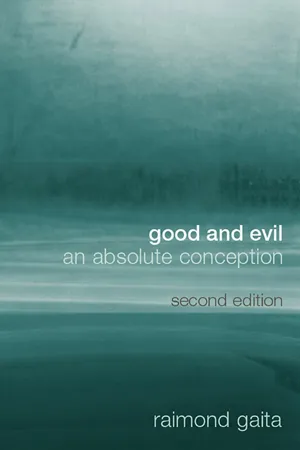
Raimond Gaita's Good and Evil is one of the most important, original and provocative books on the nature of morality to have been published in recent years. It is essential reading for anyone interested in what it means to talk about good and evil. Gaita argues that questions about morality are inseparable from the preciousness of each human being, an issue we can only address if we place the idea of remorse at the centre of moral life. Drawing on an astonishing range of thinkers and writers, including Plato, Wittgenstein, George Orwell and Primo Levi, Gaita also reflects on the place of reason and truth in morality and ultimately how questions about good and evil are connected to the meaning of our lives.
This revised edition of Good and Evil includes a substantial new preface and afterword by the author.
- 416 pages
- English
- ePUB (mobile friendly)
- Available on iOS & Android
eBook - ePub
About this book
Information
1

Evil and unconditional respect
The following is a passage from Chaim Kaplan’s Warsaw Diary:
A rabbi in Lodz was forced to spit on a Torah scroll that was in the Holy Ark. In fear of his life he complied and desecrated that which is holy to him and his people. After a short while he had no more saliva, his mouth was dry. To the Nazi’s question, why did he stop spitting, the rabbi replied that his mouth was dry. Then the son of the ‘superior race’ began to spit into the rabbi’s mouth and the rabbi continued to spit on the Torah.1
I have not quoted this to shock or to bully anyone into accepting or rejecting any philosophical position in ethics – not, for example, to refute the moral sceptic or to bully him into submission or, even, to call him to a kind of sobriety. I have quoted it to appeal to a community wider than one whose sense of philosophical reflection is conditioned by the nature of philosophy as a subject or a discipline (as studied in universities) and for whom examples such as this are a focus for ethical reflection. There is no simple way to identify that community independently of the character of its concern with good and evil. There are those who have been the victims of such evil – Jews and many others, not only at the hands of the Nazis and not only at that time. But there are many others who have neither suffered nor witnessed such evil, yet whose lives and thought have been marked by its presence.
In the face of such evil some people believe that they must assert, and others that they must deny, that even people who have done such deeds are sacred. Few people will say that in full seriousness because only someone who is religious can do it. But there are people who are not religious who want to say what they hope will be a secular equivalent of it and they will hunt for one of the inadequate expressions available to us to do it. They may say that even such people are infinitely precious, or that they are ends in themselves, or they may say, more simply, that even such people are owed unconditional respect, meaning, not that they are deserving of esteem, but that they are owed a kind of respect that is not conditional upon what they have done and that cannot be forfeited. Some will say that even the most terrible evildoers are owed this respect as human beings and that we owe it to them because we are human beings. That amounts to saying they remain our fellow human beings whatever they do. Many find that incomprehensible. They are likely to retort that if someone is to be treated or respected as a human being then they must behave like a human being. That seems to be sober common sense.
In (academic) philosophy examples such as these are often called ‘hard cases’, by which it is meant that they present serious difficulties for a philosophical thesis and it is implied that philosophical theories are judged according to how they deal with them. Consequentialists often present examples of the increasingly horrific consequences of someone’s refusal to do evil to see at what point their opponents will crack. They think of such examples as hard cases that any account must accommodate under pain of inadequacy and they think that they alone can do it comfortably. The concept of a hard case presupposes a certain conception of ethical reflection: that it aspires to be, at best, theorising. Hard cases test theories and, on this conception, provide challenges that may, in principle, be met in thought alone, in abstraction and at a distance from the actual situations they describe.
In Gorgias, Polus presents an ever-worsening catalogue of horrors against Socrates who said that it is better to suffer evil than to do it and that it is better for the evildoer to be justly punished than to escape such punishment:
What do you mean? If a man is arrested for the crime of plotting a dictatorship and racked and castrated and blinded with hot irons and finally, after suffering many other varieties of exquisite torture and seeing his wife and children suffer the same, is crucified or burnt at the stake, will he be happier than if he gets off, establishes himself as a dictator, and spends the rest of his life in power doing as he chooses, the object of envy and admiration to natives and foreigners alike? Is this what you maintain that it is impossible to prove untrue?2
Socrates replies that Polus is trying to frighten him with bogeys. That, from the point of view of someone who sees Polus as legitimately presenting hard cases to test the Socratic claim, will seem to be merely evasive. But we do not know how Socrates would have responded had he actually been confronted with an example such as Polus describes. The difference is relatively unimportant if we think that actual experience of the situation at best supplies reflection with data that might otherwise have been unavailable to it, or a psychological impetus to change our moral principles. Natural though that conception of the cognitive significance of experience may be, it is profoundly mistaken. I shall argue that in Chapter 15, but at this stage I do not want the point of my remark, that even in the presence of such evil as is described by Kaplan some people assert that every human being is owed unconditional respect, to be interpreted in the light of such a conception of the cognitive importance of experience. I am not suggesting that Kaplan has presented us with a hard case that we should use to test certain ethical theories.
Some people who suffered evils similar to the rabbi in Kaplan’s report have said that it would be no injustice against those who did such evil if they were to be shot in the street like dogs, for they have forfeited the respect owed by one human being to another. Not anyone would have the authority to assert the contrary against those who have suffered and speak in this way. That is essential to a proper conception of what it is to understand that no human being may be killed in the spirit of ridding the world of vermin. The conditions under which someone would have the right to assert, or even to think, the contrary against them are not easy to specify, but someone could not claim that right just on the ground that he had been sincerely convinced by a philosophical argument.
Someone may be sincerely convinced by philosophical argument that all human beings are unconditionally owed respect yet his sincere profession of it be, as we say, ‘mere words’, not because his profession of it is undermined by his deeds, but because it is not informed by anything sufficiently weighty in his life to earn the respect accorded to those of whom we say, in such contexts, that they ‘have something to say’ or that they ‘know what they are talking about’. There are empty assertions and denials that human beings are owed unconditional respect and they may be supported by sophisticated and ingenious arguments that give philosophers much to do, but they are not what matters. Those who command our respect, and provide us with a serious sense that there is something to think about when they either assert or deny such claims of absolute value, have arrived at neither their assertion nor their denial by argument. Philosophers often speak as though the subject-matter for philosophical reflection in ethics were statements or sentences or propositions. I believe they are mistaken. The subject-matter for ethical reflection is primarily action and speech which has a certain authority, and when it is speech, it is by those of whom we say that ‘they have something to say’ because they speak with an authority that derives from the way they have lived their lives.
The authoritative assertion that all human beings are owed unconditional respect is an expression of a sense of absolute value. It is important that it be affirmed against a serious sense of evil of the kind that is described by Kaplan, but that is not merely because we can then be assured that ‘unconditional’ unequivocally means unconditional, which (we may think) it must if the affirmation is to be an expression of absolute value. To think that would be to think that we could test a claim to absolute value in the same way as we test a generalisation. It appears to assume that it is an idea conceived in less demanding circumstances, or with less than full appreciation of its scope, and that now needs to be tested for its scope. That is a mistake. Respect is owed to those who do such terrible evil as Kaplan describes, and that it is owed even to them is internal to the kind of respect it is in all circumstances. But the claim that it is owed even to them is not the claim that an ethical idea has been taken to its furthest limit and found to be accommodating to cases at the limit. It is the acknowledgement of its profound unnaturalness, of, indeed, its mystery.3 That acknowledgement is not to anyone who takes a philosophical interest in the matter and is certainly not to someone who presents examples such as Kaplan’s in the spirit of canvassing ‘intuitions’ to test a thesis. It is to someone whose denial has the same kind of authority as has the affirmation that gives the denial its character.
Some people who feel the strain of looking upon the Nazi described by Kaplan as a fellow human being, but who wish to say that he is, nonetheless, owed unconditional respect, are likely to fall back on more abstract concepts to express it. They might say, for example, that he remains a person with certain inalienable rights. The trouble is that the very abstractness that seems to save the claim from being flagrantly unnatural (in a sense similar to the unnaturalness of the injunction that we should love our neighbour), at the same time radically weakens it, and will prompt anyone who is sceptical of its less abstract expressions to question whether there are rights that can under no circumstances be forfeited. He will suspect that it amounts to no more than saying that even someone who does such evil remains a certain kind of limit to our will, while appearing to offer an explanation of why he limits our will in that way. The concept of rights is too thin (in a sense, too mean) to invite us into a deepened understanding of the evildoer and what he did in the light of which we may better understand what kind of limit he remains to our will. To be sure, the concept of a fellow human being does not provide an explanation either. To see someone as a fellow being is to see him as a certain kind of limit to our will rather than to explain (in the sense of providing a basis or a justification) why we should acknowledge such limits on our will. But ‘fellow human being’ is an expression that invites elaboration of the kind suggested when we say to someone who is doing or contemplating evil, ‘Don’t you see what you would be doing?’, or of the kind with which an evildoer records the pained recognition of the significance of what he did when he says, remorsefully, ‘My God, what have I done?’ In later chapters I shall argue that the possibility of such elaboration is internal to the kind of seriousness that belongs to the nature of morality and to morality’s deepening engagement with other parts of our lives.
A French woman was interviewed in a television programme called The World at War. Over a long period, she had witnessed a young Nazi officer sending trainloads of (mainly) children to the death camps. She said that every day since then she had asked herself how it were possible for him to do it. Hers is not a question that invites an answer. It expresses a sense of mystery at that kind of contact with evil, and that sense of mystery is connected with a sense of the reality of evil as something sui generis. But that depends on her sense of what he did being informed by concepts that allow for more substantial elaboration than that he violated the inalienable natural rights of the children he sent to be murdered. ‘How could he violate their natural rights?’ ‘How could he fail to see that these children had natural rights?’ Such questions cannot express the kind of incredulity she expressed and they invite no elaboration that could express it. That is one of the reasons why Simone Weil called the concept of rights a mediocre concept:
If you say to someone who has ears to hear: ‘What you are doing to me is not just’, you may touch and awaken at its source the spirit of attention and love. But it is not the same with words like ‘I have the right …’ or ‘you have no right to …’ They evoke a latent war and awaken the spirit of contention. To place the notion of rights at the centre of social conflicts is to inhibit any possible impulse of charity on both sides.
Relying almost exclusively on this notion it becomes impossible to keep one’s eyes on the real problem. If someone tries to browbeat a farmer to sell his eggs at a moderate price, the farmer can say: ‘I have the right to keep my eggs if I don’t get a good enough price.’ But if a young girl is being forced into a brothel she will not talk about her rights. In such a situation the word would sound ludicrously inadequate.4
We have accorded even the most terrible evildoers legal rights, but that should not be taken as a sign that we have found such evil and what is owed to those who do it sufficiently tractable even to make law from our understanding of it. On the contrary, it is a sign that law may express a conception of justice that is sublime. This was well brought out in the trial of Adolf Eichmann in Jerusalem. Hannah Arendt reports that the presiding judge, Justice Landau, said that the trial had only one purpose, which was to do justice.5 He was moved to say that in protest against those who wished to make a show trial of it and who thought that the only justice that could be done at the trial was to Eichmann’s victims. Landau’s point was, I think, that if justice were to be done to Eichmann’s victims then justice had to be done to Eichmann because it was owed to him. The court could not act against Eichmann in a way that would be expressive of what was owed his victims without such action also being expressive of what was owed to Eichmann as a human being. In those circumstances, that was a just trial. But that is just what so many were not prepared to grant and it was not because they were morally obtuse.
There was no doubt about Eichmann’s identity and his guilt. Adherence to strict courtroom procedures was not required to avoid error on either score. For that reason it seemed to many that sticking strictly to courtroom procedures could be justified against the loss of the propaganda benefits of a show trial only on the grounds that failure to do so might turn out to be the thin edge of the wedge – that it might establish a dangerous precedent that would threaten the future integrity of judicial practices. Their thought seemed to be that, unless it was justified by such reasoning, sticking rigorously to courtroom procedures could only be a formality – pedantry indeed – that could not outweigh the benefits of teaching the world a lesson about the Holocaust. How could a mere formality express something so important as the unconditional respect owed to another human being? But of course it seemed a mere formality only to those who thought that courtroom practices are expressions of the respect owed to the accused only when they serve some other end that matters to the accused – the delivery of a truthful verdict, for example.
We may not kill human beings as though we were ridding the world of vermin, even if we kill them just to stop them from doing further evil. We cannot act against others as though they were filth. That is what Judge Landau expressed when he insisted that justice was owed to Eichmann for his sake. It entailed protecting the integrity of the court against the politicians for a variety of reasons, but partly for Eichmann’s sake, so that justice could be done to him.
Why may we not act against another human being as though he were filth? Is it because no one is filth? Some people have done the foulest things. If we turn from their deeds to their character we often find it is as foul as their deeds. That should not be surprising. From where else could such deeds have come? The Nazi in the extract from Kaplan’s diary seems to be an example. Countless others can be found in the concentration camp literature.
Are we sometimes entitled to say that because of the evil someone has done and the evil of his character, he is beyond the reach of a sober remorse? Should we say of Kaplan’s Nazi that he is beyond the terrible discovery of himself and what he did? And if he did come to see what he was and what he did, would he have to judge himself to be filth? I would say that he need not, and more strongly, that if his remorse is genuine and uncorrupt and if he is true to what it teaches him, then he cannot. But although I have spoken of the discovery and of the recognition of what he was and what he did and although I will, in later chapters, defend that as a genuine form of understanding, of ‘coming to see things as they are’, I do not wish to say, flatly, that the reason he cannot, in the light of a genuine remorse, judge that he is filth is because he is not filth. That would suggest that it is a fact that he is not filth or that there would be some point in saying, in the emphatic way philosophers are prone to say it, that it is the case that he is not filth. I do not wish to say anything like that – not with that kind of (philosophical) emphasis. The claim that no human being is filth and the corollary claims about what may or may not be discovered in a sober remorse are themselves expressions of a sense of absolute value rather than claims that would underwrite such a conception if they were true.
We sometimes say that no human being is all bad. That seems to be false or, perhaps more accurately, there are times when the grammar of the application of concepts like ‘part’ and ‘whole’ in the contexts of attributions of good and evil does not allow us to assert or deny it. There are human beings who are so steeped in evil that it seems grotesque even to try to specify what is good in them – as, for example, when people say of people like the Nazi Kaplan describes that they were, nonetheless, good family men. The point here is not that we wish to deny any empirical reports concerning their behaviour to their wives and children. Nor is it that we wish to deny that, ordinarily, behaviour of that kind would justify the judgement that someone was a good father and husband. Nor is it that we wish to say that, in one of the ways with which we are familiar, all was not as it seems, for that presupposes that there are facts not yet on the table that would undermine judgements made in ignorance of them. We should not, therefore, deny that such people had some good in them that showed in their relation to their families, their friends and their neighbours. Rather, we should express our bewilderment about the sense of what we are being asked to understand.
The thought that no human being is all bad may, however, be understood in a way that does not entail grotesque claims about the good parts of radically evil lives. It may simply be the thought that there is no deed or life so evil that it is beyond the reach of a sober remorse and that there is no remorse that requires a person, under pain of self-deception, to acknowledge that it would be best to rid the world of the filth he believes he has discovered himself to be. It is important to remember, however, that there are lives such that if we try to find...
Table of contents
- Cover
- Halftitle
- Title
- Copyright
- Dedication
- Contents
- Preface to the First Edition
- Preface to the Second Edition
- Acknowledgements for the First Edition
- 1 Evil and Unconditional Respect
- 2 The Scope of Academic Moral Philosophy
- 3 Mortal Men and Rational Beings
- 4 Remorse and its Lessons
- 5 Evil Done and Evil Suffered
- 6 Naturalism
- 7 Modalities
- 8 Meaning
- 9 Individuality
- 10 ‘An Attitude Towards a Soul’
- 11 Goodness
- 12 Ethical Other-Worldliness
- 13 ‘The Repudiation of Morality’
- 14 Ethics and Politics
- 15 Moral Understanding
- 16 Truth
- 17 Fearless Thinkers and Evil Thoughts
- Afterword
- Notes
- Index
Trusted by 375,005 students
Access to over 1.5 million titles for a fair monthly price.
Study more efficiently using our study tools.
Frequently asked questions
Yes, you can cancel anytime from the Subscription tab in your account settings on the Perlego website. Your subscription will stay active until the end of your current billing period. Learn how to cancel your subscription
No, books cannot be downloaded as external files, such as PDFs, for use outside of Perlego. However, you can download books within the Perlego app for offline reading on mobile or tablet. Learn how to download books offline
Perlego offers two plans: Essential and Complete
- Essential is ideal for learners and professionals who enjoy exploring a wide range of subjects. Access the Essential Library with 800,000+ trusted titles and best-sellers across business, personal growth, and the humanities. Includes unlimited reading time and Standard Read Aloud voice.
- Complete: Perfect for advanced learners and researchers needing full, unrestricted access. Unlock 1.5M+ books across hundreds of subjects, including academic and specialized titles. The Complete Plan also includes advanced features like Premium Read Aloud and Research Assistant.
We are an online textbook subscription service, where you can get access to an entire online library for less than the price of a single book per month. With over 1.5 million books across 990+ topics, we’ve got you covered! Learn about our mission
Look out for the read-aloud symbol on your next book to see if you can listen to it. The read-aloud tool reads text aloud for you, highlighting the text as it is being read. You can pause it, speed it up and slow it down. Learn more about Read Aloud
Yes! You can use the Perlego app on both iOS and Android devices to read anytime, anywhere — even offline. Perfect for commutes or when you’re on the go.
Please note we cannot support devices running on iOS 13 and Android 7 or earlier. Learn more about using the app
Please note we cannot support devices running on iOS 13 and Android 7 or earlier. Learn more about using the app
Yes, you can access Good and Evil by Raimond Gaita in PDF and/or ePUB format, as well as other popular books in Philosophy & Ethics & Moral Philosophy. We have over 1.5 million books available in our catalogue for you to explore.