- 177 pages
- English
- ePUB (mobile friendly)
- Available on iOS & Android
eBook - ePub
Leadership Succession
About this book
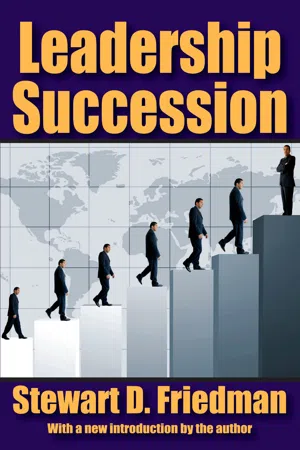
This volume focuses on the most critical strategic activity in any organization, namely, who gets chosen to sit in the top echelon of the pyramid. Friedman argues that it is the quality of corporate leadership that will determine corporate winners and losers in the global competitive game.The stakes in leadership succession are high. The selection of key figures is the one human resource activity that no one belittles for being of secondary importance. Indeed, leadership succession is so important and central in many executive minds that it crowds out any other work. The succession process is often fraught with political intrigue, it lacks discipline, and excludes meaningful involvement of senior human resource executives.The contributors to this imaginative volume reveal a succession planning process that is frequently sloppy, superficial, and regularly sabotaged by senior management when they give it short shrift in terms of quality time. In addition, senior management often overrides sound decisions when it comes to filling key positions. The result is a lack of integrity throughout the human resource systems that eventually leads to a collapse of belief in the system and its governance.Noel M. Tichy, a leading figure in the studies of human resource management, has said, ""Stewart Friedman is to be congratulated for a successful effort in providing a state of the art look at leadership succession. [He] provides us with an empirical database of what is happening in U.S. corporations, helpful prescriptions for future improvement of leadership succession, and a realistic assessment of the human resource executive challenges in this area.
Information
Subtopic
Business GeneralIndex
BusinessDilemmas in Linking Succession Planning to Individual Executive Learning*
Douglas T. Hall
This paper examines the issue of linking the selection of top-level executives with the development of these people. It first describes three stages in an organization’s development of a succession system which promotes the attainment of a firm’s objectives: 1) one-position staffing, 2) replacement planning, and 3) succession planning. Then we examine the other piece to be connected to succession planning: executive learning. It is argued that most planned executive development is aimed at task learning, not personal learning. Consistent with this condition, most executive education activities overstress classroom-style receptive methods, while neglecting active learning. Reasons for this state of affairs are proposed. The paper concludes with recommendations for enhancing personal learning for executives and for better integrating this learning with the strategic succession planning of the organization. This sort of strategic approach to executive succession is seen as the “acid test” in a firm’s strategic planning process.
This article will examine a rare phenomenon: connecting the selection of top-echelon executives with the education and development of those key organizational resources. With strong current interest in improving the succession process in many organizations, there has been a growing awareness of the need to find better methods to identify future leaders, but we must find better ways to develop and to nurture them to candidate status as well. We also need to expand the concept of executive development to encompass personal learning as well as task learning. It is argued that the more a succession system promotes all facets of an executive’s career growth, the more successful that system will be. This paper will explore some of the dilemmas involved in the succession-development connection.
The succession problem(s)
The One-Position Staffing Stage
The nature of the succession problem depends upon what stage in the evolution of its succession system the organization is in. If the organization is in the early stages of developing formal succession methods, the problem may be that there is no succession planning process at all. Key decision-makers are in a reactive mode: as critical positions become open through departures, retirements, disability, etc., the method used is the one-position staffing approach: how can we find the best qualified individual for this particular job? There is little concern for developing the candidate, because there is no time to do so. He or she must be ready now to meet the demands of this higher-level position. The specific difficulties in this stage are: a) how do we select from a number of talented but unprepared people, and b) how do we get the person we want to accept this position?
The Replacement Planning Stage
A somewhat more advanced process would be replacement planning, in which senior executives periodically review their top executives and those in the next-lower echelon and agree on two or three back-ups for each senior slot. The difference between replacement planning and staffing is that staffing is done for individual positions at the time they are vacant. Replacement is done on a regular time schedule, in advance of vacancies, for a large number of positions. It is often done subjectively, without establishing clear job descriptions (and related skills and experiences required). Because the criteria for selecting potential replacements are so subjective, and because back-ups are selected by a team of executives who have “grown up” in the company together, they may come to tacit agreement about the qualifications of candidates, and the agreement may never be tested against skill criteria that may be relevant but are not in the minds of the decision makers. As one CEO of a large manufacturing firm put it, “Our problem is not picking the people. The problem is that the same names keep showing up on every back-up list. The talent is so thin.” In other words, not enough people have been developed to be ready to move into senior management. (And this comment came from the leader of an old “Theory Z” company, well known for strong management and a well established policy of promoting from within.) Thus, the replacement planning approach is simply an extension of the staffing approach, with more square or round pegs and holes to be matched up. The problem here, then, is likely to be a shortage of executive talent.
The Succession Planning Stage
The next logical step, then, is to move beyond replacement planning (where the focus is on filling future openings) to more of a conscious succession planning process, in which the focus is on both the future executive positions and the people who might be candidates for these positions. At the heart of most well developed succession systems is the human-resource review session (Friedman, 1985). In these reviews, the top executive group reviews managers above a certain level (usually upper-middle management) in terms of their current performance, future potential, developmental needs, and plans for addressing those needs. However, if the replacement planning process errs by focusing too much on specific jobs, the succession planning review process may put too much stress on the people and too little on the positions. In particular, insufficient thought may be given to future positions and how job demands and needed skills may shift over time.
Friedman (1985) has described how the succession planning process operates in two companies noted for excellent management (both general management and human resource management): General Electric and Honeywell. During the planned human resource review sessions, critical human resource issues are discussed by the top people in the corporation. Many CEO-hours per quarter (and hours of other top executives) are devoted to human resource planning. Particular attention is paid to the promotional and developmental needs and plans of subordinates. Written forms are used as a basis for discussion. And at GE, for each manager under review, that person’s boss is held accountable for the implementation of the development plans agreed upon for that manager. Thus, there is both planning and follow-up action by senior executives, and the critical (and often neglected) link between planning and developmental action is successfully made.
Data Credibility. However, even in effective succession planning processes, problems arise in the area of development. For example, the head of executive development for a major automobile company speaks in positive terms (up to a point) of his company’s succession system:
Our procedures are as good as any. We have the annual management review sessions. We discuss potential and performance. We examine developmental needs and we agree on developmental plans. We establish accountability. The resulting forms look great.
The only problem is that people don’t pay any attention to them.
The reasons why these succession plans get so little attention, in this executive’s opinion, is that these top executives, having come up the ranks through engineering or finance, are accustomed to working with quantitative, objective data. They are not comfortable with the more subjective evaluations of people that are contained in these management reviews, and thus the reviews tend to be discounted.
Top management has to make the transition to a different measurement system, a different kind of data. It drives the engineers and financial people nuts.
And, incidentally, this is the same problem they’re having in making the transition to listening to customers. Customers may not always have a logical, rational reason for not liking a certain feature of a car. Their attitude may be quite subjective. But if it’s clear that this car is rated poorly by lots of customers, we’ve got to listen to them.
Uncertainty about Future Executive Skill Requirements*. In addition to a lack of confidence in the data about executive candidates, top management also often lacks confidence about the kinds of executive skills that the organization will require in the future. While their business planners may be telling them about new directions in which the company will have to move to be competitive in the future, top management may be uncomfortable basing too many executive decisions on this information. They are often willing to commit considerable financial and marketing resources to a strategic plan, but they often balk at, or simply fail to see, the possibility of committing major human resources (i.e., executive selection decisions) to the strategic plan. (This is especially a problem when the strategic planning data point to the selection of a person who is radically different from the current top management team, as we will discuss in the following section.) Further, drawing inferences from the business strategy about requisite future executive skills would serve to increase top management’s uncertainty and anxiety. And under conditions of uncertainty and anxiety (and thus, probably, disagreement), when faced with a promotion decision critical to the future of the organization, top management will probably play it safe by selecting a “right type” executive (i.e., someone who resembles them).
In many organizations, senior human resource planners have attempted, without success, to obtain the business strategy information from top management which would be necessary in inferring future executive skill requirements. This situation occurred, for example, at AT&T after the divestiture, and the human resource planners were forced to develop their own conclusions about what the new AT&T executive should look like.
Selecting Dissimilar Types of Executives for the Future. The problem of data credibility is aggravated when top management consciously attempts to identify the skills executives will need in the future. This goes strongly against the grain, as executives, being human, normally tend to select successors in their own image. For example, in a classic study of a bank, Argyris (1954) found that top executives tended to systematically recruit and promote a “right type” of person, one similar to their own personal style. Rosabeth Moss Kanter (1977) refers to this process as “homosocial reproduction.” Most senior executives are in the later years of middle adulthood, a time when they have a strong developmental need for generativity, to leave behind their own “fingerprints,” a lasting contribution to future generations. What better way to achieve a sense of “industrial immortality” than to leave the corporation under the command of a younger version of yourself?
However, today’s enlightened managers, informed by a strong consensus among influential management thinkers (e.g., Drucker, Nais-bett, Peters and Waterman, Bennis and Nanus), realize that a manager with a different profile of skills and experience will be needed to lead the organization of the future: a good manager of people, a participative executive, an inspiring leader, more independent and entrepreneurial, a global thinker, etc. Elsewhere in this issue, Gupta (1986) also argues that it may be necessary sometimes to select executives who do not fit the present organization. It becomes extremely difficult for top management to have confidence that they are selecting successors with this new profile when there are no data they can trust. Before, when executives were selecting successors in their own image, the data were less important, since they could use their own intuition, a sense that “he’s one of us.” (And he usually was a he.) In one large company with a largely intuition-driven, very subjective succession system, the operative description of a high potential candidate was, “We feel good about him.”
Summary of the Three Stages
A summary of the three stages in the development of succession systems is shown in Table I. The major problem with the staffing approach is that it is a one-shot, high-pressure activity where the concern is meeting an immediate crisis of succession. There is little opportunity for organizational learning and advance planning, or for learning by potential future candidates. The advantage, however, is that the crisis of a present opening gets the immediate attention of top management and thus their involvement in the process. Replacement planning focuses on the future and on a full set of positions, but it does not consider the developmental needs of candidates; in a sense, then, replacement planning is like an extension of the staffing approach, but with a multi-position, future-oriented perspective. Succession planning, on the other hand, takes into account the requirements of future positions and the development needs of candidates for these positions. Criteria are more likely to be objective because the process is more comprehensive than replacement planning or staffing. However, because of the future orientation of both replacement planning and succession planning, there may be more variability in top management’s attention to these processes.
Table I. A Summary of Three Stages in the Evolution of Succession Systems

Strategic Development Planning
To avoid the pitfalls of the one-shot staffing approach, the replacement planning approach, and the succession planning approach, a new method is required: strategic development planning (Hall, 1984), the linking of strategic organizational objectives to future executive job requirements. Here the focus is on the necessary redesign of the executive positions of the future as demanded by business objectives, as well as on the identification and development of executive candidates with the necessary skills to fit these future position profiles. The person and the position are both viewed as changing over time in ways that are not always predictable. Thus, the capacities for continual learning and adaptability (in both the organization and the executive) are needed in the succession process.
Problems in Linking Learning to Succession
The complexity of succession processes varies greatly from company to company. It ranges from General Motor’s yearly appraisal of its top 5000 managers, with predictions about where they will be in five years and at the end of their careers, to Dana Corp.’s system, which merely rotates managers “and sees how they do.” As one Dana official said, “it’s not very exotic or carefully planned” (Wall Street Journal 1985).
Typically, though, management reviews are conducted once a year and are done by the company’s top executives, assisted by senior human resource executives. The initial step is identifying the top 10 or 15 percent of management jobs in the organization that are most critical. Then, the knowledge, skills, and abilities necessary to perform we...
Table of contents
- Cover Page
- Halftitle Page
- Title Page
- Copyright Page
- Content Page
- Introduction to the Paperback Edition of Leadership Succession
- Prologue
- Succession Systems in Large Corporations: Characteristics and Correlates of Performance
- Matching Managers to Strategies: Point and Counterpoint
- Dilemmas in Linking Succession Planning to Individual Executive Learning
- Concerns of the CEO
- The Dynamic Organizational Contexts of Executive Succession: Considerations and Challenges
- Heroes in Collision: Chief Executive Retirement and the Parade of Future Leaders
- Human Resource Management In Action
Trusted by 375,005 students
Access to over 1.5 million titles for a fair monthly price.
Study more efficiently using our study tools.
Frequently asked questions
Yes, you can cancel anytime from the Subscription tab in your account settings on the Perlego website. Your subscription will stay active until the end of your current billing period. Learn how to cancel your subscription
No, books cannot be downloaded as external files, such as PDFs, for use outside of Perlego. However, you can download books within the Perlego app for offline reading on mobile or tablet. Learn how to download books offline
Perlego offers two plans: Essential and Complete
- Essential is ideal for learners and professionals who enjoy exploring a wide range of subjects. Access the Essential Library with 800,000+ trusted titles and best-sellers across business, personal growth, and the humanities. Includes unlimited reading time and Standard Read Aloud voice.
- Complete: Perfect for advanced learners and researchers needing full, unrestricted access. Unlock 1.5M+ books across hundreds of subjects, including academic and specialized titles. The Complete Plan also includes advanced features like Premium Read Aloud and Research Assistant.
We are an online textbook subscription service, where you can get access to an entire online library for less than the price of a single book per month. With over 1.5 million books across 990+ topics, we’ve got you covered! Learn about our mission
Look out for the read-aloud symbol on your next book to see if you can listen to it. The read-aloud tool reads text aloud for you, highlighting the text as it is being read. You can pause it, speed it up and slow it down. Learn more about Read Aloud
Yes! You can use the Perlego app on both iOS and Android devices to read anytime, anywhere — even offline. Perfect for commutes or when you’re on the go.
Please note we cannot support devices running on iOS 13 and Android 7 or earlier. Learn more about using the app
Please note we cannot support devices running on iOS 13 and Android 7 or earlier. Learn more about using the app
Yes, you can access Leadership Succession by Stewart D. Friedman in PDF and/or ePUB format, as well as other popular books in Business & Business General. We have over 1.5 million books available in our catalogue for you to explore.