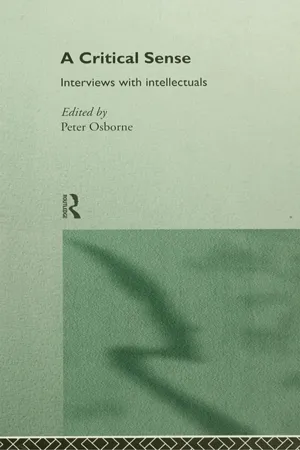
A Critical Sense brings together in a single volume the leading figures of contemporary radical theory. Moving freely between philosophy, politics and cultural studies, it offers a fascinating overview of the lines of thought of today's intellectual left.
Marxism, feminism, psychoanalysis and critical theory, literary studies, deconstruction, pragmatism, postcolonial and queer theory are discussed in a series of interviews from the journal Radical Philosophy. Those interviewed are:
Judith Butler
Cornelius Castoriadis
Drucilla Cornell
Axel Honneth
Istvan Meszaros
Edward Said
Renata Salecl
Gayatri Chakravorty Spivak
Cornel West
Slavoj Zizek
For those unfamiliar with the often daunting work of some of today's most important thinkers, ACritical Sense will offer an ideal introduction; for those already acquainted with the writings of the theorists interviewed here, the collection will throw new - and often surprising - light on familiar ground.
- 216 pages
- English
- ePUB (mobile friendly)
- Available on iOS & Android
eBook - ePub
About this book
Information
Topic
PhilosophySubtopic
Literary Criticism Theory1
Institution and Autonomy

Cornelius Castoriadis is a leading figure in the thought and politics of the postwar period in France. Throughout the 1950s and early 1960s he was a member of the now almost legendary political organization Socialisme ou Barbarie, along with other currently wellknown figures, such as Claude Lefort and Jean-François Lyotard. Unlike some of his contemporaries, however, he has remained firm in the basic political convictions of his activist years.
Castoriadis is notable for his effort to rescue the emancipatory impulse of Marx’s thought – encapsulated in his key notion of ‘autonomy’ – from what he takes to be the rigid and dogmatic structures of Marxism itself. From very early in his career he unfashionably combined a forceful critique of Communist bureaucracy with an unwavering commitment to the radical Left. Castoriadis has also played an important role in a range of debates in the philosophy of science, social theory, political philosophy and the interpretation of Freud. The major statement of his social thought is The Imaginary Institution of Society, which appeared in France in 1975 (English translation, Polity Press, 1987). His collected Political and Social Writings are available in two volumes from the University of Minnesota Press (1988). A selection of more recent pieces, Philosophy, Politics, Autonomy, was published by Oxford University Press, New York, in 1991.
Since the late 1970s Cornelius Castoriadis has been practising as a psychoanalyst in Paris. He is close, theoretically, to the ‘Quatrième Groupe’, a group of senior Lacanian analysts who broke with Lacan in 1969, over his downgrading of clinical concerns and his bizarre innovations in training procedure. Castoriadis is also a Professor at the Ecole des Hautes Etudes en Sciences Sociales, where he teaches a seminar. The Revue Européenne des Sciences Sociales has published a multilingual Festschrift for Castoriadis (vol. XXVII, 1989, no. 86), which provides a valuable range of critical perspectives on his work.
RP What were the fundamental experiences which brought you to philosophy and politics, and to the exploration of the relation between the two?
Castoriadis To begin with, there was always an intellectual curiosity for which I am indebted to my family. I came into contact with philosophy very early on, at a ridiculously early age in fact, at 13. I came to philosophy through classical manuals; to politics through Communist publications in Greece, around 1935, and then immediately afterwards, through the works of Marx. The two things have been always there – in parallel. What attracted me to Marxism, as I saw it at the time, was a very strong feeling about the absurdity and injustice of the existing state of affairs.
RP What was the political situation in Greece at that time?
Castoriadis 1935 was the eve of the Metaxas dictatorship which lasted throughout the war and the occupation. At that time, in the last year of my secondary education, I joined the Communist Youth, which was underground, of course. The cell I was in was dissolved because all my comrades were arrested. I was lucky enough not to be arrested. I started political activity again at the beginning of the occupation. First, with some comrades, in what now looks like an absurd attempt to change something in the policies of the Communist Party. Then I discovered that this was just a sheer illusion. I adhered to the Trotskyists, with whom I worked during the occupation. After I went to France in 1945/46, I went to the Trotskyist party there and founded a tendency against the official Trotskyist line of Russia as a workers’ state. We split in 1948/49 and started Socialisme ou Barbarie, which went on until 1965 (the journal) and 1967 (the group).
RP Is it true to say that you never really accepted Trotsky’s interpretation of the Soviet Union? Or did you accept it for a short time?
Castoriadis For a very short time, yes. As soon as I moved out of Stalinism, the very first thing to grasp was the idea that the revolution had degenerated and that there was a bureaucracy which was just a parasitic stratum. But I soon started to reject this. You must realize that under the Metaxas dictatorship all left-wing books were burnt. And then there was the occupation. So one was not really in touch with the literature. Still, in 1942/43 in Greece, I had the good luck to find copies of Trotsky’s The Revolution Betrayed, Victor Serge, Ciliga’s book and Boris Souvarine’s Stalin – a wonderful book which has been re-issued now in France. And it was already clear in The Revolution Betrayed that Trotsky was contradictory.
RP In what way contradictory?
Castoriadis Well, he says, for instance, that Russia is on socialist state groundings because all property belongs to the state. But he goes on to say that the state belongs to the bureaucracy. So therefore property belongs to the bureaucracy. If one is logical, one asks, ‘What has all of this to do with the workers’ state?’ The means of production belong to the bureaucracy. As I discovered afterwards, this idea had been around for some time already. One can see it among the inmates of the Russian concentration camps in 1926/27: the idea that the bureaucracy was becoming a new ruling stratum and exploiting class. What reinforced me in this conviction was the first Stalinist attempt at a coup d’état in Greece in December 1944. There really was something there, with the masses struggling under the leadership of the Communist Party; and for me it was crystal clear. If the Stalinists had gained power at that time, they would have installed a regime similar to that of Russia. I said so and wrote so at the time. It was the only time I was in disagreement with an elder militant, Spiros Stinas, who I had worked with all this time, and who, in a certain sense, was my political teacher.
How could one account for this on the basis of the Trotskyist theory of the Russian regime, that is, a proletarian revolution which has degenerated? Bureaucracy was appearing as a quasi-autonomous historical force attempting to establish a regime for its own interest and outlook. The whole development of my political conceptions about bureaucracy – and in contra-distinction to this, what is socialism? – started at this time. If socialism is not nationalized property, not just a bureaucratic method of central planning, then what is it? Immediately, the idea of autonomy arose. Socialism as self-government in production and political life; that is, collective organization and self-determination at all levels.
RP How did your move away from Trotskyism affect your understanding of the Russian revolution? As I understand it, Socialisme ou Barbarie was quite closely identified with the ideas of the Left Opposition in the Soviet Union? Did you identify politically with the Left Opposition?
Castoriadis In a certain sense, yes. But they didn’t go far enough. Later on, I wrote a text about Alexandra Kollontai’s paper on the Left Opposition of 1921, and its limitations. But this is not our problem now. The defects are obvious there: about the role of the party, the role of the trade unions and so on. Of course, Kronstadt was the last mark of some independent activity of the masses, which was crushed by the Bolshevik party. But once I started the critique of bureaucracy, it evolved quite rapidly into a critique of lots of things: of the Leninist conception of the party, and then of Marxian economics. I had started working as an economist at this time, and was working on Das Kapital. I couldn’t make much sense of it in relation to actual developments. I couldn’t make much sense of it theoretically, either. Here starts all my criticism of the theory of value, which finds its final form in the text about Marx and Aristotle which appears in Crossroads in the Labyrinth. Next came the critique of the Marxian conception of what socialism is all about, the bad utopian aspect of all this: the elimination of the idea of politics, the sort of paradisiac state depicted in the early manuscripts, where in the morning you are a fisherman, in the afternoon a poet, etc. – I don’t know what you are after dark! There is also the idea, absolutely central to Marx, that labour is slavery and freedom is outside the field of labour. Freedom is leisure. This is written in so many words. Labour is the field of necessity.
RP That’s more characteristic of the older Marx, isn’t it?
Castoriadis It is in Das Kapital. The kingdom of freedom can be built only through the reduction of the working day. During the working day, you are under necessity. This is diametrically opposed to any idea of self-management by producers, and of production itself – once it is radically changed, and once technology is also changed – as a field of exercise of human capabilities and human freedom.
RP There is also the idea of labour becoming ‘life’s prime want’.
Castoriadis That’s in the early manuscripts. But this is abandoned in the system. Next came the critique of what one can call Marxist economism. The imaginary signification of the centrality of production and economy throughout history. This is obviously a retrojection of capitalist imaginary significations throughout the whole of human history. Then there was the philosophical work, which is there in ‘Marxist Thought and Revolution’, the first part of The Imaginary Institution of Society, which was published in the last five issues of Socialisme ou Barbarie in 1964/65.
Socialisme ou Barbarie
RP Could you say something about the experience of Socialisme ou Barbarie? What was the political context in which you operated? And how, given your critique of the Leninist conception of the party, was the group organized, internally? How were its interventions made? What do you think are its enduring achievements?
Castoriadis Well, the famous organizational problem was there all the time. After an initial period during which there were strong residual elements, including in myself, in favour of the Leninist conception of the party (which I gave up about 1950), there was still an internal divide concerning the problem of organization, between people who were saying that no organization is needed (the proletariat will do everything, we are just a group trying to work out some ideas) and others, like myself, who insisted, as I still would insist, that a political organization is necessary. Not a vanguard party, certainly, but some sort of political organization. Political activity is collective activity, and it ends up with concrete acts, be it a publication or whatever. You have to take decisions. And so you have to have some rules about how you take decisions. Say, majority rules. Obviously, you allow the minority to express themselves, even publicly. But there are some points at which decisions have to be taken, and they have to be univocal. Some coordination of the general activities is necessary. But I said very early on that the only way to do this is on the basis of the idea of some sort of collective self-government. Also, the political organization could play the role, not of a model, but of a sort of exemplary activity, showing people that they can organize collectively; that they can rule their own affairs.
RP It sounds quite Luxemburgian.
Castoriadis If you wish. In a certain sense, yes. From this point of view, certainly. This led to splits with Lefort. He was against any formal organization – ‘We are an intellectual group, we publish a magazine, that’s all.’ You must remember the circumstances at the time. The Cold War started about 1947 and in Europe, especially in France, the Stalinists were almost all-powerful, even if they did leave the government in 1947. All the Left was with them. Remember the stories of Sartre and others, the fellow travellers? We were absolutely isolated. There was a period when, after the outbreak of the Korean war, we were less than a dozen in the group. And the audience was extremely limited, residual ultra-leftist groups. We cleared the ultra-left ground. Whatever was really of worth there came to Socialisme ou Barbarie – not the Trotskyists, of course. But the situation was extremely hard. Later, after 1953, with Stalin dead, the Berlin revolt, the Czechoslovakian strikes in 1954, then Hungary and Poland in 1956, the atmosphere started changing, and the review gained some audience – never very important. At the time we were selling about 1,000 copies of the magazine, which were read around. Then came the Algerian war, and the stand we took against the Algerian war. There was a kind of renaissance amongst the student youth at that time. People started coming and the group grew. Some time in 1958/59, in the whole of France, including the provinces, we were about 100. By 1962, 1963, 1964 we could hold public meetings in Paris with, say, 300 or 400 people. But all of this, as you see, was extremely limited. Of course, after 1968 lots of people said they were in Socialisme ou Barbarie. To which I have answered that if all these people who say that they were in Socialisme ou Barbarie had really been in Socialisme ou Barbarie, we probably would have grasped power in France some time around 1958.
RP So you disbanded as an organization just before that moment, in the later 1960s, when the left began to open up and expand as a result of changes in the political and economic situation more generally?
Castoriadis Yes. We had some people in the Renault factories who were producing a paper specifically for Renault workers. This was not a subsidiary of Socialisme ou Barbarie. It was produced by workers and so on. But all this was extremely limited. There was much more underground influence, unknown, anonymous; and it sprung out in 1968 in lots of people, including, for example, Dany Cohn-Bendit.
RP Why did Socialisme ou Barbarie come to an end?
Castoriadis This was a decision which I pushed very strongly. First of all, there had been a split, a second split, between 1960 and 1963. In 1960 I wrote a text called ‘Modern Capitalism and Revolution’, which was the most thorough critique of the classical Marxist position at this time: of the idea that the proletariat has a privileged role to play, of the idea that economic problems are the main problems, and so on and so forth. It argued that the problem of the transformation of society is a much more general problem. There is the question of youth, the question of women, of the changing character of labour, of urbanism, and of technology – changing technology. All this created a strong reaction from part of the group, for which the theoretical representative was Lyotard, who at the time was playing the adamant Marxist. This led to a split in 1963 which weakened the group. We were the majority. We kept the magazine, they kept the monthly journal, Workers’ Power. It was the first paper of this name. Later, the Italians published Potere Operaio. This was part of the underground influence. In Italy, lots of these people had been reading Socialisme ou Barbarie. But the group was weakened.
Public influence was expanding, as I have said. We were selling more and more. People were coming to the meetings, but they would not actively participate. They were passive consumers of the ideas. And this was reflected on the review, because to produce a magazine the main problem is the collaborators – the people who write. It’s very funny. We never had money, but publishing Socialisme ou Barbarie was never a financial problem. We always managed. The problem was the contents. Not enough people were coming into the group. Also, my own personal collaboration was beginning to take a different form. I was digging deeper and deeper into the theoretical underpinning, both of Marxist theory and of what we needed for a new conception. This was the first part of The Imaginary Institution of Society.
RP You were still working as an economist at this time?
Castoriadis Yes. I was working at the OECD. The review was taking the bizarre aspect of a theoretical-philosophical magazine which was also pretending to be a revolutionary organ. It was the first in France, and all over Europe, for instance, to produce an extensive account of the Berkeley events. The review anticipated the movements of the 1960s. It is there, about the students, the women and so on. It is written down. But this was not enough. And so at some time in 1966, we said, ‘For the time being, the thing has become meaningless. We had better stop and begin again later.’ And two years later, of course, came 1968. I don’t know what would have happened if we had still been a group in 1968. But 1968 very quickly fell under the spell of Maoists and Trotskyists and so on – not at the beginning, I mean the great period, but very quickly. One can’t rewrite history.
RP Did you have any relations with the Arguments group, the people who left the Communist Party in 1956?
Castoriadis Yes. But the relations were bizarre. Edgar Morin published a paper in which he both recognized the role of Socialisme ou Barbarie and criticized it very strongly, saying that we were obsessed with bureaucracy and making a sort of panacea or shibboleth out of selfmanagement. There were answers in Arguments on our part. But there was not very much contact, except on some personal levels. Later on, when Arguments had stopped, Morin participated in some of our public meetings. He wrote a paper in Socialisme ou Barbarie. But there was never a close collaboration. From the beginning, Arguments took itself as being a review by intellectuals for intellectuals. We never abandoned the idea that we aim at the general public, and not at intellectuals.
Philosophy and Imagination
RP Perhaps we could switch the topic back to the issue of your intellectual formation. What were the main intellectua...
Table of contents
- Cover Page
- Half Title page
- Title Page
- Copyright Page
- Contents
- Note on the Texts
- Introduction: Philosophy, and the Role of Intellectuals
- 1 Institution and Autonomy
- 2 Lacan in Slovenia
- Postscript
- 3 The Legacy of Marx
- 4 Orientalism and After
- 5 Critical Theory in Germany Today
- 6 Gender as Performance
- 7 American Radicalism
- 8 Feminism, Deconstruction and the Law
- 9 Setting to Work (Transnational Cultural Studies)
- Index
Trusted by 375,005 students
Access to over 1.5 million titles for a fair monthly price.
Study more efficiently using our study tools.
Frequently asked questions
Yes, you can cancel anytime from the Subscription tab in your account settings on the Perlego website. Your subscription will stay active until the end of your current billing period. Learn how to cancel your subscription
No, books cannot be downloaded as external files, such as PDFs, for use outside of Perlego. However, you can download books within the Perlego app for offline reading on mobile or tablet. Learn how to download books offline
Perlego offers two plans: Essential and Complete
- Essential is ideal for learners and professionals who enjoy exploring a wide range of subjects. Access the Essential Library with 800,000+ trusted titles and best-sellers across business, personal growth, and the humanities. Includes unlimited reading time and Standard Read Aloud voice.
- Complete: Perfect for advanced learners and researchers needing full, unrestricted access. Unlock 1.5M+ books across hundreds of subjects, including academic and specialized titles. The Complete Plan also includes advanced features like Premium Read Aloud and Research Assistant.
We are an online textbook subscription service, where you can get access to an entire online library for less than the price of a single book per month. With over 1.5 million books across 990+ topics, we’ve got you covered! Learn about our mission
Look out for the read-aloud symbol on your next book to see if you can listen to it. The read-aloud tool reads text aloud for you, highlighting the text as it is being read. You can pause it, speed it up and slow it down. Learn more about Read Aloud
Yes! You can use the Perlego app on both iOS and Android devices to read anytime, anywhere — even offline. Perfect for commutes or when you’re on the go.
Please note we cannot support devices running on iOS 13 and Android 7 or earlier. Learn more about using the app
Please note we cannot support devices running on iOS 13 and Android 7 or earlier. Learn more about using the app
Yes, you can access A Critical Sense by Peter Osborne in PDF and/or ePUB format, as well as other popular books in Philosophy & Literary Criticism Theory. We have over 1.5 million books available in our catalogue for you to explore.