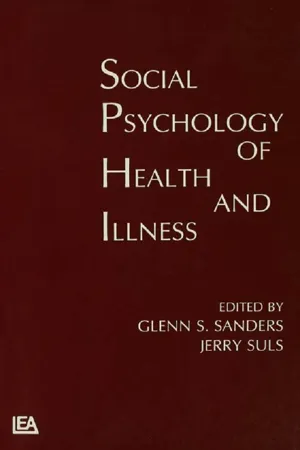
This books describes how and why "distant" social influences, such as socialization practices, interpersonal relationships, and social organization, are often just as important as medical considerations in determining an individual's tendency toward health or illness. The essays describe some of the pathways through which these social influences are exerted and also offer suggestions as to how these influences can be swayed in the direction of good health. The editors' broader aim is to stress the importance of social psychological orientation as a useful conceptual tool for the analysis of health and illness.
- 366 pages
- English
- ePUB (mobile friendly)
- Available on iOS & Android
eBook - ePub
Social Psychology of Health and Illness
About this book
Information
Publisher
Psychology PressYear
2013Print ISBN
9780805805543
9781138179943
Edition
1eBook ISBN
9781134991488
HEALTH-RELATED PERSONALITY TRAITS
| 1 | The Hardy Personality: Toward a Social Psychology of Stress and Health |
For social psychologists, the pioneer work on stressful life events and illness onset was provocative yet frustrating. Holmes and Rahe (e.g., Rahe, 1968) found environmental correlates of illness that identified disease as proper subject matter for social science. By demonstrating that the occurrence of life events that cause change and readjustment (e.g., job transfer, death of parent, marriage) increases the likelihood of one’s falling sick, Holmes, Rahe, and their colleagues forced our conceptualization of disease beyond physiological and biochemical processes to psychological and sociological processes. But, given their epidemiological orientation, these early investigations never specified the nature of the psychosocial dimensions. Countless studies were done that simply counted the number of stressful life events that subjects checked off on a standardized list, while weighing each event in terms of its objective or consensually defined stressfulness weight. The total stress score was then significantly correlated with some indicator of illness like self-report of symptoms, time of hospitalization, or amount of medication requested. Nothing was said about those psychosocial variables that served either to strengthen or weaken the positive correlation. Individual differences in response to stress were ignored.
The second source of frustration was stress investigators’ insistence on a fundamentally passive and reactive view of human behavior. Although attaching to an individual’s life-event score a numerical likelihood of getting sick in the near future (e.g., a score above 300 means that one has an 80% chance of falling ill), stress reports portrayed persons as mere victims of the changes in their environment. Working with only some parts of Selye’s model of the general adaptation response (Selye, 1956), Holmes (Holmes & Masuda, 1974) maintained that both positive and negative, minor and serious events would evoke: “adaptive efforts by the human organism that are faulty in kind or duration, lower ‘bodily resistance’ and enhance the probability of disease occurrence [p. 68].” Left out of this formulation was Selye’s recognition that there are some human organisms so constituted as to seek out stress without risk. For social psychologists, the pessimistic equation of stress with that which simply happens to and damages the person calls into question those psychological orientations that emphasize human initiative and resilience. A diversity of social psychological theories, from James (1911) on strenuousness, Fromm (1947) on the productive orientation, and Allport (1955) on propriate striving, through White (1959) on competence, to Bandura (1978) on self-efficacy and Brehm (1966) on reactance assume that persons create as well as react to the stressful life events in their lives and thrive on as well as tolerate stressful situations.
But the research on stress and illness also provided opportunities for the psychological researcher. To the social psychologist interested in personality, it offered a way of taking situational characteristics seriously. In the wake of the person-situation debate sparked by the publication of Mischel’s (1968) Personality and Assessment and fueled by many personality and social psychologists, researchers found themselves looking for occasions in which they might observe individual predispositions for acting, thinking, and feeling in particular ways (person variables) in transaction with the components of the environment (situation variables). Stressful life events presented themselves as important and measurable situation variables.
According to Holmes and Rahe (1967), a life event can be called stressful if it causes change in, and demands readjustment of, an average person’s normal routine. This definition was founded in their empirical demonstration that there is a general consensus in our culture about which particular life occurrences cause change and readjustment, and the degree to which they do so. Holmes and Rahe used the consensus data to develop a standardized list of stresses (the Schedule of Recent Life Events) and a set of stressfulness weights (the Social Readjustment Rating Scale). If a subject is given a total stress score of 300, for example, this means that he or she experienced either a few stresses that our culture would consider very severe (e.g., death of a parent, divorce, job demotion) or several stresses thought to be moderate by the majority (e.g., job transfer, marriage of a child, etc.). With this consensual or extrapersonal stress score in hand, the social personality psychologists can then turn the investigation to the characteristic psychological processes of the subject under study. The psychologist expands the research question from whether or not there is a link between stress and illness to how effectively individual predispositions either buffer or facilitate the impact of stressful life events. This elaborated research question contributes to two fields. It helps the effort within social psychology to look more closely at those characteristics relevant to interactions between individuals and their environment and fills one of the major gaps in the stress research enterprise.
A second opportunity provided by stress research to social psychologists was the chance to test some of their more optimistic interpretations of human functioning. Staying healthy in the face of stressful life events is easily seen as an indicator of adjustment and even optimal behavior. It is highly unlikely that one will be able, in the near future, to live a productive life in the full complexity of modern, urban, and technological society without encountering a number of stressful life events. Given this, one can argue that the determination of those characteristics that keep persons healthy under stress furthers the understanding of human development and well-being.
The identification of the determinants of stress resistance may also provide an immediate public service. The early work on stress and illness was quickly and loudly taken up by the popular media. Countless magazines, newspapers, and radio and television broadcasts proclaimed the message: Avoid stress if you want to stay healthy. This message was both discouraging (stress avoidance might include giving up positive changes like a job promotion) and unrealistic (one might postpone taking on a new mortgage, but how does one avoid a parent’s death?). Reports on the existence of persons who stay healthy despite stress and descriptions of their distinguishing characteristics in a form that facilitates emulation should provide more optimistic and realistic information.
I began a series of studies in the mid-1970s in response to previous stress research and in the hope of advancing a personality and social psychology with both disciplinary and social relevance. This chapter summarizes the three stages through which this research has developed. The first stage was devoted to determining the personality characteristics of those who remained healthy despite recent stressful life events. The second and prospective stage established that these traits also guarded future health from the effects of stress. The third stage involved a consideration of how personality interacts with other stress-resistance resources (e.g., social support) to keep persons healthy. The results of these studies are also considered in terms of implications for the practice of social psychology. It is easy to argue that the enterprise of stress research has significantly benefited from the perspective of social psychologists. A more difficult, but equally interesting, question is what social psychology has gained as a discipline from its preoccupation with matters of health and illness. Some possible answers to this question are offered in closing.
THEORETICAL ORIENTATION
From a variety of psychosocial mediators relevant to the stress and illness connection—including perceived social supports (e.g., Cobb, 1976), early childhood experiences (e.g., Luborsky, Todd, & Katchen, 1973), and norms governing illness behavior (e.g., Mechanic & Volkart, 1961)—personality was selected for emphasis. The basic notion throughout the research has been that persons’ general orientations toward life or characteristic interests and motivations would influence how any given stressful life event was interpreted and dealt with and, thereby, the event’s ultimate impact on the physiological and biological organism. The personality emphasis has sought to determine the conscious psychological processes by which persons efficiently recognize and act on their situations. The research goal is thereby distinguishable from that of both early psychosomatic researchers intent on elaborating an unconscious psychodynamic structure associated with disease (e.g., Alexander, 1939) and from some researchers of Type A behavior pattern and coronary heart disease (see Carver & Humphries, Chapter 2, this volume) who draw a direct parallel between psychological and organic states (e.g., Zyzanski, Jenkins, Ryan, Flessas, & Everist, 1976).
An existential theory of personality (cf. Kobasa & Maddi, 1977) has been central in this research. This theory has emerged as more relevant to an interest in stress than more traditional theories of personality on at least two counts. Existentialism’s emphasis on persons as beings-in-the-world (e.g., Heidegger, 1962; Sartre, 1956) who do not carry around a set of static internal traits, but rather continuously and dynamically construct personality through their actions, suits the personality-in-situation emphasis of the personality and stress question (cf. Mischel, 1973). Second, existentialism portrays life as always changing and therefore inevitably stressful. The mission of existentialists has been to describe how best to confront, utilize, and shape this life. Unfortunately, more space has been devoted to depicting how persons have failed in the struggle rather than succeeded (cf. Sartre, 1956). But it is recognized, on philosophical and psychological grounds, that persons can rise to the challenges of their environment and turn stressful life events into possibilities or opportunities for personal growth and benefit. Three existential concepts appear especially relevant to this optimistic orientation: commitment, control, and challenge. Together these comprise the personality style of stress resistance or hardiness.
Commitment is the ability to believe in the truth, importance, and interest value of who one is and what one is doing (cf. Maddi, 1967, 1970) and thereby the tendency to involve oneself fully in the many situations of life, including work, family, interpersonal relationships, and social institutions. Both the inner and other-directed aspects of commitment are hypothesized to ward off the illness-provoking effects of stress. Commitment to self provides an overall sense of purpose that mitigates the perceived threat of any given stressful life event in a specific life area. Even if the stressful life event is a threat to one’s view of self (e.g., an executive who sees himself as hardworking and productive in a job he is dedicated to is suddenly fired), commitment serves as a buffer. The committed person knows not only what he or she is involved in but also why the involvement was chosen. A stressful life event like being fired may negate the former but not the latter. With commitment comes the recognition of one’s distinctive goals and priorities and the appreciation of one’s ability to make decisions and hold values. This kind of self-understanding supports and revitalizes that internal structure and strength that White (1959) and other theorists (cf. Coelho, Hamburg, & Adams, 1974) deem essential for the accurate assessment and competent handling of any life situation.
But commitment is more than self-esteem or personal competence because it is based in a sense of community—what existentialists call being-with-others. Committed persons benefit from both the knowledge that they can turn to others in stressful times if they need to and the sense that others (both specific persons like a spouse and social groups like the customers one serves) are counting on their not giving up in times of great pressure. Committed persons have both the skill and the desire to cope successfully with stress. Antonovsky (1979) calls this sense of community or accountability to others the most fundamental interpersonal resource for successful coping with stress.
Control refers to the tendency to believe and act as if one can influence the course of events. Persons with control seek explanations for why something is happening not simply in terms of others’ actions or fate but also with an emphasis on their own responsibility. The efficacy of control in warding off the harmful effects of stress has been suggested in a range of laboratory and field studies (e.g., Averill, 1973; Glass, Singer, & Friedman, 1969; Lefcourt, 1978; Rodin & Langer, 1977; Seligman, 1975; Weiss, 1971). Control allows persons to perceive many stressful life events as predictable consequences of their own activity and, thereby, as subject to their direction and manipulation. The executive who appreciates the role she has played in bringing about her recent job transfer also recognizes the influence she has over its effects on her work and family life. But even those events that a person is not likely to have caused (e.g., death of a parent) are also best confronted in a spirit of control. Averill (1973) concludes from his laboratory investigations that control involves the possession of a coping repertoire (i.e., a variety of effective behavioral responses to stressful life events). Moving closer to an existential perspective, Averill also identifies decisional and cognitive dimensions of control. In the face of any stressful life event, persons in control should benefit from both autonomy and intention. They feel capable of acting effectively on their own. Further, they can interpret and incorporate various sorts of events into an ongoing life plan and transform these events into something consistent and not so jarring to the organism.
Challenge is based on the...
Table of contents
- Front Cover
- Half Title
- ENVIRONMENT AND HEALTH
- Title Page
- Copyright
- Contents
- Preface
- PART I: HEALTH-RELATED PERSONALITY TRAITS
- PART II: MEDICAL INFORMATION PROCESSING
- PART III: PROFESSIONAL/CLIENT INTERACTION
- PART IV: ENVIRONMENTAL INFLUENCES
- Author Index
- Subject Index
Trusted by 375,005 students
Access to over 1.5 million titles for a fair monthly price.
Study more efficiently using our study tools.
Frequently asked questions
Yes, you can cancel anytime from the Subscription tab in your account settings on the Perlego website. Your subscription will stay active until the end of your current billing period. Learn how to cancel your subscription
No, books cannot be downloaded as external files, such as PDFs, for use outside of Perlego. However, you can download books within the Perlego app for offline reading on mobile or tablet. Learn how to download books offline
Perlego offers two plans: Essential and Complete
- Essential is ideal for learners and professionals who enjoy exploring a wide range of subjects. Access the Essential Library with 800,000+ trusted titles and best-sellers across business, personal growth, and the humanities. Includes unlimited reading time and Standard Read Aloud voice.
- Complete: Perfect for advanced learners and researchers needing full, unrestricted access. Unlock 1.5M+ books across hundreds of subjects, including academic and specialized titles. The Complete Plan also includes advanced features like Premium Read Aloud and Research Assistant.
We are an online textbook subscription service, where you can get access to an entire online library for less than the price of a single book per month. With over 1.5 million books across 990+ topics, we’ve got you covered! Learn about our mission
Look out for the read-aloud symbol on your next book to see if you can listen to it. The read-aloud tool reads text aloud for you, highlighting the text as it is being read. You can pause it, speed it up and slow it down. Learn more about Read Aloud
Yes! You can use the Perlego app on both iOS and Android devices to read anytime, anywhere — even offline. Perfect for commutes or when you’re on the go.
Please note we cannot support devices running on iOS 13 and Android 7 or earlier. Learn more about using the app
Please note we cannot support devices running on iOS 13 and Android 7 or earlier. Learn more about using the app
Yes, you can access Social Psychology of Health and Illness by Glenn S. Sanders,Jerry Suls in PDF and/or ePUB format, as well as other popular books in Psychology & History & Theory in Psychology. We have over 1.5 million books available in our catalogue for you to explore.