Reliable, easily administered, and objective ways of assessing the well-being of the elderly and their use of, and need for, services are rare. The author of this study provides current information on the Multidimensional Functional Assessment of Older Adults (MFAQ) -- the most widely used questionnaire of its type. This volume discusses ways in which the procedure has been used and can be used by clinicians, program evaluators and planners.
The book also examines OARS (Older Americans Resources and Services Program) MFAQ and how it permits assessment of the level of functioning in five areas: social, economic, mental health, physical health and self-care. Readers will find detailed and updated information on administration, hand and computer-based scoring, as well as use of the questionnaire.
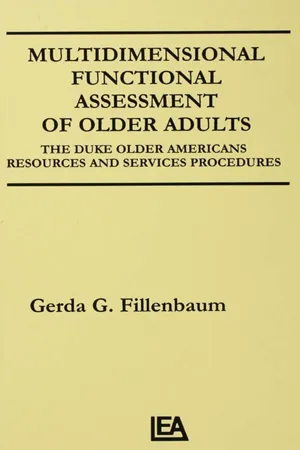
eBook - ePub
Multidimensional Functional Assessment of Older Adults
The Duke Older Americans Resources and Services Procedures
- 192 pages
- English
- ePUB (mobile friendly)
- Available on iOS & Android
eBook - ePub
Multidimensional Functional Assessment of Older Adults
The Duke Older Americans Resources and Services Procedures
About this book
Information
Publisher
Psychology PressYear
2013Print ISBN
9781138976559
9780805802412
Edition
1eBook ISBN
9781134741939
1 |
||
The OARS Multidimensional Functional Assessment Questionnaire |
||
Chapter Overview
The OARS Multidimensional Functional Assessment Questionnaire has two parts. Part A focuses on assessment of functional status, Part B on services assessment. In addition, a section covering administrative and demographic information is included. The questionnaire is so arranged that information can be obtained from three sources: the subject, an informant, and the interviewer. This chapter provides details regarding the number of items included in each area, the conceptualization underlying their selection, and item origin.
The OMFAQ is a structured questionnaire designed to obtain information on functional status (Part A), service use (Part B), and on administrative and demographic matters. Information can be obtained from each of three sources: the respondent, an informant, and the interviewer. Information is typically obtained in face-to-face interviews. These take an average of 45 minutes with community resident elderly. Information has also been obtained successfully by mail (Slavonic, 1983) and by telephone.
Part A. Functional Assessment
Part A is divided into seven major sections. These sections, in order, with a listing of the number of primary questions in each section (some questions include several parts), a brief description of the conceptualization underlying each of the five dimensions, the manner of operationalization, and question sources, are given below:


Part B. Services Assessment
Section |
Question Number |
|
Services 1 question (24 parts) |
71 |
For each of the 24 nonoverlapping services named below, enquiry is made into (a) utilization in the past six months, (b) intensity of present utilization (e.g., frequency), (c) service provider (e.g., self, family and friends, agency), and (d) perceived current need for service.
|
1 NCGCCoA North Carolina Governor’s Coordinating Council on Aging |
||
| 2 | PQ |
Preliminary Questionnaire. Although the Short Portable Mental Status Questionnaire (SPMSQ) is part of the Mental Health section it is also used as a screen to determine whether the respondent is capable of answering the OMFAQ reliably. Scores of 4 or higher are an indication to the interviewer that information may also have to be obtained from a knowledgeable informant. |
2 | ||
The Validity and Reliability of the OARS Multidimensional Functional Assessment Questionnaire | ||
Chapter Overview
If attention is to be paid to findings, those findings must be valid and reliable. Although validity and reliability do not ensure that findings will be attended to, their presence is essential if findings are not to be dismissed cavalierly. In this chapter detailed information is given on the validity and reliability of the functional assessment section of the OMFAQ. Starting with careful testing to make sure that each item was readily understood, the content, consensual and criterion validity were examined. In particular, because the instrument was also intended to be clinically relevant, we wished questionnaire-based assessments to match professional assessments of the same persons. Of the four areas examined (i.e., economic, mental and physical health, ADL or self-care capacity), significant agreement was found for each. Discriminant validity is not dealt with in this chapter, but the detailed responses from three random sample surveys of community residents, adult day care participants and the institutionalized, presented in chapter 9 attest to the ability of the OMFAQ to discriminate appropriately among diverse groups. In examining reliability we focused on the consistency of subject response over time, and on inter-rater and intrarater agreement. On all these reliability was satisfactory.
The OMFAQ is the result of an iterative procedure, which started by selecting standardized items, pretesting them for comprehension with elderly community and institutional residents, rephrasing them to improve clarity, and rearranging them to facilitate flow. The items of Part A, Functional Assessment, are those which, having survived this process, best discriminated between excellent and totally impaired functioning and were clinically important The items of Part B, Services Assessment, the 24 generically defined services, represent final agreement on a set of non-overlapping, mutually exclusive services which, as a group, were broadly encompassing, omitting no important services available at the time. These procedures were bas...
Table of contents
- Cover
- Title Page
- Copyright
- Contents
- Foreword
- Acknowledgments
- Overview
- 1. The Oars Multidimensional Functional Assessment Questionnaire
- 2. The Validity and Reliability of the OARS Multidimensional Functional Assessment Questionnaire
- 3. Psychometric Structure and Computer-Based Rating of Part A. Functional Assessment
- 4. Services
- 5. Aggregating Functional Status and Services Information
- 6. The Oars Model: Use and Uses
- 7. Administration of the OARS Multidimensional Functional Assessment Questionnaire
- 8. Differences between the 1975 and 1988 Editions of the OARS Multidimensional Functional Assessment Questionnaire
- 9. Comparison Norms: Elderly Living in the Community, Institutions, and Attending Daycare
- Appendix A. Variable List and Input Format for the 1988 Version of the OARS Multidimensional Functional Assessment Questionnaire
- Appendix B. Coding AIDS
- Appendix C. OARS Multidimensional Functional Assessment Questionnaire and Services Supplement
- References
- Author Index
- Subject Index
Trusted by 375,005 students
Access to over 1.5 million titles for a fair monthly price.
Study more efficiently using our study tools.
Frequently asked questions
Yes, you can cancel anytime from the Subscription tab in your account settings on the Perlego website. Your subscription will stay active until the end of your current billing period. Learn how to cancel your subscription
No, books cannot be downloaded as external files, such as PDFs, for use outside of Perlego. However, you can download books within the Perlego app for offline reading on mobile or tablet. Learn how to download books offline
Perlego offers two plans: Essential and Complete
- Essential is ideal for learners and professionals who enjoy exploring a wide range of subjects. Access the Essential Library with 800,000+ trusted titles and best-sellers across business, personal growth, and the humanities. Includes unlimited reading time and Standard Read Aloud voice.
- Complete: Perfect for advanced learners and researchers needing full, unrestricted access. Unlock 1.5M+ books across hundreds of subjects, including academic and specialized titles. The Complete Plan also includes advanced features like Premium Read Aloud and Research Assistant.
We are an online textbook subscription service, where you can get access to an entire online library for less than the price of a single book per month. With over 1.5 million books across 990+ topics, we’ve got you covered! Learn about our mission
Look out for the read-aloud symbol on your next book to see if you can listen to it. The read-aloud tool reads text aloud for you, highlighting the text as it is being read. You can pause it, speed it up and slow it down. Learn more about Read Aloud
Yes! You can use the Perlego app on both iOS and Android devices to read anytime, anywhere — even offline. Perfect for commutes or when you’re on the go.
Please note we cannot support devices running on iOS 13 and Android 7 or earlier. Learn more about using the app
Please note we cannot support devices running on iOS 13 and Android 7 or earlier. Learn more about using the app
Yes, you can access Multidimensional Functional Assessment of Older Adults by Gerda G. Fillenbaum in PDF and/or ePUB format, as well as other popular books in Psychology & Developmental Psychology. We have over 1.5 million books available in our catalogue for you to explore.