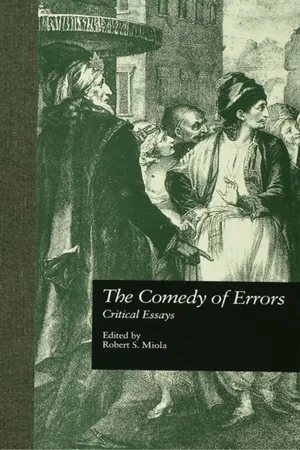
This collection of essays and reviews represents the most significant and comprehensive writing on Shakespeare's AComedy of Errors. Miola's edited work also features a comprehensive critical history, coupled with a full bibliography and photographs of major productions of the play from around the world. In the collection, there are five previously unpublished essays. The topics covered in these new essays are women in the play, the play's debt to contemporary theater, its critical and performance histories in Germany and Japan, the metrical variety of the play, and the distinctly modern perspective on the play as containing dark and disturbing elements. To compliment these new essays, the collection features significant scholarship and commentary on TheComedy of Errors that is published in obscure and difficulty accessible journals, newspapers, and other sources. This collection brings together these essays for the first time.
- 592 pages
- English
- ePUB (mobile friendly)
- Available on iOS & Android
eBook - ePub
About this book
Information
II The Comedy of Errors: Different Voices

Figure 2. Supple production, 1996, Stratford-upon-Avon, The Other Place. Dromio of Ephesus (Eric Mallett) emphasizing a point to Dromio of Syracuse (Dan Milne) in the closing moments of the play. Used with the permission of the Shakespeare Centre Library.
A Poetical Farce
Samuel Taylor Coleridge
The myriad-minded man, our, and all men's, Shakespeare, has in this piece presented us with a legitimate farce in exactest consonance with the philosophical principles and character of farce, as distinguished from comedy and from other entertainments. A proper farce is mainly distinguished from comedy by the license allowed, and even required, in the fable, in order to produce strange and laughable situations. The story need not be probable, it is enough that it is possible. A comedy would scarcely allow even the two Antipholuses; because, although there have been instances of almost indistinguishable likeness in two persons, yet these are mere individual accidents, casus ludentis naturae, and the verum will not excuse the inverisimile. But farce dares add the two Dromios, and is justified in so doing by the laws of its end and constitution. In a word, farces commence in a postulate which must be granted.
From Samuel Taylor Coleridge, Literary Remains, ed. Henry Nelson Coleridge. 4 vols. (London: William Pickering, 1836-9), 2: 114-115.
Weirdness in The Comedy of Errors
G.R. Elliott
The "The' in the title of this piay may be taken in a generic sense—that is, as the author's characteristically modest intimation that he has provided merely one more species of a well recognized genus. "Here," says he, "are the Twins of Plautus again; here is the age-old comedy of resemblances." But time has made the "The" distinctive: here is indeed the comedy of errors. It is hard to see how the hoary sport of mistaken identities could be better worked up as the central theme of a drama.
I think the underlying reason for its success is the fact that Shakespeare was thoroughly penetrated by the comic horror, so to call it, implicit in the subject. Real horror attaches to the notion of the complete identity of two human beings; as in Poe's ghastly tale of a girl who turned out to be the re-embodiment of the mother who died in giving birth to her; and as in certain ancient legends of various lands, notably China. All normal persons {and especially Shakespeare) set so much store by human individuality that they shrink from the thought of its being submerged. And since the amusing, when intense, is nigh to the serious, there is something shuddery in the close resemblance of persons just when this appears to us intensely entertaining. I recall a school-teacher many years ago who found in her class at the beginning of the term two little giris who were remarkably, even weirdly, "identical" twins; the very freckles on their noses seemed to correspond; and of course their proud mother attired them precisely alike. At the end of the first week the teacher exclaimed to us all with comic horror; "These two are the same—how can I tell them apart?" After a moment of dead silence a small boy (not I) piped out, "Mary's temper's better'n Martha's." The general laughter which ensued had in it a note of relief that was not exclusively comic. And The Comedy of Errors has a note of real weirdness just when its mirth is keenest.
Another and related feature of this play that has also, I think, not been sufficiently appreciated is its structural excellence. Critics have regarded the piece as uninspired because of its comparatively conventional style. But whole form, no less than style, may be the vehicle of inspiration. And the intensity with which Shakespeare gave himself here to the limited but uncanny fun of twinship impelled him to weave his strands into a very close and telling pattern; which, moreover, is often subserved, as I shall point out in a striking instance below, by the very conventionality of the style. I think that in sheer composition this drama surpasses most of his early works and some of his mature ones. It testifies that this poet, who was later to achieve the most expressive of styles, set his heart at the outset upon achieving wholeness of form. How much he was directly influenced in this matter by the Latin classics (not to speak of the Greek) cannot be known and is not very important. His friend to be, Ben Jonson, who was notoriously more intimate with those classics than he, was capable in maturity of producing such a work as Bartholomew Fair, rich in humour and humanity but hopelessly flimsy in architecture; no doubt it made Plautus turn in his grave. Compared with it The Comedy of Errors, by a young and "non-classical" writer, is a beautifully carved gem.
Perhaps it was written, as Professor Adams supposes, during or just after a schoolmastering interval before Shakespeare's migration to London.1 But in this case how did he attain the warm grasp of theatric art that appears in the play? Maybe his histrionic activity began in early years in the country; a discovery of new but dubious evidence pointing in this direction has recently been announced. Maybe, as Professor Adams and others maintain, he rewrote the play after he had attained a mastery of theatric art in London. In any case it is clear that the budding dramatist, more or less influenced by the ancient classical sense of form, was reacting from the slipshod construction of contemporary romantic comedy. And indeed if he had not early been sharply critical of that mode at its lowest—that "most lamentable comedy," in Quince's phrase—he could not have learned how to carry it to its height, as in Twelfth Night and As You Like It. In this later period he vented through the mouth of Polonius a feeling which must have been at work in him all along, a kindly but critical sense of the amazing variety and confusion of forms in contemporary drama.2 He desired for his own work the variety without the confusion. From the first he aimed at the sort of drama so tellingly described by Hamlet soon after Polonius's outburst: "an excellent play, well digested in the scenes, set down with as much modesty as cunning." Accordingly in his first play (as I take the one under discussion to be) he preferred the "scene individable," the unity of place, to the "poem unlimited"; he followed the "law of writ" rather than "the liberty."
Why, headstrong liberty is lashed with woe.
There's nothing situate under heaven's eye
But hath his bound, in earth, in sea, in sky...,3
There's nothing situate under heaven's eye
But hath his bound, in earth, in sea, in sky...,3
This thought, uttered by the gentle Luciana, is reiterated in Shakespeare's subsequent works. Of course it expresses the ancient doctrine of temperance which the writers of the Renaissance so much admired—often only verbally, but deeply at their best. Hamlet's praise of temperance to the Players and then to Horatio (111, ii, 1-74), voices Shakespeare's very real love of it in art and in personality. For him well-temperedness, as it may better be termed, was a quality both moral and artistic. His writings and the records of his character, taken together, show this quality preponderant in him as man and as author. Often enough his work is poorly tempered, ill shaped. But one sees him continually striving for excellence of form even more than for variety of form. Thus it was natural for him in his earliest comedy to have recourse to the aid of unity of time and place.
Obviously he was free from the pedantic notion that this device is an essential principle of drama. But he saw that the outward sort of unity, observed strictly or approximately, could be an aid to inward form. And he saw that a strict observance of it was demanded by the material and mood of The Comedy of Errors. Therefore he confined the action to a single day in a single city, Ephesus, summarizing the antecedent events in Aegeon's narrative in the first scene. No doubt a skipping series of scenes displaying some of those adventures on the stage would have pleased the stage audience of the time. But that display would not have fitted the whole emotional pattern at which the author, consciously or not, was aiming and which may be described as follows. An initial mood of swift and strange, almost weird, romance is saturated, as the play proceeds, with fun that is swift, strange, weird. Thus the romance and the fun are congruent. And they are humanized by pathos at the first and last, and, in the central phase of the action, by touches of high comedy (comedy of character) involving pathos.
Such is the ideal mood-and-mode, so to speak, of this drama. It was fulfilled to a remarkable extent by the dramatist but, of course, not perfectly. The opening scene is too heavy—especially when its long speeches are not rendered by the actors "trippingly on the tongue." Aegeon's sorrowfulness is immense. The dramatist hints, unconvincingly, that it is not merely the fruit of circumstance: it is constitutional. The old man tells us that he "would gladly have embraced" death (line 69) on a certain occasion when he was still young, rich, and blessed with a happy household! We don't see why; but we see that this stroke is intended to intensify his air of sadness. To be sure that air is convincing and satisfying in such verses as the following (lines 132 ff.):
Five summers have I spent in furthest Greece,
Roaming clean through the bounds of Asia,
And, coasting homeward, came to Ephesus,
Hopeless to find—yet loath to leave unsought;
Or that or any place that harbours men.4
Roaming clean through the bounds of Asia,
And, coasting homeward, came to Ephesus,
Hopeless to find—yet loath to leave unsought;
Or that or any place that harbours men.4
This has the very rhythm and movement of seeking, yearning love; in contrast with the "hopeless and helpless" rhetoric of the closing lines of the scene:
Hopeless and helpless doth Aegeon wend,
But to procrastinate his lifeless end.
But to procrastinate his lifeless end.
On the whole, his story takes hold of us. His emotion helps to float the strange episode of the mast that served as a "helpful ship" (line 103) to save the lives of six, and then to divide them nicely into the two triads required by the plot. But the author fails to bring out unmistakably the sole aspect of the tale that could render it fully plausible, namely its weirdness or uncanniness. Certainly this note is present, but not explicitly enough. In other words, the opening scene, from the standpoint of the play's whole mood, is not well tempered. Relatively too much stress is placed on the pathos of the romance, and too little on its weirdness. This error is not made in the final scene of the play. There the pathetic joy of the recognition and reunion of the members of Aegeon's household is skilfully intermixed with the characteristic comedy of this drama. But though the last scene of a play is important, the first scene is more so. And it is clear that in the present instance, as not in any later comedy, Shakespeare yielded to the temptation of capturing his audience at the outset by means of a heavy dose of heart-appeal.
The second scene, however, is finely turned: it provides exactly the right transition from the initial scene to the main body of the piece. The old despairing Aegeon is immediately succeeded by a young man who demeans himself very gravely. We are artfully informed at once that he too hails from Syracuse. His name, Antipholus, is here withheld from mention on the stage; but in good time we learn that he is in search of "a mother and a brother" (line 39) and we recall his father's reference to him towards the end of the preceding scene (lines 124 ff). The fine point, however, is that his very air is felt to be fathered by Aegeon's, though quite different. The old man's voluble gloom gives place to the son's sober sadness. And this "humour" (mood) is susceptible of lightening. Antipholus, smiling slightly (not laughing, I think), at his Dromio's joke, remarks that the latter is
A trusty villain, sir, that very oft,
When I am dull with care and melancholy,
Lightens my humour with his merry jests.
When I am dull with care and melancholy,
Lightens my humour with his merry jests.
[1.2.19-21]
Thus the mood of the play is modulated in the direction of mirth; and the way is actively opened by Antipholus's determination to relieve his lonely sorrow by wandering up and down in this foreign city, viewing its sights. Note the comic irony of his "I will go lose myself" {line 30), repeated {line 40) just as Dromio of Ephesus enters to take him for his brother. Superb is the sudden but carefully prepared plunge, here, into the comedy of errors. The fact that Antipholus is "not in a sportive mood" is, of course, the soul of the sport. Incidentally the new Dromio is seen by the audience to be brother in soul, even more than in body, to his jestful twin. The closing speech of the scene and act is notable. Antipholus soliloquizes:
Upon my life, by some device or other
The villain is o'er-raught of all my money.
They say this town is full of cozenage;
As, nimble jugglers that deceive the eye,
Dark-working sorcerers that change the mind,
Soul-killing witches that deform the body,
Disguised cheaters, prating mountebanks,
And many such-like liberties of sin....
The villain is o'er-raught of all my money.
They say this town is full of cozenage;
As, nimble jugglers that deceive the eye,
Dark-working sorcerers that change the mind,
Soul-killing witches that deform the body,
Disguised cheaters, prating mountebanks,
And many such-like liberties of sin....
[1.2.95-102]
This sounds the note of weirdness; which, however, is not fully brought out till the close of the second act.
Meanwhile (II, i) high comedy, centered in Adriana, comes upon the scene. ...
Table of contents
- Cover
- Title
- Copyright
- Dedication
- Contents
- ILLUSTRATIONS
- GENERAL EDITOR'S INTRODUCTION
- ACKNOWLEDGMENTS
- I. THE CRITICAL HISTORY OF THE COMEDY OF ERRORS
- II. THE COMEDY OF ERRORS: DIFFERENT VOICES
- III. THE COMEDY OF ERRORS IN PERFORMANCE
Trusted by 375,005 students
Access to over 1.5 million titles for a fair monthly price.
Study more efficiently using our study tools.
Frequently asked questions
Yes, you can cancel anytime from the Subscription tab in your account settings on the Perlego website. Your subscription will stay active until the end of your current billing period. Learn how to cancel your subscription
No, books cannot be downloaded as external files, such as PDFs, for use outside of Perlego. However, you can download books within the Perlego app for offline reading on mobile or tablet. Learn how to download books offline
Perlego offers two plans: Essential and Complete
- Essential is ideal for learners and professionals who enjoy exploring a wide range of subjects. Access the Essential Library with 800,000+ trusted titles and best-sellers across business, personal growth, and the humanities. Includes unlimited reading time and Standard Read Aloud voice.
- Complete: Perfect for advanced learners and researchers needing full, unrestricted access. Unlock 1.5M+ books across hundreds of subjects, including academic and specialized titles. The Complete Plan also includes advanced features like Premium Read Aloud and Research Assistant.
We are an online textbook subscription service, where you can get access to an entire online library for less than the price of a single book per month. With over 1.5 million books across 990+ topics, we’ve got you covered! Learn about our mission
Look out for the read-aloud symbol on your next book to see if you can listen to it. The read-aloud tool reads text aloud for you, highlighting the text as it is being read. You can pause it, speed it up and slow it down. Learn more about Read Aloud
Yes! You can use the Perlego app on both iOS and Android devices to read anytime, anywhere — even offline. Perfect for commutes or when you’re on the go.
Please note we cannot support devices running on iOS 13 and Android 7 or earlier. Learn more about using the app
Please note we cannot support devices running on iOS 13 and Android 7 or earlier. Learn more about using the app
Yes, you can access The Comedy of Errors by Robert S. Miola in PDF and/or ePUB format, as well as other popular books in Literature & Literary Criticism. We have over 1.5 million books available in our catalogue for you to explore.