
- 424 pages
- English
- ePUB (mobile friendly)
- Available on iOS & Android
eBook - ePub
Methane and its Derivatives
About this book
"Covers the chemistry, process chemistry, technology, engineering, and economics of methane conversion, including its environmental impact and commercial exploitation. Begins with methane's availability and increasing importance as an environmentally acceptable natural resource alternative and feedstock."
1
Sources and Availability of Methane
I. ENERGY OVERVIEW
A. United States Energy Supplies
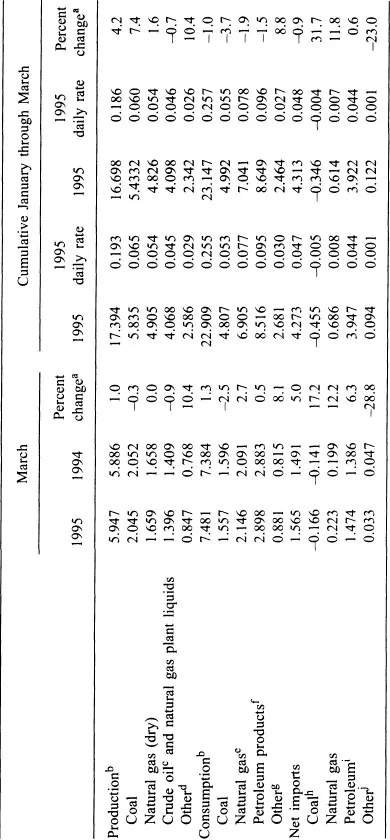
The U.S. energy production during March 1995 totaled 5.9 quadrillion Btu, which is a 1.0% increase from the level during March 1994. Crude oil and natural gas plant liquids decreased 0.9%, coal production decreased 0.3%, and natural gas production remained about the same. However, all other forms of energy production combined were up 10.4% from the level of production during March 1994 [1]. Such statistical information is available from the Monthly Energy Review by the Energy Information Administration (EIA). Table 1.1 shows the energy summary for March 1995.
Energy consumption during March 1995 totaled 7.5 quadrillion Btu, 1.3% above the level of consumption during March 1994. For the month of March 1995, the total energy production for the month is substantially lower than the total energy consumption for the same month, indicating that the consumption/production pattern is highly seasonal, and the storage of energy and fuel is a very important issue. Consumption of natural gas increased 2.7%, petroleum products consumption increased 0.5%, and coal consumption decreased 2.5%. Consumption of all other forms of energy combined increased 8.1% from the level of March 1994.
Net energy imports by the United States during March 1995 totaled’ 1.6 quadrillion Btu, which is 5.0% above the level of March 1994. Net imports of natural gas were up by 12.2% and net imports of petroleum increased 6.3%. Net exports of coal rose 17.2% from the level of the previous year.
Table 1.1 Energy Summary for March 1995. (Quadrillion Btu).
a Based on daily rates prior to rounding.
b Due to a lack of consistent historical data, some renewable energy sources are not included. For example in 1992, 3.0 quadrillion Btu of renewable energy consumed by U.S. electric utilities to generate electricity for distribution is included, but an estimated 3.0 quadrillion Btu of renewable energy used by other sectors is not included.
c Includes lease condensate.
d “Other” is hydroelectric and nuclear electric power, and electricity generated for distribution from wood, waste, geothermal, wind, photovoltaic, and solar thermal energy.
e Includes supplemental gaseous fuels.
f Products obtained from the processing of crude oil (including lease condensate), natural gas, and other hydrocarbon compounds.
g “Other” is hydroelectric and nuclear electric power, electricity generated for distribution from wood, waste, geothermal, wind, photovoltaic, and solar thermal energy; and net imports of electricity and coal coke.
h Minus sign indicates exports are greater than imports.
i Crude oil, lease condensate, petroleum products, pentanes plus, unfinished oils, gasoline blending components, and imports of crude oil for the Strategic Petroleum Reserve.
j “Other” is net imports of electricity and coal coke.
Notes: Totals may not equal sum of components due to independent rounding. Geographic coverage is the fifty States and the District of Columbia.
Source: [1]
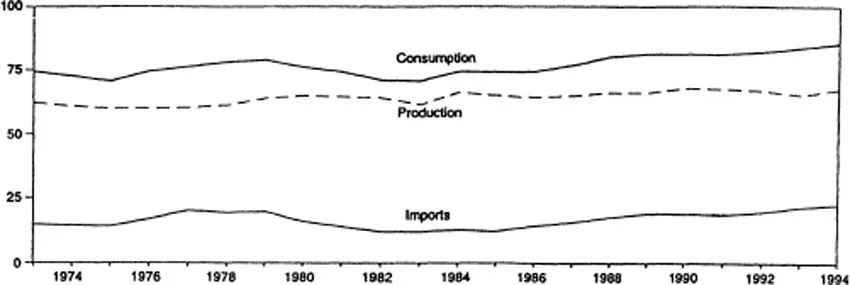
Figure 1.1 Energy overview: consumption, production, and imports, 1973–1994 (units: quadrillion Btu). Source: [1].
Figure 1.1 shows the U.S. energy consumption, production, and imports for 1973–1994. During this period, the lowest production was recorded in 1975 at 59.86 quadrillion Btu, whereas the highest production was realized in 1990 at 67.85 quadrillion Btu. For the same period, the U.S. consumption ranged from 70.52 (1983) to 85.57 (1994) quadrillion Btu, whereas the lowest and highest energy imports were recorded at 12.03 (1983) and 22.58 (1994) quadrillion Btu, respectively. From the statistics, one can also observe that the energy consumption is very strongly related with the economic strength of the country for a given year.
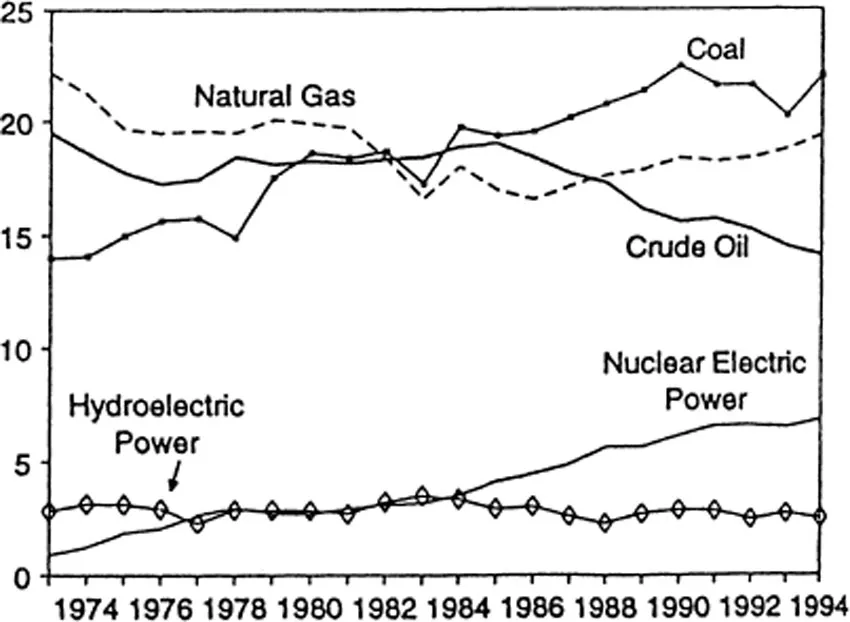
Figure 1.2 United States energy production by major sources, 1973–1994 (units: quadrillion Btu). Source: [1].
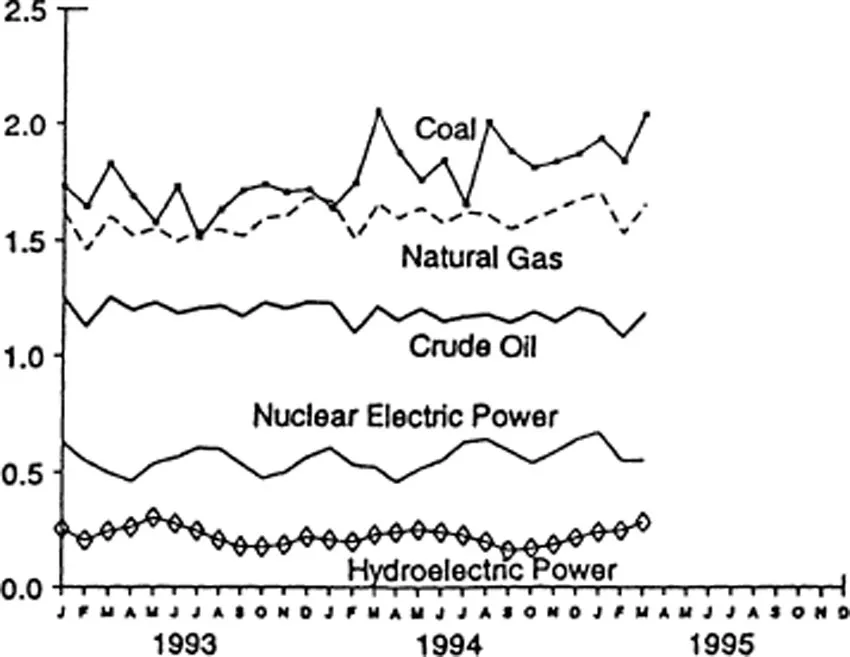
Figure 1.3 Monthly production by major sources, 1973–1994 (units: quadrillion Btu). Source: [1].
Figure 1.2 shows the U.S. energy production by major source for the period of 1973–1994. As can be clearly seen, the coal production is the most important, followed by the production of natural gas, crude oil, nuclear electric power, and hydroelectric power, in decreasing order of importance. The U.S. production of crude oil continues to decrease, while all other major sources are increasing.
The monthly production of energy by major sources is given in Figure 1.3. Coal production is the most fluctuating source, and nuclear electric power is the next. The fluctuation in monthly production is due to the effect of weather on production and manufacturing operations.
The yearly energy consumption pattern of the United States for the period of 1973–1994 is shown in Figure 1.4. The...
Table of contents
- Cover
- Half Title
- Title Page
- Copyright Page
- Table of Contents
- Preface
- 1. Sources and Availability of Methane
- 2. Synthesis Gas
- 3. Methane Derivatives via Synthesis Gas
- 4. Methane Derivatives Directly from Methane
- 5. Natural Gas Engineering
- 6. Environmental Issues of Methane Conversion Technology
- Index
Trusted by 375,005 students
Access to over 1.5 million titles for a fair monthly price.
Study more efficiently using our study tools.
Frequently asked questions
Yes, you can cancel anytime from the Subscription tab in your account settings on the Perlego website. Your subscription will stay active until the end of your current billing period. Learn how to cancel your subscription
No, books cannot be downloaded as external files, such as PDFs, for use outside of Perlego. However, you can download books within the Perlego app for offline reading on mobile or tablet. Learn how to download books offline
Perlego offers two plans: Essential and Complete
- Essential is ideal for learners and professionals who enjoy exploring a wide range of subjects. Access the Essential Library with 800,000+ trusted titles and best-sellers across business, personal growth, and the humanities. Includes unlimited reading time and Standard Read Aloud voice.
- Complete: Perfect for advanced learners and researchers needing full, unrestricted access. Unlock 1.5M+ books across hundreds of subjects, including academic and specialized titles. The Complete Plan also includes advanced features like Premium Read Aloud and Research Assistant.
We are an online textbook subscription service, where you can get access to an entire online library for less than the price of a single book per month. With over 1.5 million books across 990+ topics, we’ve got you covered! Learn about our mission
Look out for the read-aloud symbol on your next book to see if you can listen to it. The read-aloud tool reads text aloud for you, highlighting the text as it is being read. You can pause it, speed it up and slow it down. Learn more about Read Aloud
Yes! You can use the Perlego app on both iOS and Android devices to read anytime, anywhere — even offline. Perfect for commutes or when you’re on the go.
Please note we cannot support devices running on iOS 13 and Android 7 or earlier. Learn more about using the app
Please note we cannot support devices running on iOS 13 and Android 7 or earlier. Learn more about using the app
Yes, you can access Methane and its Derivatives by Sunggyu Lee in PDF and/or ePUB format, as well as other popular books in Technology & Engineering & Chemistry. We have over 1.5 million books available in our catalogue for you to explore.