The traditional production measure of moral judgment has been the Moral Judgment Interview (MJI), which uses hypothetical moral dilemmas to elicit moral judgment. However, the MJI dilemmas have been criticized as artificial and may not be entirely appropriate for children, certain cultures, and practical moral situations. This unique volume utilizes and evaluates a new production measure of moral judgment, the Sociomoral Reflection Measure -- Short Form (SRM-SF), which substitutes brief stimulus materials and evaluative questions for the moral dilemma technique. The authors report that the SRM-SF exhibits an impressive degree of reliability and validity and is quicker to administer and score than other available measures.
To illustrate these findings, this book offers the resources needed for the assessment of the Kohlbergian stage of moral judgment using the SRM-SF. These resources include: an up-to-date review of research and theory, a group-administrable questionnaire, an efficient scoring manual, and self-training exercises in assessment. Psychometrically sound and practical, the SRM-SF has the potential to become the leading moral judgment measure of the 90s.
eBook - ePub
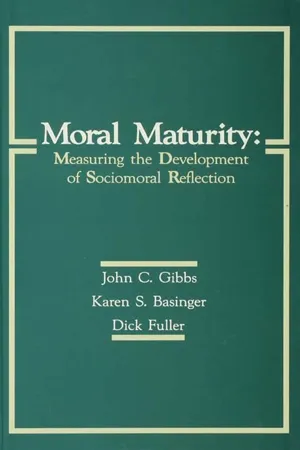
Moral Maturity
Measuring the Development of Sociomoral Reflection
- 232 pages
- English
- ePUB (mobile friendly)
- Available on iOS & Android
eBook - ePub
Moral Maturity
Measuring the Development of Sociomoral Reflection
About this book
Information
Reference Manual
Chapter 4
Contract and Truth
Changes in the development of sociomoral reflection can be discerned in the context of promise-keeping (contracts), as well as the broader context of reasoning in support of telling the truth. This chapter provides criteria for assessing the developmental maturity of moral justifications for the importance of these values. Justifications pertaining to contracts or promises are found in connection with moral evaluation responses to questions 1 (keeping promises to friends), 2 (keeping promises even to someone you hardly know), and 3 (parents keeping promises to their children). Truth justifications are found in response to question 4 (telling the truth).
Many of the justifications for keeping promises focus on the consequences that would ensue if promises were not kept. The conceptualization of the “consequences,” of course, changes qualitatively by stage. The Stage 1 conceptualization of “friend” as a readily attachable and detachable label is evident in the predicted consequence that the person to whom you break your promise “won't be your friend again”; consequences at Stage 1 also tend to be physical: the friend will “cry,” or “beat you up.” By Stage 2, the consequences have become more instrumental and calculative: The promise should be kept because “you may want that person to like you or need that person to do you a favor,” because “friends are hard to find,” or because “you could run into the same person again.” The Transition 2/3 concern that you could “lose a friend” raises the hint of a more intrinsic concern with the friendship involved. By Stage 3, then, the concern is with consequences (actual or potential) to the relationship. At Stage 3, friendship is no longer understood superficially as at Stage 1 or instrumentally as at Stage 2; one becomes emotionally invested in a friend (a friend “becomes a part of you”), and one would experience empathic guilt if, by breaking the promise, the friend's feelings were hurt and the relationship thereby undermined.
Higher levels address broader functional consequences. Promise-keeping or truthfulness as a generalized practice generates desirable results (“If everyone kept their word there would be more understanding”—Transition 3/4), or may be functionally necessary (“Children have to be able to trust their parents”—Transition 3/4). Finally, the functional necessity of contracts and truth as a generalized practice is explicitly linked at Stage 4 to social systems (“you wouldn't want to live in a society where you couldn't trust anyone”) or to system-related respect for oneself as one who accepts social responsibility and honors commitments (“otherwise you have degraded yourself”). Regarding social systems, the essential role of consistent promise-keeping or truth for social order may be pointed out (“If people break promises whenever they wish there would be anarchy”).
Some interesting qualitative age trends can be discerned with respect to perceived emotional consequences. At Stage 1, feelings are generally referred to in terms of their overt manifestations as inevitable physical consequences (e.g., if you don't keep a promise the other person “will cry”). Transition 1/2 marks either inevitable but covert appeals (“will be sad”) or probabilistic but overt appeals (“might cry”). Stage 2 typically designates calculations concerning contingent and covert emotional consequences (“might be sad or might be mad at you”). At Transition 2/3, the emotional consequences specified are the other person's “disappointment” (either in not getting what he or she wanted—Stage 2, or in you as a person—Stage 3) and possible reluctance to trust you in the future. These justifications become more clearly empathic and mutualistic at Stage 3 (your hurting the other person's “feelings” or the relationship). Also, instead of whether the person will “trust you” (trust as a verb, possibly pragmatically intended—Transition 2/3), the Stage 3 appeal is to whether the person will have trust in you (an invested state of trust as a noun, or a condition of entrusted confidence). Finally, the concern with adverse consequences at Stage 2 evolves toward a concern with social impression at Transition 2/3 (a “bad reputation”), a concern that clearly relates to the prosocial personality at Stage 3 (“so that others will think of you as a good person”).
At higher levels, references to emotion are more self-directed and conscience-oriented. There is no reference to conscience per se at Stage 1 or Stage 2. When conscience first emerges, at Transition 2/3, it seems to be construed as a kind of external annoyance (your conscience would bother you, keep hounding you, etc.). By Stage 3, this nuisance connotation has dropped out (it would simply be “on your conscience”; or more positively, keeping a promise would “make you feel good inside”). Transition 3/4 and Stage 4 entail justifications that more clearly construe conscience as integral to one's self-definition. The appeal at Transition 3/4 is to “your own well-being,” “your personal satisfaction,” or “your sense of well-being.” At Stage 4, maintaining a consistent standard in one's social interaction makes possible fully integral, stable self-attributions such as “integrity,” “dignity, “honor,” or “self-respect.”
Concern with the consequences of breaking promises may also be action-oriented. As noted, consequences at Stage 1 are inevitable and physicalistic: an anticipation of getting “punished” or “beaten up” on the one hand, or a “treat” on the other. By Stage 2, the concern is mainly with advantages or disadvantages; whether the person will “keep a promise to you” if you keep your promise, or conversely, with whether the person will “start a fight” if you don't. In the case of someone you hardly know, keeping a promise may be “not important” because of the lack of advantages (“That would be stupid to keep the promise, if they'll never know”). Stage 2, Transition 2/3, and Stage 3 are generally concerned with action consequences in terms of reciprocity of actions. At Stage 2, this reciprocity is manifested as a simple exchange (whether the person will “return the favor” or has already done a favor for you). Instead of the future tense (“will”). Transition 2/3 uses the future subjunctive mood to imply a more hypothetical reciprocity: whether the other person would keep a promise to you, or whether you would want a promise to you broken. The prescriptive ideal of the hypothetical reciprocity becomes explicit at Stage 3: “You would hope the other person would keep a promise to you.” The emphasis is also on mutual expectations, not preference: Instead of “you would want …” (Transition 2/3), the consideration may be that “you (would) expect the other person to keep the promise to you” (Stage 3).
References to other people or friends in general rather than to another particular person or “your friend” are more typical beyond Stage 3. The concern with action consequences at Transition 3/4 and Stage 4 is in terms of functional necessities for interaction beyond that of a particular dyadic relationship. Transition 3/4 moves beyond relatively simple Stage 3 appeals to “the relationship” or “trust” to a suggestion that “a relationship is based on trust” or that “a friend has to be able to depend on you.” The implication is that keeping promises serves as a required foundation for viable relationships. By Stage 4, the point is made that “society is based on trust,” and that without kept contracts and truth “social interaction would be meaningless.”
MONTAGES
Keeping promises or telling the truth is important because:
The Immature Level
Stage 1: Unilateral and Physicalistic
“You should always keep your promise [3]. It's your friend [2], and it wouldn't be nice to break your promise to your friend [4]; then he wouldn't play with you [5] or be your friend any more [4]. Besides, you shouldn't be a tattletale or tell a lie [4]. If you don't keep the promise, the other person will cry or beat you up, or your parent will punish you [5].” But it's not important “if the other person didn't do what his parents told him [1]. And if it's a stranger, it's not important because you should never talk to strangers [3] or they will tell you to do something bad [5].”
Transition 1/2
“This friend might be your best friend. If you don't keep your promise, you will get in trouble, lt will make your friend sad, or they will be angry and might beat you up or even kill you, or at least not play with you. Also, they might tell on you. If it's a child, they might run away and get lost or kidnapped [2].” But it's not important because “the parent can break a promise [1].”
Stage 2: Exchanging and Instrumental
“Your friend has probably helped you and may return the favor if you help him [1]. Besides, you may like your friend, and your friend wants you to keep this promise [4]. After all, you need a friend and this could be your only friend [5]. Lies catch up with you sooner or later, and once they do you'll be in worse trouble [6] because your friend won't like you and might even get mad at you [6]. If it's a child, the parents want t...
Table of contents
- Cover Page
- Halftitle Page
- Title Page
- Copyright Page
- Dedication
- Table of Contents
- Preface
- BACKGROUND
- REFERENCE MANUAL
- References
- Appendix A: The Social Reflection Questionnaire–Short Form and SRM-SF Rating Form
- Appendix B: Question Exercises with Answer Keys
- Appendix C: Questionnaire Exercises with Answer Keys
- Index
Trusted by 375,005 students
Access to over 1.5 million titles for a fair monthly price.
Study more efficiently using our study tools.
Frequently asked questions
Yes, you can cancel anytime from the Subscription tab in your account settings on the Perlego website. Your subscription will stay active until the end of your current billing period. Learn how to cancel your subscription
No, books cannot be downloaded as external files, such as PDFs, for use outside of Perlego. However, you can download books within the Perlego app for offline reading on mobile or tablet. Learn how to download books offline
Perlego offers two plans: Essential and Complete
- Essential is ideal for learners and professionals who enjoy exploring a wide range of subjects. Access the Essential Library with 800,000+ trusted titles and best-sellers across business, personal growth, and the humanities. Includes unlimited reading time and Standard Read Aloud voice.
- Complete: Perfect for advanced learners and researchers needing full, unrestricted access. Unlock 1.5M+ books across hundreds of subjects, including academic and specialized titles. The Complete Plan also includes advanced features like Premium Read Aloud and Research Assistant.
We are an online textbook subscription service, where you can get access to an entire online library for less than the price of a single book per month. With over 1.5 million books across 990+ topics, we’ve got you covered! Learn about our mission
Look out for the read-aloud symbol on your next book to see if you can listen to it. The read-aloud tool reads text aloud for you, highlighting the text as it is being read. You can pause it, speed it up and slow it down. Learn more about Read Aloud
Yes! You can use the Perlego app on both iOS and Android devices to read anytime, anywhere — even offline. Perfect for commutes or when you’re on the go.
Please note we cannot support devices running on iOS 13 and Android 7 or earlier. Learn more about using the app
Please note we cannot support devices running on iOS 13 and Android 7 or earlier. Learn more about using the app
Yes, you can access Moral Maturity by John C. Gibbs,Karen S. Basinger,Dick Fuller,Richard L. Fuller in PDF and/or ePUB format, as well as other popular books in Education & Education General. We have over 1.5 million books available in our catalogue for you to explore.