- 128 pages
- English
- ePUB (mobile friendly)
- Available on iOS & Android
eBook - ePub
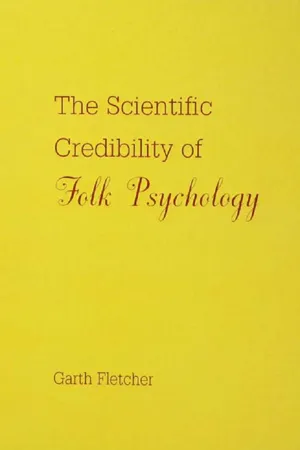
The Scientific Credibility of Folk Psychology
About this book
The examination and evaluation of folk psychology and lay cognition has been carried out predominantly in two domains: personality and social psychology, and the philosophy of psychology. Yet, work in these two areas has largely proceeded independently. The assumption on which this volume is founded is that a proper comparison between scientific cognition and folk ways of thought rests on an adequate study of both science and folk psychology. With this in mind, the author provides an analysis of the intricate, and often hidden, links between these two spheres. In doing so, the book poses two related questions. First, what is the nature of folk psychology and how is it related to scientific psychology? Second, of what should the relationship between folk psychology and scientific psychology consist? In answering these two questions, the author draws extensively from research and arguments in social psychology and social cognition, cognitive science, and the philosophy of science.
The interdisciplinary approach gives the book a unique perspective that will be of interest to scholars working in social psychology, cognitive science, and philosophy of science. Written in a concise and accessible style, this volume is suitable for undergraduate and graduate students as well as a general psychological audience.
Information
Publisher
Psychology PressYear
2013Print ISBN
9780805815719
9780805815702
Edition
1eBook ISBN
9781134787012
Chapter 1
Folk Psychology: Crock or Touchstone?
This book deals with the relations between psychology and common sense—a complex and subtle topic that has been a hotbed of debate within both psychology and philosophy for many years. In this introduction I lay the groundwork for the book by first running briefly over the history of the topic in both philosophy and psychology. Next, some of the key questions and issues dealt with are sketched out, with a description of the book’s orientation and goals.
Attitudes in both philosophy and psychology toward folk psychology have ranged from the reverential to the dismissive. In the 1950s and 1960s, under the influence of Wittgenstein and the ordinary language school, philosophers often adopted eulogistic approaches to common sense. For example, Peters (1960), in his book The Concept of Motivation, argued that
the difficulty about developing a science of psychology is that, in a sense, we already know too much about human behavior, albeit in a rather uncoordinated manner. Common-sense, which is incorporated in the concepts of ordinary language, has creamed off most of the vital distinctions. Psychology has the task of sytematizing what is already known and adding bits of special theory to supplement common-sense. (p. 155)
As Yang inevitably follows Ying, a new breed of philosopher in the last two decades has argued that folk psychology is a crock, doomed to be replaced by psychological theories with sterner scientific credentials—a position known as eliminative materialism. This group of philosophers, led by Paul Churchland, are members of a growing and influential brand of philosophy that is naturalistic and scientific in orientation, and that pays special attention to psychological research concerned with the mind or the brain. Indeed, the burgeoning field of cognitive science as a discipline includes the philosophy of the mind as one of its defining assortment of subdisciplines along with cognitive psychology, engineering, neuropsychology, and artificial intelligence.
The relation between folk psychology and scientific psychology has become an important topic in cognitive science, spawning several anthologies and a host of articles in philosophical journals. The thesis of eliminative materialism, in particular, has come under considerable attack, with more than one philosopher springing to the defense of folk psychology. In due course, I discuss what I take to be some of the key arguments advanced in this arena (especially in chapter 7). In so doing, I argue that the discussion in the philosophical literature has assumed an unduly simplistic notion of what folk psychology amounts to, and that much can be learned from consulting the relevant research in social psychology or social cognition.
It turns out, for example, that the most rigorous empirical analysis of the rationality or scientific credibility of folk cognition, combined with a good dose of theoretical argument, has taken place in social psychology, not cognitive psychology. However, philosophers working within the cognitive science tradition have, by and large, not consulted this extensive literature. In contrast, in this book I extensively review both the empirical research and associated theoretical disputes from social psychology in addressing the relation between folk psychology and scientific psychology.
Not that social psychologists, or, indeed, any other kind of psychologist, speak with one voice in assessing the scientific value of folk psychology. As in philosophical circles, the popular attitudes toward common sense in psychology have gone through cycles, with dissenting voices, of course, always present.
Radical behaviorism, for example, is famously derogatory about common sense. Its most noted proponent, Skinner (1974), wrote:
The disastrous results of common sense in the management of behavior are evident in every walk of life, from international affairs to the care of a baby, and we shall continue to be inept in these fields, until a scientific analysis clarifies the advantage of a more effective technology. It will then be obvious that the results are due to more than common sense, (p. 234)
However, it is not merely that Skinner preferred science to common sense. Rather he viewed folk psychology as the central impediment to the development of science and human progress. Thus, Skinner (1978) wrote that the main obstacle to the utilization of behavioral science is “the entrenchment of old practices—in this case the old ways of thinking about human behavior. Antiquated theories ingrained in our language and our culture stand in the way of promising scientific alternatives” (p. 85).
The history of social psychology also reveals attitudes and views that range from the reverential to the dismissive. One of the founders of modern social psychology, Heider, attempted to develop an understanding of lay psychology by careful conceptual analysis of the theoretical structures underlying everyday language. Heider (1958) argued that the analysis of these conceptual structures could play an important role in describing lay cognitive processes, and in developing a theory to explain such processes. In short, Heider took folk psychology seriously. In his words, “the ordinary person has a great and profound understanding of himself [sic] and other people which, though unformulated or only vaguely conceived, enables him [sic] to interact with others in more or less adaptive ways” (p. 2).
In contrast, textbooks in social psychology commonly seek to distance the discipline from folk psychology. This is almost invariably accomplished by pointing out that commonsense maxims abound that are contradictory (e.g., “birds of a feather flock together” vs. “opposites attract”), and perhaps also mentioning the odd social inference bias that lay social cognition is cursed with (e.g., hindsight bias, overconfidence in social judgments, ignoring base rates). The proposed replacement for folk psychology (surprise! surprise!) is held to be a (social) psychological science that is grounded in research and data.
In general, doubts about the validity or rationality of lay social cognition reached their peak in personality and social psychology in the 1980s. Personality psychology was in the throes of a debate concerning whether behavior was consistent across situations, and, although the jury was still out on the issue, powerful voices and persuasive data suggested that the concept of personality traits was a shibboleth of folk psychology. As Nisbett and Ross (1980) said, “the personality theorists’ (and the layperson’s) conviction that there are strong cross-situational consistencies in behavior may be seen as merely another instance of theory-driven covariation assessments operating in the face of contrary evidence” (p. 112).
In social cognition circles, a flood of research on errors and biases apparently demonstrated that laypeople were subject to an extraordinary range of invidious social judgment biases. Laypeople were purported to underestimate the causal role of situational determinants of behavior and overestimate the role of personal determinants (the so-called fundamental attribution error), to be poor statisticians, to be unduly influenced by prior theories while underutilizing data, and much more. As Fiske and Taylor (1984) concluded in their textbook, Social Cognition, in describing the lay psychologist, “Instead of a naive scientist entering the environment in search of the truth, we find the rather unflattering picture of a charlatan trying to make the data come out in a manner most advantageous to his or her already held theories” (p. 88).
Just as in philosophy, this rather bleak view of human rationality has been increasingly challenged over the last decade, with the consensus swinging back toward the more respectful stance adopted by Heider. This body of research and theorizing is summarized and discussed in chapters 6 and 7.
As can be seen, then, there is considerable dispute both within philosophy and psychology concerning the evaluation of folk psychology. The analysis offered in this book is based around several claims or strategies.
First, I have attempted to bring the tools and evidence from both philosophy and (social) psychology to the issues at hand. This task was approached with some trepidation, as, in my experience, this sort of interdisciplinary effort typically satisfies neither philosophers nor psychologists. I leave it to the reader to decide how successful I have been.
Second, one of my basic contentions is that a lacuna in cognitive science, philosophy, and psychology that has had dire consequences is that insufficient attention has been given to answering two critical empirical questions: First, what is the nature of folk psychology? and, second, what is the nature of the overlap between folk psychology and scientific psychology?
There is certainly a consensus that folk psychology represents something that is shared and used by us all in everyday life. Beyond, these two points, however, there is considerable divergence of opinion, and understanding the nature of folk psychology and its relation to psychology assume considerable complexity. Chapters 2, 3, and 4 are devoted to answering these two questions, although I periodically return to them throughout the book, particularly in chapters 6 and 7, where I turn to the prescriptive question of what the relationship should be between folk psychology and scientific psychology.
Another gap that I think exists in both the philosophical and psychological literature in this domain is the need for an explicit normative account of scientific inference. If judgments about the rationality or scientific probity of lay psychological theory or particular social judgments are advanced (and they regularly are), then some normative standard is being wittingly or unwittingly applied. Indeed, one of my complaints with the considerable body of research in social cognition dealing with biases and errors in social inference, is that I believe the normative (and supposedly scientific) standards used are often suspect. Accordingly, in chapter 5, I have set up an explicit model of scientific inference borrowed largely from sources in the philosophy of science. I then use this model as an organizing framework for the subsequent analysis and review of the empirical and theoretical work in relation to the scientific credibility of folk psychology in chapters 5, 6, and 7.
If this outline seems ambitious for one slim(ish) volume, it is. However, I do not pretend to offer a systematic review of all the issues and arguments involved (although I have provided references for those who wish to read further). Instead, my approach is to pluck out and express what I understand to be the kernels of the arguments. For those readers who wish to consult an even more expurgated version of this book, I have summarized the main arguments and issues raised in the concluding chapter.
Chapter 2
The Nature of Folk Psychology
In any analysis of the links between scientific psychology and folk psychology, the proposed nature and definition of folk psychology will be pivotal. Indeed, I argue later that some of the most cited and trenchant arguments directed against the viability of folk psychology by philosophers rest on a somewhat restrictive and superficial account of the beast in question. The analysis of folk psychology in this chapter is unavoidably general, as this concept turns out to be a slippery customer indeed. The aim is to erect sufficient conceptual scaffolding from which to build the remainder of my analysis and arguments.
As a beginning point, folk psychology might be defined as a cultural group’s body of shared beliefs or ways of thinking about the world. The notion that folk psychology is shared is an important ingredient in this definition—I return at various times to this aspect. A second feature of this definition is that folk psychology refers either to the content of thought or beliefs, or to underlying process or structure. This distinction between content and process is actually present in everyday usage of the term. People often say that certain beliefs are just “common sense”; that is, they are part of our commonsense store of knowledge. Conversely, the term is sometimes used to refer to the shared canons and rules that define the reasonable or correct way of thinking; for example we sometimes urge people to use their common sense (think properly or clearly) in making decisions or judgments.
So, folk psychology potentially covers everything that psychologists are interested in—in broad terms, the explanation, prediction, and control of human behavior and experience. Even though this represents an enormous field, it nevertheless excludes a good deal of commonsense thought. For example, it rules out everyday theories concerning the movement and behavior of inanimate objects (a naive physics) and commonsense biological theories. Some psychologists are, of course, interested in the development and nature of lay physical and biological theories, but my point here is that such lay theories are not themselves psychological theories. The domain of interest, for the purposes of this book, concerns those lay theories that are psychological in nature.
In addition, many areas of interest to psychologists may be relatively untouched by folk psychology including neuropsychology, our perceptual systems including the visual and auditory systems, language learning, and so forth. In contrast, folk psychology does appear to have a lot to say in relation to social psychology, personality, and, to a lesser extent, cognitive psychology. Accordingly, it is these three latter areas of psychology that I focus on throughout the book.
In the first section of this chapter I distinguish three aspects in the content of folk psychology: proverbs and fables, general shared beliefs and attitudes, and shared fundamental beliefs. Second, I deal with folk psychology in terms of shared underlying cognitive structures and processes. Third, the relations between the two levels (content and process) are analyzed, and the differences between folk psychology and idiosyncratic cognition or lay theory discussed.
THE CONTENT OF FOLK PSYCHOLOGY: THREE KINDS OF SHARED BELIEF
Proverbs and Fables
This class of items is often what springs to mind when the term common sense is used by laypeople or psychologists alike. Such beliefs are often expressed in proverbs, sometimes as valuable guides for behavior (e.g., “a stitch in time saves nine,” “look before you leap”), and sometimes as causal generalizations or psychological principles (e.g., “clothes maketh the man,” “birds of a feather flock together”). They may also be expressed in a more long-winded fashion as allegories or fables.
The stock of proverbs and aphorisms in our culture is vast. According to the list complied by Erasmus (1508), there are more than 3,000 proverbs to be garnered from antiquarian sources, and of course there are thousands more witty or helpful epithets that derive from modern literary sources. This stock of epithets is also constantly being added to from popular culture, some being derived from modern technology that would be unintelligible to earlier generations (e.g., “garbage in, garbage out”).
Moreover, it is common for groups and institutions within society to develop their own purpose-built set of slogans or proverbs, some of which may be idiosyncratic. Such institutions would include religious organizations, businesses, schools, social clubs, sports teams, and therapeutic communities. For example, Bassin (1983) remarked on the prevalence and use of slogans and proverbs in drug treatment programs, and noted that they are typically displayed prominently and sometimes recited as a group mantra. Some examples: “There is no free lunch”; “Think, think, think”; “The door swings both ways”; “What goes around comes around”; “No pain without gain”; “When the going gets tough, the tough get going”; “Pride comes before a fall”; and “Don’t drink even if your ass is on fire.” No prizes for guessing that the last proverb is from Alcoholics Anonymous!
Now proverbs undoubtedly serve a number of psychological and sociological functions including the building and reinforcement of a social ideology, a means of regulating behavior, and the building of social cohesion. Moreover, even a casual perusal of any set of proverbs or slogans will reveal a strong mora...
Table of contents
- Front Cover
- Half Title
- Title Page
- Copyright
- Dedication
- Contents
- Preface
- Chapter 1 Folk Psychology: Crock or Touchstone?
- Chapter 2 The Nature of Folk Psychology
- Chapter 3 Folk Psychology of the Mind
- Chapter 4 Uses and Abuses of Folk Psychology in Scientific Psychology
- Chapter 5 The Nature of Scientific Cognition: A Realist Account
- Chapter 6 The Scientific Status of Folk Psychology 1: Lay, Aims, Values, and Rules
- Chapter 7 The Scientific Status of Folk Psychology 2: Lay Theories
- Chapter 8 Summary, Caveats, and Morals
- References
- Author Index
- Subject Index
Trusted by 375,005 students
Access to over 1.5 million titles for a fair monthly price.
Study more efficiently using our study tools.
Frequently asked questions
Yes, you can cancel anytime from the Subscription tab in your account settings on the Perlego website. Your subscription will stay active until the end of your current billing period. Learn how to cancel your subscription
No, books cannot be downloaded as external files, such as PDFs, for use outside of Perlego. However, you can download books within the Perlego app for offline reading on mobile or tablet. Learn how to download books offline
Perlego offers two plans: Essential and Complete
- Essential is ideal for learners and professionals who enjoy exploring a wide range of subjects. Access the Essential Library with 800,000+ trusted titles and best-sellers across business, personal growth, and the humanities. Includes unlimited reading time and Standard Read Aloud voice.
- Complete: Perfect for advanced learners and researchers needing full, unrestricted access. Unlock 1.5M+ books across hundreds of subjects, including academic and specialized titles. The Complete Plan also includes advanced features like Premium Read Aloud and Research Assistant.
We are an online textbook subscription service, where you can get access to an entire online library for less than the price of a single book per month. With over 1.5 million books across 990+ topics, we’ve got you covered! Learn about our mission
Look out for the read-aloud symbol on your next book to see if you can listen to it. The read-aloud tool reads text aloud for you, highlighting the text as it is being read. You can pause it, speed it up and slow it down. Learn more about Read Aloud
Yes! You can use the Perlego app on both iOS and Android devices to read anytime, anywhere — even offline. Perfect for commutes or when you’re on the go.
Please note we cannot support devices running on iOS 13 and Android 7 or earlier. Learn more about using the app
Please note we cannot support devices running on iOS 13 and Android 7 or earlier. Learn more about using the app
Yes, you can access The Scientific Credibility of Folk Psychology by Garth J.O. Fletcher in PDF and/or ePUB format, as well as other popular books in Psychology & History & Theory in Psychology. We have over 1.5 million books available in our catalogue for you to explore.