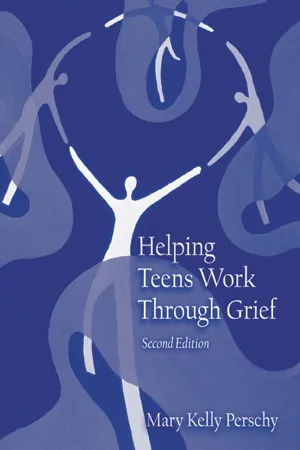
The second edition of Helping Teens Work Through Griefprovides a more complete and updated manual for facilitators of teen grief groups. It includes additional background information about developmental aspects of teens, the process of grief, aspects of trauma and its effects on teens, the value of a group, determining the group-appropriateness of particular teens, and parental involvement. The many details involved with beginning a group - publicity, interviews, registration, structure, closure, evaluation, and follow-up - are listed.
- 184 pages
- English
- ePUB (mobile friendly)
- Available on iOS & Android
eBook - ePub
Helping Teens Work Through Grief
About this book
Information
PART C
SPECIFIC STRUCTURED ACTIVITIES
Ideally, the teens gather and begin to share the pain of their own stories of grief. Gradually, they learn to listen attentively to the tales of the other teens, offer an encouraging word, or share an insight. Although this ideal group dynamic sometimes occurs, it is not the norm.
In reality, teens come together, not knowing one another, not sure what the group is all about, and often not even wanting to be there in the first place. A well-meaning or concerned parent, who is grieving the loss of the same person, just wants to make sure the teen will be all right, so that parent may insist that the teen attend the group.
The icebreakers provide the opportunity for these nervous teens to interact in an informal and even a fun way. The tension usually lessens, and the teens are more ready to enter into the group experience.
When the teens begin to share their stories about how their loved one died, changes in their daily living, or whether school personnel are helpful or not helpful, the up-tight bodies continue to relax. They become aware that they are not alone. They are normal grieving teens.
Structured, More or Less
Many factors contribute to when this sharing takes place: the number of reticent versus outgoing teens, the range of ages, or simply the chemistry of the group members. If the sharing is difficult, the facilitators may choose more of the structured activities. However, when the group gels easily, the conversations around pertinent topics of grieving occur more spontaneously. Regardless of what has been planned, the teens’ own spontaneous discussion of issues related to grief always takes priority. The agenda prepared by the leaders is secondary to the immediate needs of the teens.
Don’t be overly concerned about participants who seldom speak during the sessions. Experts assure us that even the silent members of the group can benefit from being there. The group experience gives them the chance to reflect on their own process and learn by listening to the others. However, if you sense the teen is distressed by what is shared, it might be helpful to recheck the registration form to see if there are signs of trauma. If a teen becomes more withdrawn, a conversation with the parent about additional mental health services might be necessary.
As leaders, you may decide to use part of one activity and connect it with an idea of your own or with something that evolves in the group. Someone may want to share a newly written poem, or one that he or she found. A magazine article, drawing, or song may resonate with the experiences of your specific group.
The enthusiasm will grow as the teens begin to invest in the planning and assume the leadership for topics that touch on the essence of their concerns. The facilitators will then truly personify Webster’s definition of facilitate: “to make easier or less difficult.” The creative space the adults have fostered allows the teens to heal. Teens then recognize that as difficult as this process of grief is, they can continue to draw on their inner strength and their giftedness and, with the support of others, can move through life’s most challenging experiences. Hope begins to take on a new meaning.
Chapter 7
HELPING TEENS CONNECT
It is so important to begin the first, and possibly the second, session with activities that will help the teens get to know one another. Facilitators may use an icebreaker from their own repertoire or choose from those described in this chapter. These nonintrusive icebreakers foster trust among the participants, which is so necessary for them to share their very personal experiences of the many facets of grief.
This time helps the teens relax. Often they have ambivalent feelings about joining such a group. Talking about things they like to do is a very gradual entry into the group.
7.1. Getting to Know You moves the teens into a circle throwing a beanbag, while sharing on “safe topics,” like food, music, color, and sports. It is a fun way for teens to introduce themselves; even shy teens join right in. Teens can then think of their own themes, and sometimes they are willing to continue leading the group in the warmup activity.
7.2. My Coat of Arms is another form of introducing teens, this time using drawings. This may appeal to those who learn through tactile involvement. The drawings from the six spaces can move the teens to a deeper sharing.
7.3. Line Up and 7.4. Stress Busters help to energize the teens as they move throughout the room, exploring the likes and dislikes of each other. The spirit of the group members lightens.
7.5. Mirroring introduces in a casual setting the wide range of feelings of grief, from difficult to pleasant. It is also an opportunity for the facilitator to intersperse information about feelings, such as, “Any feeling could be considered a feeling of grief, not just the obvious ones of sadness, guilt, or anger,” or “Each person’s grief is unique, although there may be some common threads among many people.”
7.6. Telling One’s Story is an important activity to include during the first session after an icebreaker or two. Telling how their loved one died and how they responded to the death helps the teens connect on a deeper level. It normalizes the experience of loss, recognizing that each person there is grieving the death of someone close. They are no longer with others who cannot comprehend the extent of the feelings of grief. They are with other young people who are able to relate to each other’s pain.
Activity 7.1
GETTING TO KNOW YOU
Goal
To help teens connect with other group members.
Objectives
To get to know some information about the other group members.
To model that it is all right to do enjoyable things, even while grieving.
Procedure
Form a circle. Throw a beanbag, a light beach ball, or a small pillow around the circle. As each person catches it, have this person say his or her name. Continue with any of the ideas from the following list. Add other categories (15 to 20 minutes). This activity may be used for another session by presenting new categories. Ask the teens to come up with other categories.
Name
School
Grade
Favorite activity
Least favorite activity
Favorite holiday
Favorite food
Least favorite food
Favorite music group
Favorite color
Favorite sport (active or spectator)
If I won $100, I would…
If I won $l,000, I would…
If I could travel anywhere, I would go to…with…
Activity 7.2
MY COAT OF ARMS
Goal
To introduce the group members to each another.
Objectives
To assist the teens in sharing information about themselves with the group.
To elicit information for the leaders to plan the agenda for fu...
Table of contents
- Cover Page
- Title Page
- Copyright Page
- Dedication
- Contents
- List of Activity Sheets
- List of Figures
- Acknowledgments
- Introduction
- Part A Understanding Grieving Teens and How to Support Them
- Part B The Teen Grief Group
- Part C Specific Structured Activities
- Part D Resource Material
- References
- About the Author
- Index
Trusted by 375,005 students
Access to over 1.5 million titles for a fair monthly price.
Study more efficiently using our study tools.
Frequently asked questions
Yes, you can cancel anytime from the Subscription tab in your account settings on the Perlego website. Your subscription will stay active until the end of your current billing period. Learn how to cancel your subscription
No, books cannot be downloaded as external files, such as PDFs, for use outside of Perlego. However, you can download books within the Perlego app for offline reading on mobile or tablet. Learn how to download books offline
Perlego offers two plans: Essential and Complete
- Essential is ideal for learners and professionals who enjoy exploring a wide range of subjects. Access the Essential Library with 800,000+ trusted titles and best-sellers across business, personal growth, and the humanities. Includes unlimited reading time and Standard Read Aloud voice.
- Complete: Perfect for advanced learners and researchers needing full, unrestricted access. Unlock 1.5M+ books across hundreds of subjects, including academic and specialized titles. The Complete Plan also includes advanced features like Premium Read Aloud and Research Assistant.
We are an online textbook subscription service, where you can get access to an entire online library for less than the price of a single book per month. With over 1.5 million books across 990+ topics, we’ve got you covered! Learn about our mission
Look out for the read-aloud symbol on your next book to see if you can listen to it. The read-aloud tool reads text aloud for you, highlighting the text as it is being read. You can pause it, speed it up and slow it down. Learn more about Read Aloud
Yes! You can use the Perlego app on both iOS and Android devices to read anytime, anywhere — even offline. Perfect for commutes or when you’re on the go.
Please note we cannot support devices running on iOS 13 and Android 7 or earlier. Learn more about using the app
Please note we cannot support devices running on iOS 13 and Android 7 or earlier. Learn more about using the app
Yes, you can access Helping Teens Work Through Grief by Mary Kelly Perschy in PDF and/or ePUB format, as well as other popular books in Psychology & Developmental Psychology. We have over 1.5 million books available in our catalogue for you to explore.