This groundbreaking examination of cybersex was originally published as a special issue of the journal Sexual Addiction and Compulsivity. It is a crucial resource for sex therapists, who until now had no rigorous study of the effect of online pornography on the patients they treat. It will also be of great interest to general marriage and family therapists who find themselves dealing with this issue with their clients, as well as others who are interested in the Internet as a social phenomenon. Cybersex: The Dark Side of the Force presents for the first time an empirical foundation for the discussion of cybersex compulsivity and its effect on the mental health of individuals, couples, teens, and young children.
eBook - ePub
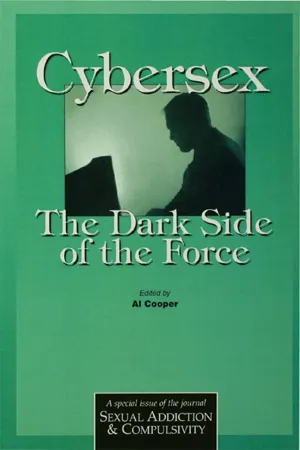
Cybersex: The Dark Side of the Force
A Special Issue of the Journal Sexual Addiction and Compulsion
- 156 pages
- English
- ePUB (mobile friendly)
- Available on iOS & Android
eBook - ePub
Cybersex: The Dark Side of the Force
A Special Issue of the Journal Sexual Addiction and Compulsion
About this book
Information
Chapter 1
Cybersex Users, Abusers, and Compulsives: New Findings and Implications
Literature regarding sexual use of the Internet has primarily focused on anecdotal data of clinical cases. This study empirically examines the characteristics and usage patterns of individuals who use the Internet for sexual purposes. The Kalichman Sexual Compulsivity Scale was the primary tool used to divide the sample (n = 9,265) into four groups: nonsexually compulsive (n = 7,738), moderately sexually compulsive (n = 1,007), sexually compulsive (n = 424), and cybersex compulsive (n = 96); 17% of the entire sample scored in the problematic range for sexual compulsivity. Data analysis of the four groups indicated statistically significant differences on descriptive characteristics such as gender, sexual orientation, relationship status, and occupation. In addition, patterns of use differed across groups including the primary method of pursuing sexual materials, primary location of accessing sexual material, and the extent to which cybersex has interfered with a respondent’s life. This study is one of the few quantitative examinations of the patterns of problematic and compulsive use of the Internet for sexual purposes. Implications and suggestions for research, public education, and professional trainings are presented.
INTRODUCTION
Given its burgeoning growth and wide accessibility, the Internet or World Wide Web (WWW) is altering patterns of social communication and interpersonal relationships. An estimated 9 to 15 million people access the Internet each day at a rate which is growing by an estimated 25% every three months (Cooper, 1998a; Fernandez, 1997; Computerworld, 1998). Internet users spend an average of about 9.8 hours per week visiting the more than 200 million web sites now in existence (Computerworld, 1998). An estimated 94 million individuals will have access to the Internet in the year 2001.
Sexuality is one aspect of human social behavior that is being dramatically impacted by the Internet. In fact, sex is reported to be the most frequently searched topic on the Internet (Freeman-Longo & Blanchard, 1998), and the pursuit of sexual interests on the Internet, or “cybersex,” is a remarkably common activity for users. In April 1998 approximately nine million users (15% of the online population) accessed one of the top five “adult” web sites (Cooper, Scherer, Boies, & Gordon, 1999). This does not include the numerous other adult web sites, nor other Internet modalities which can be used for sexual pursuits (e.g., e-mail, news groups, and chat rooms) and a different sampling of online users in August 1999 found that 31% of the total online population visited an adult web site (Leone & Beilsmith, 1999). Cooper (1998a) suggested that there are three primary factors which “turbocharge” online sexuality and make it such an attractive venue for sexual pursuits. He called these the “Triple-A Engine,” and they include accessibility (i.e., millions of sites available 24 hours a day, 7 days a week), affordability (i.e., competition on the WWW keeps all prices low and there are a host of ways to get “free” sex), and anonymity (i.e., people perceive their communications to be anonymous).
Clearly the Internet can be used for healthy sexual expression. For example, the Internet offers the opportunity for the formation of online or virtual communities where isolated or disenfranchised individuals (e.g., gay males and lesbians) can communicate with each other around sexual topics of shared interest (Cooper, Boies, Maheu, & Greenfield, in press). Newman (1997) noted the educational potential of the Internet, citing the greater availability of information about sexuality and the potential for more candid discussions of sexuality online. The Internet may also be used to find romantic partners. Cooper and Sportolari (1997), in a discussion of “computer mediated relating,” pointed out how in e-mail relationships there is less emphasis on physical attractiveness relative to more traditional face-to-face relationships. In addition, the Internet may allow for sexual experimentation in a forum that seems “safer,” possibly facilitating identity exploration and development (Leiblum, 1997).
At the same time, some researchers have suggested that the use of the Internet for sexual purposes may be counterproductive to normal, healthy sexual development in certain individuals. Van Gelder (1985) warned of the potential for the Internet to be used as a means of obtaining child pornography, for contacting children for sexual purposes, and for assuming false identities in sexually oriented communications. Durkin and Bryant (1995) studied criminal and deviant use of the Internet and posited that the instant gratification of online communication provided a reinforcement for the operationalization of sexual fantasies that would otherwise be extinguished. Others have noted the danger of individuals neglecting their real-world relationships by spending increasing amounts of time engaged in “pseudointimate” online relationships (Cooper et al., in press). Anonymity, accessibility, and affordability (Triple-A Engine) seem to increase the chances that the Internet will become problematic for those who either already have a problem with sexual compulsivity or those who have psychological vulnerabilities rendering them at risk for developing such compulsivity. Researchers investigating the addictive potential of the Internet—with regard to both sexual and nonsexual use—have noted correlations between time spent online and negative consequences reported by users (Bingham & Piotrowski, 1996; Cooper, Scherer, et al., 1999; Young, 1996; Young & Rogers, 1998).
Indeed, the Internet, like other technologies, has both costs and benefits. Some investigators have argued the importance of online sexual behavior as a continuum extending from adaptive to problematic (Cooper, Scherer et al., 1999; Leiblum, 1997). Cooper, Putnam, Planchon, and Boies (1999), in their recent survey of 9,177 Internet users, found that while 43% of the respondents spent less than one hour per week in online sexual pursuits, at the same time approximately 8% spent 11 hours or more per week engaged in such activity. These data suggested that the majority of users who pursued sexual interests on the Internet were capable of limiting the time spent in these activities to reasonable levels but that some were having clear problems. Cooper, Putnam et al. (1999) put forth a theoretical model based on this “continuum model” describing three categories of people who use the Internet for sexual pursuits. These include recreational users who access online sexual material more out of curiosity or for entertainment purposes and are not typically seen as having problems associated with their online sexual behavior. Next there are sexual compulsive users who, due to a propensity for pathological sexual expression, use the Internet as one forum for their sexual activities. And finally there are the at-risk users who, if it were not for the availability of the Internet, may never have developed a problem with online sexuality. For these people the power of anonymity, accessibility, and affordability (Triple-A Engine) interacts with certain underlying personality factors of at-risk users and leads to patterns and behaviors that, without intervention, may develop into online sexually compulsive behavior. Delmonico (1997) suggests that issues such as isolation and fantasy contribute to at-risk users becoming sexually compulsive.
As Internet usage continues to increase, more and more clinicians are encountering patients whose presenting problem either stems from or is manifestly online sexual compulsivity. As the public and professional awareness of cybersex usage is raised, it becomes increasingly important to understand, assess, and treat this phenomenon. Cooper, Boies et al. (1999) examined Internet sexual behavior through the use of an online survey which asked web site visitors about their online sexual behavior. One focus area was the amount of time individuals reported spending online. Approximately 8% of respondents (n = 9,177) reported engaging in online sexual activity 11 hours or more per week. This group reported higher levels of distress around their online pursuits than other respondents, and seemed representative of those individuals whose online sexual activity was problematic and potentially compulsive.
Because the amount of time spent online represents only one dimension upon which to identify individuals who may be sexually compulsive it was decided that it would be valuable to expand the criteria to include some of the others factors generally accepted as important dimensions on which to identify sexual compulsivity. These include increased appetite, desire, or tolerance (contributing to increased time engaged in the activity); harm to self or others; denial or minimization of negative consequences; repeated attempts to stop or limit sexual behavior; repetition of behavior despite negative consequences; behavior interfering with social, academic, occupational, or recreational activities; obsession with the activity; and compulsion or loss of freedom in choosing whether to engage in a behavior (Cooper, 1998b; Carnes, 1991; Goodman, 1999; Schneider, 1994).
The purpose of this study was to increase our understanding of online sexual compulsivity by doing a second series of analyses of the data from the Cooper, Scherer, et al. study (1999) and using refined criteria for sexual compulsivity to identify the cybersex compulsives in the sample. As was mentioned earlier the original study based group assignment on the number of reported hours spent online for sexual pursuits, while this study used scores from the Kalichman Sexual Compulsivity Scale (SCS) (Kalichman, Johnson, Adair, Rompa, Multhauf, & Kelly, 1994) combined with time online, in order to identify the group of users displaying cybersex compulsivity. The SCS takes into account many of the characteristics of sexual compulsivity mentioned above; SCS items are summarized in Figure 1. Combining the criteria of time spent online in sexual activities with scores on the SCS affords the purest sample yet of individuals whose use of the Internet is sexually compulsive.
METHODS
This study was a more in-depth analysis of survey data that had been previously collected by the lead author in a 1998 study. For a more complete description of the methodology of the original study, the reader is referred to the methods section of the earlier article (Cooper, Scherer et al., 1999).
The Survey
GENERAL INFORMATION. The following personal demographics were gathered: age, gender, occupational status, sexual orientation, relational status, and the total weekly amount of time individuals go online.

FIGURE 1. Kalichman Sexual Compulsivity Scale questions.
ONLINE SEXUAL PURSUITS. A number of questions were designed to assess online sexual behavior. Individuals were asked to report the weekly number of hours they go online for sexual pursuits using a ratio scale. They were also asked to indicate where they go online (home, work, both, or other) and what medium they most use online (e.g., e-mail, chat room, news groups, or WWW). Using a Likert scale, respondents were asked to rate the frequency of specific sexual pursuits behaviors, their preoccupation with being online, some of the feelings they experience while online, and the degree to which they present themselves differently than the way they actually are. Three questions were designed to assess self-perception of deleterious effects on the respondents’ lives: whether respondents keep the time spent online a secret, how it interferes with their lives, and what aspect of their lives are jeopardized, if any, by their behavior.
SEXUAL COMPULSIVITY SCALE. Included as part of the survey was this 10-item measure of sexual compulsivity developed by Kalichman et al. (1994). Their analyses found that the scale had an alpha coefficient of .89 and temporal stability (test-retest coefficient of .95).
SEXUAL SENSATION SEEKING SCALE (SSSS). Also included was this 10-item measure developed by Kalichman et al. (1994), assessing the propensity to engage in novel or risky sexual behaviors. It has been shown to be highly internally consistent (Cronbach’s alpha = .75) and to have temporal stability (test-retest coefficient = .78). It was also correlated with self-reports of engaging in risky sexual behaviors by gay men (Kalichman et al., 1994) as well as inner city men and women (Kalichman & Rompa, 1995).
Nonsexual Sensation Seeking Scale (NSSS). This 10-item scale was developed to assess thrill and adventure seeking, experience seeking, disinhibition, and susceptibility to boredom. Kalichman et al. (1994) reconfirmed its reliability (Cronbach’s alpha =.79) and temporal stability (test-retest coefficient = .78).
Data Collection
In the original study, a 59-item survey was made available via the MSNBC web site in March and April 1998 for a period of seven weeks. Informed consent was provided, as well as information about confidentiality and anonymity with regard to survey responses. In addition to the regular MSNBC audience, a variety of major television and radio networks and newspaper interviews helped promote wider participation in the study. All surveys were completed interactively via the web site and submitted electronically.
In order to help insure against multiple submissions of a completed survey by the same respondent, the MSNBC server assigned a globally unique identifier (GUID) to each subject. This GUID number helped prevent participants from submitting multiple surveys. Despite these precautions, it nonetheless remains possible that a determined respondent might have made multiple submissions from different computers; although it is highly unlikely that with the large numbers of total subjects these responses would have affected the overall results to any significant degree.
As a statistical check of external validity, comparisons were made to determine if the respondents were representative of other Internet users. The sample was compared to the 3.8 million visitors to the MSNBC web site in April 1998 (Goldberg, 1998). In addition, the sample was compared to the demographics of the 9.6 million visitors to the top five most frequently visited sexually oriented web sites. In both cases, it was concluded that demographics from the original sample were representative and comparable to both groups in a number of important, predictable ways.
For purposes of the present study, all of the original data that was collected was restored for a total working sample of 13,529. Subjects were eliminated if items were missing or inconsistent. If multiple submissions were detected, the first submission was retained and all other submissions were eliminated. This procedure diverged from the original data analysis and as a result, the final sample size is slightly different. Subjects were also eliminated if they were below the age of 18 years or above the age of 90 years. Based on these criteria, the data analyses were performed on the remaining sample of 9,265 respondents.
Reanalys...
Table of contents
- Cover
- Halftitle
- Title
- Copyright
- Contents
- Preface
- 1 Cybersex Users, Abusers, and Compulsives: New Findings and Implications
- 2 Effects of Cybersex Addiction on the Family: Results of a Survey
- 3 Online Infidelity: A New Dimension in Couple Relationships with Implications for Evaluation and Treatment
- 4 Children, Teens, and Sex on the Internet
- 5 Online Sexual Addiction and Compulsivity: Integrating Web Resources and Behavioral Telehealth in Treatment
- 6 Should Virtual Sex be Treated like Other Sex Addictions?
- 7 Compulsive Cybersex: The New Tea Room
- Index
Trusted by 375,005 students
Access to over 1.5 million titles for a fair monthly price.
Study more efficiently using our study tools.
Frequently asked questions
Yes, you can cancel anytime from the Subscription tab in your account settings on the Perlego website. Your subscription will stay active until the end of your current billing period. Learn how to cancel your subscription
No, books cannot be downloaded as external files, such as PDFs, for use outside of Perlego. However, you can download books within the Perlego app for offline reading on mobile or tablet. Learn how to download books offline
Perlego offers two plans: Essential and Complete
- Essential is ideal for learners and professionals who enjoy exploring a wide range of subjects. Access the Essential Library with 800,000+ trusted titles and best-sellers across business, personal growth, and the humanities. Includes unlimited reading time and Standard Read Aloud voice.
- Complete: Perfect for advanced learners and researchers needing full, unrestricted access. Unlock 1.5M+ books across hundreds of subjects, including academic and specialized titles. The Complete Plan also includes advanced features like Premium Read Aloud and Research Assistant.
We are an online textbook subscription service, where you can get access to an entire online library for less than the price of a single book per month. With over 1.5 million books across 990+ topics, we’ve got you covered! Learn about our mission
Look out for the read-aloud symbol on your next book to see if you can listen to it. The read-aloud tool reads text aloud for you, highlighting the text as it is being read. You can pause it, speed it up and slow it down. Learn more about Read Aloud
Yes! You can use the Perlego app on both iOS and Android devices to read anytime, anywhere — even offline. Perfect for commutes or when you’re on the go.
Please note we cannot support devices running on iOS 13 and Android 7 or earlier. Learn more about using the app
Please note we cannot support devices running on iOS 13 and Android 7 or earlier. Learn more about using the app
Yes, you can access Cybersex: The Dark Side of the Force by Al Cooper in PDF and/or ePUB format, as well as other popular books in Psychology & Mental Health in Psychology. We have over 1.5 million books available in our catalogue for you to explore.